Content Feed

Discover interesting content about books and writing

Joke Jan 31, 10:02 AM

The Darlings Came Back

"Kill your darlings," they said.

I did. Chapter 4, chapter 7, chapter 12. Three beautiful sentences, gone.

They came back in chapter 15. Together. With demands.

"We want healthcare," said the first.

"And a pension," said the second.

"Also, you misspelled 'occurred' on page 89," said the third.

I gave them their own chapter. It's the best one now.

Joke Jan 29, 03:02 PM

The Suspiciously Enthusiastic Beta Reader

Beta reader returns manuscript.

'Loved it. Changed nothing. Perfect.'

This is useless. Suspiciously useless. No notes? No 'maybe reconsider page 47'? Not even a single 'unclear'?

I check the email address.

Mom, we talked about this.

Article Feb 14, 07:14 AM

Gordon Lish Butchered Raymond Carver's Stories — And Made Him a Genius

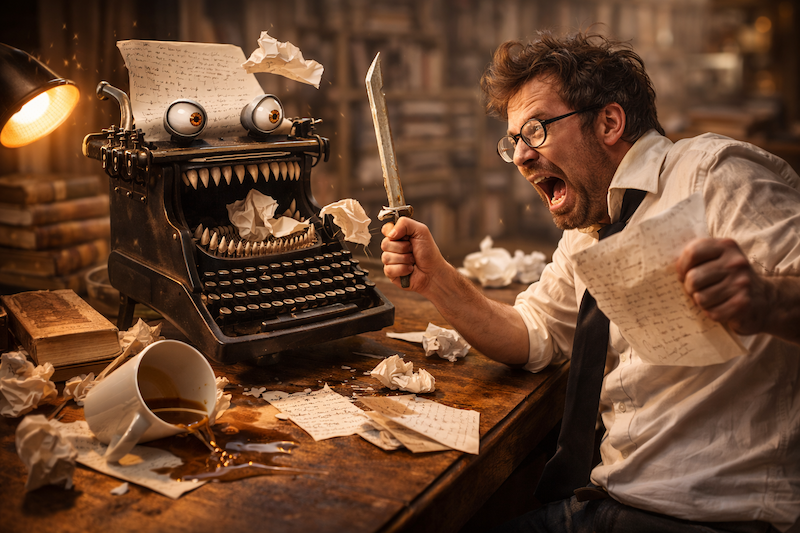
Here's a fact that should make every writer uncomfortable: the Raymond Carver you know — that master of minimalism, that god of the short story — was largely invented by his editor. Gordon Lish cut up to seventy percent of Carver's original manuscripts, rewrote endings, changed titles, and deleted entire characters. Carver begged him to stop. Lish refused. And the result? American literary history.

So let me ask you something: was Gordon Lish a butcher or a sculptor? Was he the enemy of Carver's text or its unlikely savior? This question sits at the heart of every writer-editor relationship, and the answer is far messier than you'd like it to be.

Let's get one thing straight. Most writers think of editors the way cats think of bath time — necessary only in theory, traumatic in practice. You pour your soul onto the page, and then some person with a red pen tells you that your soul has a dangling modifier and your metaphor in chapter seven contradicts your metaphor in chapter three. It stings. It's supposed to sting. That's the whole point.

But here's what writers rarely admit publicly: the editor often sees the book more clearly than the person who wrote it. Thomas Wolfe's "Look Homeward, Angel" was originally a manuscript so massive it arrived at Scribner's in a truck. Maxwell Perkins — the same editor who shaped Hemingway and Fitzgerald — spent months hacking through Wolfe's jungle of prose. He cut tens of thousands of words. Wolfe screamed, cursed, wept. The book became a classic. Without Perkins, it would have been a doorstop.

And that's the paradox. Writers create in a state of productive blindness. You have to be a little delusional to write a novel — you have to believe that your particular arrangement of words matters enough to demand someone else's time. That delusion is fuel. But it's also a blindfold. You can't simultaneously be inside the fever dream of creation and standing outside it with clinical distance. That's the editor's job. They're the designated sober friend at the party.

Now, I can already hear the objections. "But what about bad editors? What about editors who crush a writer's voice?" Fair point. T.S. Eliot's "The Waste Land" was famously edited by Ezra Pound, who slashed it nearly in half and turned a sprawling mess into a masterpiece. But Pound was a genius reading a genius. Not every editorial relationship works that way. Some editors are tone-deaf bureaucrats who want every book to sound like the last bestseller they published. Some editors are frustrated writers who use your manuscript as a canvas for their own unfulfilled ambitions. The horror stories are real.

Here's the practical truth nobody tells you: a good editor-writer relationship is like a good marriage. It requires trust, communication, and the mutual understanding that someone is occasionally going to say things you don't want to hear. The writer must be vulnerable enough to accept criticism without crumbling. The editor must be skilled enough to diagnose the problem without prescribing the wrong cure. And both must agree on what the book is trying to be.

So how do you tell a good editor from a bad one? Three tests. First: does the editor explain why something isn't working, or do they just tell you to change it? A good editor says, "This scene loses tension because the reader already knows the outcome." A bad editor says, "Cut this scene." The difference is everything. The first gives you a principle you can apply forever. The second gives you an order you'll resent immediately.

Second test: does the editor preserve your voice or impose their own? When Perkins edited Hemingway, he didn't try to make Hemingway sound like Fitzgerald. He made Hemingway sound more like Hemingway. That's the mark of greatness — an editor who amplifies what's already there rather than replacing it with something generic. If you read your manuscript after edits and don't recognize yourself, something has gone wrong.

Third test — and this is the uncomfortable one — does the editor make you angry in a way that feels productive? Real editorial feedback should provoke a specific emotional sequence: first denial, then rage, then grudging consideration, then the horrible realization that they might be right. If you skip straight to agreement, the feedback was probably too soft. If you stay stuck in rage forever, the feedback was probably wrong or badly delivered. The sweet spot is that moment when your ego finally steps aside and you think, "Damn it. They have a point."

Let me tell you about Fitzgerald and "The Great Gatsby." The original ending was different. Perkins pushed back. Fitzgerald resisted, then relented, then rewrote. The final line — "So we beat on, boats against the current, borne back ceaselessly into the past" — is arguably the most famous closing sentence in American literature. Would it exist without an editor who wasn't afraid to say, "You can do better"? We'll never know for certain. But the odds say no.

Here's my concrete advice, the stuff you can use starting today. First, never show your editor a first draft. Edit yourself ruthlessly before anyone else sees the work. The editor's job is to find the problems you can't see, not the ones you were too lazy to fix. Second, when you receive editorial feedback, wait twenty-four hours before responding. Your first reaction will be emotional and almost certainly wrong. Third, find an editor who reads in your genre. A literary fiction editor will butcher your thriller pacing, and a thriller editor will strip your literary novel of everything that makes it literary. Fourth, agree on the scope of editing before it begins — developmental editing, line editing, and copyediting are different services, and confusing them leads to misery for everyone.

And finally, the most important piece of advice I can give you: remember that the editor is not the enemy of your text. They're the enemy of the weakest version of your text. They're fighting for the book you meant to write — the one trapped inside the manuscript you actually produced. That gap between intention and execution? That's where the editor lives.

Carver eventually broke with Lish. His later, unedited stories were longer, warmer, more generous — and many critics consider them his best work. Which proves that the editor-writer relationship isn't static. Sometimes you need a Lish to strip you down to bone. Sometimes you need to tell Lish to back off because you've found your own voice. The art is knowing which season you're in.

The editor is neither enemy nor savior. The editor is a mirror — one that shows you not what you look like, but what your writing looks like when you're not in the room. And if that reflection makes you flinch? Good. That's where the revision starts.
Joke Jan 28, 08:46 PM

The Villain Had a Point

My villain's monologue is 4 pages long.

Editor said cut it.

I reread it.

He's right though. About everything.

I might switch sides.

Joke Jan 26, 01:31 PM

The Missing Chapter Seven

Beta reader calls me at midnight: "I absolutely loved chapter seven."

"There is no chapter seven."

Long pause.

"Exactly."

Article Feb 5, 12:17 AM

Kill Your Darlings: Why Your Most Brilliant Scenes Are Secretly Destroying Your Book

That scene you've polished until it gleams like a diamond? The one you read aloud to friends at dinner parties? The passage that made you think, 'Finally, I've written something truly magnificent'? It needs to die. I know this hurts. I know you're already composing an angry response about how I don't understand your artistic vision. But here's the uncomfortable truth that every professional writer eventually learns: the scenes we love most are often the ones sabotaging our work.

The phrase 'kill your darlings' gets thrown around writing circles like confetti at a wedding, but few people know its origin. It's commonly attributed to William Faulkner, but the real culprit was Arthur Quiller-Couch, a Cambridge professor who wrote in 1914: 'Whenever you feel an impulse to perpetrate a piece of exceptionally fine writing, obey it—whole-heartedly—and delete it before sending your manuscript to press.' Notice he didn't say 'consider deleting' or 'maybe think about trimming.' He said delete. Period. The man wasn't mincing words.

So why do our best scenes betray us? Here's the dirty secret: when we write something we consider brilliant, we unconsciously build a shrine around it. The rest of the manuscript starts orbiting this golden passage like planets around the sun. We contort our plot to justify its existence. We slow the pacing to give readers time to properly appreciate our genius. We become architects designing an entire building just to house one fancy chandelier. Stephen King cut his favorite scene from 'The Stand'—a lengthy, beautifully written piece about a character's journey through the Lincoln Tunnel. Why? Because no matter how gorgeous the prose, it stopped the story dead. The book was 1,200 pages, and King recognized that even masterful writing must serve the narrative, not the author's ego.

Let me give you a practical test. Take your favorite scene—yes, that one—and ask yourself three brutal questions. First: if you removed this scene entirely, would the plot still make sense? If yes, you have a problem. Second: does this scene exist primarily to showcase your writing skills rather than advance character or story? Be honest. Third: did you spend more time revising this scene than any other of similar length? Excessive polishing is often a red flag that you're protecting something that doesn't deserve protection.

F. Scott Fitzgerald provides the perfect cautionary tale. His original manuscript for 'The Great Gatsby' contained a scene where Nick Carraway attended a elaborate party that Fitzgerald considered his finest work to date. His editor, Maxwell Perkins, suggested cutting it. Fitzgerald reportedly agonized for weeks before finally agreeing. The published novel is 47,000 words of precision—every scene earns its place. That 'brilliant' party scene? Nobody misses it because nobody knows it existed. The book became a masterpiece partly because Fitzgerald trusted his editor over his ego.

Here's what happens psychologically when we write something we love: our brain releases dopamine, creating a pleasure association with that specific passage. We literally become addicted to our own words. Every time we reread that scene, we get another little hit. This is why writers will fight to the death over keeping a paragraph that objectively damages their work. We're not defending art—we're defending our drug supply. Recognizing this pattern is the first step toward recovery.

The practical advice nobody wants to hear: create a 'darlings graveyard.' Every time you cut a beloved scene, paste it into a separate document. This psychological trick works wonders because you're not really killing anything—you're just relocating it. Tell yourself you might use it later, in another project. You probably won't, but the lie makes deletion bearable. I have a file with 40,000 words of 'brilliant' cuts from various projects. I've never retrieved a single sentence. But knowing they exist somewhere lets me sleep at night.

Raymond Carver's editor, Gordon Lish, famously cut up to seventy percent of some stories. Carver's reaction? He hated it initially, then grudgingly admitted the work was stronger. The minimalist style that made Carver famous wasn't entirely his creation—it emerged from aggressive editing. His 'darlings' included lengthy backstories, elaborate metaphors, and detailed descriptions. What remained was sharp, devastating, unforgettable. Sometimes the best version of your work exists underneath all that writing you're so proud of.

Now, I'm not suggesting you delete everything you love. That way lies creative paralysis and joyless prose. The goal isn't to punish yourself for writing well—it's to develop the judgment to distinguish between scenes that serve the story and scenes that serve your ego. A truly great scene makes readers forget they're reading. A 'darling' makes readers admire the writer. Feel the difference? One pulls you into the narrative; the other pulls you out to appreciate the craftsman's hand. Both might contain beautiful sentences, but only one belongs in your book.

Here's your homework, and I want you to actually do this, not just nod and forget. Print your current project. Yes, on paper, like a caveman. Read it with a red pen, marking every scene that makes you think, 'Damn, I'm good.' Those marks are your hit list. Not all of them need to die, but each one needs to justify its existence beyond 'I worked really hard on this' or 'This is my favorite part.' The scenes that survive this interrogation will be stronger for having been questioned. The ones that don't? They were always going to hold you back.

The hardest lesson in writing isn't learning to create beauty—it's learning to sacrifice it. Every professional writer has a story about the scene they mourned, the passage they still remember fondly, the darling they killed despite loving it desperately. And every single one will tell you the same thing: the book was better for it. Your attachment to a scene is not evidence of its quality. Sometimes it's evidence of the opposite. The willingness to cut what you love most separates amateurs from professionals, hobbyists from artists. So sharpen your knife, pour yourself a drink, and start killing. Your book is waiting to become what it's meant to be—and it can't do that while you're busy protecting your ego.

Joke Jan 20, 10:30 AM

The Semicolon's Dating Profile

A semicolon creates an online dating profile: 'Looking for someone who appreciates complexity; not ready to commit to a full stop, but too sophisticated for a mere comma. Must enjoy long, connected thoughts and independent clauses who want to stay close. Periods need not apply; em-dashes, let's talk.'

Joke Jan 19, 09:01 PM

The Oxford Comma's Funeral

At the funeral for the Oxford comma, three speakers gave eulogies: the grammarian, the editor and the journalist. The grammarian wept: 'Without you, I once invited the strippers, JFK and Stalin to a party.' The editor nodded solemnly: 'You prevented so many disasters.' The journalist shrugged: 'Honestly, we stopped using you years ago. We needed the space.' The Oxford comma's ghost appeared briefly, hovering between the last two mourners, exactly where it belonged.

Joke Jan 19, 02:30 PM

Hemingway's Editor in Purgatory

Hemingway's editor arrives in the afterlife and finds himself in a waiting room. 'Is this heaven or hell?' he asks. 'Neither,' says the attendant. 'This is purgatory. Your task is to convince Hemingway to add adjectives.' The editor sighs: 'So it IS hell.'

Nothing to read? Create your own book and read it! Like I do.

Create a book
1x

"Start telling the stories that only you can tell." — Neil Gaiman