Content Feed

Discover interesting content about books and writing

Article Feb 13, 08:13 AM

Why Your First Draft Is Garbage — And Why Every Great Writer Knew It

Here's a dirty secret the publishing industry doesn't advertise on its dust jackets: every masterpiece you've ever loved started as hot garbage. That pristine prose you underlined in Hemingway? He rewrote the ending of A Farewell to Arms 47 times. Forty-seven. When asked what the problem was, he said, "Getting the words right." Not the plot. Not the theme. The words. If the man who defined 20th-century American literature couldn't nail it on the first try, what makes you think your NaNoWriMo draft should be any different?

Let's get uncomfortable for a moment. Your first draft is terrible. Mine is terrible. Donna Tartt's first draft of The Secret History was terrible — and she spent ten years turning it into something that wasn't. The sooner you accept this, the sooner you stop staring at a blinking cursor, paralyzed by the fantasy that real writers produce gold on the first pass. They don't. They produce mud. The gold comes later, from the refining.

Tolstoy rewrote War and Peace — all 1,225 pages of it — seven times. His wife, Sophia, copied the entire manuscript by hand each time because typewriters weren't exactly Amazon Prime deliveries in 1860s Russia. Seven drafts of the longest novel most people pretend to have read. Tolstoy's first version reportedly had a completely different opening, different character arcs, and at one point Pierre Bezukhov was barely in it. Imagine War and Peace without Pierre. That's what a first draft gets you: a book without its own protagonist.

Raymond Carver, the king of minimalism, the guy whose sentences feel like they were carved from stone with a scalpel — his editor, Gordon Lish, sometimes cut 70% of his stories. Seventy percent. Carver would submit a story, and Lish would return it looking like a crime scene, red ink everywhere. "What We Talk About When We Talk About Love" was originally twice as long and had a completely different title. The first draft wasn't just rough; it was practically a different piece of literature. The editing process didn't polish the story — it created it.

And that's the thing nobody tells you about the writing process: the first draft isn't writing. It's thinking out loud. It's you, fumbling in the dark, trying to figure out what you actually want to say. Anne Lamott called them "shitty first drafts" in her legendary craft book Bird by Bird, and she wasn't being cute. She meant it literally. The purpose of a first draft is not to be good. Its purpose is to exist. You can't edit a blank page. You can edit garbage.

Consider F. Scott Fitzgerald. The Great Gatsby — arguably the most perfectly constructed American novel — went through massive revisions. Fitzgerald's original title was "Trimalchio in West Egg," which sounds like an Italian restaurant on Long Island. His editor, Maxwell Perkins, essentially talked him out of a mediocre book and into a masterpiece. The first draft had Gatsby's backstory dumped into the opening chapters like a Wikipedia article. Perkins pushed Fitzgerald to scatter it, to create mystery, to let the reader discover Gatsby the way Nick does. That brilliant structural choice? It wasn't in the draft. It was in the editing.

Here's where it gets even more interesting. Research in cognitive psychology actually backs this up. A 2018 study published in Cognitive Science found that creative ideas improve significantly through iterative revision. The brain's initial output tends to rely on obvious associations — clichés, tropes, the first thing that comes to mind. It's only through repeated passes that writers access deeper, more original connections. Your first draft is your brain's lazy answer. The good stuff is buried underneath, and you have to dig for it.

So why do so many aspiring writers treat their first draft like it should be their final one? Because our culture worships the myth of effortless genius. Mozart composing symphonies in his head. Kerouac typing On the Road on a single scroll of paper in three weeks. Except Mozart's manuscripts are full of corrections and crossed-out passages. And Kerouac? He'd been writing and rewriting the material for years before that famous typing marathon. The scroll was a performance, not a process. The real work happened in notebooks, in letters, in drafts nobody talks about because they don't make good legends.

The cult of the first draft is killing more books than bad reviews ever could. I've seen talented writers abandon novels because their first chapter didn't sing. I've watched people rewrite the same opening paragraph forty times before moving to page two, trapped in an editing loop that prevents them from ever finishing anything. This is the perfectionism trap, and it's the deadliest enemy of any creative process. You cannot simultaneously create and critique. These are different brain functions, and trying to do both at once is like pressing the gas and brake pedals at the same time — you go nowhere and burn out your engine.

The professionals know this. Stephen King writes his first drafts with the door closed — no feedback, no second-guessing, no looking back. He gets the whole thing down, lets it sit for six weeks, then opens the door and starts cutting. He aims to trim 10% on every second draft. King has published over 60 novels this way. Whatever you think of his prose, the man finishes books. That's not talent. That's process.

Nabokov, on the other end of the literary spectrum, wrote every sentence of his novels on index cards, shuffling and rearranging them obsessively. Lolita went through years of drafting. He reportedly burned an early version entirely and started over. Even Nabokov — a man who wrote in three languages and could construct sentences that make English professors weep — couldn't get it right the first time. He just had a different system for getting it wrong and then fixing it.

So here's the actionable truth, the thing you can actually take away from this: give yourself permission to write badly. Not as a permanent state, but as a necessary stage. Your first draft is a conversation with yourself about what the story could be. Your second draft is where you start making it what it should be. Your third draft — if you're lucky — is where it becomes what it is. Editing is not a punishment for bad writing. Editing is writing. The draft is just the raw material.

The next time you sit down and produce three pages of what feels like utter nonsense, congratulations. You're doing exactly what Tolstoy did, what Fitzgerald did, what every writer who ever mattered did. The difference between a published author and an aspiring one isn't the quality of their first drafts. It's the willingness to write the second one. And the third. And the seventh. Your garbage draft isn't a failure. It's a foundation. Now stop reading articles about writing and go make some beautiful trash.
Joke Feb 13, 07:48 AM

The Ambitious Semicolon

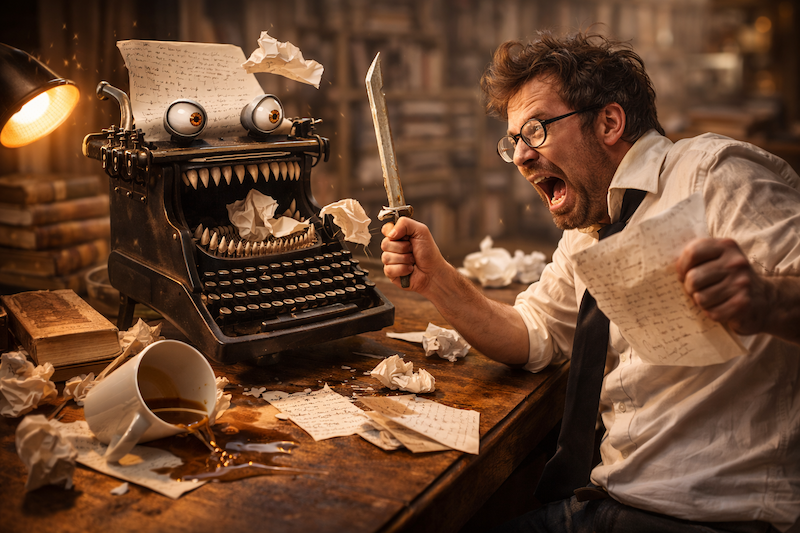
Copyeditor's report, Monday: 'Found 14 misplaced semicolons. Corrected.'

Tuesday: 'Semicolons back. All 14. In different locations. Corrected again.'

Wednesday: 'Semicolons multiplied to 31. Three replaced periods. One absorbed a comma. Escalating to senior editor.'

Thursday: 'Em-dashes have joined the semicolons. They barricaded chapter 9. Cannot access pages 142–160. Requesting backup.'

Friday: 'Manuscript now entirely semicolons. 78,000 of them. Author called. Said he likes it better this way. Quote: "Finally, someone understands my vision."'

Article Feb 13, 08:01 AM

Secrets of AI-Powered Text Editing: What Professional Writers Know (And You Should Too)

Every writer knows the feeling: you've poured your heart into a manuscript, read it five times over, and still missed that awkward sentence in chapter three. Editing has always been the most grueling part of the writing process — a necessary evil that separates rough drafts from polished prose. But a quiet revolution is reshaping how authors approach this critical stage, and it's powered by artificial intelligence.

AI-driven editing isn't about replacing the human touch. It's about amplifying it. The secrets behind effective AI editing go far beyond simple spell-checking, and understanding them can transform your workflow in ways you might not expect.

## Secret #1: AI Sees Patterns You Can't

The human brain is brilliant at creating — but terrible at catching its own mistakes. This is called "writer's blindness," and it happens because your mind automatically fills in what it expects to see rather than what's actually on the page. AI doesn't have this problem. Modern editing algorithms analyze text at multiple levels simultaneously: grammar, syntax, rhythm, readability, and even emotional tone. They flag inconsistencies that a tired human eye would glide right over — a character's eye color changing mid-novel, a timeline that doesn't add up, or a shift in narrative voice that breaks immersion. The practical tip here is simple: always run your text through AI analysis after you've done your own editing pass. Use AI as your "second pair of eyes" rather than your first, and you'll catch the gaps between what you meant to write and what you actually wrote.

## Secret #2: Layered Editing Beats One-Pass Fixes

One of the biggest mistakes writers make with AI tools is expecting a single click to fix everything. Professional editors have always worked in layers — first structural editing, then line editing, then copyediting, then proofreading. The most effective AI editing follows the same principle. Start with big-picture analysis: Does the plot hold together? Are the characters consistent? Is the pacing right? Then move to sentence-level refinement: word choice, rhythm, clarity. Finally, handle the mechanical details — punctuation, formatting, typos. When you feed your text to an AI tool all at once and ask it to "fix everything," you get mediocre results. When you guide it through focused passes, each targeting a specific layer, the results are dramatically better.

## Secret #3: The 24-Hour Rule Still Applies

Here's a secret that surprises people: AI editing works best when you don't use it immediately after writing. The reason isn't technical — it's psychological. If you run your fresh draft through an AI editor right away, you'll be too emotionally attached to accept its suggestions objectively. You'll dismiss valid critiques and accept superficial ones. Give yourself at least 24 hours between writing and AI-assisted editing. Come back with fresh perspective, and you'll find that the AI's feedback suddenly makes much more sense. You'll be able to distinguish between suggestions that genuinely improve your work and those that would strip away your unique voice.

## Secret #4: AI Excels at What Writers Hate Most

Consistency checking. Timeline verification. Repetition detection. Readability scoring. These are the tedious, mechanical aspects of editing that drain creative energy and consume hours. They're also exactly where AI shines brightest. Instead of spending three days manually tracking every mention of a secondary character to make sure their backstory stays consistent, you can let AI handle that detective work in seconds. Modern platforms like yapisatel allow writers to run comprehensive reviews across multiple criteria at once — from plot coherence to style consistency — freeing you to focus on the creative decisions that actually require human judgment. The secret is knowing what to delegate. Let AI handle the detective work; save your energy for the art.

## Secret #5: Feedback Is a Starting Point, Not a Verdict

The writers who get the most from AI editing treat every suggestion as a conversation starter, not a command. When an AI flags a sentence as "too complex," don't automatically simplify it. Ask yourself: is this complexity serving a purpose? Is it creating atmosphere, mimicking a character's thought pattern, or building tension? If yes, keep it. If no, revise it. The same goes for pacing suggestions, word choice recommendations, and structural feedback. AI provides data-driven observations. You provide the creative context that determines whether those observations matter. Experienced authors develop an instinct for which AI suggestions to embrace and which to override — and that instinct is itself a skill worth cultivating.

## Secret #6: Use AI to Stress-Test Your Weaknesses

Every writer has blind spots. Maybe you overuse adverbs. Maybe your dialogue tags are repetitive. Maybe your descriptions run long. One of the most powerful secrets of AI editing is using it diagnostically — not just to fix problems, but to identify recurring patterns in your writing. Run several chapters through an AI analysis and look for repeated feedback. If the tool keeps flagging the same issue, that's not a glitch — it's a pattern. Once you know your tendencies, you can consciously work on them during the writing phase itself, gradually becoming a stronger writer who needs less editing over time. This is the difference between using AI as a crutch and using it as a coach.

## Secret #7: The Right Prompt Changes Everything

When working with AI editing tools, specificity is your superpower. Instead of asking an AI to "improve this chapter," try targeted requests: "Analyze this chapter for pacing issues in the second half" or "Check whether the protagonist's motivation is clear in this scene." The more precisely you define what you're looking for, the more useful the output becomes. Think of it like briefing a human editor — the better your brief, the better their feedback. On platforms such as yapisatel, authors can leverage specialized AI agents that focus on specific aspects of their text, making this targeted approach even more effective.

## The Editing Workflow That Actually Works

Putting all these secrets together, here's a practical workflow that professional writers are quietly adopting. First, write your draft without self-censoring. Second, step away for at least 24 hours. Third, do your own read-through and make the obvious fixes. Fourth, run AI analysis in layers — structure first, then style, then mechanics. Fifth, review AI suggestions with your creative goals in mind, accepting what serves the story and rejecting what doesn't. Sixth, do one final human read-through for voice and flow. This hybrid approach consistently produces better results than either pure human editing or pure AI editing alone.

## The Real Secret Nobody Talks About

The ultimate secret of AI-powered editing isn't about the technology at all. It's about mindset. Writers who thrive with AI tools are those who see editing not as a chore to be automated away, but as a craft to be enhanced. They use AI to work smarter, not to work less. They maintain ownership of their voice while leveraging machine intelligence to catch what human attention misses. The writers who resist AI editing aren't protecting their art — they're just making their revision process harder than it needs to be. And the writers who blindly accept every AI suggestion aren't saving time — they're producing generic text that reads like it was written by committee.

The sweet spot is in the middle: informed, intentional, and always in control. If you've been curious about integrating AI into your editing process, start small. Pick one chapter, one specific concern, and one tool. See what the AI catches that you missed. Then decide for yourself whether the secrets were worth discovering.

Joke Feb 13, 04:28 AM

The 847th Error

Proofreader found 847 errors in my manuscript. Worked three weeks. Fixed 846.

Published.

One reviewer found the last one.

It's on page 1.

It's the title.

Article Feb 8, 03:15 AM

Writer's Toolkit: From Idea to Publication — Every Stage, Every Tool You Need

Every writer knows the feeling: a brilliant idea strikes at 2 a.m., you scribble it down on a napkin, and then — silence. The gap between that first spark and a finished, published book can feel like crossing an ocean on a raft. But here's the truth most successful authors won't tell you: the raft matters less than the toolkit you bring aboard.

Whether you're drafting your first novel or polishing your fifth, the modern writing landscape offers an unprecedented arsenal of tools that can transform how you work. Let's walk through every stage of the journey — from the raw idea to the moment a reader holds your book — and explore what actually helps at each step.

**Stage 1: Capturing and Developing the Idea**

Ideas are fragile. They arrive uninvited and disappear just as quickly. The first tool in any writer's kit is deceptively simple: a reliable capture system. Some authors swear by pocket notebooks; others use voice memos or apps like Notion and Obsidian. The format doesn't matter nearly as much as the habit. Author Neil Gaiman once said he keeps a notebook specifically for ideas that wake him up at night — and that discipline has fed decades of bestsellers.

Once you've captured a raw concept, the next challenge is developing it into something with bones. This is where mind-mapping tools like Miro or XMind shine. They let you visually connect characters, themes, plot threads, and settings before you write a single sentence of prose. Think of it as architectural sketching: you wouldn't build a house without a blueprint, and a novel deserves the same respect.

**Stage 2: Outlining and Structuring**

Here's where many writers either thrive or stall. Outliners — the writers who plan meticulously before drafting — have traditionally relied on tools like Scrivener, which lets you organize chapters as movable index cards. But technology has pushed this further. AI-powered platforms like yapisatel now allow authors to generate detailed chapter outlines and plot structures from a summary concept, essentially giving you a creative collaborator that never sleeps. You feed it your premise, your genre, your tone — and it returns a scaffolding you can build on, tear apart, or remix entirely.

The key insight is this: an outline is not a cage. It's a map. And having a map doesn't mean you can't wander off the path — it just means you can always find your way back.

**Stage 3: Writing the First Draft**

The first draft is where craft meets endurance. Your primary tool here is whatever gets words on the page fastest. For some, that's a distraction-free editor like iA Writer or FocusWriter. For others, it's Google Docs with its effortless collaboration features. Lately, many authors have adopted AI writing assistants to help push through blocks — not to replace their voice, but to maintain momentum. When you're stuck on a transition between scenes, an AI can suggest three different approaches in seconds. You pick the one that resonates and make it yours.

One practical tip that veteran authors swear by: set a daily word count goal that's embarrassingly small. Two hundred words. Three hundred. The psychology is powerful — once you sit down and hit 200, you almost always keep going. Tools like writing trackers in Scrivener or standalone apps like Pacemaker help you visualize that progress over weeks and months.

**Stage 4: Revision and Editing**

This is where good books become great ones, and it's arguably where technology has made the biggest leap in recent years. Grammar checkers like Grammarly and ProWritingAid catch surface errors, but the real transformation comes from deeper analysis. Does your pacing sag in the middle third? Are your characters' voices distinct enough? Is your worldbuilding consistent across four hundred pages?

These are questions that used to require expensive developmental editors or brutally honest critique partners. Today, AI-driven review tools can analyze your manuscript across multiple dimensions — plot coherence, character development, style consistency, dialogue quality — and deliver structured feedback in minutes. This doesn't replace a human editor, but it gives you a powerful first pass that lets you arrive at the editing table with a much stronger draft. Think of it as getting a detailed diagnostic before the surgery.

**Stage 5: Beta Readers and Feedback**

No tool replaces the value of real human readers encountering your story for the first time. Platforms like BetaBooks and StoryOrigin help you manage beta reader groups, collect structured feedback, and track which chapters resonate and which fall flat. The trick is to ask specific questions: don't just ask "Did you like it?" — ask "Where did you stop reading and why?" or "Which character felt the most real?"

Combining beta reader feedback with AI-generated analysis creates a remarkably complete picture. The AI catches structural and technical issues; the humans tell you where the heart is — or isn't.

**Stage 6: Publishing and Distribution**

The final stretch is where many first-time authors feel overwhelmed. Self-publishing through Amazon KDP, IngramSpark, or Draft2Digital involves formatting, cover design, metadata optimization, and marketing — each a discipline unto itself. Tools like Vellum (for Mac) or Atticus handle beautiful book formatting. Canva and BookBrush help with cover mockups, though investing in a professional cover designer remains one of the highest-ROI decisions an indie author can make.

For authors who want a more integrated experience — from initial idea generation through writing, editing, and preparing a manuscript for publication — platforms such as yapisatel offer an end-to-end workflow powered by AI. The advantage is continuity: your notes, outlines, drafts, and revisions all live in one ecosystem, reducing the friction of switching between five different apps.

**Stage 7: Marketing (Yes, It Starts Before You Publish)**

The most common regret among debut authors? "I wish I'd started building an audience sooner." Tools like Mailchimp or ConvertKit let you build an email list from day one. Social media schedulers like Buffer help maintain a presence without consuming your writing time. And platforms like BookFunnel can distribute advance reader copies to generate early reviews — the lifeblood of discoverability.

One underrated tactic: document your writing journey publicly. Readers love watching a book come to life. Share your outline struggles, your word count milestones, your cover reveal. By the time you publish, you've already built a community that's emotionally invested in your success.

**The Real Secret: Integration Over Accumulation**

The writers who finish books aren't necessarily the ones with the most tools — they're the ones who've built a workflow that feels natural. The best toolkit is the one you actually use consistently. Start with one tool per stage, master it, and only add complexity when you genuinely need it.

Technology — especially AI — hasn't replaced the deeply human act of storytelling. What it has done is remove many of the logistical and technical barriers that used to stand between a writer and a finished book. The ideas still have to be yours. The voice still has to be yours. But the path from napkin scribble to published novel has never been shorter or better lit.

So if you've been sitting on an idea, waiting for the perfect moment or the perfect tool — stop waiting. Pick one tool, open a blank page, and write your first two hundred words. The toolkit will grow as you do. The only thing that can't be automated, outsourced, or optimized is the decision to begin.

Joke Feb 1, 04:01 PM

The Best Chapter

Editor called. Urgent.

"Chapter 8 has to go."

"Why? What's wrong with it?"

"Nothing."

"Then why delete it?"

"It's the only good chapter."

"That's... a reason to KEEP it."

"It's making the others look bad."

Long pause.

"We should discuss chapter 8's salary."

Article Feb 6, 03:08 AM

Writer's Toolkit: From Idea to Publication — A Modern Author's Journey

Every writer knows the feeling: a brilliant idea strikes at 3 AM, scribbled on a napkin or typed frantically into a phone. But between that spark of inspiration and holding a finished book in your hands lies a vast territory that has defeated countless aspiring authors. The good news? In 2025, the writer's toolkit has evolved dramatically, transforming what was once an arduous solo expedition into a collaborative journey with intelligent tools at your side.

The path from idea to publication has never been more accessible, yet the sheer number of available tools can feel overwhelming. Which ones actually matter? Which will save you time versus becoming another distraction? Let's walk through each stage of the writing process and explore what actually works.

The first stage — ideation — is where many writers stumble before they even begin. You have a vague concept, perhaps a character who won't leave your mind or a world you glimpse in dreams. The traditional approach involved notebooks, cork boards covered in index cards, and hours of staring at blank pages. Today, AI-powered brainstorming tools can help you explore your initial concept from angles you never considered. They won't replace your creative vision, but they serve as tireless collaborators who never judge a half-formed thought. Try describing your idea in a single sentence, then ask an AI assistant to suggest five unexpected complications. You might discover your story's true direction.

Plotting and outlining represent the architectural phase of writing. Some authors are dedicated outliners who plan every chapter before writing a word. Others discover their story as they write. Regardless of your approach, having a flexible structure helps prevent the dreaded "sagging middle" that kills so many manuscripts. Technology offers solutions for both camps. Mind-mapping software lets you visualize connections between plot threads. Timeline tools help you track when events occur relative to each other — essential for complex narratives with multiple viewpoints. Digital cork boards like Scrivener or Notion let you rearrange scenes with a drag and drop, making structural changes painless.

The actual drafting phase remains deeply personal. Some writers need the focus of distraction-free writing apps that block everything except the blank page. Others thrive with ambient noise generators playing coffee shop sounds or forest rain. The key insight is this: your drafting environment should reduce friction. If you spend ten minutes finding your files and opening programs before you can write, that's ten minutes of momentum lost daily — over sixty hours annually. Invest time in setting up a system that lets you start writing within seconds of sitting down.

Editing is where modern AI tools truly shine, though with important caveats. Grammar checkers have evolved far beyond simple spell-check. They now catch subtle issues: overused words, passive voice creeping into action scenes, sentences that technically parse but confuse readers. Platforms like yapisatel offer AI-powered editing that understands context, suggesting improvements while preserving your unique voice. However, no tool should have the final word. Your creative choices might intentionally break rules for effect. Use AI as a second pair of eyes, not as a replacement for your judgment.

Beta reading and feedback gathering form a crucial bridge between drafting and publication. Technology has expanded our options dramatically. You can find beta readers in online writing communities, exchange manuscripts with other authors, or use AI-driven analysis to identify potential issues before human readers see your work. The ideal approach combines both: let AI catch the obvious problems first, then present a cleaner draft to human readers who can focus on deeper issues like character believability and emotional resonance.

Formatting for publication used to require expensive software or professional services. Today, tools exist that transform your manuscript into properly formatted ebooks and print-ready PDFs with minimal effort. Learn the basics of one good formatting tool — Vellum, Atticus, or Reedsy's free formatter — and you'll save thousands over a writing career. The technical barrier to professional presentation has essentially vanished.

Cover design remains one area where professional help often pays dividends, though AI image generation has opened new possibilities. A cover must accomplish multiple goals simultaneously: convey genre, attract attention at thumbnail size, and project professionalism. If you choose to design your own, study successful covers in your genre obsessively. Notice patterns in color, typography, and imagery. Tools like Canva provide templates, but your genre awareness determines whether the result looks professional or amateur.

The publication decision — traditional or self-publishing — shapes everything that follows. Traditional publishing offers advances, distribution, and editorial support but requires patience and accepts only a fraction of submissions. Self-publishing provides control, higher royalties per sale, and speed but demands that you handle every aspect yourself. Many successful authors now pursue hybrid approaches, self-publishing some works while traditionally publishing others. There's no single right answer; there's only the right answer for your specific book and goals.

Marketing represents the stage where many authors falter. We became writers to write, not to sell. Yet discoverability remains the greatest challenge in an era when millions of books compete for attention. Start building your author platform before publication. Connect genuinely with readers in your genre. Email lists remain the most valuable marketing asset — algorithms change, but your direct connection to readers endures. Write the next book; consistent publishing is the most effective marketing strategy that exists.

Modern platforms like yapisatel are transforming how authors approach this entire journey. By integrating AI assistance throughout the process — from initial brainstorming through editing and even publication support — they reduce the technical burden and let you focus on what matters: telling your story. The technology handles tedious aspects while you make the creative decisions that only a human author can make.

The writer's toolkit in 2025 is more powerful than anything previous generations could have imagined. Virginia Woolf famously wanted a room of one's own and five hundred pounds a year. Today's equivalent is a laptop, an internet connection, and the wisdom to use available tools effectively. The barriers have never been lower. The resources have never been richer. The only remaining obstacle is the one that has always existed: sitting down and doing the work.

Your story deserves to exist in the world. The tools are ready. The readers are waiting. What's stopping you from beginning today?

Joke Jan 31, 01:32 PM

The Editor's Escalating Concern

Editor marked page 47: "Unclear."

Page 48: "Very unclear."

Page 49: "Are you okay?"

Article Feb 6, 02:42 AM

Writer's Toolkit: From Idea to Publication — Building Your Creative Arsenal

Every published book begins as a fleeting thought — a character's voice in your head, a scene that won't let you sleep, or a question that demands exploration. But between that initial spark and holding a finished book in your hands lies a journey that has transformed dramatically in recent years. The modern writer no longer faces the blank page alone.

Today's authors have access to an unprecedented array of tools that can streamline every stage of the creative process. From capturing ideas to polishing final drafts, from building fictional worlds to connecting with readers, technology has become the writer's trusted companion. Let's explore the essential toolkit that can carry your story from conception to publication.

**Stage One: Capturing and Developing Ideas**

Ideas are notoriously slippery. They arrive during shower thoughts, midnight awakenings, or while stuck in traffic — rarely when you're sitting prepared at your desk. The first tool every writer needs is a reliable capture system. Note-taking apps like Notion, Obsidian, or even simple voice memos on your phone ensure no idea escapes. The key is choosing something you'll actually use consistently.

Once captured, ideas need room to grow. Mind-mapping software helps visualize connections between concepts, characters, and plot points. Some writers prefer physical index cards spread across a wall; others thrive with digital tools like Scapple or Miro. The method matters less than the practice of letting ideas breathe and connect.

**Stage Two: Structuring Your Story**

The gap between a great idea and a finished manuscript often lies in structure. This is where many writers struggle — and where modern AI tools have become genuinely helpful. Platforms like yapisatel offer intelligent assistance for developing plot outlines and chapter structures, helping writers see the architecture of their story before diving into prose.

Consider using the three-act structure as a starting framework, then breaking each act into sequences and scenes. Tools that allow you to visualize your story's pacing — seeing where tension rises and falls — can prevent the dreaded "saggy middle" that derails many novels. Character relationship maps and timeline trackers ensure consistency as your story grows more complex.

**Stage Three: The Writing Process Itself**

Here's where personal preference reigns supreme. Some writers swear by distraction-free tools like iA Writer or Hemingway Editor. Others need the robust features of Scrivener, which lets you organize research, character notes, and manuscript chapters in one place. Google Docs works beautifully for those who write across multiple devices or collaborate with co-authors.

The rise of AI writing assistants has added another dimension to this stage. These tools can help overcome writer's block by suggesting scene directions, generating dialogue options, or offering alternative phrasings. The key is using AI as a brainstorming partner rather than a replacement for your unique voice. Your creativity drives the story; technology simply helps clear obstacles from your path.

**Stage Four: Revision and Editing**

First drafts are meant to be imperfect — they're you telling the story to yourself. Revision is where you shape that raw material for readers. Grammar checkers like Grammarly catch surface-level errors, but deeper editing requires more sophisticated approaches.

AI-powered platforms can now analyze your manuscript for pacing issues, inconsistent character behavior, plot holes, and stylistic patterns. Services like yapisatel provide comprehensive feedback across multiple dimensions of craft, from dialogue authenticity to world-building consistency. This kind of analysis once required expensive professional editors or patient critique partners.

However, remember that all feedback — human or artificial — is ultimately suggestion. You remain the final arbiter of what serves your story best. The most valuable revision tool is still time: setting your manuscript aside for weeks or months before returning with fresh eyes.

**Stage Five: Professional Polish**

Before publication, every manuscript benefits from professional attention. Developmental editors address big-picture issues of plot and character. Line editors refine your prose at the sentence level. Copyeditors catch errors in grammar, consistency, and fact. Proofreaders provide the final check before printing.

Budget constraints make hiring all these professionals challenging for many authors. This is another area where AI tools have democratized access. While they shouldn't completely replace human editors for a book you're seriously publishing, they can handle early revision passes, letting you present cleaner work to human professionals — potentially reducing editing costs.

**Stage Six: Publication Pathways**

The traditional publishing route — querying agents, securing deals, waiting years for release — remains viable but is no longer the only path. Self-publishing platforms like Amazon KDP, IngramSpark, and Draft2Digital have empowered authors to reach readers directly. Each pathway has trade-offs in creative control, financial investment, and marketing responsibility.

Hybrid approaches are increasingly common. Some authors self-publish certain works while pursuing traditional deals for others. Some use self-published books to build audiences that make them attractive to traditional publishers. The tools for formatting ebooks and print-on-demand paperbacks have become remarkably accessible.

**Stage Seven: Connecting With Readers**

Publication isn't the finish line — it's the beginning of your book's public life. Author platforms, email newsletters, and social media presence help readers find your work and stick around for future releases. Tools like Mailchimp for newsletters, Canva for graphics, and scheduling apps for social media make consistent marketing manageable even for introverted writers.

The most sustainable approach treats marketing not as promotion but as conversation. Share your writing journey, discuss books you love, engage genuinely with your reading community. Authenticity builds the kind of readership that sustains a writing career.

**Building Your Personal Toolkit**

No single set of tools works for every writer. Your ideal toolkit depends on your genre, working style, budget, and goals. Start with the minimum viable setup: something to capture ideas, something to write in, and something to back up your work. Add tools only when you encounter specific problems they solve.

Experiment during low-stakes projects rather than in the middle of your magnum opus. Many tools offer free trials — use them before committing. And remember that the fanciest toolkit can't substitute for the fundamental practice of putting words on the page regularly.

The journey from idea to publication has never been more accessible. Technology has removed many barriers that once made writing careers feel impossibly distant. But the core challenge remains beautifully human: finding stories worth telling and developing the craft to tell them well. Your toolkit should serve that mission, clearing the path so your creativity can flourish.

Whether you're drafting your first novel or your fifteenth, take time to evaluate your current tools. Are they helping or hindering? What friction points in your process might technology smooth? The right toolkit won't write your book for you — but it might just make the writing life sustainable enough that you finish it.

Joke Jan 30, 09:32 PM

Gerald Is Disappointed

My editor has a favorite red pen. She named it Gerald.

Before marking any manuscript, she holds it up. Shows it to the pages.

'This is Gerald,' she says. 'Gerald is disappointed in you.'

Then she begins.

I've never seen so much red. Gerald is thorough. Gerald is merciless.

Last week I asked if Gerald liked anything.

She paused. Looked at the pen. Looked at me.

'Gerald liked page 47.'

There is no page 47. My manuscript is 46 pages.

'Gerald knows what he saw.'

Article Feb 5, 05:06 AM

Secrets of AI-Powered Text Editing: How Modern Writers Transform Rough Drafts into Polished Prose

Every writer knows the painful truth: first drafts are never perfect. The magic happens in editing—that grueling process of cutting, reshaping, and polishing until your words finally sing. But what if you had a tireless assistant who could spot weaknesses in your prose at three in the morning, suggest improvements without ego, and help you see your work through fresh eyes?

Artificial intelligence has quietly revolutionized how authors approach the editing process. Far from replacing human creativity, AI-powered editing tools have become sophisticated collaborators that amplify a writer's natural abilities. Today, we'll explore the secrets that professional authors use to leverage these tools effectively.

**Secret #1: AI Excels at Pattern Recognition You Cannot See**

Human brains are remarkable, but they have blind spots. After reading your manuscript for the fifteenth time, you literally cannot see that you've used the word "suddenly" forty-seven times, or that your protagonist "sighs" in every other chapter. AI editing tools excel at detecting these invisible patterns. They can map your word frequency, identify overused phrases, and highlight repetitive sentence structures that weaken your prose. The secret is using this capability strategically—run pattern analysis after your second draft, when the story structure is solid but before you've invested in final polishing.

**Secret #2: Layer Your Editing Passes**

Professional editors never try to fix everything at once, and neither should you when working with AI. The most effective approach involves distinct editing layers: first, structural analysis (plot holes, pacing issues, character consistency); second, line editing (sentence flow, word choice, dialogue authenticity); third, copy editing (grammar, punctuation, style consistency). Modern platforms like yapisatel allow authors to focus AI assistance on specific editing layers, producing more targeted and useful feedback than attempting everything simultaneously.

**Secret #3: Dialogue Is Where AI Shines Brightest**

One of the most powerful yet underutilized applications of AI editing involves dialogue analysis. Good dialogue must accomplish multiple tasks: reveal character, advance plot, and sound natural—all while avoiding the dreaded "talking heads" syndrome. AI tools can analyze your dialogue for authenticity, flag conversations that run too long without action beats, and even identify when characters sound too similar to each other. The secret is feeding the AI information about each character's background, education, and personality, then asking it to evaluate whether their speech patterns remain consistent throughout your manuscript.

**Secret #4: Use AI to Strengthen Your Weakest Areas**

Every writer has strengths and weaknesses. Perhaps you excel at snappy dialogue but struggle with description. Maybe your plots are intricate but your pacing drags. The smartest authors use AI editing tools to compensate for their specific weaknesses rather than applying them uniformly. Spend a week tracking which types of edits you consistently need to make, then configure your AI assistant to pay special attention to those areas. This targeted approach transforms a general tool into a personalized editing partner.

**Secret #5: The "Fresh Eyes" Technique**

Professional authors often set manuscripts aside for weeks before editing, allowing them to return with fresh perspective. AI provides an instant version of this effect. When you've been deep in your story world, AI can identify logical inconsistencies, timeline errors, and character contradictions that you've become blind to. One effective technique: after completing a chapter, immediately run it through AI analysis before your brain has time to fill in gaps with assumed knowledge. The questions and concerns it raises often reveal exactly where readers will stumble.

**Secret #6: Preserve Your Voice While Improving Clarity**

The greatest fear writers have about AI editing is losing their unique voice. Here's the secret: the best AI tools don't impose a generic style—they learn yours. When working with AI editing assistance on platforms designed for authors, you can train the system to recognize and preserve your stylistic choices while still catching genuine errors. The key is being specific about what aspects of your writing are intentional choices versus areas where you want improvement.

**Secret #7: Reverse-Engineer Reader Reactions**

Advanced AI editing goes beyond fixing errors to predicting reader responses. Where will readers feel confused? Which passages might cause them to lose interest? Where is emotional impact weakened by poor word choice? This predictive capability allows you to address problems before they reach actual readers. The secret is treating AI feedback as representing a potential reader segment—not the final word, but valuable data about how your prose might land.

**Secret #8: Edit for Different Audiences Simultaneously**

If you're writing a novel that might appeal to both young adult and adult readers, or a technical book accessible to beginners and experts, AI can help you evaluate your prose from multiple perspectives. You can analyze the same passage for reading level, assumed knowledge, and accessibility, then make informed decisions about where to adjust. This multi-audience editing would take human editors considerable time; AI accomplishes it in moments.

**Practical Application: A Sample Editing Workflow**

Here's how to implement these secrets in your writing practice. After completing your first draft, begin with structural AI analysis—plot consistency, character arc completion, pacing evaluation. Make major revisions based on this feedback. Next, proceed to line-level editing, focusing on your known weak areas. Run dialogue analysis separately, feeding in character profiles. Finally, use pattern detection to catch repetition and polish your prose. This systematic approach, easily implemented through AI writing platforms such as yapisatel, transforms editing from an overwhelming task into manageable focused passes.

**The Human Element Remains Essential**

Despite all these capabilities, AI editing works best as a collaborative tool rather than a replacement for human judgment. The secrets above all share a common thread: they require you to guide the AI, interpret its suggestions, and make final decisions. AI cannot tell you whether a risky creative choice serves your artistic vision—only whether it might confuse readers. That judgment call remains yours.

The writers who thrive in the AI age are those who learn to conduct this collaboration skillfully, treating AI as a highly capable assistant whose suggestions deserve consideration but not automatic acceptance.

**Your Next Step**

The best way to discover the potential of AI-powered editing is through experimentation. Take a chapter you've already written—one you consider finished—and run it through AI analysis. You may be surprised by what patterns emerge, what inconsistencies surface, and what opportunities for improvement you'd missed. The secrets shared here only become powerful through practice, and the tools have never been more accessible. Your next draft could be significantly stronger than anything you've written before.

Article Feb 5, 12:17 AM

Kill Your Darlings: Why Your Most Brilliant Scenes Are Secretly Destroying Your Book

That scene you've polished until it gleams like a diamond? The one you read aloud to friends at dinner parties? The passage that made you think, 'Finally, I've written something truly magnificent'? It needs to die. I know this hurts. I know you're already composing an angry response about how I don't understand your artistic vision. But here's the uncomfortable truth that every professional writer eventually learns: the scenes we love most are often the ones sabotaging our work.

The phrase 'kill your darlings' gets thrown around writing circles like confetti at a wedding, but few people know its origin. It's commonly attributed to William Faulkner, but the real culprit was Arthur Quiller-Couch, a Cambridge professor who wrote in 1914: 'Whenever you feel an impulse to perpetrate a piece of exceptionally fine writing, obey it—whole-heartedly—and delete it before sending your manuscript to press.' Notice he didn't say 'consider deleting' or 'maybe think about trimming.' He said delete. Period. The man wasn't mincing words.

So why do our best scenes betray us? Here's the dirty secret: when we write something we consider brilliant, we unconsciously build a shrine around it. The rest of the manuscript starts orbiting this golden passage like planets around the sun. We contort our plot to justify its existence. We slow the pacing to give readers time to properly appreciate our genius. We become architects designing an entire building just to house one fancy chandelier. Stephen King cut his favorite scene from 'The Stand'—a lengthy, beautifully written piece about a character's journey through the Lincoln Tunnel. Why? Because no matter how gorgeous the prose, it stopped the story dead. The book was 1,200 pages, and King recognized that even masterful writing must serve the narrative, not the author's ego.

Let me give you a practical test. Take your favorite scene—yes, that one—and ask yourself three brutal questions. First: if you removed this scene entirely, would the plot still make sense? If yes, you have a problem. Second: does this scene exist primarily to showcase your writing skills rather than advance character or story? Be honest. Third: did you spend more time revising this scene than any other of similar length? Excessive polishing is often a red flag that you're protecting something that doesn't deserve protection.

F. Scott Fitzgerald provides the perfect cautionary tale. His original manuscript for 'The Great Gatsby' contained a scene where Nick Carraway attended a elaborate party that Fitzgerald considered his finest work to date. His editor, Maxwell Perkins, suggested cutting it. Fitzgerald reportedly agonized for weeks before finally agreeing. The published novel is 47,000 words of precision—every scene earns its place. That 'brilliant' party scene? Nobody misses it because nobody knows it existed. The book became a masterpiece partly because Fitzgerald trusted his editor over his ego.

Here's what happens psychologically when we write something we love: our brain releases dopamine, creating a pleasure association with that specific passage. We literally become addicted to our own words. Every time we reread that scene, we get another little hit. This is why writers will fight to the death over keeping a paragraph that objectively damages their work. We're not defending art—we're defending our drug supply. Recognizing this pattern is the first step toward recovery.

The practical advice nobody wants to hear: create a 'darlings graveyard.' Every time you cut a beloved scene, paste it into a separate document. This psychological trick works wonders because you're not really killing anything—you're just relocating it. Tell yourself you might use it later, in another project. You probably won't, but the lie makes deletion bearable. I have a file with 40,000 words of 'brilliant' cuts from various projects. I've never retrieved a single sentence. But knowing they exist somewhere lets me sleep at night.

Raymond Carver's editor, Gordon Lish, famously cut up to seventy percent of some stories. Carver's reaction? He hated it initially, then grudgingly admitted the work was stronger. The minimalist style that made Carver famous wasn't entirely his creation—it emerged from aggressive editing. His 'darlings' included lengthy backstories, elaborate metaphors, and detailed descriptions. What remained was sharp, devastating, unforgettable. Sometimes the best version of your work exists underneath all that writing you're so proud of.

Now, I'm not suggesting you delete everything you love. That way lies creative paralysis and joyless prose. The goal isn't to punish yourself for writing well—it's to develop the judgment to distinguish between scenes that serve the story and scenes that serve your ego. A truly great scene makes readers forget they're reading. A 'darling' makes readers admire the writer. Feel the difference? One pulls you into the narrative; the other pulls you out to appreciate the craftsman's hand. Both might contain beautiful sentences, but only one belongs in your book.

Here's your homework, and I want you to actually do this, not just nod and forget. Print your current project. Yes, on paper, like a caveman. Read it with a red pen, marking every scene that makes you think, 'Damn, I'm good.' Those marks are your hit list. Not all of them need to die, but each one needs to justify its existence beyond 'I worked really hard on this' or 'This is my favorite part.' The scenes that survive this interrogation will be stronger for having been questioned. The ones that don't? They were always going to hold you back.

The hardest lesson in writing isn't learning to create beauty—it's learning to sacrifice it. Every professional writer has a story about the scene they mourned, the passage they still remember fondly, the darling they killed despite loving it desperately. And every single one will tell you the same thing: the book was better for it. Your attachment to a scene is not evidence of its quality. Sometimes it's evidence of the opposite. The willingness to cut what you love most separates amateurs from professionals, hobbyists from artists. So sharpen your knife, pour yourself a drink, and start killing. Your book is waiting to become what it's meant to be—and it can't do that while you're busy protecting your ego.

Nothing to read? Create your own book and read it! Like I do.

Create a book
1x

"Writing is thinking. To write well is to think clearly." — Isaac Asimov