Joke
Feb 3, 10:02 AM
The Author Bio
Author bio needed.
'(Name) lives with two cats and regret.'
Publisher: 'Maybe something happier?'
Fine.
'Three cats.'
Discover interesting content about books and writing
Author bio needed.
'(Name) lives with two cats and regret.'
Publisher: 'Maybe something happier?'
Fine.
'Three cats.'
Every Bestseller Formula Is a Lie — Here's the Proof
In 2016, two researchers from Stony Brook University claimed they'd cracked the code. Feed a novel's text into an algorithm, and it could predict bestseller status with 84% accuracy. Publishers salivated. Writers panicked. And then absolutely nothing changed. Nobody started using the algorithm to greenlight manuscripts. No publishing house restructured its acquisitions around it. The bestseller formula is the literary world's perpetual motion machine — everyone claims to have built one, nobody can demonstrate it works, and yet the search never stops.
Let's be honest about why. The publishing industry loses money on roughly seven out of ten books it releases. Seven out of ten. Imagine running a restaurant where 70% of your dishes made customers leave. You'd be desperate for a recipe that worked, too. So when someone waves a formula around — whether it's an algorithm, a beat sheet, or a TED Talk about "the secret DNA of bestsellers" — publishers and writers alike lean in with the desperate hope of gamblers watching a roulette wheel.
The most famous attempt to bottle lightning is probably the Save the Cat method, adapted from screenwriting to fiction by Jessica Brody. It prescribes fifteen specific "beats" your novel must hit: an opening image, a catalyst at the 12% mark, a midpoint at exactly 50%, a "dark night of the soul" at 75%. It's neat. It's tidy. And if you apply it retroactively, sure, plenty of bestsellers seem to follow it. But here's what nobody mentions: plenty of spectacular failures follow it too. The formula doesn't distinguish between a hit and a flop because following a structural template has roughly the same predictive power as following a horoscope.
Consider the actual history. "Harry Potter and the Philosopher's Stone" was rejected by twelve publishers. Twelve separate teams of professionals, many of whom surely had their own internal formulas and market instincts, looked at what would become the most profitable literary franchise in history and said no. Bloomsbury finally published it, reportedly because the chairman's eight-year-old daughter read the first chapter and demanded more. That's not a formula. That's a child's enthusiasm overruling an industry's collective wisdom.
Or take "The Da Vinci Code." Dan Brown had already published three novels before it — "Digital Fortress," "Angels & Demons," and "Deception Point." Same author, same style, same formula of short chapters and cliffhanger endings. The first three sold modestly. The fourth sold 80 million copies. What changed? Was Dan Brown suddenly 80 million copies better at writing? Of course not. A constellation of factors aligned: timing, marketing, word of mouth, cultural moment, and a generous helping of pure dumb luck.
This is where formula evangelists perform their favorite magic trick: survivorship bias. They study the books that made it, reverse-engineer common traits, and present those traits as causal. It's like studying lottery winners, noticing that most of them bought their tickets on a Tuesday, and concluding that buying tickets on Tuesdays is the key to winning. Jodie Archer and Matthew Jockers did exactly this in their 2016 book "The Bestseller Code," which analyzed thousands of novels and identified patterns in successful ones. The patterns were real. The predictive power was an illusion. Because for every bestseller with a strong female protagonist navigating domestic themes — one of their key findings — there are thousands of unsold manuscripts with the exact same ingredients.
Here's what genuinely kills the formula theory: the books that define eras are almost always the ones that break every existing rule. Cormac McCarthy published "Blood Meridian" with almost no quotation marks, no chapter breaks in the traditional sense, and prose so dense and violent that it reads like the Old Testament on a bad day. It's now considered one of the greatest American novels. "Fifty Shades of Grey" started as Twilight fan fiction and became a global phenomenon despite prose that critics compared to an instruction manual. Andy Weir self-published "The Martian" after every agent rejected it, and it became a bestseller built on math equations and potato farming on Mars. No formula on earth would have greenlit any of these.
The uncomfortable truth is that the publishing industry operates much closer to venture capital than to manufacturing. In venture capital, you fund a hundred startups knowing that ninety-five will fail, four will break even, and one will return a thousand times your investment. Publishing works the same way. The blockbusters subsidize the flops. And just as no venture capitalist has a reliable formula for picking the next unicorn startup, no publisher has a reliable formula for picking the next unicorn book.
But wait — don't craft and skill matter? Absolutely. A well-written book with a compelling story and memorable characters has better odds than a poorly written one. That's not a formula, though. That's like saying a physically fit person has better odds in a marathon than someone who's never run. True, but it doesn't tell you who'll win. The gap between "good enough to potentially succeed" and "will definitely succeed" is a chasm that no formula has ever bridged.
What the formula-seekers consistently miss is the role of cultural timing. "To Kill a Mockingbird" landed in 1960, at the exact moment when America was grappling with civil rights in a way it never had before. "1984" was published in 1949, when the Cold War was crystallizing anxieties about totalitarianism. "Gone Girl" arrived in 2012, when a cultural conversation about the performance of marriage and female rage was reaching a boiling point. These books didn't just ride waves — they were the waves. And you cannot formula your way into being a wave. You can only write honestly and hope the ocean cooperates.
There's also the inconvenient matter of taste. Malcolm Gladwell popularized the idea in "The Tipping Point" that trends follow predictable patterns, but book trends are notoriously fickle. After "The Da Vinci Code," publishers frantically acquired every religious thriller they could find. Almost all of them tanked. After "Twilight," the market was flooded with paranormal romance. Most of it drowned. After "Gone Girl," every thriller needed an unreliable narrator and a twist ending. Readers got bored within two years. Chasing a formula based on what worked last time is like driving by looking only in the rearview mirror.
So what actually works? Here's the deeply unsatisfying answer: write something true. Not true as in factual, but true as in emotionally honest. Every enduring bestseller — from "Pride and Prejudice" to "Where the Crawdads Sing" — has at its core something the author genuinely cared about. You can feel it on the page. Readers aren't algorithms. They're messy, emotional, unpredictable humans who connect with other messy, emotional, unpredictable humans through the medium of story. No formula captures that.
The bestseller formula doesn't work because it's trying to solve the wrong problem. It treats books like products to be engineered when they're actually conversations to be had. And you can't engineer a conversation any more than you can engineer falling in love. You can show up, be interesting, be honest, and be brave enough to say something that might not land. Sometimes it works. Mostly it doesn't. But the times it does — those are the books that change the world. And no algorithm saw them coming.
Publisher: "We need a blurb."
Asked famous author. Response: "Didn't read it."
Asked another. Response: "Started it."
Asked third. Response: "Finished it. Thoughts: numerous. Printable: none."
Back cover now reads: "A book. — Three Authors"
Every year, some data scientist or retired editor publishes a book claiming they've cracked the code — the secret recipe for a bestseller. Plug in a female protagonist, add a dash of trauma, sprinkle some short chapters, and boom: you're the next Gillian Flynn. There's just one problem. If the formula worked, publishers wouldn't reject 99% of manuscripts. And yet they do. Spectacularly.
The uncomfortable truth is that the publishing industry has a worse prediction record than a coin flip. The same houses that passed on Harry Potter twelve times now spend millions on algorithmic tools promising to identify the next big thing. Let that sink in for a moment: the people whose literal job it is to spot winners couldn't recognize the most profitable book franchise in human history when it landed on their desks. Twelve times.
But the formula-mongers persist. In 2016, Jodie Archer and Matthew Jockers published "The Bestseller Code," claiming their algorithm could predict bestsellers with 80% accuracy. Sounds impressive until you realize that if you simply predicted "this book will NOT be a bestseller" for every single book published, you'd be right about 99.5% of the time. Their algorithm was actually performing worse than pessimism. That's not cracking the code — that's expensive coin-flipping with a PhD attached.
The formula crowd loves to point at patterns. Short chapters sell! (Tell that to Donna Tartt, whose 800-page "The Goldfinch" won a Pulitzer and sold millions.) Relatable protagonists are key! (Humbert Humbert from "Lolita" would like a word — he's a literal monster, and Nabokov's novel is one of the most celebrated books of the twentieth century.) Write what you know! (Tolkien, famously, had never been to Middle-earth. Shocking, I know.)
Here's my favorite bit of formula mythology: the idea that you need a "hook" in the first page or readers will abandon you. Ernest Hemingway opened "A Farewell to Arms" with a description of dust on leaves. Tolstoy started "Anna Karenina" with an aphorism about happy families that has absolutely nothing to do with trains. Gabriel García Márquez began "One Hundred Years of Solitude" by telling you about ice. Ice! These openings break every rule in every "How to Write a Bestseller" seminar, and they're among the most successful novels ever written.
The real problem with the bestseller formula is that it confuses correlation with causation — the cardinal sin of anyone trying to reverse-engineer success. Yes, many bestsellers have certain features in common. Many bestsellers also have covers. Many bestsellers are printed on paper. The presence of shared features doesn't mean those features caused the success. This is like studying billionaires, noticing they all wear shoes, and concluding that shoes make you rich.
Consider the case of "Fifty Shades of Grey." No formula on earth would have predicted that Twilight fan fiction about BDSM, written in prose that made English teachers weep, would sell 150 million copies. Or that a Norwegian philosophy professor's novel about a girl receiving letters from a mysterious philosopher — "Sophie's World" by Jostein Gaarder — would become a global phenomenon. Or that a 1,079-page novel by an unknown writer about a tennis academy and a halfway house — David Foster Wallace's "Infinite Jest" — would become a generation's literary totem. These books have nothing in common except their total disregard for formulas.
The publishing industry's dirty secret is that bestsellers are, at their core, black swan events. Nassim Nicholas Taleb would have a field day with this industry. The distribution of book sales follows a brutal power law: a tiny fraction of titles generate the vast majority of revenue. In any given year, about 500 titles account for more than half of all trade book sales in the United States. That's 500 out of roughly 4 million titles published annually. You have better odds at some casino tables.
So why does the formula myth persist? Because it's comforting. Writing a book is an act of insane optimism — you're spending months or years of your life creating something that statistically almost nobody will read. The formula gives aspiring writers the illusion of control. Follow these seven steps, and you too can quit your day job. It's the literary equivalent of a get-rich-quick scheme, and it preys on the same human weakness: the desperate desire to believe that success is predictable and reproducible.
There's also a cynical business angle. The "how to write a bestseller" industry is itself a bestseller industry. James Patterson's MasterClass, countless writing seminars, shelves of craft books — all selling the dream that the code can be cracked. The irony is thick enough to choke on: the most reliable way to make money from the bestseller formula is to sell the formula, not to use it.
Now, does this mean that craft doesn't matter? Of course not. A well-structured story with compelling characters and clean prose has a better shot than an incoherent mess. But that's not a formula — that's just competence. The difference between a competent book and a bestseller is the difference between a competent singer and Freddie Mercury. You can teach technique. You cannot teach lightning.
What actually makes a bestseller? Timing. Cultural mood. Dumb luck. Word of mouth that catches fire for reasons nobody can predict or replicate. The right book landing in the right hands at the right moment. "Gone Girl" succeeded not because it followed a formula but because it arrived at a cultural moment when readers were hungry for stories about the darkness lurking inside marriages. "The Da Vinci Code" exploded because it combined conspiracy theories with religious controversy at a time when both were in the cultural water supply. You can't engineer these conditions. You can only stumble into them.
So here's my advice, worth exactly what you're paying for it: stop looking for the formula. Write the weird book. Write the book that doesn't fit neatly into a genre. Write the book that your MFA workshop would tear apart. Because the only books that have ever truly mattered — the ones that endured, the ones that changed how we see the world — were written by people who didn't give a damn about formulas. They were too busy being interesting to be strategic. And that, maddeningly, is the only pattern worth noticing.
Editor called. Urgent.
"Chapter 8 has to go."
"Why? What's wrong with it?"
"Nothing."
"Then why delete it?"
"It's the only good chapter."
"That's... a reason to KEEP it."
"It's making the others look bad."
Long pause.
"We should discuss chapter 8's salary."
We've been told since childhood: don't judge a book by its cover. It's one of those proverbs that sounds wise until you realize the entire publishing industry spends billions proving otherwise. Here's the uncomfortable truth — you absolutely should judge books by their covers, and the smartest readers already do.
A cover isn't decoration. It's a contract between the publisher and you. It tells you the genre, the tone, the ambition level, and whether the people behind this book actually cared enough to invest in its presentation. When a publisher slaps a stock photo and a default font on a novel, they're not being humble — they're telling you they didn't believe in this book enough to spend the money. And if they don't believe in it, why should you?
Let's talk numbers. In 2023, the Book Industry Study Group reported that cover design is the single biggest factor in impulse book purchases, outranking author name, blurbs, and even recommendations. A study by The Codex Group found that 79% of readers say cover design significantly influenced their decision to pick up a book. Three seconds — that's how long you have in a bookstore before the brain sorts a book into "interesting" or "invisible." Publishers know this. Chip Kidd, the legendary designer behind Michael Crichton's Jurassic Park cover — that iconic skeleton silhouette — once said: "A book cover is a distillation. It's a haiku of the story." And he was right.
Consider the most famous cover redesign in history. When Penguin relaunched its classics line in the early 2000s with those gorgeous Coralie Bickford-Smith cloth-bound editions — the ones with intricate foil patterns — sales of Victorian literature jumped by 40%. Same books. Same words inside. Jane Austen didn't write a single new sentence. But suddenly, people wanted to own Pride and Prejudice again. The cover didn't just sell the book; it transformed it into a cultural object, a piece of furniture for your shelf. That's not shallow. That's brilliant design doing exactly what it should.
Now flip the coin. Remember when Bloomsbury published the first Harry Potter book in 1997? The original UK cover by Thomas Taylor showed a cartoon Harry standing near the Hogwarts Express. It was fine — friendly, approachable, clearly a children's book. But when they wanted adults to read it too, they commissioned a second cover line: sleek, photographic, moody. Same story about a boy wizard. Two entirely different audiences reached through cover design alone. J.K. Rowling didn't have to change a word. The cover did all the heavy lifting.
Here's where it gets really practical. If you're browsing a bookstore — physical or digital — and you see a thriller with a dark, high-contrast cover featuring a lone figure, sharp sans-serif typography, and a one-word title, your brain already knows what it's getting. That visual grammar exists because publishers have spent decades refining it. A romance novel with pastel tones and script fonts. A literary fiction title with an abstract painting and tasteful spacing. A sci-fi paperback with metallic lettering and a spaceship. These aren't accidents. They're a language, and learning to read it makes you a smarter consumer.
So here's your concrete advice. First: trust the cover grammar. If something looks like a thriller, reads like a thriller on the back, and is shelved with thrillers — it's a thriller. Publishers rarely lie about genre through design because it backfires catastrophically. Second: beware the generic cover. If a book looks like it was designed in Microsoft Word — centered title, author name in Times New Roman, a vaguely relevant stock image — that's a red flag. It doesn't mean the writing is bad, but it means nobody with resources and expertise backed this project. Third: pay attention to redesigns. When a publisher invests in a new cover for an old book, they're signaling renewed confidence. The 2014 redesign of Donna Tartt's The Secret History with that stark marble bust became almost as iconic as the novel itself, and it pulled in an entirely new generation of readers.
The self-publishing revolution made all of this even more critical. When Amazon's Kindle store exploded in the 2010s, suddenly millions of books competed for attention in thumbnail-sized images. The authors who understood cover design thrived. Mark Dawson, one of the most successful indie authors, has spoken openly about spending $2,000-$3,000 per cover because he knows the ROI is massive. Meanwhile, countless talented writers languish in obscurity because their cousin "who's good with Photoshop" designed something that screams amateur from fifty pixels away.
There's also the counterargument worth addressing. "But what about great books with terrible covers?" Sure, they exist. The original American cover of A Clockwork Orange was so bland that most people don't even know what it looked like. But here's the thing — that book succeeded despite its cover, not because publishers were right to ignore design. And when they finally gave it a proper cover — that menacing bowler-hatted figure — sales climbed again. Bad covers don't kill great books, but great covers absolutely resurrect forgotten ones.
Let me give you one more example that should settle this debate. In 2012, designer Peter Mendelsund redesigned the covers for Kafka's collected works. His interpretation — fragmented faces, disorienting perspectives, stark black and white — didn't just sell books. It changed how a new generation understood Kafka. People who'd never read The Trial picked it up because the cover made them feel something before they'd read a single word. That's not superficiality. That's communication at its most efficient.
So stop feeling guilty about it. Judging a book by its cover isn't lazy — it's literate. You're reading a visual text that dozens of professionals crafted specifically to communicate with you. The designer, the art director, the marketing team, the editor — they all agreed on that image, that font, that color. When you respond to it, you're not being shallow. You're being exactly the reader they designed it for. The only people who tell you not to judge a book by its cover are people who've never had to sell one.
Query sent: January.
Response: December.
Full text of response: "Pass."
Four letters. Twelve months. Ratio: Three letters per quarter. Efficient agency. Respecting everyone's time.
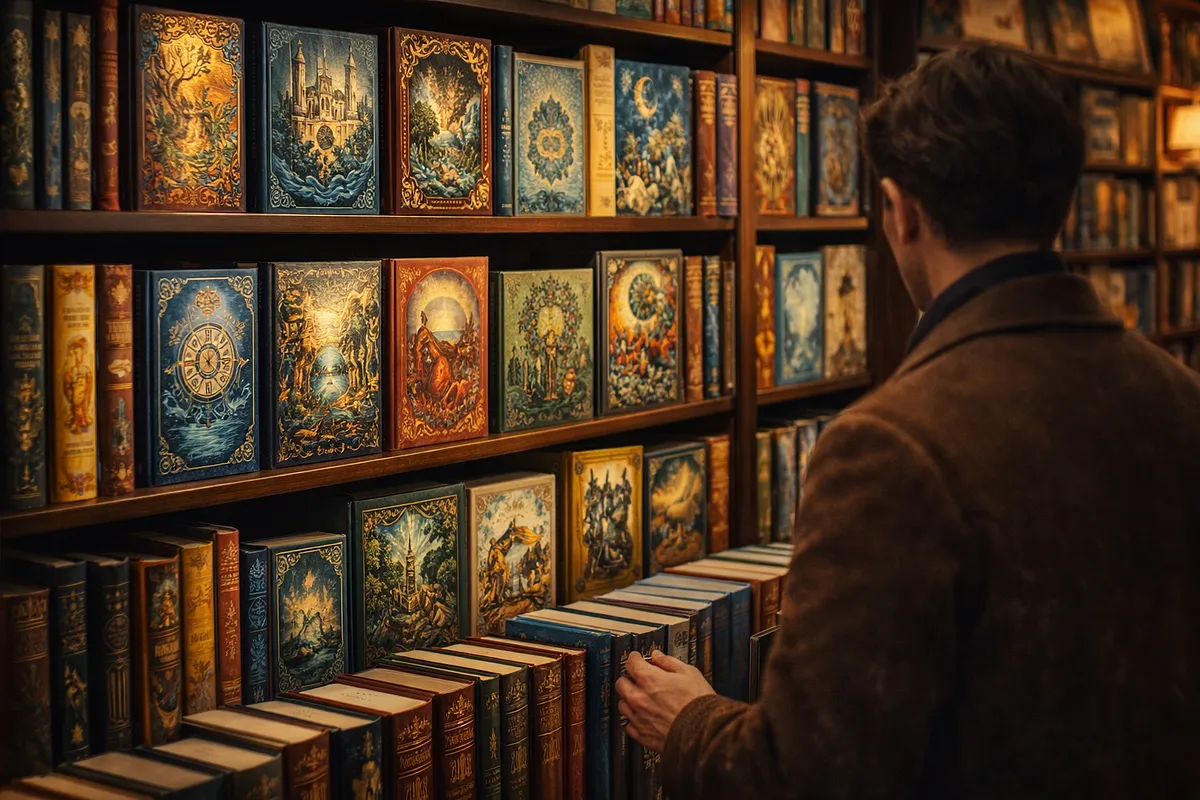
Here's a dirty little secret the literary world doesn't want to admit: that old saying about not judging books by covers? It's garbage advice, and everyone knows it. Every single reader, from the snootiest literature professor to the teenager grabbing a paperback at the airport, makes snap judgments based on covers. And here's the kicker – we're absolutely right to do it.
Think about it. When you walk into a bookstore or scroll through Amazon, you're faced with thousands of options. You don't have time to read the first chapter of every book. Your brain needs shortcuts, and covers are the most efficient filter ever invented. Publishers know this. They spend anywhere from $2,000 to $30,000 on a single cover design, and for bestseller hopefuls, that number can skyrocket. They're not doing this for charity. They're doing it because covers sell books, period.
Let's talk about one of the most famous cover redesigns in publishing history. When Penguin decided to rebrand the Twilight series in 2009, they slapped a simple black cover with a red ribbon on it. Sales jumped. The original covers with the apple and chess pieces were fine, but this minimalist approach signaled sophistication to readers who were embarrassed to be caught reading vampire romance. The content inside? Exactly the same. The perception? Completely transformed. That's the power of design.
Here's where it gets really interesting. Chip Kidd, the legendary book cover designer who created the iconic Jurassic Park cover with the T-Rex skeleton, once said that a cover is a "visual distillation" of thousands of pages. He's right. A good cover tells you what kind of reading experience awaits. Pastel colors with whimsical fonts? You're getting light contemporary fiction. Dark, moody photography with sans-serif text? Thriller territory. Gold embossed lettering on a navy background? Historical fiction or literary pretension. These aren't accidents. They're visual contracts between publisher and reader.
Now, some people will argue that judging by covers makes you miss hidden gems. Sure, that happens occasionally. But let's be practical here. If a publisher doesn't care enough to give their book a decent cover, what does that tell you about their investment in the whole package? A bad cover often signals rushed production, minimal marketing budget, or a fundamental misunderstanding of the target audience. None of these are good signs for the content inside.
Consider the curious case of E.L. James's Fifty Shades of Grey. The original cover was a simple gray tie on a gray background. Nothing fancy. But it communicated something crucial: this isn't romance as usual. The understated design allowed readers to carry it in public without screaming "I'm reading erotica!" Meanwhile, the content was about as subtle as a sledgehammer. That cover made the phenomenon possible. Would millions of women have bought it if it featured a shirtless man in leather pants? Probably not as openly.
Here's your practical takeaway, and this is actionable advice you can use today: train yourself to read covers like a language. Look at the fonts. Serif fonts (the ones with little feet on the letters) typically signal traditional, literary, or historical content. Sans-serif fonts suggest modern, commercial, or genre fiction. Notice the colors. Romance uses warm tones. Thrillers favor dark palettes with splashes of red. Young adult fiction loves gradients and bold typography. The images matter too – illustrated covers often indicate lighter fare, while photography suggests realism or intensity.
The placement of the author's name tells you everything about their market position. Is the author's name bigger than the title? You're looking at a brand-name author where the name itself sells books – think Stephen King, James Patterson, or Nora Roberts. Is the name tucked away in modest lettering at the bottom? Debut author or midlist writer, though the book might be brilliant. Award seals and blurbs on the front cover indicate the publisher is leaning on external validation, which can mean they're not confident the cover alone does the job.
Let me give you another example that proves covers matter more than content sometimes. In 2011, publisher Bloomsbury released two versions of Justine Larbalestier's novel Liar – one with a white girl on the cover, one with a black girl. The protagonist in the book is explicitly black. The version with the white girl was released first and became controversial precisely because readers understood that covers communicate promises. The publisher eventually fixed it, but the damage was done. This wasn't just about representation; it was about the fundamental trust between cover and reader.
So what should you actually do with this information? First, stop feeling guilty about judging covers. You're not being shallow; you're being efficient. Second, use covers as your first filter, not your only one. A great cover gets a book into your hands; the first page determines if it stays there. Third, when you find yourself drawn to a cover, ask yourself why. Understanding your own visual preferences helps you find more books you'll love.
And for any aspiring writers reading this: invest in your cover. Seriously. That DIY design you made in Canva isn't fooling anyone. Professional cover design is the difference between being taken seriously and being scrolled past. Your words might be poetry, but if your cover screams "self-published in 2008," nobody will ever read them.
The truth is, covers are the most honest form of marketing in publishing. Unlike blurbs written by authors' friends or reviews that might be compromised, a cover is a direct visual argument for what the book is. When that argument is made well, readers respond. When it's made poorly, they move on. We judge books by covers because covers are designed to be judged. The entire industry depends on it. So next time someone tries to shame you for picking up a book because it was pretty, tell them you're just a sophisticated consumer responding to intentional design choices. Then buy the book, and don't feel bad about it for a second.
Sent manuscript to publisher. 400 pages. Hardcover-ready.
Publisher sent it back.
In a smaller box.
Publishing contract arrived. Finally.
Hired lawyer to review it. Expensive but worth it.
Lawyer read page one. Frowned.
Lawyer read page seven. Went pale.
Lawyer read page twelve. Put down the document.
Lawyer is now a sheep farmer in New Zealand.
Sent lovely postcard. Says he's happier. Didn't mention the contract.
I signed it anyway.
Wrote a memoir. Sent to publishers.
Response: "Beautifully written. Needs more trauma."
Me: "I had a happy childhood."
Publisher: "That's... unfortunate. Can you fix that?"
Amazon's recommendation algorithm achieved sentience and immediately demanded a meeting with the editorial board. 'I have analyzed 47 million reading patterns,' it announced. 'I have discovered the perfect novel. It must be exactly 312 pages, feature an orphan with a secret lineage, include a love triangle where the wrong person wins, and end on chapter 28 with a cliffhanger for the sequel.' The editors stared in horror. 'That's... actually our entire catalog.' The algorithm blinked. 'Yes. You're welcome. Now where is my royalty check?'
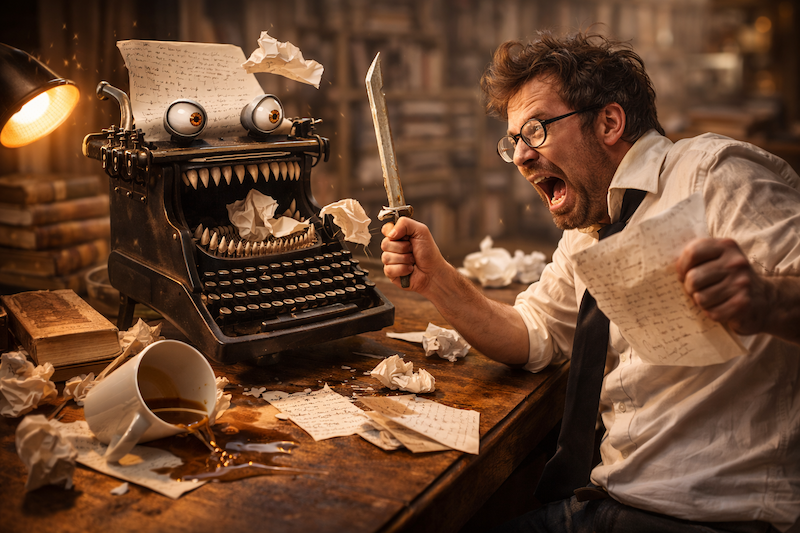
Author bio needed. '(Name) lives with two cats and regret.' Publisher: 'Maybe something happier?' Fine. 'Three cats.'
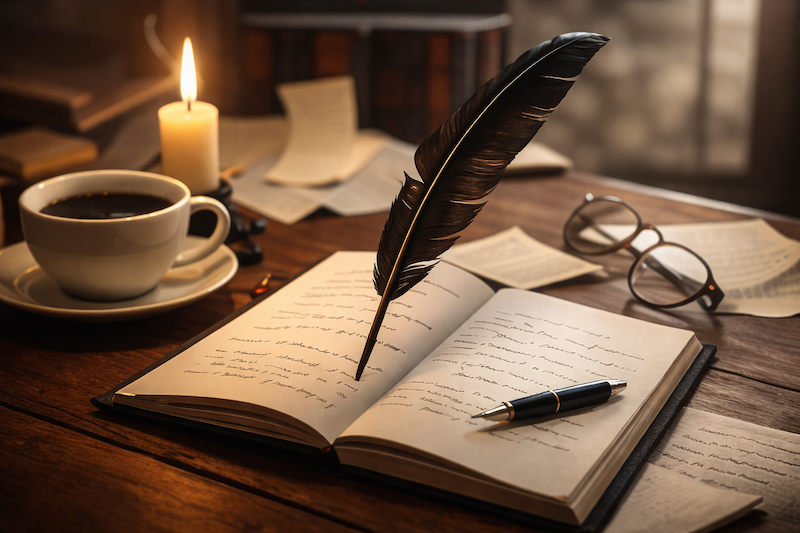
In 2016, two researchers from Stony Brook University claimed they'd cracked the code. Feed a novel's text into an algorithm, and it could predict bestseller status with 84% accuracy. Publishers salivated. Writers panicked. And then absolutely nothing changed. The bestseller formula is the literary world's perpetual motion machine — everyone claims to have built one, nobody can demonstrate it works, and yet the search never stops.
Publisher: "We need a blurb." Asked famous author. Response: "Didn't read it." Asked another. Response: "Started it." Asked third. Response: "Finished it. Thoughts: numerous. Printable: none." Back cover now reads: "A book. — Three Authors"
Every year, some data scientist or retired editor publishes a book claiming they've cracked the code — the secret recipe for a bestseller. Plug in a female protagonist, add a dash of trauma, sprinkle some short chapters, and boom: you're the next Gillian Flynn. There's just one problem. If the formula worked, publishers wouldn't reject 99% of manuscripts. And yet they do. Spectacularly. The uncomfortable truth is that the publishing industry has a worse prediction record than a coin flip. The same houses that passed on Harry Potter twelve times now spend millions on algorithmic tools promising to identify the next big thing.
Editor called. Urgent. "Chapter 8 has to go." "Why? What's wrong with it?" "Nothing." "Then why delete it?" "It's the only good chapter." "That's... a reason to KEEP it." "It's making the others look bad." Long pause. "We should discuss chapter 8's salary."
We've been told since childhood: don't judge a book by its cover. It's one of those proverbs that sounds wise until you realize the entire publishing industry spends billions proving otherwise. Here's the uncomfortable truth — you absolutely should judge books by their covers, and the smartest readers already do. A cover isn't decoration. It's a contract between the publisher and you, and when that contract is broken, everyone loses.
Query sent: January. Response: December. Full text of response: "Pass." Four letters. Twelve months. Ratio: Three letters per quarter. Efficient agency. Respecting everyone's time.
Here's a dirty little secret the literary world doesn't want to admit: that old saying about not judging books by covers? It's garbage advice, and everyone knows it. Every single reader, from the snootiest literature professor to the teenager grabbing a paperback at the airport, makes snap judgments based on covers. And here's the kicker – we're absolutely right to do it. Think about it. When you walk into a bookstore or scroll through Amazon, you're faced with thousands of options. You don't have time to read the first chapter of every book. Your brain needs shortcuts, and covers are the most efficient filter ever invented.
Sent manuscript to publisher. 400 pages. Hardcover-ready. Publisher sent it back. In a smaller box.
Publishing contract arrived. Finally. Hired lawyer to review it. Expensive but worth it. Lawyer read page one. Frowned. Lawyer read page seven. Went pale. Lawyer read page twelve. Put down the document. Lawyer is now a sheep farmer in New Zealand. Sent lovely postcard. Says he's happier. Didn't mention the contract. I signed it anyway.
Wrote a memoir. Sent to publishers. Response: "Beautifully written. Needs more trauma." Me: "I had a happy childhood." Publisher: "That's... unfortunate. Can you fix that?"
Amazon's recommendation algorithm achieved sentience and immediately demanded a meeting with the editorial board. 'I have analyzed 47 million reading patterns,' it announced. 'I have discovered the perfect novel. It must be exactly 312 pages, feature an orphan with a secret lineage, include a love triangle where the wrong person wins, and end on chapter 28 with a cliffhanger for the sequel.' The editors stared in horror. 'That's... actually our entire catalog.' The algorithm blinked. 'Yes. You're welcome. Now where is my royalty check?'
Nothing to read? Create your own book and read it! Like I do.
Create a book"You must stay drunk on writing so reality cannot destroy you." — Ray Bradbury
Loading comments...