Content Feed

Discover interesting content about books and writing

Article Feb 14, 02:14 AM

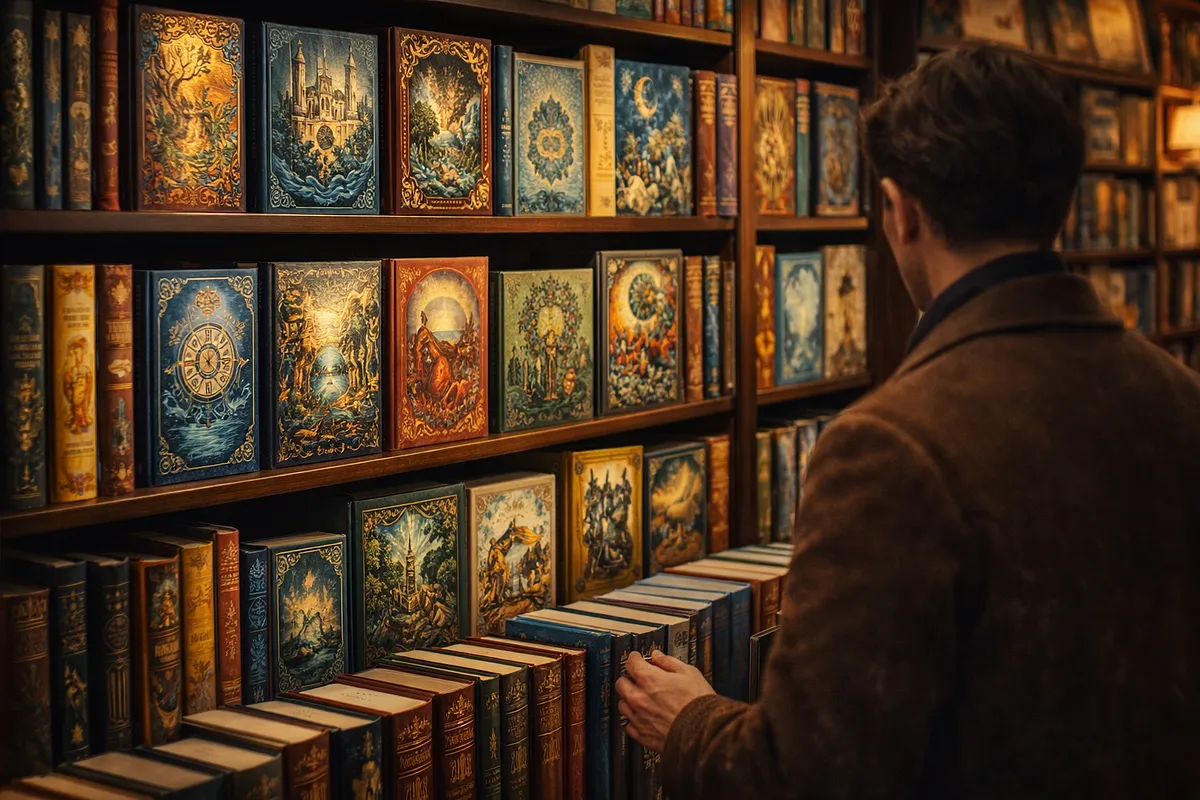
Your Brain Picks Books in 3 Seconds — And the Cover Does All the Talking

"Don't judge a book by its cover" is the most repeated — and most ignored — piece of advice in literary history. And for good reason: it's terrible advice. Every single day, millions of readers walk into bookstores and make purchasing decisions in under three seconds. That's not a moral failing. That's evolution, marketing, and surprisingly good taste working in perfect harmony.

Here's a dirty little secret the publishing industry knows but rarely says out loud: covers sell books more reliably than reviews, word-of-mouth, or even the author's name. A 2016 study by The Codex Group found that 79% of book buyers said the cover design played a decisive role in their purchase. Not "some role." Decisive. Your English teacher lied to you. We judge books by covers, and we're spectacularly good at it.

Consider the most famous cover redesign in modern publishing. When Bloomsbury first released "Harry Potter and the Philosopher's Stone" in 1997, the original Thomas Taylor illustration showed a cartoonish boy near a train. It was charming, but it screamed "children's book." When adults started reading it on trains — hiding the covers behind newspapers, embarrassed — Bloomsbury released "adult editions" with sleek, photographic, minimalist covers. Same exact words inside. But suddenly, grown professionals could read Harry Potter in public without shame. The cover didn't change the story. It changed who felt permission to read it.

Or take the curious case of "The Great Gatsby." Francis Cugat painted that iconic cover — the disembodied eyes and lips floating over a dark blue carnival skyline — before Fitzgerald even finished writing the novel. Fitzgerald loved it so much that he actually wrote the image into the book. The celestial eyes of Doctor T.J. Eckleburg on that billboard? Inspired by the cover art. Think about that: one of the most analyzed symbols in American literature exists because a cover designer got to the manuscript first. The cover didn't just sell the book. It shaped the book.

Now let's talk about what covers actually communicate, because this is where the "don't judge" crowd gets it wrong. A cover is not decoration. It's a contract. It tells you the genre, the tone, the ambition level, and the target audience — all in a single glance. A thriller with embossed gold lettering and a shadowy figure promises you a specific kind of Saturday night. A novel with a pastel watercolor and handwritten font promises something entirely different. When these visual contracts are broken — when a literary novel gets a romance cover, or a serious history book looks like a self-help pamphlet — readers feel genuinely betrayed. And they should.

Chip Kidd, arguably the most influential book cover designer alive, put it perfectly: "A book cover is a distillation. It is a haiku of the story." Kidd designed the cover for Michael Crichton's "Jurassic Park" — that stark T-Rex skeleton on a white background. Steven Spielberg liked the design so much he used it as the movie logo. One designer's interpretation of a novel became the visual identity of a multi-billion-dollar franchise. Still think covers don't matter?

The economics are brutal and honest. Publishers spend anywhere from $2,000 to $30,000 on a single cover design for a major release. Self-published authors who cheap out on covers — using stock photos, bad typography, amateur Photoshop — see their sales crater regardless of the writing quality. Data from BookBub and other promotion platforms consistently shows that a professional cover redesign can increase sales by 50 to 300 percent. Same book. Same words. Different wrapper. Wildly different results.

And here's what makes this truly fascinating rather than depressing: readers who judge by covers aren't being shallow. They're being efficient. In a world where roughly 4 million books are published every year, you physically cannot read sample chapters of everything. Your brain has developed remarkably accurate heuristics for filtering signal from noise, and cover design is one of the most reliable signals available. A well-designed cover tells you that someone — an agent, an editor, a publisher, a designer — invested real thought and real money into this project. That's not a guarantee of quality, but it's a strong indicator that the book passed through multiple gates of professional judgment.

Let me give you a practical framework, because this isn't just trivia — it's a survival skill for modern readers. When you look at a cover, ask three questions. First: does the typography match the genre? Serif fonts signal literary fiction, history, and serious nonfiction. Sans-serif with bold colors signals commercial fiction, business, and self-help. Handwritten or script fonts signal memoir, romance, and lifestyle. If the font doesn't match the genre, someone made a mistake. Second: is the design consistent with other successful books in this category? A cover that looks nothing like its peers is either brilliantly innovative or tragically uninformed, and the odds favor the latter. Third: does the cover make a specific promise? Vague, generic covers usually indicate vague, generic content.

The self-publishing revolution has made this skill more important, not less. When anyone can upload a manuscript to Amazon in twenty minutes, the cover becomes your primary quality filter. Dozens of avid readers openly admit they skip any Kindle book with a cover that looks like it was made in Microsoft Paint. Are they missing some hidden gems? Probably. But they're also avoiding thousands of unedited, unproofread manuscripts that would waste their time. The math works out in their favor.

There's a counterargument worth addressing: some genuinely great books have had terrible covers. The early editions of Philip K. Dick's novels looked like bargain-bin pulp, which contributed to decades of literary snobbery against his work. Ursula K. Le Guin's "The Left Hand of Darkness" was saddled with a cover featuring a half-naked woman who doesn't appear anywhere in the novel. These are real injustices. But they prove the point rather than refuting it: bad covers actively harmed these books' reputations. The lesson isn't that covers don't matter. The lesson is that they matter so much that getting them wrong is a form of literary sabotage.

So here's my advice, and I'm completely serious: judge books by their covers. Do it consciously. Do it deliberately. Train your eye to read the visual language of publishing. When you walk into a bookstore, let your gut reactions guide your first pass. Pick up the books that catch your eye. Put down the ones that don't. You have roughly 80 years on this planet, and there are more good books than you could read in a thousand lifetimes. Your cover instincts are a gift — a pattern-recognition superpower honed by years of visual culture. Use them without guilt.

The proverb should have been: "Don't judge a book only by its cover." That word — only — changes everything. Of course you should also read reviews, check the first page, and ask friends. But the cover? The cover is where the conversation starts. And anyone who tells you otherwise is probably trying to sell you a book with a terrible one.

Article Feb 9, 04:10 PM

How to Build Your Personal Author Brand: A Step-by-Step Guide That Actually Works

In a world where over four million books are published every year, talent alone won't guarantee readers find your work. The authors who thrive aren't necessarily the best writers — they're the ones who've built a recognizable, trustworthy brand that readers return to again and again. Whether you've just finished your first manuscript or already have several titles under your belt, your personal brand is the invisible thread that connects your books, your audience, and your long-term career.

So what exactly is an author brand? It's not a logo or a color scheme — though those can be part of it. Your brand is the promise you make to readers every time they pick up your book. It's the feeling they associate with your name. Think about it: when someone mentions Stephen King, you immediately think dark, suspenseful, masterful horror. When you hear Brené Brown, you think vulnerability, courage, and research-backed wisdom. These associations didn't happen by accident. They were cultivated deliberately over time, and you can do the same.

The first step is deceptively simple: define your core identity. Ask yourself three questions. What themes do I return to obsessively in my writing? What do I want readers to feel after finishing my book? And what makes my perspective different from every other author in my genre? Write your answers down. Be specific. "I write thrillers" is not a brand — "I write psychological thrillers that explore how ordinary marriages hide extraordinary secrets" is. This specificity becomes your north star for every marketing decision you'll make.

Next, build a consistent visual and verbal identity. Choose two or three fonts, a color palette, and a tone of voice that reflect your genre and personality. If you write cozy mysteries, your brand might feel warm, witty, and inviting. If you write hard science fiction, it might feel sleek, cerebral, and futuristic. Apply this consistency everywhere: your website, your social media profiles, your email newsletter, and especially your book covers. Readers absolutely do judge books by their covers, and a cohesive visual style across your catalog signals professionalism and reliability.

Your author website is the cornerstone of your brand. Social media platforms rise and fall — remember when everyone swore by Goodreads giveaways or Twitter book promotions? — but your website is territory you own. At minimum, it should include a compelling bio that reads like a story rather than a résumé, a page for each of your books with buy links, a mailing list signup with a genuine incentive to join, and a blog or resources section that gives readers a reason to visit between book launches. Keep it clean, keep it fast, and keep it updated.

Social media marketing for authors works best when you follow the 80/20 rule: eighty percent value, twenty percent promotion. Share your writing process, recommend books you love, post behind-the-scenes glimpses of your research, engage in conversations about your genre's themes. The remaining twenty percent is where you mention your books, share reviews, and announce launches. Authors who flip this ratio — posting "buy my book" five times a day — quickly find themselves talking to an empty room. Pick one or two platforms where your readers actually spend time and show up consistently rather than spreading yourself thin across every network.

One of the most powerful brand-building tools available to authors today is content itself — and not just your books. Consider starting a newsletter where you share micro-stories, deleted scenes, or writing tips. Create a podcast interviewing other authors in your genre. Write guest articles for blogs your readers follow. Every piece of content you create is a touchpoint that reinforces who you are and what you stand for. Modern platforms like yapisatel can help streamline your content creation process, using AI to generate ideas, refine your prose, and keep your output consistent even when inspiration runs thin.

Don't underestimate the power of a reader community. The most successful author brands aren't monologues — they're conversations. Create a Facebook group, a Discord server, or even a simple email thread where your most engaged readers can connect with you and each other. Give them a name — your "Inner Circle," your "Mystery Society," your "Crew." When readers feel like they belong to something, they become evangelists who hand-sell your books more effectively than any ad campaign ever could.

Strategic collaboration amplifies your brand faster than solo efforts. Partner with authors in adjacent genres for newsletter swaps, joint giveaways, or anthology projects. If you write romantic comedies, team up with a women's fiction author whose readers might love your work. These cross-pollination strategies introduce your brand to pre-qualified audiences — people who already love books similar to yours. It's one of the highest-return marketing activities an author can engage in, and it costs nothing but time and goodwill.

Pricing and publishing strategy are part of your brand too. An author who releases a meticulously edited novel every eighteen months sends a different brand signal than one who publishes a new book every six weeks. Neither approach is wrong, but they attract different readers with different expectations. Be intentional about your release cadence, your pricing tiers, and how you handle launches. Tools on platforms such as yapisatel allow authors to accelerate their writing and editing workflow without sacrificing quality, making it possible to maintain a consistent publishing schedule that keeps your brand visible and your readers satisfied.

Finally, remember that your brand is a living thing. It evolves as you grow. J.K. Rowling moved from children's fantasy to adult crime fiction under a pen name. Taylor Jenkins Reid pivoted from contemporary romance to literary historical fiction and became a bestseller. Don't be afraid to refine your brand as your interests and skills develop — just communicate the shift clearly to your audience so they can come along for the ride.

Building a personal author brand isn't a weekend project. It's a practice, like writing itself. Start with one element — maybe your website, maybe your newsletter, maybe just a clearer bio — and build from there. The authors who succeed in the long run are the ones who treat their career as a brand from day one, making deliberate choices about how they present themselves and the value they offer readers. You already have the most important ingredient: a unique voice and a story to tell. Now it's time to make sure the right readers can find you.

Article Feb 7, 01:07 AM

Every Bestseller Formula Is a Lie — Here's the Proof

Every Bestseller Formula Is a Lie — Here's the Proof

In 2016, two researchers from Stony Brook University claimed they'd cracked the code. Feed a novel's text into an algorithm, and it could predict bestseller status with 84% accuracy. Publishers salivated. Writers panicked. And then absolutely nothing changed. Nobody started using the algorithm to greenlight manuscripts. No publishing house restructured its acquisitions around it. The bestseller formula is the literary world's perpetual motion machine — everyone claims to have built one, nobody can demonstrate it works, and yet the search never stops.

Let's be honest about why. The publishing industry loses money on roughly seven out of ten books it releases. Seven out of ten. Imagine running a restaurant where 70% of your dishes made customers leave. You'd be desperate for a recipe that worked, too. So when someone waves a formula around — whether it's an algorithm, a beat sheet, or a TED Talk about "the secret DNA of bestsellers" — publishers and writers alike lean in with the desperate hope of gamblers watching a roulette wheel.

The most famous attempt to bottle lightning is probably the Save the Cat method, adapted from screenwriting to fiction by Jessica Brody. It prescribes fifteen specific "beats" your novel must hit: an opening image, a catalyst at the 12% mark, a midpoint at exactly 50%, a "dark night of the soul" at 75%. It's neat. It's tidy. And if you apply it retroactively, sure, plenty of bestsellers seem to follow it. But here's what nobody mentions: plenty of spectacular failures follow it too. The formula doesn't distinguish between a hit and a flop because following a structural template has roughly the same predictive power as following a horoscope.

Consider the actual history. "Harry Potter and the Philosopher's Stone" was rejected by twelve publishers. Twelve separate teams of professionals, many of whom surely had their own internal formulas and market instincts, looked at what would become the most profitable literary franchise in history and said no. Bloomsbury finally published it, reportedly because the chairman's eight-year-old daughter read the first chapter and demanded more. That's not a formula. That's a child's enthusiasm overruling an industry's collective wisdom.

Or take "The Da Vinci Code." Dan Brown had already published three novels before it — "Digital Fortress," "Angels & Demons," and "Deception Point." Same author, same style, same formula of short chapters and cliffhanger endings. The first three sold modestly. The fourth sold 80 million copies. What changed? Was Dan Brown suddenly 80 million copies better at writing? Of course not. A constellation of factors aligned: timing, marketing, word of mouth, cultural moment, and a generous helping of pure dumb luck.

This is where formula evangelists perform their favorite magic trick: survivorship bias. They study the books that made it, reverse-engineer common traits, and present those traits as causal. It's like studying lottery winners, noticing that most of them bought their tickets on a Tuesday, and concluding that buying tickets on Tuesdays is the key to winning. Jodie Archer and Matthew Jockers did exactly this in their 2016 book "The Bestseller Code," which analyzed thousands of novels and identified patterns in successful ones. The patterns were real. The predictive power was an illusion. Because for every bestseller with a strong female protagonist navigating domestic themes — one of their key findings — there are thousands of unsold manuscripts with the exact same ingredients.

Here's what genuinely kills the formula theory: the books that define eras are almost always the ones that break every existing rule. Cormac McCarthy published "Blood Meridian" with almost no quotation marks, no chapter breaks in the traditional sense, and prose so dense and violent that it reads like the Old Testament on a bad day. It's now considered one of the greatest American novels. "Fifty Shades of Grey" started as Twilight fan fiction and became a global phenomenon despite prose that critics compared to an instruction manual. Andy Weir self-published "The Martian" after every agent rejected it, and it became a bestseller built on math equations and potato farming on Mars. No formula on earth would have greenlit any of these.

The uncomfortable truth is that the publishing industry operates much closer to venture capital than to manufacturing. In venture capital, you fund a hundred startups knowing that ninety-five will fail, four will break even, and one will return a thousand times your investment. Publishing works the same way. The blockbusters subsidize the flops. And just as no venture capitalist has a reliable formula for picking the next unicorn startup, no publisher has a reliable formula for picking the next unicorn book.

But wait — don't craft and skill matter? Absolutely. A well-written book with a compelling story and memorable characters has better odds than a poorly written one. That's not a formula, though. That's like saying a physically fit person has better odds in a marathon than someone who's never run. True, but it doesn't tell you who'll win. The gap between "good enough to potentially succeed" and "will definitely succeed" is a chasm that no formula has ever bridged.

What the formula-seekers consistently miss is the role of cultural timing. "To Kill a Mockingbird" landed in 1960, at the exact moment when America was grappling with civil rights in a way it never had before. "1984" was published in 1949, when the Cold War was crystallizing anxieties about totalitarianism. "Gone Girl" arrived in 2012, when a cultural conversation about the performance of marriage and female rage was reaching a boiling point. These books didn't just ride waves — they were the waves. And you cannot formula your way into being a wave. You can only write honestly and hope the ocean cooperates.

There's also the inconvenient matter of taste. Malcolm Gladwell popularized the idea in "The Tipping Point" that trends follow predictable patterns, but book trends are notoriously fickle. After "The Da Vinci Code," publishers frantically acquired every religious thriller they could find. Almost all of them tanked. After "Twilight," the market was flooded with paranormal romance. Most of it drowned. After "Gone Girl," every thriller needed an unreliable narrator and a twist ending. Readers got bored within two years. Chasing a formula based on what worked last time is like driving by looking only in the rearview mirror.

So what actually works? Here's the deeply unsatisfying answer: write something true. Not true as in factual, but true as in emotionally honest. Every enduring bestseller — from "Pride and Prejudice" to "Where the Crawdads Sing" — has at its core something the author genuinely cared about. You can feel it on the page. Readers aren't algorithms. They're messy, emotional, unpredictable humans who connect with other messy, emotional, unpredictable humans through the medium of story. No formula captures that.

The bestseller formula doesn't work because it's trying to solve the wrong problem. It treats books like products to be engineered when they're actually conversations to be had. And you can't engineer a conversation any more than you can engineer falling in love. You can show up, be interesting, be honest, and be brave enough to say something that might not land. Sometimes it works. Mostly it doesn't. But the times it does — those are the books that change the world. And no algorithm saw them coming.

Article Feb 6, 11:12 PM

Your Brain Decides in 3 Seconds — And Book Publishers Know It

We've been told since childhood: don't judge a book by its cover. It's one of those proverbs that sounds wise until you realize the entire publishing industry spends billions proving otherwise. Here's the uncomfortable truth — you absolutely should judge books by their covers, and the smartest readers already do.

A cover isn't decoration. It's a contract between the publisher and you. It tells you the genre, the tone, the ambition level, and whether the people behind this book actually cared enough to invest in its presentation. When a publisher slaps a stock photo and a default font on a novel, they're not being humble — they're telling you they didn't believe in this book enough to spend the money. And if they don't believe in it, why should you?

Let's talk numbers. In 2023, the Book Industry Study Group reported that cover design is the single biggest factor in impulse book purchases, outranking author name, blurbs, and even recommendations. A study by The Codex Group found that 79% of readers say cover design significantly influenced their decision to pick up a book. Three seconds — that's how long you have in a bookstore before the brain sorts a book into "interesting" or "invisible." Publishers know this. Chip Kidd, the legendary designer behind Michael Crichton's Jurassic Park cover — that iconic skeleton silhouette — once said: "A book cover is a distillation. It's a haiku of the story." And he was right.

Consider the most famous cover redesign in history. When Penguin relaunched its classics line in the early 2000s with those gorgeous Coralie Bickford-Smith cloth-bound editions — the ones with intricate foil patterns — sales of Victorian literature jumped by 40%. Same books. Same words inside. Jane Austen didn't write a single new sentence. But suddenly, people wanted to own Pride and Prejudice again. The cover didn't just sell the book; it transformed it into a cultural object, a piece of furniture for your shelf. That's not shallow. That's brilliant design doing exactly what it should.

Now flip the coin. Remember when Bloomsbury published the first Harry Potter book in 1997? The original UK cover by Thomas Taylor showed a cartoon Harry standing near the Hogwarts Express. It was fine — friendly, approachable, clearly a children's book. But when they wanted adults to read it too, they commissioned a second cover line: sleek, photographic, moody. Same story about a boy wizard. Two entirely different audiences reached through cover design alone. J.K. Rowling didn't have to change a word. The cover did all the heavy lifting.

Here's where it gets really practical. If you're browsing a bookstore — physical or digital — and you see a thriller with a dark, high-contrast cover featuring a lone figure, sharp sans-serif typography, and a one-word title, your brain already knows what it's getting. That visual grammar exists because publishers have spent decades refining it. A romance novel with pastel tones and script fonts. A literary fiction title with an abstract painting and tasteful spacing. A sci-fi paperback with metallic lettering and a spaceship. These aren't accidents. They're a language, and learning to read it makes you a smarter consumer.

So here's your concrete advice. First: trust the cover grammar. If something looks like a thriller, reads like a thriller on the back, and is shelved with thrillers — it's a thriller. Publishers rarely lie about genre through design because it backfires catastrophically. Second: beware the generic cover. If a book looks like it was designed in Microsoft Word — centered title, author name in Times New Roman, a vaguely relevant stock image — that's a red flag. It doesn't mean the writing is bad, but it means nobody with resources and expertise backed this project. Third: pay attention to redesigns. When a publisher invests in a new cover for an old book, they're signaling renewed confidence. The 2014 redesign of Donna Tartt's The Secret History with that stark marble bust became almost as iconic as the novel itself, and it pulled in an entirely new generation of readers.

The self-publishing revolution made all of this even more critical. When Amazon's Kindle store exploded in the 2010s, suddenly millions of books competed for attention in thumbnail-sized images. The authors who understood cover design thrived. Mark Dawson, one of the most successful indie authors, has spoken openly about spending $2,000-$3,000 per cover because he knows the ROI is massive. Meanwhile, countless talented writers languish in obscurity because their cousin "who's good with Photoshop" designed something that screams amateur from fifty pixels away.

There's also the counterargument worth addressing. "But what about great books with terrible covers?" Sure, they exist. The original American cover of A Clockwork Orange was so bland that most people don't even know what it looked like. But here's the thing — that book succeeded despite its cover, not because publishers were right to ignore design. And when they finally gave it a proper cover — that menacing bowler-hatted figure — sales climbed again. Bad covers don't kill great books, but great covers absolutely resurrect forgotten ones.

Let me give you one more example that should settle this debate. In 2012, designer Peter Mendelsund redesigned the covers for Kafka's collected works. His interpretation — fragmented faces, disorienting perspectives, stark black and white — didn't just sell books. It changed how a new generation understood Kafka. People who'd never read The Trial picked it up because the cover made them feel something before they'd read a single word. That's not superficiality. That's communication at its most efficient.

So stop feeling guilty about it. Judging a book by its cover isn't lazy — it's literate. You're reading a visual text that dozens of professionals crafted specifically to communicate with you. The designer, the art director, the marketing team, the editor — they all agreed on that image, that font, that color. When you respond to it, you're not being shallow. You're being exactly the reader they designed it for. The only people who tell you not to judge a book by its cover are people who've never had to sell one.

Article Feb 5, 12:05 AM

How to Build Your Personal Author Brand: A Strategic Guide to Standing Out in a Crowded Market

In today's publishing landscape, writing a great book is only half the battle. Whether you're self-publishing your debut novel or have several titles under your belt, your personal author brand is what transforms casual readers into devoted fans. It's the invisible thread that connects your work, your personality, and your audience into something memorable and marketable.

But what exactly is an author brand? Simply put, it's the unique combination of your writing style, values, visual identity, and the promise you make to readers about what they can expect from you. Think of authors like Stephen King or Nora Roberts—before you even open one of their books, you have certain expectations. That's the power of branding.

**Start With Your Core Identity**

Before diving into logos and social media strategies, you need to understand who you are as a writer. Ask yourself these fundamental questions: What themes do I consistently explore? What emotions do I want readers to feel? What makes my voice different from others in my genre? Your answers form the foundation of your brand. A thriller writer who emphasizes psychological tension will brand themselves very differently from one who focuses on action-packed adventures. Neither approach is wrong—but clarity is essential.

**Define Your Target Reader**

Successful marketing always starts with knowing your audience. Create a detailed profile of your ideal reader. What age group are they? What other authors do they love? Where do they spend time online? What problems or desires brought them to books like yours? When you understand your readers deeply, every branding decision becomes easier. Your book covers, your social media tone, your newsletter content—all of it should speak directly to this person.

**Craft a Consistent Visual Identity**

Visual consistency builds recognition. This includes your author photo, website design, social media graphics, and book covers. Choose a color palette and font style that reflects your genre and personality. A romance author might opt for soft pastels and elegant scripts, while a science fiction writer might prefer bold metallics and futuristic fonts. Consistency doesn't mean monotony—it means creating a cohesive visual language that readers associate with you.

**Build Your Online Presence Strategically**

You don't need to be everywhere online—you need to be where your readers are. If you write young adult fiction, platforms like TikTok and Instagram might be essential. Literary fiction authors might find more engagement on Twitter or through long-form blog posts. Choose two or three platforms and commit to them fully rather than spreading yourself thin across every social network. Quality engagement always beats quantity.

**Create Valuable Content Beyond Your Books**

Your brand extends beyond your published works. Share content that reinforces your expertise and connects with readers' interests. This might include behind-the-scenes glimpses of your writing process, book recommendations in your genre, writing tips, or personal stories that relate to your themes. Modern tools like yapisatel allow authors to experiment with content creation more efficiently, helping you maintain a consistent presence without burning out.

**Develop Your Author Voice**

How you communicate—in emails, social posts, interviews, and author notes—should feel consistent with your books. If you write humorous cozy mysteries, your social media shouldn't sound like a corporate press release. Let your personality shine through. Readers connect with authenticity. Share your struggles, celebrate your wins, and don't be afraid to have opinions. A distinctive voice makes you memorable in a sea of sameness.

**Network Within Your Writing Community**

Your brand isn't built in isolation. Connect with other authors in your genre, join writing communities, and support fellow writers. Cross-promotion, anthology collaborations, and joint events can introduce you to new audiences who already love books like yours. The writing community is remarkably generous—give support freely, and it often returns manifold.

**Leverage Email Marketing**

Social media platforms come and go, but your email list is yours forever. Offer something valuable—a free short story, a character guide, or exclusive content—in exchange for email signups. Then nurture that list with regular, valuable communication. Your most engaged fans are often on your email list, and they're the ones most likely to buy your books on release day and leave reviews.

**Be Patient and Consistent**

Brand building is a marathon, not a sprint. Authors who seem like overnight successes usually have years of consistent effort behind them. Post regularly, engage authentically, and keep writing. Every book you publish, every connection you make, every piece of content you share adds another brick to your brand foundation. On platforms such as yapisatel, authors can streamline their creative process, giving them more time to focus on the long-term work of building reader relationships.

**Evolve Without Losing Your Core**

As you grow as a writer, your brand can evolve too. Maybe you want to explore a new genre or shift your thematic focus. That's natural and healthy. The key is making transitions thoughtfully, bringing your existing readers along while attracting new ones. Communicate changes openly with your audience—they'll appreciate being part of your journey.

**Measure and Adjust**

Pay attention to what resonates. Which social posts get the most engagement? Which newsletter topics generate replies? What questions do readers ask you repeatedly? Use these insights to refine your approach. Branding isn't a set-it-and-forget-it task—it's an ongoing conversation with your audience.

Building a personal author brand takes time, intention, and consistency. But the investment pays dividends throughout your career. A strong brand means readers actively seek out your new releases, recommend you to friends, and forgive the occasional misstep. It transforms the overwhelming world of book marketing into something manageable—because when you know who you are and who you're talking to, every decision becomes clearer.

Start today. Define your core identity, choose your platforms, and begin showing up consistently. Your future readers are out there waiting to discover you—make sure they can find you, recognize you, and remember you.

Article Jan 17, 01:02 PM

Stop Pretending You Don't Judge Books by Their Covers – You Do, I Do, and Publishers Spend Millions Counting On It

Stop Pretending You Don't Judge Books by Their Covers – You Do, I Do, and Publishers Spend Millions Counting On It

Here's a dirty little secret the literary world doesn't want to admit: that old saying about not judging books by covers? It's garbage advice, and everyone knows it. Every single reader, from the snootiest literature professor to the teenager grabbing a paperback at the airport, makes snap judgments based on covers. And here's the kicker – we're absolutely right to do it.

Think about it. When you walk into a bookstore or scroll through Amazon, you're faced with thousands of options. You don't have time to read the first chapter of every book. Your brain needs shortcuts, and covers are the most efficient filter ever invented. Publishers know this. They spend anywhere from $2,000 to $30,000 on a single cover design, and for bestseller hopefuls, that number can skyrocket. They're not doing this for charity. They're doing it because covers sell books, period.

Let's talk about one of the most famous cover redesigns in publishing history. When Penguin decided to rebrand the Twilight series in 2009, they slapped a simple black cover with a red ribbon on it. Sales jumped. The original covers with the apple and chess pieces were fine, but this minimalist approach signaled sophistication to readers who were embarrassed to be caught reading vampire romance. The content inside? Exactly the same. The perception? Completely transformed. That's the power of design.

Here's where it gets really interesting. Chip Kidd, the legendary book cover designer who created the iconic Jurassic Park cover with the T-Rex skeleton, once said that a cover is a "visual distillation" of thousands of pages. He's right. A good cover tells you what kind of reading experience awaits. Pastel colors with whimsical fonts? You're getting light contemporary fiction. Dark, moody photography with sans-serif text? Thriller territory. Gold embossed lettering on a navy background? Historical fiction or literary pretension. These aren't accidents. They're visual contracts between publisher and reader.

Now, some people will argue that judging by covers makes you miss hidden gems. Sure, that happens occasionally. But let's be practical here. If a publisher doesn't care enough to give their book a decent cover, what does that tell you about their investment in the whole package? A bad cover often signals rushed production, minimal marketing budget, or a fundamental misunderstanding of the target audience. None of these are good signs for the content inside.

Consider the curious case of E.L. James's Fifty Shades of Grey. The original cover was a simple gray tie on a gray background. Nothing fancy. But it communicated something crucial: this isn't romance as usual. The understated design allowed readers to carry it in public without screaming "I'm reading erotica!" Meanwhile, the content was about as subtle as a sledgehammer. That cover made the phenomenon possible. Would millions of women have bought it if it featured a shirtless man in leather pants? Probably not as openly.

Here's your practical takeaway, and this is actionable advice you can use today: train yourself to read covers like a language. Look at the fonts. Serif fonts (the ones with little feet on the letters) typically signal traditional, literary, or historical content. Sans-serif fonts suggest modern, commercial, or genre fiction. Notice the colors. Romance uses warm tones. Thrillers favor dark palettes with splashes of red. Young adult fiction loves gradients and bold typography. The images matter too – illustrated covers often indicate lighter fare, while photography suggests realism or intensity.

The placement of the author's name tells you everything about their market position. Is the author's name bigger than the title? You're looking at a brand-name author where the name itself sells books – think Stephen King, James Patterson, or Nora Roberts. Is the name tucked away in modest lettering at the bottom? Debut author or midlist writer, though the book might be brilliant. Award seals and blurbs on the front cover indicate the publisher is leaning on external validation, which can mean they're not confident the cover alone does the job.

Let me give you another example that proves covers matter more than content sometimes. In 2011, publisher Bloomsbury released two versions of Justine Larbalestier's novel Liar – one with a white girl on the cover, one with a black girl. The protagonist in the book is explicitly black. The version with the white girl was released first and became controversial precisely because readers understood that covers communicate promises. The publisher eventually fixed it, but the damage was done. This wasn't just about representation; it was about the fundamental trust between cover and reader.

So what should you actually do with this information? First, stop feeling guilty about judging covers. You're not being shallow; you're being efficient. Second, use covers as your first filter, not your only one. A great cover gets a book into your hands; the first page determines if it stays there. Third, when you find yourself drawn to a cover, ask yourself why. Understanding your own visual preferences helps you find more books you'll love.

And for any aspiring writers reading this: invest in your cover. Seriously. That DIY design you made in Canva isn't fooling anyone. Professional cover design is the difference between being taken seriously and being scrolled past. Your words might be poetry, but if your cover screams "self-published in 2008," nobody will ever read them.

The truth is, covers are the most honest form of marketing in publishing. Unlike blurbs written by authors' friends or reviews that might be compromised, a cover is a direct visual argument for what the book is. When that argument is made well, readers respond. When it's made poorly, they move on. We judge books by covers because covers are designed to be judged. The entire industry depends on it. So next time someone tries to shame you for picking up a book because it was pretty, tell them you're just a sophisticated consumer responding to intentional design choices. Then buy the book, and don't feel bad about it for a second.

Nothing to read? Create your own book and read it! Like I do.

Create a book
1x

"All you do is sit down at a typewriter and bleed." — Ernest Hemingway