Content Feed

Discover interesting content about books and writing

Article Feb 14, 07:14 AM

Gordon Lish Butchered Raymond Carver's Stories — And Made Him a Genius

Here's a fact that should make every writer uncomfortable: the Raymond Carver you know — that master of minimalism, that god of the short story — was largely invented by his editor. Gordon Lish cut up to seventy percent of Carver's original manuscripts, rewrote endings, changed titles, and deleted entire characters. Carver begged him to stop. Lish refused. And the result? American literary history.

So let me ask you something: was Gordon Lish a butcher or a sculptor? Was he the enemy of Carver's text or its unlikely savior? This question sits at the heart of every writer-editor relationship, and the answer is far messier than you'd like it to be.

Let's get one thing straight. Most writers think of editors the way cats think of bath time — necessary only in theory, traumatic in practice. You pour your soul onto the page, and then some person with a red pen tells you that your soul has a dangling modifier and your metaphor in chapter seven contradicts your metaphor in chapter three. It stings. It's supposed to sting. That's the whole point.

But here's what writers rarely admit publicly: the editor often sees the book more clearly than the person who wrote it. Thomas Wolfe's "Look Homeward, Angel" was originally a manuscript so massive it arrived at Scribner's in a truck. Maxwell Perkins — the same editor who shaped Hemingway and Fitzgerald — spent months hacking through Wolfe's jungle of prose. He cut tens of thousands of words. Wolfe screamed, cursed, wept. The book became a classic. Without Perkins, it would have been a doorstop.

And that's the paradox. Writers create in a state of productive blindness. You have to be a little delusional to write a novel — you have to believe that your particular arrangement of words matters enough to demand someone else's time. That delusion is fuel. But it's also a blindfold. You can't simultaneously be inside the fever dream of creation and standing outside it with clinical distance. That's the editor's job. They're the designated sober friend at the party.

Now, I can already hear the objections. "But what about bad editors? What about editors who crush a writer's voice?" Fair point. T.S. Eliot's "The Waste Land" was famously edited by Ezra Pound, who slashed it nearly in half and turned a sprawling mess into a masterpiece. But Pound was a genius reading a genius. Not every editorial relationship works that way. Some editors are tone-deaf bureaucrats who want every book to sound like the last bestseller they published. Some editors are frustrated writers who use your manuscript as a canvas for their own unfulfilled ambitions. The horror stories are real.

Here's the practical truth nobody tells you: a good editor-writer relationship is like a good marriage. It requires trust, communication, and the mutual understanding that someone is occasionally going to say things you don't want to hear. The writer must be vulnerable enough to accept criticism without crumbling. The editor must be skilled enough to diagnose the problem without prescribing the wrong cure. And both must agree on what the book is trying to be.

So how do you tell a good editor from a bad one? Three tests. First: does the editor explain why something isn't working, or do they just tell you to change it? A good editor says, "This scene loses tension because the reader already knows the outcome." A bad editor says, "Cut this scene." The difference is everything. The first gives you a principle you can apply forever. The second gives you an order you'll resent immediately.

Second test: does the editor preserve your voice or impose their own? When Perkins edited Hemingway, he didn't try to make Hemingway sound like Fitzgerald. He made Hemingway sound more like Hemingway. That's the mark of greatness — an editor who amplifies what's already there rather than replacing it with something generic. If you read your manuscript after edits and don't recognize yourself, something has gone wrong.

Third test — and this is the uncomfortable one — does the editor make you angry in a way that feels productive? Real editorial feedback should provoke a specific emotional sequence: first denial, then rage, then grudging consideration, then the horrible realization that they might be right. If you skip straight to agreement, the feedback was probably too soft. If you stay stuck in rage forever, the feedback was probably wrong or badly delivered. The sweet spot is that moment when your ego finally steps aside and you think, "Damn it. They have a point."

Let me tell you about Fitzgerald and "The Great Gatsby." The original ending was different. Perkins pushed back. Fitzgerald resisted, then relented, then rewrote. The final line — "So we beat on, boats against the current, borne back ceaselessly into the past" — is arguably the most famous closing sentence in American literature. Would it exist without an editor who wasn't afraid to say, "You can do better"? We'll never know for certain. But the odds say no.

Here's my concrete advice, the stuff you can use starting today. First, never show your editor a first draft. Edit yourself ruthlessly before anyone else sees the work. The editor's job is to find the problems you can't see, not the ones you were too lazy to fix. Second, when you receive editorial feedback, wait twenty-four hours before responding. Your first reaction will be emotional and almost certainly wrong. Third, find an editor who reads in your genre. A literary fiction editor will butcher your thriller pacing, and a thriller editor will strip your literary novel of everything that makes it literary. Fourth, agree on the scope of editing before it begins — developmental editing, line editing, and copyediting are different services, and confusing them leads to misery for everyone.

And finally, the most important piece of advice I can give you: remember that the editor is not the enemy of your text. They're the enemy of the weakest version of your text. They're fighting for the book you meant to write — the one trapped inside the manuscript you actually produced. That gap between intention and execution? That's where the editor lives.

Carver eventually broke with Lish. His later, unedited stories were longer, warmer, more generous — and many critics consider them his best work. Which proves that the editor-writer relationship isn't static. Sometimes you need a Lish to strip you down to bone. Sometimes you need to tell Lish to back off because you've found your own voice. The art is knowing which season you're in.

The editor is neither enemy nor savior. The editor is a mirror — one that shows you not what you look like, but what your writing looks like when you're not in the room. And if that reflection makes you flinch? Good. That's where the revision starts.
Joke Feb 4, 04:01 AM

The Darling's Revenge

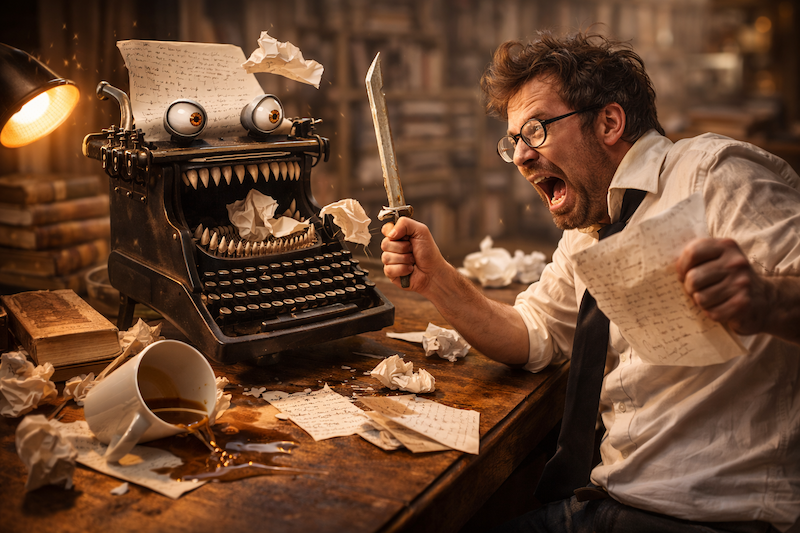
Workshop advice: kill your darlings.

Killed my darling. Favorite paragraph. Gone.

Darling came back. Chapter 7. Brought friends.

Now they're plotting against the protagonist.

I didn't write this scene.

Article Feb 13, 03:14 AM

Every Author You Admire Is Lying About How They Write

Here's a dirty little secret the literary world doesn't want you to know: almost every famous author has lied about their writing process. Not exaggerated. Not embellished. Lied. That romantic image of Hemingway standing at his typewriter at dawn, fueled by nothing but black coffee and masculine determination? Half-fiction. That story about Maya Angelou renting a hotel room and writing from 6 AM to 2 PM like clockwork? Carefully curated mythology. Writers are, by profession, the best liars on the planet — and their favorite fiction isn't in their novels. It's in their interviews.

Let's start with the biggest whopper of them all: "I write every single day." This is the commandment carved into every writing advice book ever published, and roughly ninety percent of the authors who preach it don't actually follow it. Stephen King famously claims he writes 2,000 words a day, every day, including Christmas and his birthday. And maybe he does — now. But King himself has admitted that during the 1980s, he was so deep in cocaine and alcohol addiction that entire novels were written in blackout states. He doesn't even remember writing "Cujo." Every. Single. Day. Sure, Steve.

Then there's the "I don't use outlines" lie. Pantsers — writers who claim to fly by the seat of their pants — love to present themselves as wild creative spirits channeling stories directly from the muse. George R.R. Martin calls himself a "gardener" rather than an "architect." He just plants seeds and watches them grow, he says. Which sounds lovely until you realize the man has been stuck on "The Winds of Winter" for over a decade. Maybe a little architecture wouldn't hurt, George. Meanwhile, J.K. Rowling — who sometimes gets lumped into the pantser camp — actually created elaborate spreadsheets tracking every subplot, timeline, and character arc across all seven Harry Potter books. The spreadsheet photos leaked online. They look like a NASA mission control document. So much for divine inspiration.

The "I never revise" myth is perhaps the most destructive lie in literary history. Jack Kerouac built his entire legend on the claim that he wrote "On the Road" in a three-week Benzedrine-fueled frenzy on a single continuous scroll of paper. One draft. Pure spontaneous prose. It became the foundational myth of Beat Generation writing. There's just one problem: it's nonsense. Kerouac had been working on the novel in various forms since 1948 — three full years before the famous scroll session in 1951. And after that legendary sprint? He revised it extensively. His editors revised it more. The scroll itself was a rewrite of material he'd already drafted in notebooks. The "first thought, best thought" philosophy was marketing, not method.

Next up: the drinking lie. Oh, how writers love to romanticize alcohol. Hemingway's famous quote — "Write drunk, edit sober" — has been printed on more coffee mugs than any actual line from his books. There's just one inconvenient fact: Hemingway never said it. The quote is completely fabricated, likely originating from a Peter De Vries novel. And Hemingway himself was quite clear that he never drank while writing. "Jeezus Christ! Have you ever heard of anyone who drank while he worked?" he wrote in a letter to Harvey Breit in 1950. The man who became the patron saint of boozy writing was actually disciplined and sober at his desk. Fitzgerald, Faulkner, Dorothy Parker — they all drank heroically, but their best work was almost universally produced during periods of relative sobriety. The alcohol was the disease. The writing happened despite it, not because of it.

The "morning person" fabrication deserves its own wing in the Museum of Literary Lies. Every other Paris Review interview features some author claiming they rise at 5 AM, greet the dawn with gratitude, and produce their masterwork before the rest of the world has had breakfast. Haruki Murakami says he wakes at 4 AM and writes for five to six hours. Toni Morrison said she watched the sunrise and began writing. It creates this aspirational image that makes every night-owl writer feel like a failure. But Franz Kafka wrote almost exclusively at night, usually from 11 PM to 3 AM, after working a full-time insurance job during the day. Gustave Flaubert was a night writer. So was Marcel Proust, who rarely surfaced before 3 PM. Some of the greatest literature ever written was produced by people who would have failed every productivity guru's morning routine challenge.

Then there's the false modesty lie — the "oh, it just came to me" routine. Coleridge claimed that "Kubla Khan" appeared to him complete in an opium dream, and he merely transcribed it upon waking before being interrupted by the infamous "person from Porlock." Literary scholars have largely concluded this is theatrical nonsense. Surviving manuscripts show evidence of careful composition and revision. The "person from Porlock" was likely an invention to excuse the fact that Coleridge simply couldn't figure out how to end the poem. It's the 18th-century equivalent of saying your dog ate your homework.

The "I don't read reviews" lie is so universal it's practically an industry standard. Every author in every interview says they don't read their reviews. They're above it. They don't need external validation. They write for themselves. This is, with almost no exceptions, a bald-faced lie. Norman Mailer once headbutted Gore Vidal at a party partly over a bad review. Hemingway threatened to beat up critics. Jonathan Franzen publicly feuded with reviewers for years. These are not people who don't read their reviews. Writers read every single review, every Goodreads comment, every tweet. They Google themselves at 2 AM like the rest of us. They just know they're not supposed to admit it.

The "writing is suffering" performance is perhaps the most profitable lie of all. Authors love to describe writing as agonizing, torturous, soul-destroying labor. "There is nothing to writing," said attributed-to-everyone journalist Red Smith. "All you do is sit down at a typewriter and open a vein." This theatrical suffering serves a purpose: it makes writing seem heroic and justifies the occasionally terrible pay. But plenty of great writers have admitted they actually enjoy it. Anthony Trollope wrote with the cheerful regularity of a banker going to work. P.G. Wodehouse described writing as essentially playing. Terry Pratchett called it the most fun you could have by yourself. The suffering narrative sells books and sympathy. The reality is that many writers write because it genuinely feels good — but that's a much less interesting story to tell at a literary festival.

So why do writers lie about their habits? Because they're building brands. The tortured genius. The disciplined monk. The wild bohemian. These are characters, as carefully constructed as any in their novels. The writing process is messy, inconsistent, boring, and deeply unglamorous. It involves a lot of staring at walls, eating crackers over your keyboard, and googling strange forensic questions at 3 AM while your spouse eyes you nervously. That doesn't look good on a book jacket.

Here's the truth that no one puts on a coffee mug: there is no correct way to write. There is no magic morning hour, no ideal number of daily words, no proper ratio of outlining to improvisation. The only real writing habit that matters is the one nobody wants to talk about because it's crushingly boring — you sit down, you struggle, you produce something mediocre, you fix it, and you repeat this hundreds of times until you have a book. Everything else is mythology.

And the next time your favorite author tells you they write 2,000 words before breakfast without ever looking at a review? Smile, nod, and remember: they're professional fiction writers. They never really stop working.

Joke Feb 2, 07:32 AM

The Perfect Villain

'Your villain needs motivation.' Added tragic backstory. 'Too sympathetic now.' Made him kick a dog. 'Too obvious.' Fine. He collects NFTs. Perfect villain. No notes.

Article Feb 7, 12:16 AM

The Bestseller Formula: A $28 Billion Lie the Publishing Industry Sells Itself

Every year, some data scientist or retired editor publishes a book claiming they've cracked the code — the secret recipe for a bestseller. Plug in a female protagonist, add a dash of trauma, sprinkle some short chapters, and boom: you're the next Gillian Flynn. There's just one problem. If the formula worked, publishers wouldn't reject 99% of manuscripts. And yet they do. Spectacularly.

The uncomfortable truth is that the publishing industry has a worse prediction record than a coin flip. The same houses that passed on Harry Potter twelve times now spend millions on algorithmic tools promising to identify the next big thing. Let that sink in for a moment: the people whose literal job it is to spot winners couldn't recognize the most profitable book franchise in human history when it landed on their desks. Twelve times.

But the formula-mongers persist. In 2016, Jodie Archer and Matthew Jockers published "The Bestseller Code," claiming their algorithm could predict bestsellers with 80% accuracy. Sounds impressive until you realize that if you simply predicted "this book will NOT be a bestseller" for every single book published, you'd be right about 99.5% of the time. Their algorithm was actually performing worse than pessimism. That's not cracking the code — that's expensive coin-flipping with a PhD attached.

The formula crowd loves to point at patterns. Short chapters sell! (Tell that to Donna Tartt, whose 800-page "The Goldfinch" won a Pulitzer and sold millions.) Relatable protagonists are key! (Humbert Humbert from "Lolita" would like a word — he's a literal monster, and Nabokov's novel is one of the most celebrated books of the twentieth century.) Write what you know! (Tolkien, famously, had never been to Middle-earth. Shocking, I know.)

Here's my favorite bit of formula mythology: the idea that you need a "hook" in the first page or readers will abandon you. Ernest Hemingway opened "A Farewell to Arms" with a description of dust on leaves. Tolstoy started "Anna Karenina" with an aphorism about happy families that has absolutely nothing to do with trains. Gabriel García Márquez began "One Hundred Years of Solitude" by telling you about ice. Ice! These openings break every rule in every "How to Write a Bestseller" seminar, and they're among the most successful novels ever written.

The real problem with the bestseller formula is that it confuses correlation with causation — the cardinal sin of anyone trying to reverse-engineer success. Yes, many bestsellers have certain features in common. Many bestsellers also have covers. Many bestsellers are printed on paper. The presence of shared features doesn't mean those features caused the success. This is like studying billionaires, noticing they all wear shoes, and concluding that shoes make you rich.

Consider the case of "Fifty Shades of Grey." No formula on earth would have predicted that Twilight fan fiction about BDSM, written in prose that made English teachers weep, would sell 150 million copies. Or that a Norwegian philosophy professor's novel about a girl receiving letters from a mysterious philosopher — "Sophie's World" by Jostein Gaarder — would become a global phenomenon. Or that a 1,079-page novel by an unknown writer about a tennis academy and a halfway house — David Foster Wallace's "Infinite Jest" — would become a generation's literary totem. These books have nothing in common except their total disregard for formulas.

The publishing industry's dirty secret is that bestsellers are, at their core, black swan events. Nassim Nicholas Taleb would have a field day with this industry. The distribution of book sales follows a brutal power law: a tiny fraction of titles generate the vast majority of revenue. In any given year, about 500 titles account for more than half of all trade book sales in the United States. That's 500 out of roughly 4 million titles published annually. You have better odds at some casino tables.

So why does the formula myth persist? Because it's comforting. Writing a book is an act of insane optimism — you're spending months or years of your life creating something that statistically almost nobody will read. The formula gives aspiring writers the illusion of control. Follow these seven steps, and you too can quit your day job. It's the literary equivalent of a get-rich-quick scheme, and it preys on the same human weakness: the desperate desire to believe that success is predictable and reproducible.

There's also a cynical business angle. The "how to write a bestseller" industry is itself a bestseller industry. James Patterson's MasterClass, countless writing seminars, shelves of craft books — all selling the dream that the code can be cracked. The irony is thick enough to choke on: the most reliable way to make money from the bestseller formula is to sell the formula, not to use it.

Now, does this mean that craft doesn't matter? Of course not. A well-structured story with compelling characters and clean prose has a better shot than an incoherent mess. But that's not a formula — that's just competence. The difference between a competent book and a bestseller is the difference between a competent singer and Freddie Mercury. You can teach technique. You cannot teach lightning.

What actually makes a bestseller? Timing. Cultural mood. Dumb luck. Word of mouth that catches fire for reasons nobody can predict or replicate. The right book landing in the right hands at the right moment. "Gone Girl" succeeded not because it followed a formula but because it arrived at a cultural moment when readers were hungry for stories about the darkness lurking inside marriages. "The Da Vinci Code" exploded because it combined conspiracy theories with religious controversy at a time when both were in the cultural water supply. You can't engineer these conditions. You can only stumble into them.

So here's my advice, worth exactly what you're paying for it: stop looking for the formula. Write the weird book. Write the book that doesn't fit neatly into a genre. Write the book that your MFA workshop would tear apart. Because the only books that have ever truly mattered — the ones that endured, the ones that changed how we see the world — were written by people who didn't give a damn about formulas. They were too busy being interesting to be strategic. And that, maddeningly, is the only pattern worth noticing.

Joke Feb 2, 02:31 AM

The Genre Accuracy Problem

"Your murder mystery needs work."

"What's wrong?"

"The detective solved it on page 3."

"He's competent."

"That's not the genre."

"So I should make him stupid?"

"Make him thorough. 300 pages of thorough."

Article Feb 6, 10:05 AM

How to Write Sex Scenes Without Looking Like an Idiot: A Brutally Honest Guide

Every year, the Literary Review hands out the Bad Sex in Fiction Award, and every year, established authors line up to collect their trophy of shame. Norman Mailer won it. John Updike got nominated. Even Sebastian Faulks took home the dubious honor. These aren't amateurs—they're literary giants who somehow forgot how to write the moment clothes started coming off.

So what's the secret? How do you write about the most universal human experience without sounding like a Victorian medical textbook crossed with a teenager's diary? I've read enough terrible sex scenes to fill a very uncomfortable library, and I've distilled it down to advice you can actually use.

**Rule One: Stop Calling Body Parts by Weird Names**

Let's address the elephant in the bedroom. The moment you write "his throbbing member" or "her heaving bosom," you've lost the reader. They're not turned on—they're laughing. Or cringing. Probably both. The 2008 Bad Sex Award went to a passage describing genitalia as a "shuddering, ejaculating column." Read that aloud. Now imagine your grandmother reading it. See the problem?

Here's the thing: you don't need elaborate euphemisms. You don't need clinical terminology either. D.H. Lawrence understood this in 1928 with "Lady Chatterley's Lover"—he used direct, honest language and got banned for it. The book became a bestseller precisely because it treated sex like a natural part of human existence, not a linguistic obstacle course.

**Rule Two: Character First, Gymnastics Second**

The best sex scenes aren't really about sex. They're about what happens between people emotionally. Take Ian McEwan's "On Chesil Beach"—the wedding night scene is devastating not because of what happens physically, but because of what doesn't happen between two people who can't communicate.

Before you write a single sensual sentence, ask yourself: What does this scene reveal about my characters? Are they vulnerable? Powerful? Desperate? Bored? If your answer is "nothing, they're just having sex," then congratulations—you've written pornography. Which is fine, but it's not literature, and it probably won't be very interesting either.

**Rule Three: Less Is Almost Always More**

Hemingway never wrote explicit sex scenes. Neither did most of the greats before 1960. Yet their books crackle with sexual tension. The ending of "A Farewell to Arms," the hotel scenes in "The Sun Also Rises"—you know exactly what's happening without anyone describing tab A entering slot B.

Consider this: in Gabriel García Márquez's "Love in the Time of Cholera," there's a scene where Florentino finally consummates his decades-long love affair. Márquez gives us emotional devastation, not anatomical inventory. The reader fills in the physical details themselves, which makes it infinitely more powerful than any description could be.

**Rule Four: Avoid the Choreography Trap**

Nothing kills a sex scene faster than turning it into an IKEA instruction manual. "He moved his left hand to her right shoulder while simultaneously shifting his weight to his knees" reads like you're assembling furniture, not making love. Your reader doesn't need a blow-by-blow (pun intended) account of every movement.

John Updike, despite his nominations for Bad Sex, actually understood this in his best work. In "Rabbit, Run," the sex scenes work because they focus on sensation and emotion, not mechanics. It's when he got older and more experimental that things went sideways.

**Rule Five: Context Matters More Than Content**

A sex scene in a thriller serves a different purpose than one in a romance novel. In James Ellroy's noir fiction, sex is often violent, transactional, desperate—because that's the world his characters inhabit. In romance, it's meant to be the emotional climax (again, pun intended) of a relationship arc. Writing the wrong type of scene for your genre is like wearing a tuxedo to a beach party.

Anne Rice, writing erotica as A.N. Roquelaure, understood genre expectations perfectly. Her "Sleeping Beauty" trilogy is explicit because it's meant to be. When she wrote her vampire novels under her own name, the sensuality was present but more restrained. Different books, different rules.

**Rule Six: Humor Is Your Secret Weapon**

Here's something most writing guides won't tell you: sex is frequently awkward, funny, and ridiculous. Bodies make strange noises. People say stupid things. Someone's arm falls asleep at the worst possible moment. If your sex scenes are all perfectly choreographed encounters with no awkwardness, they'll feel fake.

Nicholson Baker's "Vox," an entire novel about phone sex, works because it acknowledges the absurdity of the situation. The characters laugh, they get embarrassed, they make jokes. That's realistic. That's human. That's what separates genuine intimacy from fantasy.

**Rule Seven: Read It Out Loud**

This is the simplest and most effective test. Read your sex scene aloud. If you can't get through it without laughing, blushing, or wanting to set your manuscript on fire, revise it. If it sounds like something you'd hear in a bad movie from 1985, revise it. If you wouldn't be comfortable reading it at a literary event with your mother in the audience... well, that one's actually okay. But you should at least be able to read it with a straight face.

**The Final Truth**

Here's what nobody tells you about writing sex scenes: they're hard because they require vulnerability from the writer. You're exposing not just your characters but yourself—your understanding of intimacy, your attitudes toward bodies, your ability to write about something deeply personal without hiding behind jokes or purple prose.

The writers who do it well—Toni Morrison, Michael Ondaatje, Jeanette Winterson—aren't thinking about shocking readers or titillating them. They're thinking about truth. About what happens when two people are physically close and emotionally exposed.

So here's my final advice: write the scene that your story needs, not the scene you think readers expect. Be honest. Be brave. And for the love of all that is literary, never, ever use the word "moist" unless you're describing cake.

Joke Feb 1, 08:32 AM

The Literal Hook Problem

"Your opening needs a hook."

Added hook.

"Not a literal— why is chapter one entirely about fishing?"

"You said hook."

"Metaphorical hook."

"Page two is about metaphors. Also fishing metaphors."

Article Feb 5, 12:17 AM

Kill Your Darlings: Why Your Most Brilliant Scenes Are Secretly Destroying Your Book

That scene you've polished until it gleams like a diamond? The one you read aloud to friends at dinner parties? The passage that made you think, 'Finally, I've written something truly magnificent'? It needs to die. I know this hurts. I know you're already composing an angry response about how I don't understand your artistic vision. But here's the uncomfortable truth that every professional writer eventually learns: the scenes we love most are often the ones sabotaging our work.

The phrase 'kill your darlings' gets thrown around writing circles like confetti at a wedding, but few people know its origin. It's commonly attributed to William Faulkner, but the real culprit was Arthur Quiller-Couch, a Cambridge professor who wrote in 1914: 'Whenever you feel an impulse to perpetrate a piece of exceptionally fine writing, obey it—whole-heartedly—and delete it before sending your manuscript to press.' Notice he didn't say 'consider deleting' or 'maybe think about trimming.' He said delete. Period. The man wasn't mincing words.

So why do our best scenes betray us? Here's the dirty secret: when we write something we consider brilliant, we unconsciously build a shrine around it. The rest of the manuscript starts orbiting this golden passage like planets around the sun. We contort our plot to justify its existence. We slow the pacing to give readers time to properly appreciate our genius. We become architects designing an entire building just to house one fancy chandelier. Stephen King cut his favorite scene from 'The Stand'—a lengthy, beautifully written piece about a character's journey through the Lincoln Tunnel. Why? Because no matter how gorgeous the prose, it stopped the story dead. The book was 1,200 pages, and King recognized that even masterful writing must serve the narrative, not the author's ego.

Let me give you a practical test. Take your favorite scene—yes, that one—and ask yourself three brutal questions. First: if you removed this scene entirely, would the plot still make sense? If yes, you have a problem. Second: does this scene exist primarily to showcase your writing skills rather than advance character or story? Be honest. Third: did you spend more time revising this scene than any other of similar length? Excessive polishing is often a red flag that you're protecting something that doesn't deserve protection.

F. Scott Fitzgerald provides the perfect cautionary tale. His original manuscript for 'The Great Gatsby' contained a scene where Nick Carraway attended a elaborate party that Fitzgerald considered his finest work to date. His editor, Maxwell Perkins, suggested cutting it. Fitzgerald reportedly agonized for weeks before finally agreeing. The published novel is 47,000 words of precision—every scene earns its place. That 'brilliant' party scene? Nobody misses it because nobody knows it existed. The book became a masterpiece partly because Fitzgerald trusted his editor over his ego.

Here's what happens psychologically when we write something we love: our brain releases dopamine, creating a pleasure association with that specific passage. We literally become addicted to our own words. Every time we reread that scene, we get another little hit. This is why writers will fight to the death over keeping a paragraph that objectively damages their work. We're not defending art—we're defending our drug supply. Recognizing this pattern is the first step toward recovery.

The practical advice nobody wants to hear: create a 'darlings graveyard.' Every time you cut a beloved scene, paste it into a separate document. This psychological trick works wonders because you're not really killing anything—you're just relocating it. Tell yourself you might use it later, in another project. You probably won't, but the lie makes deletion bearable. I have a file with 40,000 words of 'brilliant' cuts from various projects. I've never retrieved a single sentence. But knowing they exist somewhere lets me sleep at night.

Raymond Carver's editor, Gordon Lish, famously cut up to seventy percent of some stories. Carver's reaction? He hated it initially, then grudgingly admitted the work was stronger. The minimalist style that made Carver famous wasn't entirely his creation—it emerged from aggressive editing. His 'darlings' included lengthy backstories, elaborate metaphors, and detailed descriptions. What remained was sharp, devastating, unforgettable. Sometimes the best version of your work exists underneath all that writing you're so proud of.

Now, I'm not suggesting you delete everything you love. That way lies creative paralysis and joyless prose. The goal isn't to punish yourself for writing well—it's to develop the judgment to distinguish between scenes that serve the story and scenes that serve your ego. A truly great scene makes readers forget they're reading. A 'darling' makes readers admire the writer. Feel the difference? One pulls you into the narrative; the other pulls you out to appreciate the craftsman's hand. Both might contain beautiful sentences, but only one belongs in your book.

Here's your homework, and I want you to actually do this, not just nod and forget. Print your current project. Yes, on paper, like a caveman. Read it with a red pen, marking every scene that makes you think, 'Damn, I'm good.' Those marks are your hit list. Not all of them need to die, but each one needs to justify its existence beyond 'I worked really hard on this' or 'This is my favorite part.' The scenes that survive this interrogation will be stronger for having been questioned. The ones that don't? They were always going to hold you back.

The hardest lesson in writing isn't learning to create beauty—it's learning to sacrifice it. Every professional writer has a story about the scene they mourned, the passage they still remember fondly, the darling they killed despite loving it desperately. And every single one will tell you the same thing: the book was better for it. Your attachment to a scene is not evidence of its quality. Sometimes it's evidence of the opposite. The willingness to cut what you love most separates amateurs from professionals, hobbyists from artists. So sharpen your knife, pour yourself a drink, and start killing. Your book is waiting to become what it's meant to be—and it can't do that while you're busy protecting your ego.

Joke Jan 31, 10:02 AM

The Darlings Came Back

"Kill your darlings," they said.

I did. Chapter 4, chapter 7, chapter 12. Three beautiful sentences, gone.

They came back in chapter 15. Together. With demands.

"We want healthcare," said the first.

"And a pension," said the second.

"Also, you misspelled 'occurred' on page 89," said the third.

I gave them their own chapter. It's the best one now.

Nothing to read? Create your own book and read it! Like I do.

Create a book
1x

"Write with the door closed, rewrite with the door open." — Stephen King