Content Feed

Discover interesting content about books and writing

Article Feb 13, 07:18 PM

Why Your First Draft Is Garbage — And Why Every Great Writer Knew It

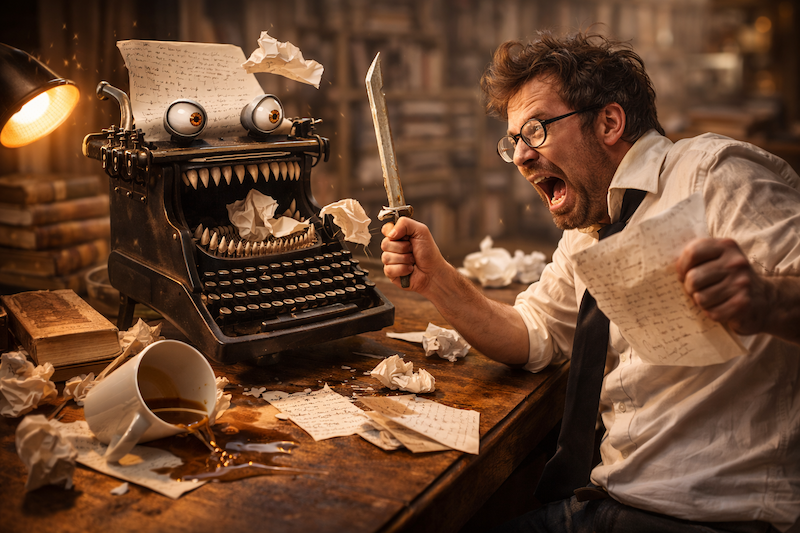
Here's a dirty little secret the writing industry doesn't want you to know: every single masterpiece you've ever loved started as hot garbage. That pristine prose on your bookshelf? It was once a mess of crossed-out sentences, half-baked ideas, and paragraphs that made their authors physically cringe. Hemingway said it best — and he didn't mince words — 'The first draft of anything is shit.' Not 'could use improvement.' Not 'needs a little polish.' Shit. And if Papa Hemingway's first drafts were terrible, what makes you think yours should be any different?

Let me tell you about Leo Tolstoy. The man wrote War and Peace — one of the greatest novels in human history, a book that has humbled readers and writers for over 150 years. Do you know how many drafts it took? His wife, Sophia, hand-copied the entire manuscript seven times. Seven. That's roughly 1,500 pages, multiplied by seven, copied by hand with a quill pen. The first draft of War and Peace wasn't War and Peace. It was a sprawling, unfocused mess called 'The Year 1805,' and Tolstoy himself described early versions as embarrassing. So the next time you look at your shaky first attempt and want to throw your laptop out the window, remember: Tolstoy felt the same way, and he had a countess doing his secretarial work.

The cult of the first draft is one of the most toxic myths in writing. Somewhere along the way, we started believing that real writers sit down and genius just flows out of them like water from a tap. That Mozart composed symphonies in one sitting. That Kerouac typed On the Road in three weeks on a single scroll of paper and never looked back. Here's the thing about that Kerouac story — it's mostly nonsense. Yes, he typed a version in April 1951 on a continuous scroll of paper. But he'd been working on the material in notebooks for three years before that. And after the scroll? Six more years of revisions before it was published in 1957. The 'spontaneous' masterpiece was nearly a decade in the making.

Raymond Carver, the master of the American short story, had his work so heavily edited by Gordon Lish that scholars still argue about who actually wrote those spare, devastating sentences. Carver's first drafts were often twice as long as the published versions. Lish would slash and burn, cutting sometimes 70 percent of the text. Carver's original draft of 'What We Talk About When We Talk About Love' was a completely different beast — longer, softer, more explanatory. Lish carved it into a diamond. The first draft was the raw stone; the editing was the craft.

And then there's F. Scott Fitzgerald. The Great Gatsby — 180 pages of pure, distilled American perfection. Fitzgerald's editor, Maxwell Perkins, received a first draft that was, by Fitzgerald's own admission, 'a mess.' Fitzgerald then rewrote the entire novel, restructuring the chronology, cutting characters, and rewriting the ending multiple times. The iconic last line — 'So we beat on, boats against the current, borne back ceaselessly into the past' — didn't exist in the first draft. It was born in revision. The most quoted sentence in American literature was an afterthought.

So why do we torture ourselves over first drafts? Because we confuse the process with the product. We see the finished book on the shelf and assume it arrived fully formed. We don't see the seventeen versions in the recycling bin. We don't see Dostoevsky gambling away his advance and then dictating The Gambler in twenty-six days to a stenographer because he was desperate for money — and then spending months fixing the mess. We don't see the panic, the self-doubt, the three a.m. rewrites fueled by cold coffee and existential dread.

Here's what a first draft actually is: it's a conversation with yourself. You're figuring out what you want to say. You're laying bricks — ugly, uneven, sometimes cracked — but you're building a wall. You can't sand and paint a wall that doesn't exist. Anne Lamott, in her brilliant book Bird by Bird, calls them 'shitty first drafts' and insists that every writer she knows produces them. Not most writers. Every writer. The difference between a published author and someone with an abandoned manuscript in a drawer isn't talent — it's the willingness to go back and do the brutal, unglamorous work of rewriting.

The editing process is where the actual magic happens. It's not sexy. Nobody writes inspirational quotes about the fourth revision. But consider this: Michael Crichton rewrote Jurassic Park from scratch after his editor told him the original version didn't work. Not a light revision — he threw it out and started over. Stephen King, in On Writing, recommends cutting your first draft by at least ten percent. He calls it 'killing your darlings,' a phrase originally attributed to Arthur Quiller-Couch in 1914. You write the beautiful sentence, the clever metaphor, the brilliant aside — and then you murder it because it doesn't serve the story. That's editing. That's the job.

The real danger isn't writing a bad first draft. The real danger is never writing one at all. Perfectionism is procrastination wearing a tuxedo. It looks respectable, even admirable — 'Oh, I just have such high standards' — but the result is the same: nothing gets written. You stare at the blank page, paralyzed by the gap between the masterpiece in your head and the clumsy words on the screen. Meanwhile, the writers who actually finish books? They've made peace with being terrible. They've embraced the garbage. They know that you can fix a bad page, but you can't fix a blank one.

There's a famous story about a ceramics teacher who divided his class into two groups. One group would be graded on quantity — the more pots they made, the higher the grade. The other would be graded on quality — they just had to make one perfect pot. At the end of the semester, the best pots came from the quantity group. By making pot after pot, they learned, improved, and accidentally produced excellence. The quality group spent the whole semester theorizing about the perfect pot and produced mediocre work. Writing is the same. Your first draft is pot number one. It's supposed to be lumpy.

So here's my challenge to you, whoever you are, wherever you are in your writing: write the terrible first draft. Write the scene that makes you wince. Write the dialogue that sounds wooden. Write the description that's cliché and overwrought and would make your writing teacher weep. Get it all out. Because buried in that mess — in between the bad metaphors and the plot holes and the characters who all sound suspiciously like you — there are sparks. There are moments of genuine truth. And those moments are what you'll build on in draft two, three, four, and seven.

The first draft isn't the book. It never was. It's the raw ore you pull from the mine — dirty, rough, full of rock and sediment. The book is what emerges after you smelt it, hammer it, shape it, and polish it until it gleams. Every great writer in history has known this. The only question is whether you'll trust the process long enough to discover it yourself. Now stop reading articles about writing, open that document, and go make some beautiful garbage.
Article Feb 13, 04:28 PM

Hemingway Wrote Drunk, Rewrote Sober — and So Should You

Here's a dirty little secret the publishing industry doesn't want you to know: every masterpiece you've ever loved started as hot garbage. That pristine prose you worship? It was once a steaming pile of crossed-out sentences, coffee-stained pages, and existential dread. Hemingway said the first draft of anything is shit. He wasn't being humble — he was being clinical. And if Papa Hemingway's first drafts were trash, what makes you think yours should be any different?

Let's get one thing straight before we go any further. Your first draft is supposed to be bad. Not mediocre. Not rough-around-the-edges. Bad. Spectacularly, gloriously, embarrassingly bad. The sooner you accept this, the sooner you'll actually finish writing something. Because right now, I'd bet money you're stuck on page three of a novel you started two years ago, endlessly polishing a paragraph that doesn't matter yet.

Consider Tolstoy. The man rewrote War and Peace — all 1,225 pages of it — seven times. His wife Sophia hand-copied the entire manuscript each time, because photocopiers weren't exactly an option in the 1860s. Seven drafts. That means the first six versions of one of the greatest novels ever written were, by Tolstoy's own ruthless standards, not good enough. Draft one? Probably unrecognizable. And this was a genius. A titan of literature. A man whose sentences could make you weep. Even he needed seven swings at it.

Or take Fitzgerald and The Great Gatsby. The original title was "Trimalchio in West Egg." Let that sink in. One of the most iconic titles in American literature almost got saddled with a name that sounds like an Italian restaurant in the Hamptons. Fitzgerald's editor, Maxwell Perkins, talked him out of it. The early drafts were bloated, unfocused, and missing the precise economy of language that makes the final version sing. Fitzgerald slashed, restructured, rewrote entire chapters. The Gatsby you know was sculpted from a much uglier block of marble.

Here's where it gets interesting from a psychological standpoint. There's a phenomenon called the "inner critic" — that nasty little voice in your head that tells you every sentence is wrong the moment you type it. Neuroscience actually backs this up. Research from the University of Greifswald found that experienced writers literally suppress their dorsolateral prefrontal cortex — the brain's editing center — when drafting. They let the creative regions run wild and save the judgment for later. Novice writers? They keep the editor switched on the entire time, which is like trying to drive a car with one foot on the gas and the other on the brake. You'll burn out the engine and go nowhere.

Raymond Carver, the master of minimalist fiction, had a secret weapon: his editor Gordon Lish. Lish didn't just tweak Carver's stories — he gutted them. He cut "What We Talk About When We Talk About Love" by over fifty percent. Whole paragraphs, characters, subplots — gone. Some literary scholars argue Lish essentially co-authored Carver's most famous work. Controversial? Absolutely. But it proves a point: the magic isn't in the first draft. It's in the cutting room.

Now, I can already hear the objections. "But what about Kerouac? He wrote On the Road on a single scroll in three weeks!" Yeah, about that. First, Kerouac spent seven years taking notes, journaling, and mentally composing the book before that famous scroll session. Second, the scroll draft wasn't the published version. Viking Press made him revise it significantly. The myth of the spontaneous masterpiece is exactly that — a myth. Even the Beats, those champions of raw, unfiltered expression, edited their work.

Stephen King, in his memoir On Writing, describes the first draft as writing with the door closed. It's just you and the story. No audience, no expectations, no pressure. The second draft is writing with the door open — that's when you let the world in, when you start thinking about readers, clarity, pacing. King typically cuts ten percent of his word count between drafts. For a guy who writes eight-hundred-page novels, that's eighty pages hitting the trash. And King writes fast. He's prolific. He's confident. Even he knows the first pass isn't the finished product.

The real danger isn't writing a bad first draft. The real danger is perfectionism — the silent killer of more novels than writer's block ever was. Perfectionism is seductive because it masquerades as high standards. "I just want it to be good," you tell yourself, as you rewrite the opening sentence for the fortieth time. But perfectionism isn't about quality. It's about fear. Fear of judgment, fear of failure, fear of putting something imperfect into a world that's already drowning in content. And that fear will paralyze you if you let it.

Anne Lamott nailed this in her classic Bird by Bird when she coined the term "shitty first drafts." She wrote: "All good writers write them. This is how they end up with good second drafts and terrific third drafts." Lamott wasn't giving permission to be lazy. She was giving permission to be human. Because the alternative — demanding perfection on the first try — isn't ambition. It's delusion.

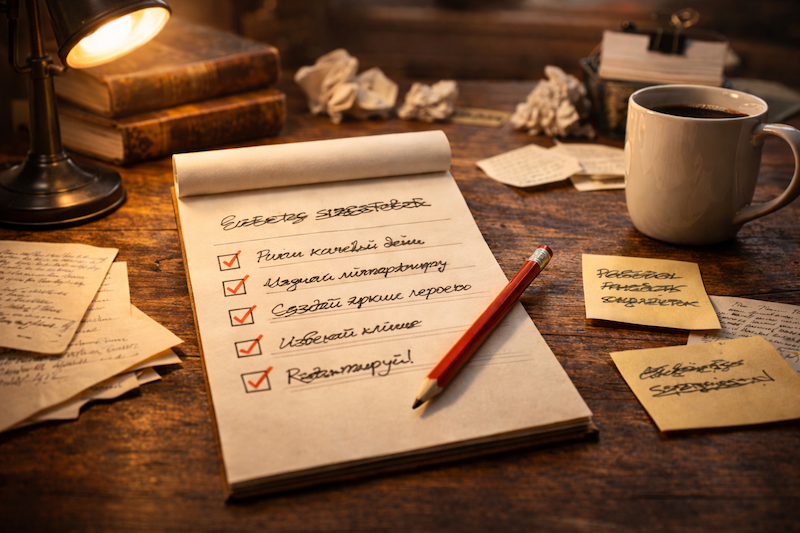
Let me give you a practical framework. Draft one is for you. It's the discovery phase. You're figuring out what the story is actually about, who the characters really are, where the plot actually wants to go. Half your outline will prove useless. Characters you planned as minor will demand center stage. Scenes you thought were crucial will feel dead on arrival. That's normal. That's the process working exactly as it should.

Draft two is for structure. Now you know what you've got, and you can start shaping it. Move scenes around. Cut the dead weight. Strengthen the through-line. This is where a book starts to look like a book instead of a fever dream transcription.

Draft three is for language. Now — and only now — do you start worrying about individual sentences, word choice, rhythm, the music of prose. Polishing words before you've locked down the structure is like choosing curtains for a house that doesn't have walls yet.

So here's my challenge to you. Go write something terrible today. Seriously. Open a document and let it rip. Write the worst, most clichéd, most structurally unsound thing you can. Give yourself permission to be embarrassingly bad. Because behind every polished masterpiece on your bookshelf sits a graveyard of awful first drafts — and the only difference between those published authors and you is that they had the guts to write the garbage first, and the patience to fix it after.

Joke Jan 31, 10:02 AM

The Darlings Came Back

"Kill your darlings," they said.

I did. Chapter 4, chapter 7, chapter 12. Three beautiful sentences, gone.

They came back in chapter 15. Together. With demands.

"We want healthcare," said the first.

"And a pension," said the second.

"Also, you misspelled 'occurred' on page 89," said the third.

I gave them their own chapter. It's the best one now.

Article Feb 13, 08:13 AM

Why Your First Draft Is Garbage — And Why Every Great Writer Knew It

Here's a dirty secret the publishing industry doesn't advertise on its dust jackets: every masterpiece you've ever loved started as hot garbage. That pristine prose you underlined in Hemingway? He rewrote the ending of A Farewell to Arms 47 times. Forty-seven. When asked what the problem was, he said, "Getting the words right." Not the plot. Not the theme. The words. If the man who defined 20th-century American literature couldn't nail it on the first try, what makes you think your NaNoWriMo draft should be any different?

Let's get uncomfortable for a moment. Your first draft is terrible. Mine is terrible. Donna Tartt's first draft of The Secret History was terrible — and she spent ten years turning it into something that wasn't. The sooner you accept this, the sooner you stop staring at a blinking cursor, paralyzed by the fantasy that real writers produce gold on the first pass. They don't. They produce mud. The gold comes later, from the refining.

Tolstoy rewrote War and Peace — all 1,225 pages of it — seven times. His wife, Sophia, copied the entire manuscript by hand each time because typewriters weren't exactly Amazon Prime deliveries in 1860s Russia. Seven drafts of the longest novel most people pretend to have read. Tolstoy's first version reportedly had a completely different opening, different character arcs, and at one point Pierre Bezukhov was barely in it. Imagine War and Peace without Pierre. That's what a first draft gets you: a book without its own protagonist.

Raymond Carver, the king of minimalism, the guy whose sentences feel like they were carved from stone with a scalpel — his editor, Gordon Lish, sometimes cut 70% of his stories. Seventy percent. Carver would submit a story, and Lish would return it looking like a crime scene, red ink everywhere. "What We Talk About When We Talk About Love" was originally twice as long and had a completely different title. The first draft wasn't just rough; it was practically a different piece of literature. The editing process didn't polish the story — it created it.

And that's the thing nobody tells you about the writing process: the first draft isn't writing. It's thinking out loud. It's you, fumbling in the dark, trying to figure out what you actually want to say. Anne Lamott called them "shitty first drafts" in her legendary craft book Bird by Bird, and she wasn't being cute. She meant it literally. The purpose of a first draft is not to be good. Its purpose is to exist. You can't edit a blank page. You can edit garbage.

Consider F. Scott Fitzgerald. The Great Gatsby — arguably the most perfectly constructed American novel — went through massive revisions. Fitzgerald's original title was "Trimalchio in West Egg," which sounds like an Italian restaurant on Long Island. His editor, Maxwell Perkins, essentially talked him out of a mediocre book and into a masterpiece. The first draft had Gatsby's backstory dumped into the opening chapters like a Wikipedia article. Perkins pushed Fitzgerald to scatter it, to create mystery, to let the reader discover Gatsby the way Nick does. That brilliant structural choice? It wasn't in the draft. It was in the editing.

Here's where it gets even more interesting. Research in cognitive psychology actually backs this up. A 2018 study published in Cognitive Science found that creative ideas improve significantly through iterative revision. The brain's initial output tends to rely on obvious associations — clichés, tropes, the first thing that comes to mind. It's only through repeated passes that writers access deeper, more original connections. Your first draft is your brain's lazy answer. The good stuff is buried underneath, and you have to dig for it.

So why do so many aspiring writers treat their first draft like it should be their final one? Because our culture worships the myth of effortless genius. Mozart composing symphonies in his head. Kerouac typing On the Road on a single scroll of paper in three weeks. Except Mozart's manuscripts are full of corrections and crossed-out passages. And Kerouac? He'd been writing and rewriting the material for years before that famous typing marathon. The scroll was a performance, not a process. The real work happened in notebooks, in letters, in drafts nobody talks about because they don't make good legends.

The cult of the first draft is killing more books than bad reviews ever could. I've seen talented writers abandon novels because their first chapter didn't sing. I've watched people rewrite the same opening paragraph forty times before moving to page two, trapped in an editing loop that prevents them from ever finishing anything. This is the perfectionism trap, and it's the deadliest enemy of any creative process. You cannot simultaneously create and critique. These are different brain functions, and trying to do both at once is like pressing the gas and brake pedals at the same time — you go nowhere and burn out your engine.

The professionals know this. Stephen King writes his first drafts with the door closed — no feedback, no second-guessing, no looking back. He gets the whole thing down, lets it sit for six weeks, then opens the door and starts cutting. He aims to trim 10% on every second draft. King has published over 60 novels this way. Whatever you think of his prose, the man finishes books. That's not talent. That's process.

Nabokov, on the other end of the literary spectrum, wrote every sentence of his novels on index cards, shuffling and rearranging them obsessively. Lolita went through years of drafting. He reportedly burned an early version entirely and started over. Even Nabokov — a man who wrote in three languages and could construct sentences that make English professors weep — couldn't get it right the first time. He just had a different system for getting it wrong and then fixing it.

So here's the actionable truth, the thing you can actually take away from this: give yourself permission to write badly. Not as a permanent state, but as a necessary stage. Your first draft is a conversation with yourself about what the story could be. Your second draft is where you start making it what it should be. Your third draft — if you're lucky — is where it becomes what it is. Editing is not a punishment for bad writing. Editing is writing. The draft is just the raw material.

The next time you sit down and produce three pages of what feels like utter nonsense, congratulations. You're doing exactly what Tolstoy did, what Fitzgerald did, what every writer who ever mattered did. The difference between a published author and an aspiring one isn't the quality of their first drafts. It's the willingness to write the second one. And the third. And the seventh. Your garbage draft isn't a failure. It's a foundation. Now stop reading articles about writing and go make some beautiful trash.

Article Feb 5, 12:17 AM

Kill Your Darlings: Why Your Most Brilliant Scenes Are Secretly Destroying Your Book

That scene you've polished until it gleams like a diamond? The one you read aloud to friends at dinner parties? The passage that made you think, 'Finally, I've written something truly magnificent'? It needs to die. I know this hurts. I know you're already composing an angry response about how I don't understand your artistic vision. But here's the uncomfortable truth that every professional writer eventually learns: the scenes we love most are often the ones sabotaging our work.

The phrase 'kill your darlings' gets thrown around writing circles like confetti at a wedding, but few people know its origin. It's commonly attributed to William Faulkner, but the real culprit was Arthur Quiller-Couch, a Cambridge professor who wrote in 1914: 'Whenever you feel an impulse to perpetrate a piece of exceptionally fine writing, obey it—whole-heartedly—and delete it before sending your manuscript to press.' Notice he didn't say 'consider deleting' or 'maybe think about trimming.' He said delete. Period. The man wasn't mincing words.

So why do our best scenes betray us? Here's the dirty secret: when we write something we consider brilliant, we unconsciously build a shrine around it. The rest of the manuscript starts orbiting this golden passage like planets around the sun. We contort our plot to justify its existence. We slow the pacing to give readers time to properly appreciate our genius. We become architects designing an entire building just to house one fancy chandelier. Stephen King cut his favorite scene from 'The Stand'—a lengthy, beautifully written piece about a character's journey through the Lincoln Tunnel. Why? Because no matter how gorgeous the prose, it stopped the story dead. The book was 1,200 pages, and King recognized that even masterful writing must serve the narrative, not the author's ego.

Let me give you a practical test. Take your favorite scene—yes, that one—and ask yourself three brutal questions. First: if you removed this scene entirely, would the plot still make sense? If yes, you have a problem. Second: does this scene exist primarily to showcase your writing skills rather than advance character or story? Be honest. Third: did you spend more time revising this scene than any other of similar length? Excessive polishing is often a red flag that you're protecting something that doesn't deserve protection.

F. Scott Fitzgerald provides the perfect cautionary tale. His original manuscript for 'The Great Gatsby' contained a scene where Nick Carraway attended a elaborate party that Fitzgerald considered his finest work to date. His editor, Maxwell Perkins, suggested cutting it. Fitzgerald reportedly agonized for weeks before finally agreeing. The published novel is 47,000 words of precision—every scene earns its place. That 'brilliant' party scene? Nobody misses it because nobody knows it existed. The book became a masterpiece partly because Fitzgerald trusted his editor over his ego.

Here's what happens psychologically when we write something we love: our brain releases dopamine, creating a pleasure association with that specific passage. We literally become addicted to our own words. Every time we reread that scene, we get another little hit. This is why writers will fight to the death over keeping a paragraph that objectively damages their work. We're not defending art—we're defending our drug supply. Recognizing this pattern is the first step toward recovery.

The practical advice nobody wants to hear: create a 'darlings graveyard.' Every time you cut a beloved scene, paste it into a separate document. This psychological trick works wonders because you're not really killing anything—you're just relocating it. Tell yourself you might use it later, in another project. You probably won't, but the lie makes deletion bearable. I have a file with 40,000 words of 'brilliant' cuts from various projects. I've never retrieved a single sentence. But knowing they exist somewhere lets me sleep at night.

Raymond Carver's editor, Gordon Lish, famously cut up to seventy percent of some stories. Carver's reaction? He hated it initially, then grudgingly admitted the work was stronger. The minimalist style that made Carver famous wasn't entirely his creation—it emerged from aggressive editing. His 'darlings' included lengthy backstories, elaborate metaphors, and detailed descriptions. What remained was sharp, devastating, unforgettable. Sometimes the best version of your work exists underneath all that writing you're so proud of.

Now, I'm not suggesting you delete everything you love. That way lies creative paralysis and joyless prose. The goal isn't to punish yourself for writing well—it's to develop the judgment to distinguish between scenes that serve the story and scenes that serve your ego. A truly great scene makes readers forget they're reading. A 'darling' makes readers admire the writer. Feel the difference? One pulls you into the narrative; the other pulls you out to appreciate the craftsman's hand. Both might contain beautiful sentences, but only one belongs in your book.

Here's your homework, and I want you to actually do this, not just nod and forget. Print your current project. Yes, on paper, like a caveman. Read it with a red pen, marking every scene that makes you think, 'Damn, I'm good.' Those marks are your hit list. Not all of them need to die, but each one needs to justify its existence beyond 'I worked really hard on this' or 'This is my favorite part.' The scenes that survive this interrogation will be stronger for having been questioned. The ones that don't? They were always going to hold you back.

The hardest lesson in writing isn't learning to create beauty—it's learning to sacrifice it. Every professional writer has a story about the scene they mourned, the passage they still remember fondly, the darling they killed despite loving it desperately. And every single one will tell you the same thing: the book was better for it. Your attachment to a scene is not evidence of its quality. Sometimes it's evidence of the opposite. The willingness to cut what you love most separates amateurs from professionals, hobbyists from artists. So sharpen your knife, pour yourself a drink, and start killing. Your book is waiting to become what it's meant to be—and it can't do that while you're busy protecting your ego.

Nothing to read? Create your own book and read it! Like I do.

Create a book
1x

"Start telling the stories that only you can tell." — Neil Gaiman