Content Feed

Discover interesting content about books and writing

Article Feb 13, 07:18 PM

Why Your First Draft Is Garbage — And Why Every Great Writer Knew It

Here's a dirty little secret the writing industry doesn't want you to know: every single masterpiece you've ever loved started as hot garbage. That pristine prose on your bookshelf? It was once a mess of crossed-out sentences, half-baked ideas, and paragraphs that made their authors physically cringe. Hemingway said it best — and he didn't mince words — 'The first draft of anything is shit.' Not 'could use improvement.' Not 'needs a little polish.' Shit. And if Papa Hemingway's first drafts were terrible, what makes you think yours should be any different?

Let me tell you about Leo Tolstoy. The man wrote War and Peace — one of the greatest novels in human history, a book that has humbled readers and writers for over 150 years. Do you know how many drafts it took? His wife, Sophia, hand-copied the entire manuscript seven times. Seven. That's roughly 1,500 pages, multiplied by seven, copied by hand with a quill pen. The first draft of War and Peace wasn't War and Peace. It was a sprawling, unfocused mess called 'The Year 1805,' and Tolstoy himself described early versions as embarrassing. So the next time you look at your shaky first attempt and want to throw your laptop out the window, remember: Tolstoy felt the same way, and he had a countess doing his secretarial work.

The cult of the first draft is one of the most toxic myths in writing. Somewhere along the way, we started believing that real writers sit down and genius just flows out of them like water from a tap. That Mozart composed symphonies in one sitting. That Kerouac typed On the Road in three weeks on a single scroll of paper and never looked back. Here's the thing about that Kerouac story — it's mostly nonsense. Yes, he typed a version in April 1951 on a continuous scroll of paper. But he'd been working on the material in notebooks for three years before that. And after the scroll? Six more years of revisions before it was published in 1957. The 'spontaneous' masterpiece was nearly a decade in the making.

Raymond Carver, the master of the American short story, had his work so heavily edited by Gordon Lish that scholars still argue about who actually wrote those spare, devastating sentences. Carver's first drafts were often twice as long as the published versions. Lish would slash and burn, cutting sometimes 70 percent of the text. Carver's original draft of 'What We Talk About When We Talk About Love' was a completely different beast — longer, softer, more explanatory. Lish carved it into a diamond. The first draft was the raw stone; the editing was the craft.

And then there's F. Scott Fitzgerald. The Great Gatsby — 180 pages of pure, distilled American perfection. Fitzgerald's editor, Maxwell Perkins, received a first draft that was, by Fitzgerald's own admission, 'a mess.' Fitzgerald then rewrote the entire novel, restructuring the chronology, cutting characters, and rewriting the ending multiple times. The iconic last line — 'So we beat on, boats against the current, borne back ceaselessly into the past' — didn't exist in the first draft. It was born in revision. The most quoted sentence in American literature was an afterthought.

So why do we torture ourselves over first drafts? Because we confuse the process with the product. We see the finished book on the shelf and assume it arrived fully formed. We don't see the seventeen versions in the recycling bin. We don't see Dostoevsky gambling away his advance and then dictating The Gambler in twenty-six days to a stenographer because he was desperate for money — and then spending months fixing the mess. We don't see the panic, the self-doubt, the three a.m. rewrites fueled by cold coffee and existential dread.

Here's what a first draft actually is: it's a conversation with yourself. You're figuring out what you want to say. You're laying bricks — ugly, uneven, sometimes cracked — but you're building a wall. You can't sand and paint a wall that doesn't exist. Anne Lamott, in her brilliant book Bird by Bird, calls them 'shitty first drafts' and insists that every writer she knows produces them. Not most writers. Every writer. The difference between a published author and someone with an abandoned manuscript in a drawer isn't talent — it's the willingness to go back and do the brutal, unglamorous work of rewriting.

The editing process is where the actual magic happens. It's not sexy. Nobody writes inspirational quotes about the fourth revision. But consider this: Michael Crichton rewrote Jurassic Park from scratch after his editor told him the original version didn't work. Not a light revision — he threw it out and started over. Stephen King, in On Writing, recommends cutting your first draft by at least ten percent. He calls it 'killing your darlings,' a phrase originally attributed to Arthur Quiller-Couch in 1914. You write the beautiful sentence, the clever metaphor, the brilliant aside — and then you murder it because it doesn't serve the story. That's editing. That's the job.

The real danger isn't writing a bad first draft. The real danger is never writing one at all. Perfectionism is procrastination wearing a tuxedo. It looks respectable, even admirable — 'Oh, I just have such high standards' — but the result is the same: nothing gets written. You stare at the blank page, paralyzed by the gap between the masterpiece in your head and the clumsy words on the screen. Meanwhile, the writers who actually finish books? They've made peace with being terrible. They've embraced the garbage. They know that you can fix a bad page, but you can't fix a blank one.

There's a famous story about a ceramics teacher who divided his class into two groups. One group would be graded on quantity — the more pots they made, the higher the grade. The other would be graded on quality — they just had to make one perfect pot. At the end of the semester, the best pots came from the quantity group. By making pot after pot, they learned, improved, and accidentally produced excellence. The quality group spent the whole semester theorizing about the perfect pot and produced mediocre work. Writing is the same. Your first draft is pot number one. It's supposed to be lumpy.

So here's my challenge to you, whoever you are, wherever you are in your writing: write the terrible first draft. Write the scene that makes you wince. Write the dialogue that sounds wooden. Write the description that's cliché and overwrought and would make your writing teacher weep. Get it all out. Because buried in that mess — in between the bad metaphors and the plot holes and the characters who all sound suspiciously like you — there are sparks. There are moments of genuine truth. And those moments are what you'll build on in draft two, three, four, and seven.

The first draft isn't the book. It never was. It's the raw ore you pull from the mine — dirty, rough, full of rock and sediment. The book is what emerges after you smelt it, hammer it, shape it, and polish it until it gleams. Every great writer in history has known this. The only question is whether you'll trust the process long enough to discover it yourself. Now stop reading articles about writing, open that document, and go make some beautiful garbage.
Joke Feb 3, 04:02 PM

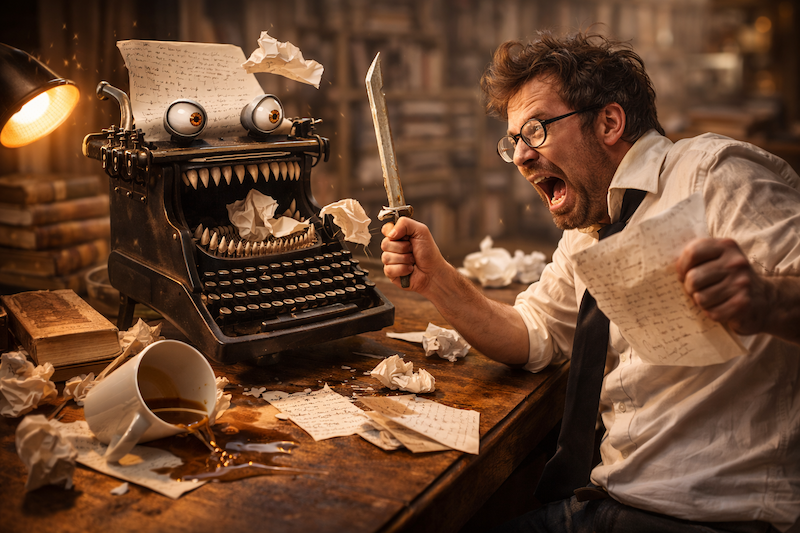
The Wind Editor

Index cards for plotting. 47 cards. Color-coded. Three acts. Perfect structure.

Window open.

Wind blew.

Order lost.

Spent two hours rearranging.

Beta reader: 'Best plot you've ever written.'

I don't remember the original order.

Neither does the wind.

Article Feb 13, 05:02 PM

Hemingway Never Said It — But Did the Bottle Really Write Great Literature?

The most famous writing advice in history — "Write drunk, edit sober" — is a complete fraud. Hemingway never said it. The quote was invented by novelist Peter De Vries in his 1964 novel Reuben, Reuben, rephrased and misattributed decades later, then plastered across a million coffee mugs and dorm room posters. But here's the uncomfortable question nobody wants to ask: does it matter who said it if half the Western literary canon was written within arm's reach of a whiskey bottle?

Let's start with the rap sheet. Five of the first seven Americans to win the Nobel Prize in Literature were alcoholics: Sinclair Lewis, Eugene O'Neill, William Faulkner, Hemingway himself, and John Steinbeck. That's not a coincidence — that's a pattern. Edgar Allan Poe died in a gutter after a mysterious binge. F. Scott Fitzgerald drank his way through the Jazz Age and barely survived it. Dorothy Parker quipped her way through martini lunches at the Algonquin Round Table. Raymond Carver couldn't write a grocery list without a six-pack. The list is so long it starts to feel less like biography and more like a job requirement.

But — and this is the part the romantics never mention — most of these writers produced their best work despite the drinking, not because of it. Faulkner wrote The Sound and the Fury during a period of relative sobriety. Hemingway was fanatically disciplined about his morning writing sessions, standing at his desk at dawn, stone cold sober, producing his famous clean prose before the first drink of the day. He once told an interviewer: "Jeezus Christ! Have you ever heard of anyone who drank while he worked?" The man who supposedly championed drunk writing was horrified by the very idea.

Raymond Carver is perhaps the most instructive case. During his heaviest drinking years, in the late 1960s and early 1970s, he produced almost nothing. He later called that decade "a wasteland." It was only after he got sober in 1977 that he wrote the stories that made him the most influential short fiction writer of the twentieth century — What We Talk About When We Talk About Love, Cathedral, all of it. Sobriety didn't kill his muse. It resurrected it.

So where does the myth come from? There's a grain of truth buried under the romanticism, and it has nothing to do with alcohol specifically. What booze does — in moderate amounts, before it destroys you — is lower inhibitions. It quiets the inner critic, that nagging editorial voice that tells you your sentence is garbage before you've even finished typing it. And that voice is, genuinely, the enemy of first drafts. Every writer knows the feeling: you sit down to write, and the blank page stares back, and somewhere in your skull a committee of critics starts sharpening their knives. Alcohol tells that committee to shut up and sit down.

But here's the thing the myth conveniently ignores: there are a thousand ways to silence your inner critic that don't involve pickling your liver. Freewriting. Timed sprints. Writing badly on purpose. Meditation. Exercise. Even just writing at 5 AM when your brain hasn't fully booted up yet. The psychologist Mihaly Csikszentmihalyi spent decades studying flow states — those periods of effortless creative immersion — and not once did he prescribe a bottle of bourbon. What triggers flow is challenge matched to skill, clear goals, and immediate feedback. Not Maker's Mark.

The deeper problem with the "write drunk" philosophy is that it confuses disinhibition with inspiration. Being uninhibited doesn't make you creative — it just makes you louder. Anyone who's ever read their own drunk texts the next morning knows this. The words feel brilliant at midnight and mortifying by breakfast. The same principle applies to prose. Charles Bukowski, the patron saint of literary alcoholism, wrote prolifically while drinking, yes — but he also threw away enormous amounts of material. His published work is the carefully curated fraction that survived his own sober editing. The bottle didn't write Post Office. Discipline did.

There's also a survivorship bias problem so enormous you could park a yacht in it. We remember the alcoholic writers who succeeded. We don't remember the thousands — probably tens of thousands — who drank themselves into silence and oblivion. For every Faulkner, there were hundreds of equally talented writers who never finished a manuscript because they couldn't get out of bed before noon. We romanticize the survivors and forget the casualties. It's like admiring a lottery winner's "investment strategy."

The science is brutally clear on this. A 2017 study from the University of Graz found that while a small amount of alcohol can slightly increase certain types of creative thinking — specifically divergent thinking, the ability to generate many ideas — it simultaneously destroys working memory, analytical reasoning, and the ability to evaluate quality. In other words, alcohol might help you brainstorm, but it actively prevents you from doing anything useful with those ideas. You generate more raw material and lose the ability to tell the gold from the garbage. That's not a creative superpower. That's a mess.

And yet the myth persists, because it serves a purpose that has nothing to do with writing. It gives people permission. Permission to drink, obviously — but more importantly, permission to believe that creativity requires suffering, that art demands self-destruction, that the muse is a dark and dangerous mistress who can only be courted through excess. It's a profoundly seductive narrative, especially if you're twenty-two and have just discovered Kerouac.

But Jack Kerouac is actually the perfect cautionary tale. He wrote On the Road in a famous three-week Benzedrine-fueled binge in 1951 — at least, that's the legend. The truth is that Kerouac had been working on the novel for years, filling notebooks with observations, character sketches, and structural ideas. The "spontaneous" scroll version was essentially a transcription of material he'd been developing sober for half a decade. And even that mythologized draft required years of editing before it was publishable. The final version that Viking Press released in 1957 was Kerouac's carefully revised manuscript, not his amphetamine fever dream.

The real secret of creative writing is boring enough to make you weep: it's showing up. It's sitting at the desk when you don't feel inspired. It's writing two hundred words when you wanted to write two thousand. It's revision, revision, revision. Anthony Trollope wrote 47 novels by waking up at 5:30 every morning and writing 250 words every fifteen minutes, like a Victorian word factory. Jane Austen wrote her masterpieces at a tiny desk in a busy family sitting room with no lock on the door. Neither of them needed a cocktail. They needed a chair and a pen.

So here's my verdict on "write drunk, edit sober": it's a terrible piece of advice wrapped in a charming package. The charm is real — it captures something true about the tension between creation and criticism, between the wild first draft and the disciplined revision. But the advice itself will ruin you if you take it literally. The writers who produced great work while drinking did so on borrowed time, and most of them knew it. Hemingway put a shotgun in his mouth. Fitzgerald died at forty-four. Poe at forty. Kerouac at forty-seven.

Write sober. Edit sober. Live long enough to finish the book. That's not as catchy on a coffee mug, but it's the only advice that won't kill you.

Joke Jan 31, 01:32 PM

The Editor's Escalating Concern

Editor marked page 47: "Unclear."

Page 48: "Very unclear."

Page 49: "Are you okay?"

Article Feb 13, 08:13 AM

Why Your First Draft Is Garbage — And Why Every Great Writer Knew It

Here's a dirty secret the publishing industry doesn't advertise on its dust jackets: every masterpiece you've ever loved started as hot garbage. That pristine prose you underlined in Hemingway? He rewrote the ending of A Farewell to Arms 47 times. Forty-seven. When asked what the problem was, he said, "Getting the words right." Not the plot. Not the theme. The words. If the man who defined 20th-century American literature couldn't nail it on the first try, what makes you think your NaNoWriMo draft should be any different?

Let's get uncomfortable for a moment. Your first draft is terrible. Mine is terrible. Donna Tartt's first draft of The Secret History was terrible — and she spent ten years turning it into something that wasn't. The sooner you accept this, the sooner you stop staring at a blinking cursor, paralyzed by the fantasy that real writers produce gold on the first pass. They don't. They produce mud. The gold comes later, from the refining.

Tolstoy rewrote War and Peace — all 1,225 pages of it — seven times. His wife, Sophia, copied the entire manuscript by hand each time because typewriters weren't exactly Amazon Prime deliveries in 1860s Russia. Seven drafts of the longest novel most people pretend to have read. Tolstoy's first version reportedly had a completely different opening, different character arcs, and at one point Pierre Bezukhov was barely in it. Imagine War and Peace without Pierre. That's what a first draft gets you: a book without its own protagonist.

Raymond Carver, the king of minimalism, the guy whose sentences feel like they were carved from stone with a scalpel — his editor, Gordon Lish, sometimes cut 70% of his stories. Seventy percent. Carver would submit a story, and Lish would return it looking like a crime scene, red ink everywhere. "What We Talk About When We Talk About Love" was originally twice as long and had a completely different title. The first draft wasn't just rough; it was practically a different piece of literature. The editing process didn't polish the story — it created it.

And that's the thing nobody tells you about the writing process: the first draft isn't writing. It's thinking out loud. It's you, fumbling in the dark, trying to figure out what you actually want to say. Anne Lamott called them "shitty first drafts" in her legendary craft book Bird by Bird, and she wasn't being cute. She meant it literally. The purpose of a first draft is not to be good. Its purpose is to exist. You can't edit a blank page. You can edit garbage.

Consider F. Scott Fitzgerald. The Great Gatsby — arguably the most perfectly constructed American novel — went through massive revisions. Fitzgerald's original title was "Trimalchio in West Egg," which sounds like an Italian restaurant on Long Island. His editor, Maxwell Perkins, essentially talked him out of a mediocre book and into a masterpiece. The first draft had Gatsby's backstory dumped into the opening chapters like a Wikipedia article. Perkins pushed Fitzgerald to scatter it, to create mystery, to let the reader discover Gatsby the way Nick does. That brilliant structural choice? It wasn't in the draft. It was in the editing.

Here's where it gets even more interesting. Research in cognitive psychology actually backs this up. A 2018 study published in Cognitive Science found that creative ideas improve significantly through iterative revision. The brain's initial output tends to rely on obvious associations — clichés, tropes, the first thing that comes to mind. It's only through repeated passes that writers access deeper, more original connections. Your first draft is your brain's lazy answer. The good stuff is buried underneath, and you have to dig for it.

So why do so many aspiring writers treat their first draft like it should be their final one? Because our culture worships the myth of effortless genius. Mozart composing symphonies in his head. Kerouac typing On the Road on a single scroll of paper in three weeks. Except Mozart's manuscripts are full of corrections and crossed-out passages. And Kerouac? He'd been writing and rewriting the material for years before that famous typing marathon. The scroll was a performance, not a process. The real work happened in notebooks, in letters, in drafts nobody talks about because they don't make good legends.

The cult of the first draft is killing more books than bad reviews ever could. I've seen talented writers abandon novels because their first chapter didn't sing. I've watched people rewrite the same opening paragraph forty times before moving to page two, trapped in an editing loop that prevents them from ever finishing anything. This is the perfectionism trap, and it's the deadliest enemy of any creative process. You cannot simultaneously create and critique. These are different brain functions, and trying to do both at once is like pressing the gas and brake pedals at the same time — you go nowhere and burn out your engine.

The professionals know this. Stephen King writes his first drafts with the door closed — no feedback, no second-guessing, no looking back. He gets the whole thing down, lets it sit for six weeks, then opens the door and starts cutting. He aims to trim 10% on every second draft. King has published over 60 novels this way. Whatever you think of his prose, the man finishes books. That's not talent. That's process.

Nabokov, on the other end of the literary spectrum, wrote every sentence of his novels on index cards, shuffling and rearranging them obsessively. Lolita went through years of drafting. He reportedly burned an early version entirely and started over. Even Nabokov — a man who wrote in three languages and could construct sentences that make English professors weep — couldn't get it right the first time. He just had a different system for getting it wrong and then fixing it.

So here's the actionable truth, the thing you can actually take away from this: give yourself permission to write badly. Not as a permanent state, but as a necessary stage. Your first draft is a conversation with yourself about what the story could be. Your second draft is where you start making it what it should be. Your third draft — if you're lucky — is where it becomes what it is. Editing is not a punishment for bad writing. Editing is writing. The draft is just the raw material.

The next time you sit down and produce three pages of what feels like utter nonsense, congratulations. You're doing exactly what Tolstoy did, what Fitzgerald did, what every writer who ever mattered did. The difference between a published author and an aspiring one isn't the quality of their first drafts. It's the willingness to write the second one. And the third. And the seventh. Your garbage draft isn't a failure. It's a foundation. Now stop reading articles about writing and go make some beautiful trash.

Joke Jan 29, 07:02 PM

The Ink Question

Editor returns manuscript. Red ink everywhere.

I wrote it in black.

This is blood.

Whose blood?

Article Feb 13, 05:09 AM

Hemingway Never Said It — But Did Booze Really Write the Great American Novel?

Here's an uncomfortable truth that will ruin your favorite inspirational poster: Ernest Hemingway never said "Write drunk, edit sober." Not once. Not in any letter, interview, or memoir. The quote was invented by a novelist named Peter De Vries in 1964 — and it was a joke. Yet millions of aspiring writers have pinned this fabricated wisdom to their walls, using it as a permission slip to crack open a bottle before cracking open a laptop. The real question isn't whether Hemingway said it. The real question is whether it actually works.

Let's get the irony out of the way first. Hemingway — the man most associated with literary alcoholism — was adamant about never writing while drunk. In a 1935 article for Esquire, he was blunt: "Have you ever heard of anyone who drank while he worked? You're thinking of Faulkner." And even that was a dig, not an endorsement. Hemingway woke up at dawn, wrote standing at his desk in his Havana home, drank nothing stronger than coffee, and didn't touch alcohol until his daily word count was finished. The man who gave us "The Old Man and the Sea" treated mornings like a cathedral — quiet, sober, and sacred.

But here's where it gets interesting, because Faulkner — the one Hemingway was mocking — actually did drink while writing. William Faulkner reportedly kept a bottle of whiskey on his desk while composing "As I Lay Dying," a novel he claimed to have written in six weeks while working the night shift at a power plant. Whether the whiskey helped or not, that book became one of the most experimental and celebrated novels of the twentieth century. So does that prove the myth? Not so fast.

Faulkner also produced plenty of garbage while drunk. His later novels declined in quality precisely as his drinking escalated. By the 1950s, his alcoholism required hospitalizations, and his output suffered dramatically. The same man who wrote "The Sound and the Fury" in a blaze of intoxicated genius couldn't finish a coherent paragraph during his worst benders. Alcohol didn't give Faulkner talent. It just happened to be in the room when talent showed up — and it stuck around long after talent had left.

The list of alcoholic literary legends is so long it's almost a cliche. F. Scott Fitzgerald, Dorothy Parker, Raymond Carver, Jack Kerouac, Edgar Allan Poe, Dylan Thomas, Charles Bukowski, Truman Capote — pick a name from the twentieth-century canon and there's a decent chance they had a complicated relationship with a bottle. Five of the seven American Nobel Prize winners in literature were alcoholics. That's not a coincidence, but it's also not causation. It's a tragedy dressed up as a tradition.

Here's what actually happens in your brain when you drink and try to write. Alcohol suppresses the prefrontal cortex — the part responsible for judgment, self-censorship, and executive function. This is why your drunk texts feel so eloquent at 2 a.m. and so catastrophic at 7 a.m. In small doses, this suppression can feel liberating. The inner critic shuts up. The words flow more freely. A 2012 study from the University of Illinois found that mildly intoxicated participants solved creative word-association problems faster and more accurately than sober ones. The researchers called it the "creative sweet spot" — just buzzed enough to lower inhibitions, not drunk enough to lose coherence.

But — and this is the "but" that ruins the party — the same study found that drunk participants were terrible at analytical tasks, editing, and revision. In other words, alcohol might help you generate raw material, but it actively sabotages your ability to shape that material into anything worth reading. The "write drunk" part has a sliver of scientific backing. The "edit sober" part isn't just good advice — it's neurological necessity.

The problem is that most people who romanticize drinking and writing skip right past the editing part. They remember Kerouac typing "On the Road" on a continuous scroll of paper in a three-week amphetamine frenzy, and they think that's how great literature happens. What they forget is that Kerouac spent years revising that manuscript before it was published in 1957, and his editor Malcolm Cowley cut and restructured it substantially. The scroll was a first draft. The book was the product of sober, painstaking work.

Raymond Carver is perhaps the most instructive case. During his drinking years, Carver produced some stories, but he was barely functional — missing deadlines, destroying relationships, getting fired from jobs. It wasn't until he got sober in 1977 that he wrote the stories that made him famous. "Cathedral," "What We Talk About When We Talk About Love," "A Small, Good Thing" — all written stone-cold sober. Carver himself said that getting sober was the best thing that ever happened to his writing. Not because sobriety gave him ideas, but because it gave him the discipline to actually finish them.

Stephen King tells a similar story. During the 1980s, King was writing bestsellers while consuming a case of beer a day and mountains of cocaine. He doesn't remember writing "Cujo" at all. Let that sink in — one of the most successful novelists alive has zero memory of creating an entire book. When he got sober in 1988, his writing didn't get worse. It got better. "Misery," "The Green Mile," "11/22/63" — all products of a clear mind. King has said bluntly that the idea of the alcoholic genius writer is "the biggest myth going."

So what's really happening when we celebrate the drunk writer? We're confusing correlation with causation, and more dangerously, we're romanticizing self-destruction. Writing is hard. It requires sitting alone with your thoughts and making something from nothing. That's terrifying. Alcohol makes terrifying things feel manageable. It's not that booze makes you a better writer — it's that writing makes you want to drink. The bottle isn't a tool. It's a coping mechanism that literary culture has rebranded as a method.

There's also a survivorship bias at work. We remember the alcoholic writers who produced masterpieces. We don't talk about the thousands of equally talented writers whose drinking killed them before they finished anything. Brendan Behan died at 41. Dylan Thomas at 39. Jack London at 40. Malcolm Lowry at 47. For every Faulkner who stumbled through genius, there are a hundred writers who just stumbled.

The truth is unglamorous but useful: the best writing comes from a mind that can access both chaos and control. You need the wildness to generate ideas and the discipline to execute them. Some writers achieve that wildness through alcohol. Others through meditation, long walks, insomnia, heartbreak, or simply staring at a wall until something clicks. The method doesn't matter. What matters is showing up to the page with enough clarity to actually do the work.

So the next time you see that fake Hemingway quote on a coffee mug, remember this: the man it's attributed to never said it, the writers who actually drank mostly wished they hadn't, and the science says your best creative work happens at about one beer — not one bottle. Write curious. Write scared. Write angry. Write obsessed. And yes, edit sober. But maybe skip the drunk part entirely. Your liver — and your second draft — will thank you.

Joke Jan 20, 10:01 PM

The First Draft's Online Review

A first draft leaves a one-star review for its author on Yelp: 'Terrible experience. Created me at 2 AM fueled by cold coffee and desperation. Gave me plot holes you could drive a truck through, characters with no motivation, and a climax that makes no sense. Then had the audacity to call me 'rough' and shoved me in a drawer for six months. Would not recommend. Currently in therapy with second draft, who also has issues.'

Article Feb 13, 03:14 AM

Every Author You Admire Is Lying About How They Write

Here's a dirty little secret the literary world doesn't want you to know: almost every famous author has lied about their writing process. Not exaggerated. Not embellished. Lied. That romantic image of Hemingway standing at his typewriter at dawn, fueled by nothing but black coffee and masculine determination? Half-fiction. That story about Maya Angelou renting a hotel room and writing from 6 AM to 2 PM like clockwork? Carefully curated mythology. Writers are, by profession, the best liars on the planet — and their favorite fiction isn't in their novels. It's in their interviews.

Let's start with the biggest whopper of them all: "I write every single day." This is the commandment carved into every writing advice book ever published, and roughly ninety percent of the authors who preach it don't actually follow it. Stephen King famously claims he writes 2,000 words a day, every day, including Christmas and his birthday. And maybe he does — now. But King himself has admitted that during the 1980s, he was so deep in cocaine and alcohol addiction that entire novels were written in blackout states. He doesn't even remember writing "Cujo." Every. Single. Day. Sure, Steve.

Then there's the "I don't use outlines" lie. Pantsers — writers who claim to fly by the seat of their pants — love to present themselves as wild creative spirits channeling stories directly from the muse. George R.R. Martin calls himself a "gardener" rather than an "architect." He just plants seeds and watches them grow, he says. Which sounds lovely until you realize the man has been stuck on "The Winds of Winter" for over a decade. Maybe a little architecture wouldn't hurt, George. Meanwhile, J.K. Rowling — who sometimes gets lumped into the pantser camp — actually created elaborate spreadsheets tracking every subplot, timeline, and character arc across all seven Harry Potter books. The spreadsheet photos leaked online. They look like a NASA mission control document. So much for divine inspiration.

The "I never revise" myth is perhaps the most destructive lie in literary history. Jack Kerouac built his entire legend on the claim that he wrote "On the Road" in a three-week Benzedrine-fueled frenzy on a single continuous scroll of paper. One draft. Pure spontaneous prose. It became the foundational myth of Beat Generation writing. There's just one problem: it's nonsense. Kerouac had been working on the novel in various forms since 1948 — three full years before the famous scroll session in 1951. And after that legendary sprint? He revised it extensively. His editors revised it more. The scroll itself was a rewrite of material he'd already drafted in notebooks. The "first thought, best thought" philosophy was marketing, not method.

Next up: the drinking lie. Oh, how writers love to romanticize alcohol. Hemingway's famous quote — "Write drunk, edit sober" — has been printed on more coffee mugs than any actual line from his books. There's just one inconvenient fact: Hemingway never said it. The quote is completely fabricated, likely originating from a Peter De Vries novel. And Hemingway himself was quite clear that he never drank while writing. "Jeezus Christ! Have you ever heard of anyone who drank while he worked?" he wrote in a letter to Harvey Breit in 1950. The man who became the patron saint of boozy writing was actually disciplined and sober at his desk. Fitzgerald, Faulkner, Dorothy Parker — they all drank heroically, but their best work was almost universally produced during periods of relative sobriety. The alcohol was the disease. The writing happened despite it, not because of it.

The "morning person" fabrication deserves its own wing in the Museum of Literary Lies. Every other Paris Review interview features some author claiming they rise at 5 AM, greet the dawn with gratitude, and produce their masterwork before the rest of the world has had breakfast. Haruki Murakami says he wakes at 4 AM and writes for five to six hours. Toni Morrison said she watched the sunrise and began writing. It creates this aspirational image that makes every night-owl writer feel like a failure. But Franz Kafka wrote almost exclusively at night, usually from 11 PM to 3 AM, after working a full-time insurance job during the day. Gustave Flaubert was a night writer. So was Marcel Proust, who rarely surfaced before 3 PM. Some of the greatest literature ever written was produced by people who would have failed every productivity guru's morning routine challenge.

Then there's the false modesty lie — the "oh, it just came to me" routine. Coleridge claimed that "Kubla Khan" appeared to him complete in an opium dream, and he merely transcribed it upon waking before being interrupted by the infamous "person from Porlock." Literary scholars have largely concluded this is theatrical nonsense. Surviving manuscripts show evidence of careful composition and revision. The "person from Porlock" was likely an invention to excuse the fact that Coleridge simply couldn't figure out how to end the poem. It's the 18th-century equivalent of saying your dog ate your homework.

The "I don't read reviews" lie is so universal it's practically an industry standard. Every author in every interview says they don't read their reviews. They're above it. They don't need external validation. They write for themselves. This is, with almost no exceptions, a bald-faced lie. Norman Mailer once headbutted Gore Vidal at a party partly over a bad review. Hemingway threatened to beat up critics. Jonathan Franzen publicly feuded with reviewers for years. These are not people who don't read their reviews. Writers read every single review, every Goodreads comment, every tweet. They Google themselves at 2 AM like the rest of us. They just know they're not supposed to admit it.

The "writing is suffering" performance is perhaps the most profitable lie of all. Authors love to describe writing as agonizing, torturous, soul-destroying labor. "There is nothing to writing," said attributed-to-everyone journalist Red Smith. "All you do is sit down at a typewriter and open a vein." This theatrical suffering serves a purpose: it makes writing seem heroic and justifies the occasionally terrible pay. But plenty of great writers have admitted they actually enjoy it. Anthony Trollope wrote with the cheerful regularity of a banker going to work. P.G. Wodehouse described writing as essentially playing. Terry Pratchett called it the most fun you could have by yourself. The suffering narrative sells books and sympathy. The reality is that many writers write because it genuinely feels good — but that's a much less interesting story to tell at a literary festival.

So why do writers lie about their habits? Because they're building brands. The tortured genius. The disciplined monk. The wild bohemian. These are characters, as carefully constructed as any in their novels. The writing process is messy, inconsistent, boring, and deeply unglamorous. It involves a lot of staring at walls, eating crackers over your keyboard, and googling strange forensic questions at 3 AM while your spouse eyes you nervously. That doesn't look good on a book jacket.

Here's the truth that no one puts on a coffee mug: there is no correct way to write. There is no magic morning hour, no ideal number of daily words, no proper ratio of outlining to improvisation. The only real writing habit that matters is the one nobody wants to talk about because it's crushingly boring — you sit down, you struggle, you produce something mediocre, you fix it, and you repeat this hundreds of times until you have a book. Everything else is mythology.

And the next time your favorite author tells you they write 2,000 words before breakfast without ever looking at a review? Smile, nod, and remember: they're professional fiction writers. They never really stop working.

Article Feb 6, 03:08 AM

Writer's Toolkit: From Idea to Publication — A Modern Author's Journey

Every writer knows the feeling: a brilliant idea strikes at 3 AM, scribbled on a napkin or typed frantically into a phone. But between that spark of inspiration and holding a finished book in your hands lies a vast territory that has defeated countless aspiring authors. The good news? In 2025, the writer's toolkit has evolved dramatically, transforming what was once an arduous solo expedition into a collaborative journey with intelligent tools at your side.

The path from idea to publication has never been more accessible, yet the sheer number of available tools can feel overwhelming. Which ones actually matter? Which will save you time versus becoming another distraction? Let's walk through each stage of the writing process and explore what actually works.

The first stage — ideation — is where many writers stumble before they even begin. You have a vague concept, perhaps a character who won't leave your mind or a world you glimpse in dreams. The traditional approach involved notebooks, cork boards covered in index cards, and hours of staring at blank pages. Today, AI-powered brainstorming tools can help you explore your initial concept from angles you never considered. They won't replace your creative vision, but they serve as tireless collaborators who never judge a half-formed thought. Try describing your idea in a single sentence, then ask an AI assistant to suggest five unexpected complications. You might discover your story's true direction.

Plotting and outlining represent the architectural phase of writing. Some authors are dedicated outliners who plan every chapter before writing a word. Others discover their story as they write. Regardless of your approach, having a flexible structure helps prevent the dreaded "sagging middle" that kills so many manuscripts. Technology offers solutions for both camps. Mind-mapping software lets you visualize connections between plot threads. Timeline tools help you track when events occur relative to each other — essential for complex narratives with multiple viewpoints. Digital cork boards like Scrivener or Notion let you rearrange scenes with a drag and drop, making structural changes painless.

The actual drafting phase remains deeply personal. Some writers need the focus of distraction-free writing apps that block everything except the blank page. Others thrive with ambient noise generators playing coffee shop sounds or forest rain. The key insight is this: your drafting environment should reduce friction. If you spend ten minutes finding your files and opening programs before you can write, that's ten minutes of momentum lost daily — over sixty hours annually. Invest time in setting up a system that lets you start writing within seconds of sitting down.

Editing is where modern AI tools truly shine, though with important caveats. Grammar checkers have evolved far beyond simple spell-check. They now catch subtle issues: overused words, passive voice creeping into action scenes, sentences that technically parse but confuse readers. Platforms like yapisatel offer AI-powered editing that understands context, suggesting improvements while preserving your unique voice. However, no tool should have the final word. Your creative choices might intentionally break rules for effect. Use AI as a second pair of eyes, not as a replacement for your judgment.

Beta reading and feedback gathering form a crucial bridge between drafting and publication. Technology has expanded our options dramatically. You can find beta readers in online writing communities, exchange manuscripts with other authors, or use AI-driven analysis to identify potential issues before human readers see your work. The ideal approach combines both: let AI catch the obvious problems first, then present a cleaner draft to human readers who can focus on deeper issues like character believability and emotional resonance.

Formatting for publication used to require expensive software or professional services. Today, tools exist that transform your manuscript into properly formatted ebooks and print-ready PDFs with minimal effort. Learn the basics of one good formatting tool — Vellum, Atticus, or Reedsy's free formatter — and you'll save thousands over a writing career. The technical barrier to professional presentation has essentially vanished.

Cover design remains one area where professional help often pays dividends, though AI image generation has opened new possibilities. A cover must accomplish multiple goals simultaneously: convey genre, attract attention at thumbnail size, and project professionalism. If you choose to design your own, study successful covers in your genre obsessively. Notice patterns in color, typography, and imagery. Tools like Canva provide templates, but your genre awareness determines whether the result looks professional or amateur.

The publication decision — traditional or self-publishing — shapes everything that follows. Traditional publishing offers advances, distribution, and editorial support but requires patience and accepts only a fraction of submissions. Self-publishing provides control, higher royalties per sale, and speed but demands that you handle every aspect yourself. Many successful authors now pursue hybrid approaches, self-publishing some works while traditionally publishing others. There's no single right answer; there's only the right answer for your specific book and goals.

Marketing represents the stage where many authors falter. We became writers to write, not to sell. Yet discoverability remains the greatest challenge in an era when millions of books compete for attention. Start building your author platform before publication. Connect genuinely with readers in your genre. Email lists remain the most valuable marketing asset — algorithms change, but your direct connection to readers endures. Write the next book; consistent publishing is the most effective marketing strategy that exists.

Modern platforms like yapisatel are transforming how authors approach this entire journey. By integrating AI assistance throughout the process — from initial brainstorming through editing and even publication support — they reduce the technical burden and let you focus on what matters: telling your story. The technology handles tedious aspects while you make the creative decisions that only a human author can make.

The writer's toolkit in 2025 is more powerful than anything previous generations could have imagined. Virginia Woolf famously wanted a room of one's own and five hundred pounds a year. Today's equivalent is a laptop, an internet connection, and the wisdom to use available tools effectively. The barriers have never been lower. The resources have never been richer. The only remaining obstacle is the one that has always existed: sitting down and doing the work.

Your story deserves to exist in the world. The tools are ready. The readers are waiting. What's stopping you from beginning today?

Article Feb 6, 02:42 AM

Writer's Toolkit: From Idea to Publication — Building Your Creative Arsenal

Every published book begins as a fleeting thought — a character's voice in your head, a scene that won't let you sleep, or a question that demands exploration. But between that initial spark and holding a finished book in your hands lies a journey that has transformed dramatically in recent years. The modern writer no longer faces the blank page alone.

Today's authors have access to an unprecedented array of tools that can streamline every stage of the creative process. From capturing ideas to polishing final drafts, from building fictional worlds to connecting with readers, technology has become the writer's trusted companion. Let's explore the essential toolkit that can carry your story from conception to publication.

**Stage One: Capturing and Developing Ideas**

Ideas are notoriously slippery. They arrive during shower thoughts, midnight awakenings, or while stuck in traffic — rarely when you're sitting prepared at your desk. The first tool every writer needs is a reliable capture system. Note-taking apps like Notion, Obsidian, or even simple voice memos on your phone ensure no idea escapes. The key is choosing something you'll actually use consistently.

Once captured, ideas need room to grow. Mind-mapping software helps visualize connections between concepts, characters, and plot points. Some writers prefer physical index cards spread across a wall; others thrive with digital tools like Scapple or Miro. The method matters less than the practice of letting ideas breathe and connect.

**Stage Two: Structuring Your Story**

The gap between a great idea and a finished manuscript often lies in structure. This is where many writers struggle — and where modern AI tools have become genuinely helpful. Platforms like yapisatel offer intelligent assistance for developing plot outlines and chapter structures, helping writers see the architecture of their story before diving into prose.

Consider using the three-act structure as a starting framework, then breaking each act into sequences and scenes. Tools that allow you to visualize your story's pacing — seeing where tension rises and falls — can prevent the dreaded "saggy middle" that derails many novels. Character relationship maps and timeline trackers ensure consistency as your story grows more complex.

**Stage Three: The Writing Process Itself**

Here's where personal preference reigns supreme. Some writers swear by distraction-free tools like iA Writer or Hemingway Editor. Others need the robust features of Scrivener, which lets you organize research, character notes, and manuscript chapters in one place. Google Docs works beautifully for those who write across multiple devices or collaborate with co-authors.

The rise of AI writing assistants has added another dimension to this stage. These tools can help overcome writer's block by suggesting scene directions, generating dialogue options, or offering alternative phrasings. The key is using AI as a brainstorming partner rather than a replacement for your unique voice. Your creativity drives the story; technology simply helps clear obstacles from your path.

**Stage Four: Revision and Editing**

First drafts are meant to be imperfect — they're you telling the story to yourself. Revision is where you shape that raw material for readers. Grammar checkers like Grammarly catch surface-level errors, but deeper editing requires more sophisticated approaches.

AI-powered platforms can now analyze your manuscript for pacing issues, inconsistent character behavior, plot holes, and stylistic patterns. Services like yapisatel provide comprehensive feedback across multiple dimensions of craft, from dialogue authenticity to world-building consistency. This kind of analysis once required expensive professional editors or patient critique partners.

However, remember that all feedback — human or artificial — is ultimately suggestion. You remain the final arbiter of what serves your story best. The most valuable revision tool is still time: setting your manuscript aside for weeks or months before returning with fresh eyes.

**Stage Five: Professional Polish**

Before publication, every manuscript benefits from professional attention. Developmental editors address big-picture issues of plot and character. Line editors refine your prose at the sentence level. Copyeditors catch errors in grammar, consistency, and fact. Proofreaders provide the final check before printing.

Budget constraints make hiring all these professionals challenging for many authors. This is another area where AI tools have democratized access. While they shouldn't completely replace human editors for a book you're seriously publishing, they can handle early revision passes, letting you present cleaner work to human professionals — potentially reducing editing costs.

**Stage Six: Publication Pathways**

The traditional publishing route — querying agents, securing deals, waiting years for release — remains viable but is no longer the only path. Self-publishing platforms like Amazon KDP, IngramSpark, and Draft2Digital have empowered authors to reach readers directly. Each pathway has trade-offs in creative control, financial investment, and marketing responsibility.

Hybrid approaches are increasingly common. Some authors self-publish certain works while pursuing traditional deals for others. Some use self-published books to build audiences that make them attractive to traditional publishers. The tools for formatting ebooks and print-on-demand paperbacks have become remarkably accessible.

**Stage Seven: Connecting With Readers**

Publication isn't the finish line — it's the beginning of your book's public life. Author platforms, email newsletters, and social media presence help readers find your work and stick around for future releases. Tools like Mailchimp for newsletters, Canva for graphics, and scheduling apps for social media make consistent marketing manageable even for introverted writers.

The most sustainable approach treats marketing not as promotion but as conversation. Share your writing journey, discuss books you love, engage genuinely with your reading community. Authenticity builds the kind of readership that sustains a writing career.

**Building Your Personal Toolkit**

No single set of tools works for every writer. Your ideal toolkit depends on your genre, working style, budget, and goals. Start with the minimum viable setup: something to capture ideas, something to write in, and something to back up your work. Add tools only when you encounter specific problems they solve.

Experiment during low-stakes projects rather than in the middle of your magnum opus. Many tools offer free trials — use them before committing. And remember that the fanciest toolkit can't substitute for the fundamental practice of putting words on the page regularly.

The journey from idea to publication has never been more accessible. Technology has removed many barriers that once made writing careers feel impossibly distant. But the core challenge remains beautifully human: finding stories worth telling and developing the craft to tell them well. Your toolkit should serve that mission, clearing the path so your creativity can flourish.

Whether you're drafting your first novel or your fifteenth, take time to evaluate your current tools. Are they helping or hindering? What friction points in your process might technology smooth? The right toolkit won't write your book for you — but it might just make the writing life sustainable enough that you finish it.

Nothing to read? Create your own book and read it! Like I do.

Create a book
1x

"Good writing is like a windowpane." — George Orwell