Content Feed

Discover interesting content about books and writing

Article Feb 13, 07:18 PM

Why Your First Draft Is Garbage — And Why Every Great Writer Knew It

Here's a dirty little secret the writing industry doesn't want you to know: every single masterpiece you've ever loved started as hot garbage. That pristine prose on your bookshelf? It was once a mess of crossed-out sentences, half-baked ideas, and paragraphs that made their authors physically cringe. Hemingway said it best — and he didn't mince words — 'The first draft of anything is shit.' Not 'could use improvement.' Not 'needs a little polish.' Shit. And if Papa Hemingway's first drafts were terrible, what makes you think yours should be any different?

Let me tell you about Leo Tolstoy. The man wrote War and Peace — one of the greatest novels in human history, a book that has humbled readers and writers for over 150 years. Do you know how many drafts it took? His wife, Sophia, hand-copied the entire manuscript seven times. Seven. That's roughly 1,500 pages, multiplied by seven, copied by hand with a quill pen. The first draft of War and Peace wasn't War and Peace. It was a sprawling, unfocused mess called 'The Year 1805,' and Tolstoy himself described early versions as embarrassing. So the next time you look at your shaky first attempt and want to throw your laptop out the window, remember: Tolstoy felt the same way, and he had a countess doing his secretarial work.

The cult of the first draft is one of the most toxic myths in writing. Somewhere along the way, we started believing that real writers sit down and genius just flows out of them like water from a tap. That Mozart composed symphonies in one sitting. That Kerouac typed On the Road in three weeks on a single scroll of paper and never looked back. Here's the thing about that Kerouac story — it's mostly nonsense. Yes, he typed a version in April 1951 on a continuous scroll of paper. But he'd been working on the material in notebooks for three years before that. And after the scroll? Six more years of revisions before it was published in 1957. The 'spontaneous' masterpiece was nearly a decade in the making.

Raymond Carver, the master of the American short story, had his work so heavily edited by Gordon Lish that scholars still argue about who actually wrote those spare, devastating sentences. Carver's first drafts were often twice as long as the published versions. Lish would slash and burn, cutting sometimes 70 percent of the text. Carver's original draft of 'What We Talk About When We Talk About Love' was a completely different beast — longer, softer, more explanatory. Lish carved it into a diamond. The first draft was the raw stone; the editing was the craft.

And then there's F. Scott Fitzgerald. The Great Gatsby — 180 pages of pure, distilled American perfection. Fitzgerald's editor, Maxwell Perkins, received a first draft that was, by Fitzgerald's own admission, 'a mess.' Fitzgerald then rewrote the entire novel, restructuring the chronology, cutting characters, and rewriting the ending multiple times. The iconic last line — 'So we beat on, boats against the current, borne back ceaselessly into the past' — didn't exist in the first draft. It was born in revision. The most quoted sentence in American literature was an afterthought.

So why do we torture ourselves over first drafts? Because we confuse the process with the product. We see the finished book on the shelf and assume it arrived fully formed. We don't see the seventeen versions in the recycling bin. We don't see Dostoevsky gambling away his advance and then dictating The Gambler in twenty-six days to a stenographer because he was desperate for money — and then spending months fixing the mess. We don't see the panic, the self-doubt, the three a.m. rewrites fueled by cold coffee and existential dread.

Here's what a first draft actually is: it's a conversation with yourself. You're figuring out what you want to say. You're laying bricks — ugly, uneven, sometimes cracked — but you're building a wall. You can't sand and paint a wall that doesn't exist. Anne Lamott, in her brilliant book Bird by Bird, calls them 'shitty first drafts' and insists that every writer she knows produces them. Not most writers. Every writer. The difference between a published author and someone with an abandoned manuscript in a drawer isn't talent — it's the willingness to go back and do the brutal, unglamorous work of rewriting.

The editing process is where the actual magic happens. It's not sexy. Nobody writes inspirational quotes about the fourth revision. But consider this: Michael Crichton rewrote Jurassic Park from scratch after his editor told him the original version didn't work. Not a light revision — he threw it out and started over. Stephen King, in On Writing, recommends cutting your first draft by at least ten percent. He calls it 'killing your darlings,' a phrase originally attributed to Arthur Quiller-Couch in 1914. You write the beautiful sentence, the clever metaphor, the brilliant aside — and then you murder it because it doesn't serve the story. That's editing. That's the job.

The real danger isn't writing a bad first draft. The real danger is never writing one at all. Perfectionism is procrastination wearing a tuxedo. It looks respectable, even admirable — 'Oh, I just have such high standards' — but the result is the same: nothing gets written. You stare at the blank page, paralyzed by the gap between the masterpiece in your head and the clumsy words on the screen. Meanwhile, the writers who actually finish books? They've made peace with being terrible. They've embraced the garbage. They know that you can fix a bad page, but you can't fix a blank one.

There's a famous story about a ceramics teacher who divided his class into two groups. One group would be graded on quantity — the more pots they made, the higher the grade. The other would be graded on quality — they just had to make one perfect pot. At the end of the semester, the best pots came from the quantity group. By making pot after pot, they learned, improved, and accidentally produced excellence. The quality group spent the whole semester theorizing about the perfect pot and produced mediocre work. Writing is the same. Your first draft is pot number one. It's supposed to be lumpy.

So here's my challenge to you, whoever you are, wherever you are in your writing: write the terrible first draft. Write the scene that makes you wince. Write the dialogue that sounds wooden. Write the description that's cliché and overwrought and would make your writing teacher weep. Get it all out. Because buried in that mess — in between the bad metaphors and the plot holes and the characters who all sound suspiciously like you — there are sparks. There are moments of genuine truth. And those moments are what you'll build on in draft two, three, four, and seven.

The first draft isn't the book. It never was. It's the raw ore you pull from the mine — dirty, rough, full of rock and sediment. The book is what emerges after you smelt it, hammer it, shape it, and polish it until it gleams. Every great writer in history has known this. The only question is whether you'll trust the process long enough to discover it yourself. Now stop reading articles about writing, open that document, and go make some beautiful garbage.
Joke Jan 25, 07:55 PM

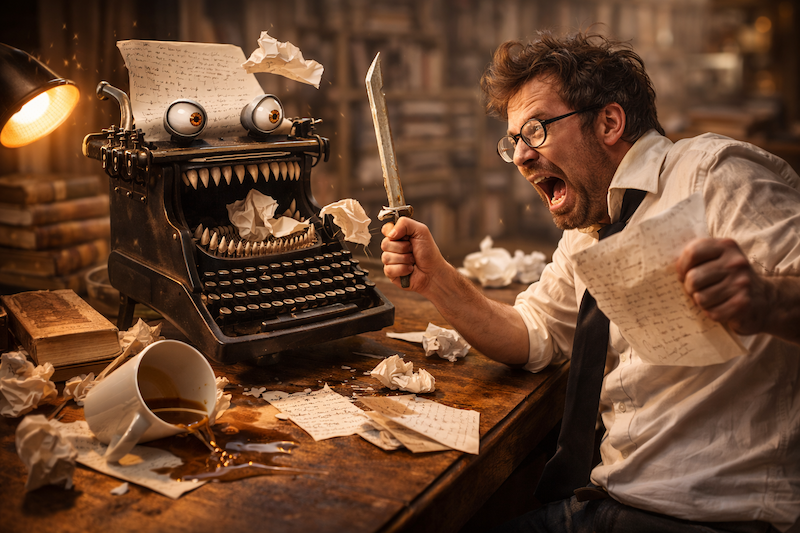
The First Draft's Farewell

Writer finishes first draft. 90,000 words. Celebrates.

Editor returns it: "Cut 30,000 words."

Writer: "Which ones?"

Editor: "The bad ones."

Writer: "They're all my children."

Editor: "Then you have 30,000 ugly children."

Writer deletes 30,000 words. Sends revision.

Editor: "Better. Now cut 20,000 more."

Writer: "I only have 60,000 left."

Editor: "Exactly."

Article Feb 13, 04:28 PM

Hemingway Wrote Drunk, Rewrote Sober — and So Should You

Here's a dirty little secret the publishing industry doesn't want you to know: every masterpiece you've ever loved started as hot garbage. That pristine prose you worship? It was once a steaming pile of crossed-out sentences, coffee-stained pages, and existential dread. Hemingway said the first draft of anything is shit. He wasn't being humble — he was being clinical. And if Papa Hemingway's first drafts were trash, what makes you think yours should be any different?

Let's get one thing straight before we go any further. Your first draft is supposed to be bad. Not mediocre. Not rough-around-the-edges. Bad. Spectacularly, gloriously, embarrassingly bad. The sooner you accept this, the sooner you'll actually finish writing something. Because right now, I'd bet money you're stuck on page three of a novel you started two years ago, endlessly polishing a paragraph that doesn't matter yet.

Consider Tolstoy. The man rewrote War and Peace — all 1,225 pages of it — seven times. His wife Sophia hand-copied the entire manuscript each time, because photocopiers weren't exactly an option in the 1860s. Seven drafts. That means the first six versions of one of the greatest novels ever written were, by Tolstoy's own ruthless standards, not good enough. Draft one? Probably unrecognizable. And this was a genius. A titan of literature. A man whose sentences could make you weep. Even he needed seven swings at it.

Or take Fitzgerald and The Great Gatsby. The original title was "Trimalchio in West Egg." Let that sink in. One of the most iconic titles in American literature almost got saddled with a name that sounds like an Italian restaurant in the Hamptons. Fitzgerald's editor, Maxwell Perkins, talked him out of it. The early drafts were bloated, unfocused, and missing the precise economy of language that makes the final version sing. Fitzgerald slashed, restructured, rewrote entire chapters. The Gatsby you know was sculpted from a much uglier block of marble.

Here's where it gets interesting from a psychological standpoint. There's a phenomenon called the "inner critic" — that nasty little voice in your head that tells you every sentence is wrong the moment you type it. Neuroscience actually backs this up. Research from the University of Greifswald found that experienced writers literally suppress their dorsolateral prefrontal cortex — the brain's editing center — when drafting. They let the creative regions run wild and save the judgment for later. Novice writers? They keep the editor switched on the entire time, which is like trying to drive a car with one foot on the gas and the other on the brake. You'll burn out the engine and go nowhere.

Raymond Carver, the master of minimalist fiction, had a secret weapon: his editor Gordon Lish. Lish didn't just tweak Carver's stories — he gutted them. He cut "What We Talk About When We Talk About Love" by over fifty percent. Whole paragraphs, characters, subplots — gone. Some literary scholars argue Lish essentially co-authored Carver's most famous work. Controversial? Absolutely. But it proves a point: the magic isn't in the first draft. It's in the cutting room.

Now, I can already hear the objections. "But what about Kerouac? He wrote On the Road on a single scroll in three weeks!" Yeah, about that. First, Kerouac spent seven years taking notes, journaling, and mentally composing the book before that famous scroll session. Second, the scroll draft wasn't the published version. Viking Press made him revise it significantly. The myth of the spontaneous masterpiece is exactly that — a myth. Even the Beats, those champions of raw, unfiltered expression, edited their work.

Stephen King, in his memoir On Writing, describes the first draft as writing with the door closed. It's just you and the story. No audience, no expectations, no pressure. The second draft is writing with the door open — that's when you let the world in, when you start thinking about readers, clarity, pacing. King typically cuts ten percent of his word count between drafts. For a guy who writes eight-hundred-page novels, that's eighty pages hitting the trash. And King writes fast. He's prolific. He's confident. Even he knows the first pass isn't the finished product.

The real danger isn't writing a bad first draft. The real danger is perfectionism — the silent killer of more novels than writer's block ever was. Perfectionism is seductive because it masquerades as high standards. "I just want it to be good," you tell yourself, as you rewrite the opening sentence for the fortieth time. But perfectionism isn't about quality. It's about fear. Fear of judgment, fear of failure, fear of putting something imperfect into a world that's already drowning in content. And that fear will paralyze you if you let it.

Anne Lamott nailed this in her classic Bird by Bird when she coined the term "shitty first drafts." She wrote: "All good writers write them. This is how they end up with good second drafts and terrific third drafts." Lamott wasn't giving permission to be lazy. She was giving permission to be human. Because the alternative — demanding perfection on the first try — isn't ambition. It's delusion.

Let me give you a practical framework. Draft one is for you. It's the discovery phase. You're figuring out what the story is actually about, who the characters really are, where the plot actually wants to go. Half your outline will prove useless. Characters you planned as minor will demand center stage. Scenes you thought were crucial will feel dead on arrival. That's normal. That's the process working exactly as it should.

Draft two is for structure. Now you know what you've got, and you can start shaping it. Move scenes around. Cut the dead weight. Strengthen the through-line. This is where a book starts to look like a book instead of a fever dream transcription.

Draft three is for language. Now — and only now — do you start worrying about individual sentences, word choice, rhythm, the music of prose. Polishing words before you've locked down the structure is like choosing curtains for a house that doesn't have walls yet.

So here's my challenge to you. Go write something terrible today. Seriously. Open a document and let it rip. Write the worst, most clichéd, most structurally unsound thing you can. Give yourself permission to be embarrassingly bad. Because behind every polished masterpiece on your bookshelf sits a graveyard of awful first drafts — and the only difference between those published authors and you is that they had the guts to write the garbage first, and the patience to fix it after.

Joke Jan 20, 10:01 PM

The First Draft's Online Review

A first draft leaves a one-star review for its author on Yelp: 'Terrible experience. Created me at 2 AM fueled by cold coffee and desperation. Gave me plot holes you could drive a truck through, characters with no motivation, and a climax that makes no sense. Then had the audacity to call me 'rough' and shoved me in a drawer for six months. Would not recommend. Currently in therapy with second draft, who also has issues.'

Article Feb 13, 08:13 AM

Why Your First Draft Is Garbage — And Why Every Great Writer Knew It

Here's a dirty secret the publishing industry doesn't advertise on its dust jackets: every masterpiece you've ever loved started as hot garbage. That pristine prose you underlined in Hemingway? He rewrote the ending of A Farewell to Arms 47 times. Forty-seven. When asked what the problem was, he said, "Getting the words right." Not the plot. Not the theme. The words. If the man who defined 20th-century American literature couldn't nail it on the first try, what makes you think your NaNoWriMo draft should be any different?

Let's get uncomfortable for a moment. Your first draft is terrible. Mine is terrible. Donna Tartt's first draft of The Secret History was terrible — and she spent ten years turning it into something that wasn't. The sooner you accept this, the sooner you stop staring at a blinking cursor, paralyzed by the fantasy that real writers produce gold on the first pass. They don't. They produce mud. The gold comes later, from the refining.

Tolstoy rewrote War and Peace — all 1,225 pages of it — seven times. His wife, Sophia, copied the entire manuscript by hand each time because typewriters weren't exactly Amazon Prime deliveries in 1860s Russia. Seven drafts of the longest novel most people pretend to have read. Tolstoy's first version reportedly had a completely different opening, different character arcs, and at one point Pierre Bezukhov was barely in it. Imagine War and Peace without Pierre. That's what a first draft gets you: a book without its own protagonist.

Raymond Carver, the king of minimalism, the guy whose sentences feel like they were carved from stone with a scalpel — his editor, Gordon Lish, sometimes cut 70% of his stories. Seventy percent. Carver would submit a story, and Lish would return it looking like a crime scene, red ink everywhere. "What We Talk About When We Talk About Love" was originally twice as long and had a completely different title. The first draft wasn't just rough; it was practically a different piece of literature. The editing process didn't polish the story — it created it.

And that's the thing nobody tells you about the writing process: the first draft isn't writing. It's thinking out loud. It's you, fumbling in the dark, trying to figure out what you actually want to say. Anne Lamott called them "shitty first drafts" in her legendary craft book Bird by Bird, and she wasn't being cute. She meant it literally. The purpose of a first draft is not to be good. Its purpose is to exist. You can't edit a blank page. You can edit garbage.

Consider F. Scott Fitzgerald. The Great Gatsby — arguably the most perfectly constructed American novel — went through massive revisions. Fitzgerald's original title was "Trimalchio in West Egg," which sounds like an Italian restaurant on Long Island. His editor, Maxwell Perkins, essentially talked him out of a mediocre book and into a masterpiece. The first draft had Gatsby's backstory dumped into the opening chapters like a Wikipedia article. Perkins pushed Fitzgerald to scatter it, to create mystery, to let the reader discover Gatsby the way Nick does. That brilliant structural choice? It wasn't in the draft. It was in the editing.

Here's where it gets even more interesting. Research in cognitive psychology actually backs this up. A 2018 study published in Cognitive Science found that creative ideas improve significantly through iterative revision. The brain's initial output tends to rely on obvious associations — clichés, tropes, the first thing that comes to mind. It's only through repeated passes that writers access deeper, more original connections. Your first draft is your brain's lazy answer. The good stuff is buried underneath, and you have to dig for it.

So why do so many aspiring writers treat their first draft like it should be their final one? Because our culture worships the myth of effortless genius. Mozart composing symphonies in his head. Kerouac typing On the Road on a single scroll of paper in three weeks. Except Mozart's manuscripts are full of corrections and crossed-out passages. And Kerouac? He'd been writing and rewriting the material for years before that famous typing marathon. The scroll was a performance, not a process. The real work happened in notebooks, in letters, in drafts nobody talks about because they don't make good legends.

The cult of the first draft is killing more books than bad reviews ever could. I've seen talented writers abandon novels because their first chapter didn't sing. I've watched people rewrite the same opening paragraph forty times before moving to page two, trapped in an editing loop that prevents them from ever finishing anything. This is the perfectionism trap, and it's the deadliest enemy of any creative process. You cannot simultaneously create and critique. These are different brain functions, and trying to do both at once is like pressing the gas and brake pedals at the same time — you go nowhere and burn out your engine.

The professionals know this. Stephen King writes his first drafts with the door closed — no feedback, no second-guessing, no looking back. He gets the whole thing down, lets it sit for six weeks, then opens the door and starts cutting. He aims to trim 10% on every second draft. King has published over 60 novels this way. Whatever you think of his prose, the man finishes books. That's not talent. That's process.

Nabokov, on the other end of the literary spectrum, wrote every sentence of his novels on index cards, shuffling and rearranging them obsessively. Lolita went through years of drafting. He reportedly burned an early version entirely and started over. Even Nabokov — a man who wrote in three languages and could construct sentences that make English professors weep — couldn't get it right the first time. He just had a different system for getting it wrong and then fixing it.

So here's the actionable truth, the thing you can actually take away from this: give yourself permission to write badly. Not as a permanent state, but as a necessary stage. Your first draft is a conversation with yourself about what the story could be. Your second draft is where you start making it what it should be. Your third draft — if you're lucky — is where it becomes what it is. Editing is not a punishment for bad writing. Editing is writing. The draft is just the raw material.

The next time you sit down and produce three pages of what feels like utter nonsense, congratulations. You're doing exactly what Tolstoy did, what Fitzgerald did, what every writer who ever mattered did. The difference between a published author and an aspiring one isn't the quality of their first drafts. It's the willingness to write the second one. And the third. And the seventh. Your garbage draft isn't a failure. It's a foundation. Now stop reading articles about writing and go make some beautiful trash.

Article Feb 8, 05:06 PM

How to Write a Book in a Month: A Step-by-Step Plan That Actually Works

Writing a book in 30 days sounds like a fantasy reserved for full-time novelists with cabin retreats and unlimited coffee. But thousands of authors prove every November during NaNoWriMo that a complete draft is absolutely achievable in a single month — even if you have a day job, kids, or a cat that insists on sitting on your keyboard. The secret isn't talent or luck. It's a clear plan, realistic daily targets, and the discipline to keep moving forward even when your inner critic screams that every sentence is garbage.

Before we dive in, let's set one expectation: writing a book in a month means finishing a first draft. Not a polished, publication-ready manuscript. The goal is to get the full story out of your head and onto the page. Editing, refining, and perfecting come later. With that mindset firmly in place, here's a step-by-step plan you can start using today.

**Week Zero: Prepare Before You Write a Single Word**

The biggest mistake aspiring speed-writers make is sitting down on Day 1 with nothing but a vague idea. Spend three to five days before your writing month doing the groundwork. Decide on your genre, premise, and target word count. A standard novel runs between 50,000 and 80,000 words. If you aim for 60,000 words over 30 days, that's 2,000 words per day — roughly 90 minutes of focused writing for most people. Create a one-page summary of your story: beginning, middle, and end. Sketch out your main characters with brief profiles covering their goals, fears, and quirks. Outline your chapters — even a loose, bullet-point outline dramatically reduces the chances of staring at a blank screen mid-month. Modern AI tools like yapisatel can speed up this preparation phase significantly, helping you brainstorm plot structures, generate character backstories, and build detailed chapter outlines in a fraction of the time it would take manually.

**Week One (Days 1–7): Build Momentum**

The first week is about establishing your habit. Write every single day, ideally at the same time and in the same place. Your brain starts to associate that environment with creative output, and after a few days, the words come more easily. Aim for your daily target — 2,000 words if you're going for 60,000 — but don't panic if you fall short on a tough day. What matters is showing up. A practical tip: start each session by re-reading the last paragraph you wrote the day before. It acts as a runway that gets you back into the flow without staring at a blinking cursor. By the end of Week One, you should have roughly 14,000 words and a solid sense of your characters' voices.

**Week Two (Days 8–14): Push Through the Middle**

This is where most people quit. The excitement of a new project fades, the middle of your story feels like a swamp, and you start wondering if the whole idea was a mistake. It wasn't. Every writer who has ever finished a book has fought through this exact phase. The solution is structure. Refer back to your outline and focus on the next scene, not the whole remaining book. Break your daily session into two shorter sprints — say, 1,000 words in the morning and 1,000 in the evening — if a single long session feels overwhelming. Introduce a subplot, a new conflict, or a surprising revelation to re-energize both yourself and the narrative. By Day 14, you should be at roughly 28,000 words, which is nearly the halfway mark.

**Week Three (Days 15–21): Accelerate Toward the Climax**

By now, something remarkable happens. Your characters feel real. The plot has its own gravity pulling events forward. Writing sessions become faster because you know where the story is going and you're eager to get there. This is the week to start setting up your climax. Plant the seeds of your final confrontation, let tensions escalate, and begin closing subplots that have served their purpose. Many writers find that their daily word count naturally increases during Week Three because the story demands to be told. Ride that wave. If you're ahead of schedule, fantastic — bank those extra words as insurance against a tough day later.

**Week Four (Days 22–30): Finish Strong**

The final stretch. Your climax should land somewhere around Day 24 or 25, giving you five to six days for the resolution and final chapters. Resist the temptation to rush the ending — readers remember how a book makes them feel in the last twenty pages more than anything else. Write the conclusion your characters deserve. Then, on the last day, write the two most overlooked parts of any book: the opening hook (yes, rewrite your first chapter's opening paragraph now that you know the full story) and a brief epilogue if the genre calls for it. When you type the final period, close your laptop and celebrate. You just wrote a book.

**Productivity Hacks That Make the Difference**

Beyond the weekly structure, a few tactical habits separate those who finish from those who don't. First, turn off your internet during writing sessions. No email, no social media, no "quick research" that turns into an hour-long Wikipedia spiral. Second, use a word-count tracker — a simple spreadsheet works — so you can see your progress visually. Watching that number climb is surprisingly motivating. Third, tell someone about your goal. Accountability partners, whether a friend, a writing group, or an online community, add social pressure that keeps you honest. Fourth, give yourself permission to write badly. The phrase "I'll fix it in editing" should be your daily mantra. Perfectionism is the enemy of productivity when you're drafting.

**What Comes After the Draft**

Finishing your draft is a massive achievement, but it's the beginning of a new phase. Let the manuscript rest for at least a week before you start editing. Fresh eyes catch problems that exhausted ones miss. Then do a structural edit first — are the chapters in the right order? Does the pacing work? Are there plot holes? — before moving on to line editing for style and grammar. This is another stage where platforms such as yapisatel can be genuinely useful, offering AI-assisted editing and review tools that help you identify weak spots in your narrative, sharpen dialogue, and polish prose before you send it to beta readers or a professional editor.

**The Real Secret: It's About the Plan, Not the Talent**

Writing a book in a month is not a test of raw literary genius. It's a project management challenge. You need a clear goal, a broken-down plan, daily discipline, and the resilience to keep going when it gets hard. Thousands of first-time authors have done it, and their books sit on real shelves and real e-readers right now. The only thing separating you from them is the decision to start — and a plan to follow through.

So pick your month. Build your outline. Set your daily word count. And write. Thirty days from now, you could be holding a completed manuscript in your hands. Not a dream. Not an idea. A book — your book. The blank page is waiting, and honestly, it's a lot less scary than it looks.

Article Feb 7, 12:14 PM

How to Write a Book in a Month: A Step-by-Step Plan That Actually Works

Writing a book in 30 days sounds impossible — until you break it down into manageable daily tasks. Thousands of authors have done it during NaNoWriMo, and many of them weren't full-time writers. They were teachers, engineers, parents, and students who carved out time between obligations to put words on the page. The secret isn't talent or endless free time. It's having a concrete plan, realistic daily targets, and the discipline to show up even when inspiration doesn't.

In this guide, you'll get a week-by-week breakdown, practical productivity tips, and honest advice on what to do when you hit the wall — because you will hit the wall. Let's turn your book idea into a finished draft.

## Before You Start: The Foundation Week (Days -7 to 0)

The biggest mistake aspiring authors make is sitting down on Day 1 with nothing but a vague idea. Spend the week before your writing month on preparation. Choose your genre and target word count. A standard novel runs 60,000–80,000 words, but a focused nonfiction book or a novella can be 30,000–50,000. For your first attempt, aim for 50,000 words — that's roughly 1,667 words per day. Write a one-page summary of your book: the main conflict, the beginning, the middle, and the ending. You don't need every detail, but you need to know where you're headed. Create a simple character sheet for your three to five main characters. List their goals, fears, and the lies they believe about themselves. Finally, outline your chapters. Even a rough list of 15–20 chapter titles with a one-sentence description each will save you hours of staring at a blank screen later.

## Week One (Days 1–7): Build the Habit

Your only goal this week is to establish a daily writing routine. Pick a consistent time — early morning before the house wakes up, lunch breaks, or late evenings after the kids are asleep. The specific hour matters less than consistency. Set a timer for 60–90 minutes and write without editing. This is critical: do not go back and fix sentences. Do not rewrite your opening paragraph for the fourth time. Push forward. Your daily target is 1,700 words, which most people can produce in about 90 minutes of focused writing. By the end of Week One, you should have roughly 12,000 words and the first three to four chapters drafted. You'll also have proven to yourself that the daily habit is possible, which is the real victory.

## Week Two (Days 8–14): Find Your Rhythm

By now, the initial excitement has faded and the routine feels like work. This is normal. This is where most people quit, and this is exactly where your plan saves you. Lean on your outline. When you sit down and don't know what to write, look at your chapter plan and write the next scene on the list. If a particular scene feels impossible, skip it and write the one after it. You can fill gaps later. This week, experiment with productivity techniques. The Pomodoro method — 25 minutes of writing followed by a 5-minute break — works well for many authors. Others prefer longer sprints with music or ambient noise. Find what keeps your fingers moving. Your word count by Day 14 should be around 24,000 words. If you're behind, don't panic. Schedule one catch-up session on the weekend where you write double your daily target.

## Week Three (Days 15–21): The Messy Middle

Welcome to the hardest part of your book — and your month. The middle of any story is where plots sag, motivation drops, and self-doubt screams loudest. You'll read back a paragraph and think it's terrible. You might be right. Write it anyway. Here's a technique that professional authors use: when you're stuck, introduce a complication. A character receives unexpected news. A plan fails. A secret is revealed. Conflict creates momentum, and momentum creates words. If you find yourself struggling with plot holes or inconsistencies, modern AI writing tools can be surprisingly helpful at this stage. Platforms like yapisatel allow you to brainstorm plot solutions, test dialogue variations, and generate ideas for scenes that bridge the gaps in your narrative — without replacing your creative voice. By Day 21, aim for 36,000 words. You're past the halfway point and heading into the home stretch.

## Week Four (Days 22–30): Sprint to the Finish

The end is in sight, and something remarkable often happens in the final week: energy returns. You can see the finish line, and your story is pulling you toward its conclusion. Lean into this momentum. Increase your daily sessions if possible. Write during lunch breaks, on your commute, or in the fifteen minutes before bed. Every word counts now. On your final days, focus on writing the climax and resolution. These scenes tend to flow faster because you've been building toward them for weeks. Don't worry about the ending being perfect. You're writing a first draft, not a final manuscript. Hit your word count, type the words "The End," and celebrate.

## Daily Productivity Hacks That Keep You on Track

Beyond the weekly plan, these specific tactics will protect your daily output. First, end each session mid-sentence. It sounds strange, but when you return the next day, you'll know exactly how to start, which eliminates the dreaded blank-page paralysis. Second, track your word count visually. A simple spreadsheet or a progress bar taped to your wall creates accountability. Third, eliminate distractions ruthlessly. Turn off your phone, close your browser, and use a distraction-free writing app. Fourth, tell someone about your goal. Accountability partners — whether a friend, a writing group, or an online community — dramatically increase your chances of finishing.

## What Happens After Day 30

You have a completed first draft. It's messy, imperfect, and probably longer or shorter than you planned. That's exactly what it should be. Put it away for at least two weeks. Distance gives you the objectivity to edit effectively. When you return to it, read the entire manuscript in one or two sittings and take notes on what works and what doesn't. Then begin your second draft, which is where the real writing happens. For the revision stage, AI-powered tools on platforms such as yapisatel can help you analyze pacing, identify weak character arcs, and catch inconsistencies across chapters — tasks that are tedious to do manually but essential for a polished book.

## Common Pitfalls and How to Avoid Them

Perfectionism is enemy number one. If you spend thirty minutes choosing the right adjective, you'll never finish. Give yourself permission to write badly. You can fix bad writing; you can't fix a blank page. Overplanning is enemy number two. Some writers spend their entire month building elaborate outlines and world-building documents instead of writing actual prose. Your outline should be a guide, not a procrastination tool. Finally, comparison is enemy number three. Don't read published novels during your writing month. They'll make your rough draft feel inadequate, which it is — because it's a draft, not a finished book.

## The Math of a Book in a Month

Let's be concrete. A 50,000-word book in 30 days requires 1,667 words per day. At an average typing speed of 40 words per minute during creative writing — which accounts for thinking pauses — that's about 42 minutes of actual writing. Add warm-up time, brief outline review, and a few breaks, and you're looking at 90 minutes to two hours daily. That's less time than most people spend on social media. The question isn't whether you have the time. It's whether you'll choose to use it.

Writing a book in a month isn't about superhuman effort. It's about showing up consistently, following a plan, and resisting the urge to edit before you've finished creating. Your first draft is the raw material. Everything great that your book will eventually become starts with those imperfect, sometimes embarrassing, always necessary first words. Open a blank document, set your timer, and begin. Thirty days from now, you could be holding a completed manuscript — and wondering why you waited so long to start.

Nothing to read? Create your own book and read it! Like I do.

Create a book
1x

"All you do is sit down at a typewriter and bleed." — Ernest Hemingway