Content Feed

Discover interesting content about books and writing

Article Feb 13, 06:00 AM

Dostoyevsky Wrote for Gambling Debts — And Created Masterpieces

Here's a dirty little secret the literary world doesn't want you to hear: almost every "genius" whose work you studied in school was desperately chasing a paycheck. That tortured artist starving in a garret, writing only when the muse descends? A myth — invented, ironically, by writers who were paid to invent myths.

Let's get uncomfortable for a moment. The next time someone sneers at a writer for "selling out," ask them this: selling out compared to whom, exactly? Because if we're talking about the literary canon — the sacred, untouchable pantheon of Great Literature — we're talking about a bunch of people who were absolutely obsessed with money.

Start with Fyodor Dostoyevsky, the man who gave us "Crime and Punishment" and "The Brothers Karamazov." You know why he wrote "The Gambler" in twenty-six days? Because he'd literally gambled away his advance and owed his publisher a completed novel or he'd lose the rights to his entire body of work for nine years. He dictated it to a stenographer, Anna Grigoryevna, at a pace that would make a modern content mill blush. And guess what? It's still taught in universities. He also married the stenographer, so the deadline worked out on multiple levels.

Or take Charles Dickens, the undisputed king of writing for money. Dickens serialized his novels in weekly and monthly installments because that's where the cash was. He literally adjusted plotlines based on sales figures. When "Martin Chuzzlewit" wasn't selling well enough, he shipped his protagonist off to America mid-story to boost interest. He paid himself per word, padded descriptions like a contractor padding an invoice, and became the wealthiest author in England. "A Christmas Carol"? He wrote it in six weeks because he needed money to cover household expenses. The most beloved holiday story in the English language exists because a guy was behind on his bills.

Shakespeare — yes, the Bard himself — was a shareholder in the Globe Theatre. He wasn't some ethereal poet communing with the cosmos. He was a businessman who wrote plays because plays sold tickets, and tickets paid dividends. He recycled plots from other writers, cranked out crowd-pleasers, and threw in dirty jokes to keep the groundlings happy. His comedies were basically the Marvel movies of Elizabethan England: formulaic, entertaining, and enormously profitable. Nobody called him a sellout. They called him a genius. Posthumously, of course — during his lifetime, they mostly called him "that actor who also writes."

Now here's where it gets really interesting. The entire concept of the "pure artist" who shouldn't sully themselves with commerce is surprisingly recent — and suspiciously classist. It emerged in the Romantic era, championed largely by poets who had family money. Lord Byron could afford to brood about art for art's sake because he was a baron. Percy Shelley's father was a wealthy baronet. It's awfully easy to romanticize poverty when you've never actually experienced it. The "starving artist" ideal was, from the very beginning, a rich person's fantasy about what creative integrity looks like.

Meanwhile, the writers who actually had to eat kept producing work that we now consider timeless. Samuel Johnson, who compiled the first major English dictionary, said it plainly in 1776: "No man but a blockhead ever wrote, except for money." Mark Twain turned himself into a one-man media empire — lectures, books, brand deals (yes, he endorsed products). Twain went bankrupt, rebuilt his fortune through writing, and never once pretended he was above commercial concerns. He understood something that modern literary snobs still refuse to accept: professionalism and artistry are not enemies.

The false dichotomy of "art versus commerce" falls apart the second you examine it. Consider the pulp fiction era of the 1930s and 40s. Raymond Chandler, Dashiell Hammett, and countless others wrote for penny-a-word magazines. They wrote fast, they wrote to spec, and they created an entire genre that reshaped American literature. Chandler's prose style — lean, mean, dripping with metaphor — was forged under the pressure of deadlines and word rates. The constraint didn't kill the art. It sharpened it.

Or look at the modern world. Stephen King has sold over 350 million books and is one of the most commercially successful authors alive. Literary critics spent decades dismissing him as a hack. Then in 2003, the National Book Foundation gave him a lifetime achievement award, and half the literary establishment lost their minds. One committee member reportedly called it "another low point" for American letters. But here's the thing: King's best work — "The Shining," "It," "Misery" — is as psychologically complex and technically accomplished as anything produced by his "serious" contemporaries. He just also happens to be readable.

The real sellout, if we're being honest, isn't the writer who takes money. It's the writer who deliberately makes their work obscure, inaccessible, or boring because they think difficulty equals depth. There's a whole cottage industry of literary fiction that nobody reads, nobody enjoys, and nobody remembers — but it wins prizes because it signals the right kind of seriousness. That's not art. That's performance.

So where does this leave us? Pretty simple, actually. Writing for money means showing up every day, meeting deadlines, serving your reader, and treating your craft like a profession rather than a hobby. It means being accountable to someone other than your own ego. Dostoyevsky didn't write worse under deadline pressure — he wrote "The Gambler" and fell in love. Dickens didn't corrupt his art by serializing — he invented the cliffhanger and shaped the modern novel. Shakespeare didn't diminish his legacy by caring about ticket sales — he built a body of work that has survived four centuries.

The next time someone asks whether writing for money is selling out or being professional, hand them a copy of "Crime and Punishment" and tell them it was written by a degenerate gambler who needed to pay off his bookie. Then watch their face as they try to reconcile that with the greatest novel about guilt and redemption ever written. Art doesn't care about your financial motivations. It only cares whether you did the work.

Article Feb 5, 12:17 AM

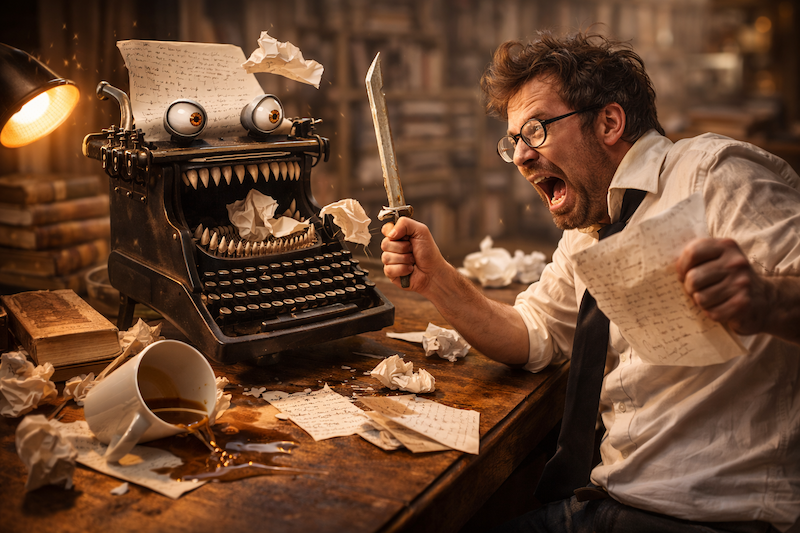
Kill Your Darlings: Why Your Most Brilliant Scenes Are Secretly Destroying Your Book

That scene you've polished until it gleams like a diamond? The one you read aloud to friends at dinner parties? The passage that made you think, 'Finally, I've written something truly magnificent'? It needs to die. I know this hurts. I know you're already composing an angry response about how I don't understand your artistic vision. But here's the uncomfortable truth that every professional writer eventually learns: the scenes we love most are often the ones sabotaging our work.

The phrase 'kill your darlings' gets thrown around writing circles like confetti at a wedding, but few people know its origin. It's commonly attributed to William Faulkner, but the real culprit was Arthur Quiller-Couch, a Cambridge professor who wrote in 1914: 'Whenever you feel an impulse to perpetrate a piece of exceptionally fine writing, obey it—whole-heartedly—and delete it before sending your manuscript to press.' Notice he didn't say 'consider deleting' or 'maybe think about trimming.' He said delete. Period. The man wasn't mincing words.

So why do our best scenes betray us? Here's the dirty secret: when we write something we consider brilliant, we unconsciously build a shrine around it. The rest of the manuscript starts orbiting this golden passage like planets around the sun. We contort our plot to justify its existence. We slow the pacing to give readers time to properly appreciate our genius. We become architects designing an entire building just to house one fancy chandelier. Stephen King cut his favorite scene from 'The Stand'—a lengthy, beautifully written piece about a character's journey through the Lincoln Tunnel. Why? Because no matter how gorgeous the prose, it stopped the story dead. The book was 1,200 pages, and King recognized that even masterful writing must serve the narrative, not the author's ego.

Let me give you a practical test. Take your favorite scene—yes, that one—and ask yourself three brutal questions. First: if you removed this scene entirely, would the plot still make sense? If yes, you have a problem. Second: does this scene exist primarily to showcase your writing skills rather than advance character or story? Be honest. Third: did you spend more time revising this scene than any other of similar length? Excessive polishing is often a red flag that you're protecting something that doesn't deserve protection.

F. Scott Fitzgerald provides the perfect cautionary tale. His original manuscript for 'The Great Gatsby' contained a scene where Nick Carraway attended a elaborate party that Fitzgerald considered his finest work to date. His editor, Maxwell Perkins, suggested cutting it. Fitzgerald reportedly agonized for weeks before finally agreeing. The published novel is 47,000 words of precision—every scene earns its place. That 'brilliant' party scene? Nobody misses it because nobody knows it existed. The book became a masterpiece partly because Fitzgerald trusted his editor over his ego.

Here's what happens psychologically when we write something we love: our brain releases dopamine, creating a pleasure association with that specific passage. We literally become addicted to our own words. Every time we reread that scene, we get another little hit. This is why writers will fight to the death over keeping a paragraph that objectively damages their work. We're not defending art—we're defending our drug supply. Recognizing this pattern is the first step toward recovery.

The practical advice nobody wants to hear: create a 'darlings graveyard.' Every time you cut a beloved scene, paste it into a separate document. This psychological trick works wonders because you're not really killing anything—you're just relocating it. Tell yourself you might use it later, in another project. You probably won't, but the lie makes deletion bearable. I have a file with 40,000 words of 'brilliant' cuts from various projects. I've never retrieved a single sentence. But knowing they exist somewhere lets me sleep at night.

Raymond Carver's editor, Gordon Lish, famously cut up to seventy percent of some stories. Carver's reaction? He hated it initially, then grudgingly admitted the work was stronger. The minimalist style that made Carver famous wasn't entirely his creation—it emerged from aggressive editing. His 'darlings' included lengthy backstories, elaborate metaphors, and detailed descriptions. What remained was sharp, devastating, unforgettable. Sometimes the best version of your work exists underneath all that writing you're so proud of.

Now, I'm not suggesting you delete everything you love. That way lies creative paralysis and joyless prose. The goal isn't to punish yourself for writing well—it's to develop the judgment to distinguish between scenes that serve the story and scenes that serve your ego. A truly great scene makes readers forget they're reading. A 'darling' makes readers admire the writer. Feel the difference? One pulls you into the narrative; the other pulls you out to appreciate the craftsman's hand. Both might contain beautiful sentences, but only one belongs in your book.

Here's your homework, and I want you to actually do this, not just nod and forget. Print your current project. Yes, on paper, like a caveman. Read it with a red pen, marking every scene that makes you think, 'Damn, I'm good.' Those marks are your hit list. Not all of them need to die, but each one needs to justify its existence beyond 'I worked really hard on this' or 'This is my favorite part.' The scenes that survive this interrogation will be stronger for having been questioned. The ones that don't? They were always going to hold you back.

The hardest lesson in writing isn't learning to create beauty—it's learning to sacrifice it. Every professional writer has a story about the scene they mourned, the passage they still remember fondly, the darling they killed despite loving it desperately. And every single one will tell you the same thing: the book was better for it. Your attachment to a scene is not evidence of its quality. Sometimes it's evidence of the opposite. The willingness to cut what you love most separates amateurs from professionals, hobbyists from artists. So sharpen your knife, pour yourself a drink, and start killing. Your book is waiting to become what it's meant to be—and it can't do that while you're busy protecting your ego.

Nothing to read? Create your own book and read it! Like I do.

Create a book
1x

"Write with the door closed, rewrite with the door open." — Stephen King