Joke
Feb 2, 09:02 PM
The Unread Author
Bookmark at page 3.
For six months.
Book is mine.
I wrote it.
Discover interesting content about books and writing
Bookmark at page 3.
For six months.
Book is mine.
I wrote it.
Every writer knows the feeling: you sit down at your desk, open a fresh document, and nothing comes. The cursor blinks like a metronome counting the seconds of silence in your head. Writer's block is one of the oldest creative afflictions — and one of the most misunderstood. It is not laziness, not a lack of talent, and certainly not a sign that you should quit.
What if the solution to writer's block is not to fight it alone, but to invite an intelligent collaborator to the table? Artificial intelligence is quietly transforming the way authors approach the blank page, and the results are worth paying attention to.
## Why Writer's Block Happens in the First Place
Before we talk about solutions, it helps to understand what is actually going on. Psychologists generally identify several root causes of creative block: perfectionism (the fear that your first draft won't be good enough), decision fatigue (too many possible directions and no clear path), burnout (the well of ideas has simply run dry), and isolation (writing alone with no feedback loop). Each of these has a different remedy — and this is where AI becomes genuinely useful, because it can address all four at once.
## The AI Brainstorming Partner You Didn't Know You Needed
One of the most effective ways to break through a block is to start a conversation. Writers have always done this — calling a friend, joining a workshop, talking to an editor. AI tools now offer that same dynamic, available at any hour. You can describe the vague shape of an idea and ask for ten variations. You can paste a paragraph that feels stuck and ask for three alternative directions. You are not handing over creative control; you are using the AI as a sounding board. The decision about what to keep and what to discard remains entirely yours. Think of it as a creative sparring partner who never gets tired and never judges your rough drafts.
## Five Practical Ways AI Can Unblock Your Writing Today
Here are specific techniques you can try the next time you hit a wall:
**1. The "What If" Generator.** Give the AI your premise and ask it to produce a list of "what if" scenarios. If you are writing a mystery novel and your detective has reached a dead end, ask the AI: "What if the victim was not who everyone assumed?" or "What if the key witness is lying for sympathetic reasons?" These prompts are not meant to write the book for you — they are meant to crack open the door so your own imagination can walk through.
**2. Character Interviews.** Ask the AI to role-play as one of your characters and then interview them. What do they want? What are they hiding? What do they sound like when they are angry? This exercise often reveals motivations and backstory details that were lurking in your subconscious but had not yet found their way onto the page.
**3. Scene Scaffolding.** When you know what needs to happen in a chapter but cannot figure out how to begin, ask the AI to draft a rough structural outline: opening image, escalating tension, turning point, resolution. You are not copying the output — you are using it as scaffolding that you will replace with your own prose, brick by brick.
**4. Tone and Style Experiments.** Paste a passage and ask the AI to rewrite it in a different tone — more humorous, more lyrical, more terse. Seeing your own material through a different stylistic lens often breaks the mental logjam and reminds you what your authentic voice actually sounds like by contrast.
**5. The Freewrite Prompt Chain.** Ask the AI to give you a series of unrelated creative prompts, one every five minutes. Write without stopping, without editing, without judging. The goal is volume, not quality. After thirty minutes, you will almost certainly find a sentence or an image that sparks something real.
## A Real-World Example
Consider the case of a novelist working on a historical fiction project set during the 1920s. She had completed six chapters and then stalled completely — the plot had backed itself into a corner. Using an AI assistant, she fed in her chapter summaries and asked for five possible plot developments that would honor the established character arcs. Three of the suggestions were unusable, one was interesting but wrong for the tone, and the fifth unlocked an entirely new subplot involving a secondary character she had nearly abandoned. That subplot became the emotional heart of the finished book. The AI did not write the novel. It handed her the key she could not find on her own.
## Where Platforms Like Yapisatel Fit In
Modern AI platforms designed specifically for writers take these techniques further by integrating them into a complete creative workflow. On platforms such as yapisatel, authors can generate plot ideas, develop character profiles, outline entire books, write and refine chapters, and even get comprehensive reviews of their manuscripts — all in one place. The advantage over generic AI chatbots is specialization: these tools understand narrative structure, pacing, genre conventions, and the specific needs of long-form storytelling. They are built by people who understand that writing a novel is fundamentally different from writing an email.
## The Fear That AI Will Replace Writers
Let us address the elephant in the room. Many writers worry that using AI somehow diminishes their creative authenticity. This concern is understandable, but it rests on a misunderstanding. A carpenter who uses a power drill instead of a hand drill is not less of a craftsman. A musician who uses a digital audio workstation is not less of an artist. AI is a tool — an unusually powerful and flexible one, but a tool nonetheless. The story you want to tell, the voice you bring to it, the emotional truth at its center — these remain irreplaceably human. No algorithm can replicate the specific texture of your lived experience or the particular way you see the world.
## Building a Sustainable Creative Practice
The deepest value of AI for writers may not be any single feature but rather something more subtle: it lowers the activation energy required to start. And starting is almost always the hardest part. When you know that you have a collaborator ready to help you brainstorm, outline, or push past a difficult scene, the blank page becomes less intimidating. Over time, this reduces the frequency and severity of creative blocks. You develop a habit of forward motion, and that momentum becomes self-sustaining.
## Your Next Step
If you are currently staring at a stalled manuscript or an empty document, try one of the five techniques described above. You do not need to commit to anything permanent — just experiment. Let AI handle the heavy lifting of generating raw material, and then bring your own judgment, taste, and voice to shape it into something meaningful. The block is not a wall. It is a door that opens from the other side, and sometimes you just need someone — or something — to knock.
The writers who thrive in the coming years will not be those who avoid new tools, but those who learn to use them wisely. Your story is still yours. AI just helps you find your way back to it.
Writing retreat roommate also writes. 5am: typing. Noon: typing. Midnight: typing. Me: zero words. Roommate: 47,000 words. Checked roommate's screen. Same sentence. For three days. Copying it.
Every writer knows the feeling. You sit down at your desk, open a fresh document, and the cursor blinks back at you like a metronome counting the seconds of your silence. Writer's block is not a myth — it is a well-documented psychological phenomenon that has tormented authors from Tolstoy to Stephen King. But what if the solution to a centuries-old problem arrived in the form of a technology that is barely a decade old?
Artificial intelligence is quietly reshaping the way writers work, not by replacing human creativity but by acting as a catalyst for it. In this article, we will explore practical, proven ways AI tools can help you push past the paralysis of the blank page and rediscover the joy of writing.
## Understanding the Root of the Block
Before we talk solutions, it helps to understand what writer's block actually is. Psychologists generally identify three main triggers: perfectionism (the fear that your first draft will not be good enough), decision fatigue (too many possible directions for your story), and creative exhaustion (you have simply run out of raw material in your mental reserves). The good news is that AI can address all three — not by thinking for you, but by lowering the stakes of each individual creative decision.
## Technique 1: Use AI as a Brainstorming Partner
One of the simplest and most effective ways to break a block is to generate a list of twenty bad ideas. Seriously. When you remove the pressure to be brilliant, your brain relaxes, and genuine inspiration often sneaks in through the back door. AI excels at this exercise. Ask it to give you fifteen possible plot twists for your stuck chapter, or ten character motivations you have not considered. You will reject most of them — and that is the point. The act of evaluating ideas is itself a creative process that reignites your thinking.
Try this right now: describe your current scene to an AI assistant and ask for five wildly different ways the conversation between your characters could end. You will be surprised how quickly your own imagination responds with "No, not that — but what about this?"
## Technique 2: Let AI Write the Worst First Draft
Perfectionism kills more novels than rejection letters ever will. Many writers freeze because they cannot bear to write a mediocre sentence. Here is a liberating trick: let the AI write a rough version of the scene you are stuck on. It will not be your voice — it will not capture your vision — and that is exactly why it works. Reading an imperfect version of your scene gives your inner editor something to react against. Suddenly you know what the paragraph should sound like, because you can see clearly what it should not sound like.
This approach is particularly powerful for opening chapters and transition scenes — the places where writers most commonly stall. Generate a draft, then rewrite it entirely in your own style. The blank page is no longer blank, and the creative friction does the rest.
## Technique 3: Build Story Structure Before You Write
Sometimes the block is not about words at all — it is about architecture. You do not know what happens next because you never fully mapped where your story is going. Modern AI platforms designed for writers, such as yapisatel, allow you to generate detailed chapter outlines and plot structures before you write a single line of prose. This means you can stress-test your narrative arc, identify weak points, and build confidence in your story's direction — all before the pressure of actual drafting begins.
Think of it like building scaffolding before constructing a wall. The scaffolding is not the building, but without it, the bricklayer has nowhere to stand. A solid outline created with AI assistance gives you that creative scaffolding.
## Technique 4: Change Your Entry Point
Who says you have to write scenes in order? If Chapter Seven is giving you trouble, skip to Chapter Twelve. Use AI to generate a brief summary of the skipped sections so you have continuity context, and keep writing where the energy is. Many professional authors — including Toni Morrison and George R.R. Martin — have talked about writing out of sequence. AI just makes this easier by maintaining a consistent reference you can check against when you return to fill in the gaps.
## Technique 5: Use AI for Character Conversations
Here is an exercise that sounds unusual but works remarkably well. Open a chat with an AI and ask it to respond as one of your characters. Then interview that character. Ask them about their childhood, their fears, what they had for breakfast, what they would never forgive. You are not looking for canonical answers — you are looking for sparks. Often, one unexpected reply will illuminate an entire subplot you had not considered, and suddenly the block dissolves because you have somewhere urgent to go.
## The Myth of Cheating
Let us address the elephant in the room. Some writers worry that using AI is a form of cheating. But consider this: no one accuses a songwriter of cheating for noodling on a piano before writing lyrics. No one accuses an architect of cheating for using CAD software instead of drawing every line by hand. AI is an instrument. The melody still comes from you.
The writers who thrive with AI tools are the ones who use them to amplify their own creative instincts — not to outsource them. On platforms like yapisatel, authors retain full creative control while using AI to handle the mechanical parts of the process: generating initial structures, checking consistency, and offering suggestions that the writer is always free to ignore.
## A Practical Daily Routine to Beat the Block
If you are currently stuck, try this simple daily protocol for one week. First, spend five minutes asking an AI to generate random prompts related to your genre. Second, pick the one prompt that irritates you the most — irritation is a sign of creative engagement. Third, write for twenty minutes in response to that prompt, without stopping to edit. Fourth, at the end of the week, review what you have written. You will almost certainly find at least one passage worth keeping, and more importantly, you will have rebuilt the habit of putting words on a page.
## The Cursor Does Not Have to Win
Writer's block feels permanent when you are inside it, but it never is. It is a temporary disruption of the creative signal, and AI offers a genuinely new way to restore that signal — not by replacing your voice, but by giving it a surface to push against. Whether you use AI to brainstorm, outline, draft, or simply hold a conversation with a fictional character, the result is the same: you start writing again.
If the blank page has been staring you down, consider giving one of these techniques a try today. Open any AI writing tool, describe your stuck moment in plain language, and see what comes back. The worst that can happen is you get a bad idea — and as every experienced writer knows, a bad idea is infinitely more useful than no idea at all.
Writer stares at blank page for six hours. Finally types one sentence.
Bookshelf creaks. Hemingway's collected works fall. Spine lands open to: "Write drunk, edit sober."
Writer looks at clock. 9 AM.
Bookshelf creaks again. Fitzgerald falls open: "Don't listen to him."
Every writer knows the feeling: you sit down at your desk, open a blank document, and... nothing. The cursor blinks mockingly. Minutes stretch into hours, and the page stays white. Writer's block is one of the oldest and most universal creative struggles — yet in 2026, it no longer has to be a dead end.
Artificial intelligence has quietly become one of the most powerful allies a writer can have. Not as a replacement for human creativity, but as a catalyst that helps restart the engine when it stalls. Whether you're working on your first novel or your fifteenth, understanding how AI can help you push past creative barriers is a skill worth developing.
## Why Writer's Block Happens in the First Place
Before we talk about solutions, it's worth understanding the problem. Writer's block rarely comes from a lack of talent. More often, it stems from perfectionism — the fear that the next sentence won't be good enough. Sometimes it's decision fatigue: too many possible directions for the story and no clear path forward. Other times, the writer simply runs out of raw material — they've used up their mental stockpile of ideas and haven't replenished it. Each of these causes requires a different approach, and this is where AI tools become genuinely useful.
## The Brainstorming Partner Who Never Gets Tired
One of the simplest yet most effective ways AI helps with creative block is brainstorming. Imagine you're writing a mystery novel and your detective has just arrived at the crime scene — but you have no idea what the crucial clue should be. You could stare at the ceiling for an hour, or you could describe your scenario to an AI assistant and ask for fifteen possible clues. You won't use most of them. But one or two will spark something, and suddenly you're writing again. The key insight here is that AI doesn't need to give you the perfect answer. It just needs to give you enough raw material to trigger your own creativity. Think of it as tossing pebbles into a still pond — the ripples do the real work.
## Breaking the Outline Barrier
Many writers get stuck not at the sentence level but at the structural level. They have a concept for a book but can't figure out how to organize it into chapters, arcs, and turning points. This is where AI-powered planning tools shine. Modern platforms like yapisatel allow authors to generate detailed chapter outlines from a summary, then refine and reshape them before writing a single page. This transforms the overwhelming question of "how do I write a whole book?" into the much more manageable question of "how do I write this specific scene?" Structure removes ambiguity, and ambiguity is one of the biggest fuel sources for creative block.
## The "Bad First Draft" Technique, Supercharged
Every writing teacher will tell you: give yourself permission to write badly. The first draft is supposed to be rough. But knowing this intellectually and actually doing it are two different things. AI can help bridge that gap. Try this: describe a scene you're struggling with in plain, conversational language — almost like you're telling a friend what happens. Then ask AI to expand it into a narrative draft. The result won't be publishable, but it gives you something concrete to react to. You'll read it and think, "No, the tone is wrong here" or "Actually, the character would say something sharper." Suddenly you're editing instead of creating from scratch, and editing is almost always easier than generating. This psychological shift — from blank-page panic to revision mode — is one of AI's most underrated benefits for writers.
## Character Development When You're Stuck
Another common block point: your characters feel flat, and you don't know how to deepen them. AI can help you run thought experiments. Ask it to generate a backstory for your character, or to suggest how a character with specific personality traits would react in a given situation. You can interview your own characters through AI, asking questions you hadn't thought to ask before. What's their earliest memory? What do they lie about? What are they afraid of that they'd never admit? These exercises often reveal dimensions of a character that break open entire plot possibilities you hadn't considered.
## Overcoming the Midpoint Slump
The middle of a novel is where most books go to die. The initial excitement has faded, the ending is still far away, and the writer loses momentum. AI can help you map out the connective tissue between your strong opening and your planned finale. It can suggest subplots, complications, or character conflicts that create forward momentum through the sagging middle section. On platforms such as yapisatel, authors can use preliminary review features to evaluate their story plan before they commit to writing — catching structural weaknesses early, when they're cheap to fix, rather than discovering them fifty thousand words in.
## What AI Cannot Do (And Why That's Good)
Let's be honest about the limitations. AI cannot feel what your story means. It cannot channel the specific heartbreak of your lived experience or the precise humor that makes your voice unique. It doesn't know why a particular sentence matters to you or why a certain metaphor captures exactly the right shade of emotion. These things are yours, and they're irreplaceable. What AI does is handle the mechanical and generative heavy lifting — the brainstorming, structuring, and drafting — so that your creative energy is free for the work that only you can do. The best writers using AI aren't those who outsource their creativity. They're the ones who use AI to clear the path so their creativity can flow without obstruction.
## Practical Tips for Using AI to Beat Writer's Block
Here are five concrete strategies you can try today. First, the "ten options" method: whenever you're stuck on a decision, ask AI for ten alternatives and pick the one that resonates. Second, the "scene sketch" approach: describe what needs to happen in a scene in plain language and let AI draft a version you can react against. Third, use AI to write from a different character's perspective — seeing your story through another set of eyes often reveals new possibilities. Fourth, try the "what if" game: feed AI your current plot and ask it to suggest five unexpected complications. Fifth, when you're truly stuck, step away from your manuscript entirely and use AI to do a creative exercise — write a short poem, a fake news article from your story's world, or a diary entry from your villain's childhood. These lateral moves often unstick your thinking in ways that direct effort cannot.
## The Writer's Block Paradox
Here's something counterintuitive: the more tools you have for overcoming creative block, the less often it occurs. When you know that getting stuck isn't a dead end — just a temporary pause before you deploy one of your strategies — the anxiety around it diminishes. And since anxiety is one of the primary causes of block in the first place, this creates a virtuous cycle. Writers who integrate AI into their process often report not just faster output but a more relaxed, enjoyable creative experience overall.
## Moving Forward
Writer's block is real, but it's not a wall. It's more like a locked door — and in 2026, you have more keys than any generation of writers before you. AI tools won't write your book for you, and they shouldn't. But they can help you brainstorm when ideas dry up, structure when planning overwhelms you, draft when perfectionism paralyzes you, and explore when your imagination needs a push. The blank page is not your enemy. It's an invitation. And now, you have a creative partner ready to help you answer it. If you've been struggling with a stalled project or an idea that won't take shape, consider giving AI-assisted writing a try — you might be surprised how quickly the words start flowing again.
Son drew picture of daddy at work.
Daddy at computer. Very detailed. Even the coffee cup.
Teacher: "Why is daddy crying?"
Son, matter-of-fact: "The words are bad again."
Teacher looks at me during pickup. I have no defense.
Son: "The cursor was angry too. It kept blinking."
Every writer you admire has lied to you. That beautiful morning routine Hemingway described? The disciplined schedule Murakami swears by? The sober, ascetic lifestyle your favorite contemporary author claims to maintain? It's all carefully curated mythology. Pull back the curtain on any celebrated author's 'writing process,' and you'll find a mess of contradictions, exaggerations, and outright fabrications designed to make them seem more romantic, disciplined, or tortured than they actually are.
Let's start with the granddaddy of all writing lies: the sacred morning ritual. Hemingway famously claimed he wrote standing up, starting at first light, producing exactly 500 words before stopping mid-sentence so he'd know where to pick up tomorrow. Sounds beautiful, right? Except his letters reveal days, sometimes weeks, where he produced nothing but excuses. His editor, Maxwell Perkins, had to practically drag manuscripts out of him. The standing desk? He used it sometimes. When his back hurt. The rest of the time he wrote wherever he damn well pleased, often hungover, often horizontal.
Then there's the 'I write every single day' crowd. Stephen King claims he writes 2,000 words daily, including Christmas. Anthony Trollope allegedly produced 250 words every fifteen minutes by the clock. These stories have spawned a cottage industry of guilt among aspiring writers who can't maintain such discipline. But here's what they don't tell you: King has admitted to periods of complete creative drought. Trollope? He had servants, no children to raise, and a government job that left him with abundant free time. Context matters, but it doesn't make for inspiring interviews.
The sobriety myth might be the most insidious lie of all. Modern authors love claiming they write best with clear heads, sipping green tea and doing yoga. Meanwhile, literary history is a graveyard of functioning alcoholics who produced masterpieces while thoroughly pickled. Faulkner allegedly wrote most of 'As I Lay Dying' in six weeks while working the night shift at a power plant, sustained by whiskey. Dorothy Parker wrote hungover more often than not. Raymond Chandler would go on benders, then emerge with some of the sharpest prose in American detective fiction. Today's authors pretend they've evolved beyond this, but visit any literary festival after-party and watch that green tea transform into bourbon.
The 'first draft genius' lie deserves special mention. You've heard authors claim their prose flows perfectly formed, requiring minimal revision. Jack Kerouac supposedly wrote 'On the Road' in three weeks on a continuous scroll of paper, pure spontaneous brilliance. Except he'd been working on the material for years. That 'scroll draft' was actually his seventh attempt at the novel, and it still required significant editing before publication. The spontaneous masterpiece is almost always a carefully constructed myth designed to make genius seem effortless.
Writer's block denial is another favorite fabrication. Successful authors love claiming they've never experienced it, that discipline conquers all. They make it sound like showing up is enough. Tell that to Harper Lee, who published one novel and spent the rest of her life reportedly paralyzed by expectations. Tell it to Ralph Ellison, who worked on his second novel for forty years and never finished it. These aren't failures of discipline; they're proof that the creative process is far more mysterious and fragile than the productivity gurus want you to believe.
The 'I don't read reviews' lie is universal and universally false. Every single author reads their reviews. They claim they don't to seem above the fray, too focused on their art to care about public opinion. Norman Mailer didn't just read his reviews; he once headbutted a critic at a party. Truman Capote memorized his negative reviews and would recite them while drunk, adding his own commentary. Jonathan Franzen claims indifference to criticism while simultaneously writing essays defending himself against it. The truth is writers are desperately insecure creatures who read everything written about them, often multiple times.
Then there's the romantic poverty narrative. Authors love suggesting they suffered for their art, writing in freezing garrets, choosing literature over financial security. J.K. Rowling's welfare-to-billionaire story is legendary. What gets mentioned less: her ex-husband was a journalist, she had a teaching degree to fall back on, and her sister worked in publishing. This isn't to diminish her struggles, but the complete destitution narrative has been polished smooth. Similarly, plenty of your favorite 'starving artists' had trust funds, wealthy spouses, or day jobs they conveniently forget to mention.
The 'my characters write themselves' claim might be the most annoying fabrication. Authors love suggesting their creations take on independent life, making decisions the author never planned. It sounds mystical and removes responsibility for controversial choices. But characters don't write themselves any more than sculptures carve themselves. Every word is a deliberate choice. When George R.R. Martin kills a beloved character, it's not because the character 'had to die' – it's because Martin decided to kill them. The mystification of craft is just another form of self-protection.
Outline denial rounds out our catalog of lies. Pantsers – writers who claim to write 'by the seat of their pants' with no outline – are often secret planners ashamed to admit it. Writing without an outline sounds more creative, more artistic, more spontaneous. But even the most famous pantsers usually have extensive notes, character sketches, and mental roadmaps they conveniently forget to mention. Meanwhile, rigid outliners pretend their planning is minimal to avoid seeming mechanical. The truth falls somewhere in the messy middle that doesn't make for good interviews.
So why do authors lie about their habits? Because the truth is boring, embarrassing, or insufficiently romantic. Nobody wants to hear that your bestseller was written in stolen moments between childcare duties, fueled by cold coffee and desperation. Nobody wants to know you spent three months playing video games between chapters. The mythology of authorship requires suffering, discipline, and a touch of madness – and if reality doesn't provide these elements, authors will manufacture them.
Here's the liberating truth buried under all these lies: there is no correct way to write. The authors you admire didn't succeed because of their morning routines or daily word counts. They succeeded despite their chaotic, inconsistent, often unhealthy processes. They succeeded because they finished books that people wanted to read. Everything else is narrative decoration.
The next time a famous author describes their pristine creative process, smile and nod. Then go write however you actually write – in bed, at midnight, surrounded by snacks, with the TV on in the background. Your habits don't need to be Instagram-worthy. They just need to produce pages. The dirty secret of literature is that the words on the page are all that ultimately matters, and nobody needs to know how they got there.
"How's the novel going?"
"Blocked. Cat's sitting on my keyboard."
"Just move him."
"I can't. He's written three chapters while sitting there."
"So?"
"They're better than mine. My agent wants to represent him. He's negotiating treats."
Every writer knows the feeling: you sit down at your desk, open a blank document, and nothing happens. The cursor blinks mockingly while your mind remains frustratingly empty. Writer's block isn't just an inconvenience—it's a creative crisis that has derailed countless promising projects and left authors questioning their abilities.
But here's the good news: we live in an era where artificial intelligence has become a powerful ally in the battle against creative paralysis. AI doesn't replace the writer—it serves as a collaborative partner that can help spark ideas, overcome mental barriers, and keep the creative momentum flowing. Let's explore exactly how this technology can transform your writing process.
## Understanding the Root of Writer's Block
Before we dive into solutions, it helps to understand what causes writer's block in the first place. Research suggests several common culprits: perfectionism that paralyzes action, fear of judgment, exhaustion of ideas, lack of direction, or simply the overwhelming pressure of a blank page. Sometimes the block comes from external stress; other times, it's purely creative fatigue. The beauty of AI assistance is that it can address multiple causes simultaneously.
## Breaking the Ice with AI-Generated Prompts
One of the most effective ways AI helps writers is through prompt generation. When you're staring at an empty page with no idea where to begin, an AI can offer dozens of starting points in seconds. These aren't meant to be used verbatim—they're creative kindling. A single unexpected prompt can trigger an avalanche of ideas you never would have discovered on your own.
For example, if you're writing a mystery novel and feel stuck on how to introduce your detective, an AI might suggest: "What if the detective first appears solving a completely trivial mystery that mirrors the larger case?" This reframing can unlock entirely new narrative possibilities.
## Dialogue as a Brainstorming Partner
Traditionally, writers have used friends, writing groups, or editors as sounding boards. AI now offers an always-available brainstorming partner. You can describe your plot, your characters, your themes, and receive immediate feedback and suggestions. This dialogue process often reveals solutions that were hiding in your own subconscious—you just needed someone (or something) to ask the right questions.
Modern platforms like yapisatel have refined this conversational approach, allowing authors to engage in extended creative dialogues where ideas build upon each other organically. The AI remembers context, understands your project's unique elements, and provides suggestions that actually fit your vision rather than generic advice.
## Overcoming the Perfectionism Trap
Many writers block themselves by demanding perfection from their first draft. AI helps by generating "throwaway" text—rough versions you can react to rather than create from scratch. It's psychologically easier to edit and improve existing text than to produce perfect prose from nothing. Even if you rewrite every word the AI suggests, the mere act of having something to respond to breaks the paralysis.
This approach aligns with what professional authors have always known: first drafts are supposed to be rough. AI simply makes it easier to accept this truth by giving you material to shape and refine.
## Character and Plot Development Assistance
Sometimes writer's block stems from structural problems you haven't consciously identified. Your story might be stuck because a character's motivation is unclear, or because you've written yourself into a plot corner. AI tools excel at analyzing narrative structure and identifying these hidden obstacles.
You can describe your stuck scene to an AI and ask: "Why might this not be working?" The analysis often reveals issues like pacing problems, missing conflict, or character inconsistencies. Once the problem is diagnosed, the solution frequently becomes obvious.
## The Research Acceleration Effect
Writer's block sometimes disguises itself as a research problem. You can't write the scene because you don't know enough about the historical period, the technical process, or the geographical setting. AI dramatically accelerates research by providing quick, contextual information that keeps you in creative flow rather than falling down research rabbit holes.
Need to know how a Victorian locksmith would approach a particular mechanism? What emotions a character might realistically experience in a specific situation? How a certain profession's daily routine unfolds? AI provides rapid answers that keep your writing momentum intact.
## Maintaining Consistency Across Long Projects
For novel-length works, block often strikes when writers lose track of their own story's details. What color were the protagonist's eyes in chapter three? What was the timeline of events before the current scene? AI assistants on platforms such as yapisatel can help maintain consistency by tracking character details, plot points, and timeline elements, freeing your creative energy for actual storytelling.
## Practical Tips for AI-Assisted Writing
To maximize AI's help with writer's block, consider these approaches: First, be specific in your requests—the more context you provide, the more useful the suggestions. Second, use AI output as a starting point, not an endpoint; your unique voice should always be the final filter. Third, don't be afraid to reject AI suggestions entirely—sometimes knowing what you don't want clarifies what you do want. Fourth, experiment with different types of assistance: plot suggestions, dialogue experiments, descriptive passages, or structural analysis.
## The Human Element Remains Central
It's worth emphasizing that AI doesn't diminish the writer's role—it amplifies it. The creativity, emotional truth, and personal vision that make stories meaningful all come from human experience. AI simply removes friction from the creative process. Think of it like a musician using better instruments: the tools don't create the music, but they make it easier to express what's already inside.
## Taking the First Step
If you're currently facing writer's block, here's a simple exercise: describe your stuck project to an AI assistant in as much detail as you can. Explain where you are, where you want to go, and what seems to be blocking you. Often, the act of articulating the problem—combined with AI's fresh perspective—is enough to crack the creative dam.
The blank page doesn't have to be your enemy. With AI as a collaborative partner, writer's block becomes not an insurmountable wall but a temporary obstacle with multiple available paths around it. The stories inside you deserve to be told, and the tools to help you tell them have never been more accessible. Your next chapter is waiting—sometimes you just need a little help finding your way to it.
The Annual Writer's Block Convention was canceled again this year. Not because of low attendance—three thousand authors registered. The problem was that no one could write the opening speech. The keynote speaker stared at a blank page for six hours before emailing the organizers: 'I know exactly what I want to say. I just can't seem to start.' The irony was noted by everyone present, though none could articulate it.
A minimalist writer decided to pen his autobiography. After three years of work, he proudly presented his editor with the final manuscript: a single page reading 'I was born. Things happened. I'm still here.' When asked about the missing details, he shrugged and said, 'I cut all the unnecessary parts.' The editor replied, 'But where's the story?' The writer gasped, horrified: 'I knew I over-edited something.'
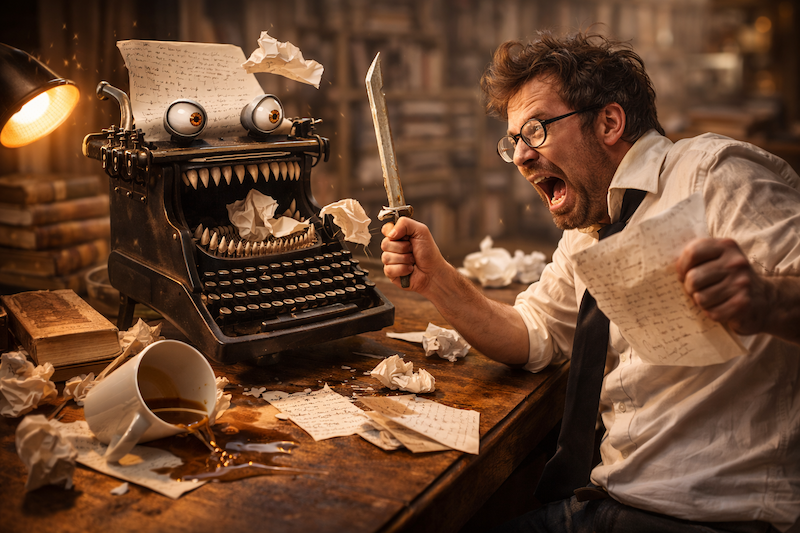

Every writer knows the feeling: you sit down at your desk, open a fresh document, and nothing comes. The cursor blinks like a metronome counting the seconds of silence in your head. Writer's block is one of the oldest creative afflictions — and one of the most misunderstood. It is not laziness, not a lack of talent, and certainly not a sign that you should quit. What if the solution to writer's block is not to fight it alone, but to invite an intelligent collaborator to the table? Artificial intelligence is quietly transforming the way authors approach the blank page, and the results are worth paying attention to.
Writing retreat roommate also writes. 5am: typing. Noon: typing. Midnight: typing. Me: zero words. Roommate: 47,000 words. Checked roommate's screen. Same sentence. For three days. Copying it.
Every writer knows the feeling. You sit down at your desk, open a fresh document, and the cursor blinks back at you like a metronome counting the seconds of your silence. Writer's block is not a myth — it is a well-documented psychological phenomenon that has tormented authors from Tolstoy to Stephen King. But what if the solution to a centuries-old problem arrived in the form of a technology that is barely a decade old? Artificial intelligence is quietly reshaping the way writers work, not by replacing human creativity but by acting as a catalyst for it.
Writer stares at blank page for six hours. Finally types one sentence. Bookshelf creaks. Hemingway's collected works fall. Spine lands open to: "Write drunk, edit sober." Writer looks at clock. 9 AM. Bookshelf creaks again. Fitzgerald falls open: "Don't listen to him."
Every writer knows the feeling: you sit down at your desk, open a blank document, and... nothing. The cursor blinks mockingly. Minutes stretch into hours, and the page stays white. Writer's block is one of the oldest and most universal creative struggles — yet in 2026, it no longer has to be a dead end. Artificial intelligence has quietly become one of the most powerful allies a writer can have. Not as a replacement for human creativity, but as a catalyst that helps restart the engine when it stalls.
Son drew picture of daddy at work. Daddy at computer. Very detailed. Even the coffee cup. Teacher: "Why is daddy crying?" Son, matter-of-fact: "The words are bad again." Teacher looks at me during pickup. I have no defense. Son: "The cursor was angry too. It kept blinking."
Every writer you admire has lied to you. That beautiful morning routine Hemingway described? The disciplined schedule Murakami swears by? The sober, ascetic lifestyle your favorite contemporary author claims to maintain? It's all carefully curated mythology. Pull back the curtain on any celebrated author's 'writing process,' and you'll find a mess of contradictions, exaggerations, and outright fabrications designed to make them seem more romantic, disciplined, or tortured than they actually are.
"How's the novel going?" "Blocked. Cat's sitting on my keyboard." "Just move him." "I can't. He's written three chapters while sitting there." "So?" "They're better than mine. My agent wants to represent him. He's negotiating treats."
Every writer knows the feeling: you sit down at your desk, open a blank document, and nothing happens. The cursor blinks mockingly while your mind remains frustratingly empty. Writer's block isn't just an inconvenience—it's a creative crisis that has derailed countless promising projects and left authors questioning their abilities. But here's the good news: we live in an era where artificial intelligence has become a powerful ally in the battle against creative paralysis. AI doesn't replace the writer—it serves as a collaborative partner that can help spark ideas, overcome mental barriers, and keep the creative momentum flowing.
The Annual Writer's Block Convention was canceled again this year. Not because of low attendance—three thousand authors registered. The problem was that no one could write the opening speech. The keynote speaker stared at a blank page for six hours before emailing the organizers: 'I know exactly what I want to say. I just can't seem to start.' The irony was noted by everyone present, though none could articulate it.
A minimalist writer decided to pen his autobiography. After three years of work, he proudly presented his editor with the final manuscript: a single page reading 'I was born. Things happened. I'm still here.' When asked about the missing details, he shrugged and said, 'I cut all the unnecessary parts.' The editor replied, 'But where's the story?' The writer gasped, horrified: 'I knew I over-edited something.'
Nothing to read? Create your own book and read it! Like I do.
Create a book"Write with the door closed, rewrite with the door open." — Stephen King
Loading comments...