Content Feed

Discover interesting content about books and writing

Night Horrors Feb 12, 12:01 AM

The Counting Game

It started as a harmless childhood habit — counting things before sleep. Tiles on the bathroom floor, books on the shelf, cracks in the ceiling. Eleanor's mother used to say she'd been born with a mathematician's brain and a poet's heart. She counted everything, always had.

So when she moved into her late Aunt Margery's cottage in the village of Dunmore, unpacking boxes alone in the October dusk, it was only natural that she counted the objects in her new bedroom before her first night's sleep.

Forty-seven.

She counted them methodically, the way she always did. The iron bedframe — one. The mattress — two. Two pillows — three, four. The oak nightstand — five. The porcelain lamp on it — six. She went on, cataloguing every item: the wardrobe, the three coat hooks on the back of the door, the oval mirror with the foxed glass, the stack of Aunt Margery's old hatboxes in the corner. The curtains, the curtain rod, the tie-backs. The small wooden chair by the window. The rug with its faded rose pattern.

Forty-seven objects. She was certain.

Eleanor turned off the lamp and lay in the unfamiliar dark. The cottage was a mile from the nearest neighbor, and the silence was unlike anything she'd known in the city. No traffic. No voices through walls. Just the occasional creak of old timber settling, and somewhere far off, an owl.

She slept well enough.

The next evening, she counted again. A ritual, a lullaby for the anxious mind.

Forty-eight.

Eleanor frowned. She sat on the edge of the bed and went through the room again, pointing at each object, whispering the numbers. The bedframe, the mattress, the pillows, the nightstand, the lamp. Everything where it should be. She reached the corner with the hatboxes and paused.

There had been four hatboxes yesterday. Now there were five.

She stared at the stack. The fifth box sat at the very bottom, slightly larger than the others, its cardboard a shade darker — the deep burgundy of old blood. She didn't remember it. She was certain — absolutely certain — it hadn't been there when she'd unpacked.

She knelt and reached for it. Then stopped. A feeling crept over her, the way cold water seeps under a door. Something told her not to open it. Not yet.

Eleanor told herself she'd simply miscounted the night before. She was tired from the move, unfamiliar with the space. That was all.

Forty-eight. Fine.

She slept, but not as well. She dreamed of her aunt's face, mouth open as though trying to speak, but producing only a thin, dry clicking sound, like someone tapping a fingernail against wood.

The third evening. She counted before she even changed for bed.

Forty-nine.

Her hands trembled as she scanned the room. Everything was the same — the bed, the nightstand, the wardrobe, the hatboxes (still five). But on the small wooden chair by the window, which had been empty, there now sat a porcelain figurine.

It was a child. A girl, maybe five or six years old, in a white dress. Her hands were clasped in front of her, and her painted eyes were wide open, staring at the bed.

Eleanor picked it up. It was cold. Colder than porcelain should be, even in an unheated room. She turned it over. On the base, in tiny script, someone had scratched two words into the glaze with something sharp:

COUNT ME.

She put it down on the nightstand, face turned toward the wall. She did not sleep. She lay rigid under the covers, listening to the house breathe around her, and she thought she heard — just once, just faintly — that clicking sound from her dream.

The fourth evening.

Fifty.

The new object was a pair of shoes. Small, black, child-sized. They sat neatly on the rug beside the bed, toes pointing toward her pillow. There was dust on them, the kind of dust that accumulates over decades. But the soles were clean. As though someone had recently walked in them.

Eleanor called her cousin David, who had handled Aunt Margery's affairs. Did Margery have children? she asked. No, David said. Never. Why do you ask?

No reason.

She moved the shoes to the hallway. She moved the figurine to the kitchen. She counted the bedroom again.

Forty-eight. Correct. Back to where it should be, minus the two objects she'd removed.

She felt a flicker of relief. Whatever was happening, she could control it. Remove what appeared. Keep the count stable.

She went to bed with the light on.

At some point in the night, she woke. The lamp was off. She hadn't turned it off. The room was pitch black, the kind of blackness that feels heavy, that presses against your open eyes.

And from the corner of the room, near the hatboxes, she heard breathing.

Not her own. She was holding her breath. This was something else — slow, shallow, deliberate. The breathing of someone who had been still for a very long time and was only now remembering how.

Eleanor couldn't move. Her body had locked, every muscle frozen in that ancient mammalian response to a predator's presence. She lay there, rigid, eyes straining against the dark, and she listened to whatever was in the corner breathe.

It went on for hours. Or minutes. She couldn't tell.

Then it stopped. And in the silence that followed, she heard a single footstep on the wooden floor.

Then another.

Then the clicking. That dry, rhythmic tapping — a fingernail against wood — and it was coming from the direction of the nightstand. Right beside her head.

Eleanor lunged for the lamp. Light flooded the room.

Nothing. No one. The room was exactly as she'd left it. She counted, gasping, her hands shaking so badly she had to start over twice.

Fifty-one.

The shoes were back. The figurine was back. And on her pillow — on the pillow her head had been resting on — there was a small, folded piece of paper.

She opened it with numb fingers. The handwriting was cramped and old-fashioned, the ink brown with age.

YOU KEEP COUNTING. GOOD.
I WAS WORRIED YOU'D STOP.
WHEN YOU REACH FIFTY-FIVE,
I'LL BE CLOSE ENOUGH TO STAY.

Eleanor packed a bag in four minutes. She drove to a motel thirty miles away and sat in the parking lot with the engine running and the headlights on, shaking.

She didn't go back. She called David and told him to sell the cottage. She didn't explain why. She moved back to the city, to her small apartment with its traffic noise and thin walls, and she told herself it was over.

But here's the thing about counting. Once you start, you can't stop.

The first night back in her apartment, she lay in bed and stared at the ceiling, and before she could help herself, she was counting. The lamp, the books, the phone charger, the water glass.

Thirty-four objects.

She closed her eyes.

The next night: thirty-five.

The new object was small. She almost missed it. A single black button, sitting on the windowsill, half-hidden behind the curtain.

She picked it up. It was cold.

On the back, scratched into the plastic with something sharp, were two words she already knew.

COUNT ME.

Eleanor dropped it. Her hands were shaking. She looked around the apartment — her apartment, her safe, familiar apartment — and for the first time noticed how many shadows there were. How the streetlight outside carved dark shapes behind every piece of furniture. How the silence between passing cars felt exactly like held breath.

She counted the button. Thirty-five.

She has twenty more to go.

She tries not to think about what happens at fifty-five. She tries not to think about the breathing, or the footsteps, or the clicking sound that she now hears some nights, faintly, from somewhere inside the walls.

Mostly, she tries not to count.

But she always does. Every night. She can't help it.

Thirty-six.

Thirty-seven.

Thirty-eight.

It's getting closer.
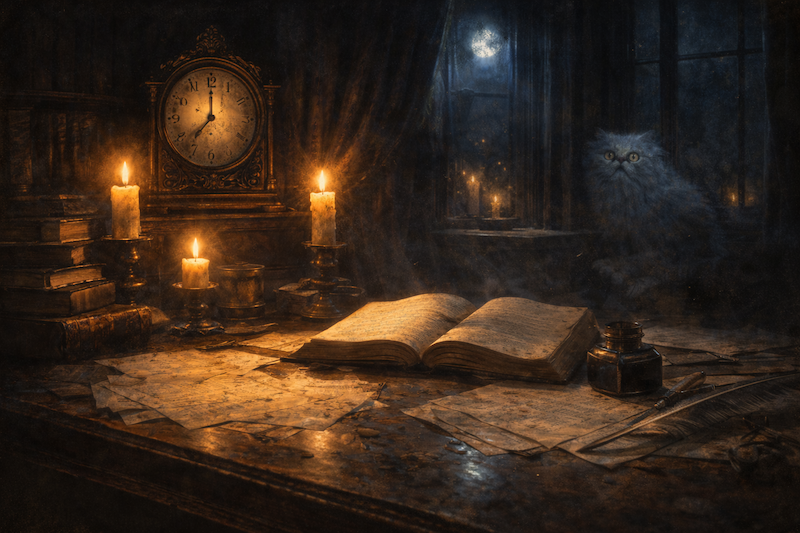
Joke Feb 2, 08:02 AM

The Productive Roommate

Writing retreat roommate also writes. 5am: typing. Noon: typing. Midnight: typing. Me: zero words. Roommate: 47,000 words. Checked roommate's screen. Same sentence. For three days. Copying it.

Dark Romance Feb 4, 06:46 PM

The Phantom of the Opera Exists, and He's in Love with Me

I never believed in ghosts until I heard him sing.

The Paris Opera House had been my dream, my escape from a mundane life in America. When the prestigious Académie de Musique offered me a position as their new soprano understudy, I abandoned everything—my apartment, my cautious boyfriend, my predictable future—and boarded a plane to France without looking back.

But from the moment I stepped onto that ancient stage, I felt eyes upon me. Burning, possessive, eternal.

They said the Phantom was a legend, a story to frighten chorus girls and sell tickets to tourists. The older performers would whisper about Box Five, always empty yet somehow occupied. About the notes written in red ink that appeared beneath dressing room doors. About the voice that echoed through the catacombs when the theatre fell silent.

They were wrong about him being a legend. He was real, he was watching, and somehow, impossibly, he had chosen me.

***

The first note appeared three weeks after my arrival.

I found it tucked into the mirror frame of my modest dressing room, the paper yellowed and elegant, the handwriting precise yet somehow desperate:

*Your voice carries sorrow you haven't yet learned to name. I could teach you to transform that pain into something magnificent. Come to the stage at midnight. Come alone.*

I should have reported it. Should have laughed it off as a prank from jealous ensemble members. Instead, I found myself standing center stage at midnight, my heart hammering against my ribs, the darkness of the empty theatre pressing against me like velvet.

"You came."

The voice seemed to emerge from everywhere and nowhere—from the gilded ceiling, from the orchestra pit, from inside my own chest. It was the most beautiful sound I had ever heard, rich and haunting, carrying centuries of loneliness in each syllable.

"Show yourself," I demanded, proud that my voice didn't tremble.

"Not yet." A pause. "Are you afraid?"

"Should I be?"

Silence. Then, impossibly soft: "Everyone else is."

"I'm not everyone else."

A sound that might have been laughter echoed through the empty seats. "No. No, you're not."

***

The lessons began that night.

He would never let me see his face, always remaining in shadow, always keeping impossible distance. But his voice guided mine, coaxing notes from my throat I never knew I could produce. He taught me to breathe from depths I didn't know existed, to feel music not as sound but as something living, something dangerous.

"Music is not meant to be safe," he told me one night, his voice closer than usual, almost a whisper against my ear though I could see nothing in the darkness. "Music is meant to consume. To possess. To make you feel things that should terrify you."

"Like you?" I asked.

Another long silence. "Yes. Exactly like me."

I should have been afraid. My colleagues certainly were when they noticed the changes in me—the dark circles under my eyes, the distant look, the way I would sometimes pause mid-sentence, tilting my head as if listening to something only I could hear.

"You're spending too much time alone in this theatre," warned Marie-Claire, the lead soprano whose position I was understudying. "There are stories, you know. About girls who become... obsessed."

"With what?"

She lowered her voice. "With him. The ghost. He's taken them before. Some say he drives them mad. Others say..." She crossed herself. "Others say worse."

"What could be worse than madness?"

Marie-Claire's eyes met mine, and I saw genuine fear there. "Loving him back."

***

The first time I saw his face, I was alone in the catacombs beneath the theatre.

I had followed the sound of music—a piano playing something so achingly beautiful it made my chest hurt. Down forgotten staircases, through passages that shouldn't exist, past underground lakes that reflected candlelight like scattered stars.

He sat at an ancient piano, his back to me, his fingers moving across the keys with desperate grace. He wore a black cloak, a white mask covering half his face.

"You shouldn't have come here," he said without turning.

"I know."

"You should run."

"I know that too."

Slowly, so slowly, he turned. The masked half of his face was beautiful—sharp cheekbones, full lips, eyes the color of smoke. But even in the dim light, I could see the scarred skin that crept past the mask's edge, could imagine what lay beneath.

"Now you see," he whispered. "Now you understand why I hide."

I walked toward him. I couldn't help it. Something beyond reason, beyond self-preservation, pulled me forward.

"I see a man who creates the most beautiful music I've ever heard," I said. "I see someone who has been alone so long he's forgotten he deserves not to be."

His hand caught my wrist before I could touch him—his grip cold, his fingers trembling. "You don't know what I am. What I've done."

"Then tell me."

His eyes searched mine, and I saw something break behind them—some wall he had built over decades, perhaps centuries, crumbling in a single moment.

"I was born in this theatre," he said, his voice barely audible. "My mother was a singer. My father... was a monster who wore a human face. I inherited both their gifts—music and monstrosity. When the world rejected me, I descended into these shadows. And here I have remained, watching, waiting."

"Waiting for what?"

His free hand rose, hovering near my face but not quite touching, as if I were something precious and forbidden. "For someone who wouldn't run when they saw the truth. For someone whose voice could match the darkness in mine."

"And have you found her?"

His eyes burned into mine. "You tell me."

***

We existed between worlds after that night.

I would perform my duties during the day—rehearsals, fittings, the endless politics of the opera world. But at night, I descended into his kingdom of shadows and music.

He showed me wonders hidden beneath the theatre—a lake that glowed with phosphorescent light, chambers filled with instruments from centuries past, manuscripts of music that had never been performed, would never be performed, written only for the darkness.

And he showed me himself, slowly, painfully—removing the mask inch by inch, letting me see the scars that mapped his face like a landscape of suffering. The first time I kissed the ruined skin of his cheek, he wept without sound, his entire body shaking.

"Why?" he asked. "Why don't you fear me?"

"Because fear and love aren't as different as people pretend," I answered. "Both make your heart race. Both keep you awake at night. Both make you do impossible things."

He pulled me close, and I felt the centuries of loneliness radiating from him like heat. "If you stay with me, you'll belong to two worlds. The light above, and the darkness below. It will tear you apart."

"Then let it."

***

But the worlds could not remain separate forever.

Marie-Claire fell ill the night of our biggest performance—Faust, appropriately enough. They needed an understudy. They needed me.

As I stood in the wings, waiting for my cue, I felt him watching from Box Five. I couldn't see him, but I knew he was there, as certain as I knew my own heartbeat.

I stepped onto the stage and began to sing. But I wasn't singing for the audience, for the critics, for my career. I was singing for him. Every note was a love letter written in sound, every breath a confession of the impossible thing that had grown between us.

The audience rose to their feet when I finished. The applause was thunderous. But I heard only silence—the profound silence of Box Five.

I found the note in my dressing room after:

*You have outgrown my shadows. The world above needs your voice more than I do. Forget me. Live in the light. Please.*

*—E*

I ran to the catacombs. Through the passages, past the lake, to the chamber where he always waited.

It was empty. The piano sat silent. The candles had been extinguished.

But on the piano bench lay his mask.

I picked it up, holding it against my chest, feeling something shatter inside me that I knew would never fully heal.

***

That was three months ago.

I am the lead soprano now. They call me a sensation, a revelation. They write articles about my "mysterious melancholy" and "haunted beauty."

They don't know I still descend to the catacombs every night. They don't know I sit at that silent piano and sing into the darkness, hoping, praying, begging for an answer that never comes.

But sometimes—sometimes—I hear a voice join mine. Distant, echoing, impossible to locate. A harmony that makes my blood sing and my heart break simultaneously.

He's still there. Still watching. Still loving me in the only way he knows how—from the shadows.

And every night, I return to those shadows, because I learned something in his arms that I can never unlearn: the light means nothing if you've tasted the dark.

The mask sits on my dressing table now. I touch it before every performance.

Someday, I tell myself. Someday he'll come for me again.

And when he does, I won't let him disappear.

***

Last night, I found a new note. The handwriting trembled more than before, the ink darker, almost desperate:

*I tried to let you go. I cannot. I am yours, always have been, always will be. Meet me where we began. Midnight. I will finally show you everything—if you still want to see.*

Midnight approaches. The empty stage awaits.

And I find myself wondering: when you love a ghost, do you become a ghost yourself?

I suppose I'm about to find out.

Nothing to read? Create your own book and read it! Like I do.

Create a book
1x

"You must stay drunk on writing so reality cannot destroy you." — Ray Bradbury