Content Feed

Discover interesting content about books and writing

Article Feb 14, 03:10 AM

The Thin Line Between Genius and Madness Was Written in Ink

Here's a dirty little secret the literary establishment doesn't like to talk about at cocktail parties: virtually every writer whose work you were forced to read in school was, by modern clinical standards, certifiably unhinged. Not eccentric. Not quirky. Not "delightfully unconventional." We're talking hallucinations, manic episodes, addiction spirals, and the kind of behavior that today would earn you a wellness check and a mandatory 72-hour hold.

And here's the kicker — that's probably why their writing was so damn good.

Let's start with the numbers, because this isn't just barroom philosophy. In 1987, psychiatrist Kay Redfield Jamison at Johns Hopkins studied prominent British and Irish writers and found that they were eight times more likely to suffer from major depressive disorder than the general population. Eight times. A later study from the Karolinska Institute in Sweden, published in 2011, examined over a million patients and their relatives and concluded that writers specifically — not painters, not musicians, writers — had a significantly higher incidence of schizophrenia, bipolar disorder, anxiety, and substance abuse. The data doesn't whisper. It screams.

Consider Edgar Allan Poe. The man who invented the detective story, pioneered psychological horror, and basically created the American short story as we know it was a raging alcoholic who married his thirteen-year-old cousin, was found delirious on a Baltimore street in someone else's clothes, and died four days later under circumstances still debated. His tales of premature burial, murderous guilt, and creeping madness weren't just stories. They were dispatches from the front lines of his own fractured psyche. You don't write "The Tell-Tale Heart" because you had a pleasant childhood and a stable relationship with your therapist.

Or take Virginia Woolf, who heard birds singing in Greek outside her window during her breakdowns. She completed some of the most luminous, structurally revolutionary novels in the English language — "Mrs Dalloway," "To the Lighthouse," "The Waves" — while battling what we'd now diagnose as bipolar disorder. Her prose literally mimics the rhythms of a mind cycling between rapture and despair. In 1941, she filled her coat pockets with stones and walked into the River Ouse. She was fifty-nine. The suicide note she left for her husband Leonard is one of the most heartbreaking documents in literary history: "I feel certain that I am going mad again. I feel we can't go through another of those terrible times."

Dostoevsky was an epileptic who described his pre-seizure auras as moments of transcendent ecstasy — a few seconds of divine clarity before the convulsions hit. He gambled away every ruble he ever earned, sometimes pawning his wife's wedding ring to fund another night at the roulette table. Yet from this chaos came "Crime and Punishment," "The Brothers Karamazov," and "The Idiot" — novels that dissected the human soul with surgical precision that Freud himself later acknowledged as superior to his own methods. Freud literally said Dostoevsky understood the unconscious better than psychoanalysis did. Let that sink in.

Hemingway drank enough to float a battleship, survived two plane crashes in consecutive days in Africa in 1954, was treated with electroshock therapy that obliterated his memory — the one tool a writer cannot afford to lose — and shot himself with his favorite shotgun in 1961. Sylvia Plath stuck her head in a gas oven at thirty. David Foster Wallace hanged himself in 2008 after decades of depression that his magnum opus, "Infinite Jest," had essentially been a 1,079-page attempt to outrun. The list doesn't end. It just gets longer and more depressing.

But why? Why this horrifying correlation between literary brilliance and psychological torment?

The neuroscience offers some clues. Research from Harvard psychologist Shelley Carson suggests that highly creative individuals have reduced "latent inhibition" — the brain's automatic filtering system that screens out irrelevant stimuli. Most people's brains are bouncers at a nightclub, letting in only what matters. A writer's brain is an open door at Mardi Gras. Everything floods in: sensory details, emotional undercurrents, contradictions, patterns, the particular way light falls on a stranger's face at four in the afternoon. This cognitive openness fuels extraordinary perception — but it also leaves the mind vulnerable to being overwhelmed. The same neural architecture that lets you write a sentence that makes a stranger weep can also make the sound of a ticking clock feel like psychological warfare.

There's also the uncomfortable truth that suffering generates material. Philip Larkin wrote, "Deprivation is for me what daffodils were for Wordsworth." He wasn't being glib. Pain strips away pretense. It forces a confrontation with the raw machinery of existence that comfortable, well-adjusted people can happily avoid their entire lives. Kafka, who spent his nights writing feverish parables about alienation and transformation while working as an insurance clerk by day, understood this intimately. He asked his friend Max Brod to burn all his manuscripts after his death. Brod refused. Thank God for disloyal friends.

Now, before someone accuses me of romanticizing mental illness — I'm not. Mental illness is not a prerequisite for good writing, and suggesting otherwise is both dangerous and idiotic. Plenty of brilliant writers have been relatively stable human beings. Tolkien was a devoted family man and Oxford professor who wrote his masterpieces between grading papers. Jane Austen produced some of the sharpest social commentary in English literature while living a quiet life in Hampshire. The myth of the tortured artist has killed people — literally — by convincing vulnerable creators that their suffering is essential to their art and that seeking help would somehow dull their edge.

What I am saying is this: the qualities that make someone a great writer — hypersensitivity to the world, an inability to accept surface-level explanations, a compulsion to dig into the ugly and uncomfortable, an awareness of mortality that most people successfully repress — are the same qualities that make ordinary life extraordinarily difficult to bear. It's not that madness creates genius. It's that genius and madness drink from the same well.

Faulkner put it best, as he usually did, with characteristic Southern understatement wrapped around a hand grenade: "The writer's only responsibility is to his art. He will be completely ruthless if he is a good one... If a writer has to rob his mother, he will not hesitate; the 'Ode on a Grecian Urn' is worth any number of old ladies." That level of obsessive devotion — the willingness to sacrifice everything, including your own sanity, for the right sentence — isn't normal. It was never supposed to be.

So the next time you crack open a novel that rearranges your understanding of what it means to be human, spare a thought for the person who wrote it. They probably did so at three in the morning, half-drunk, fully terrified, hearing birds sing in Greek, with a brain that refused to let the world's noise stay outside. They paid for every perfect paragraph with something you and I will never have to. The least we can do is read the damn book.

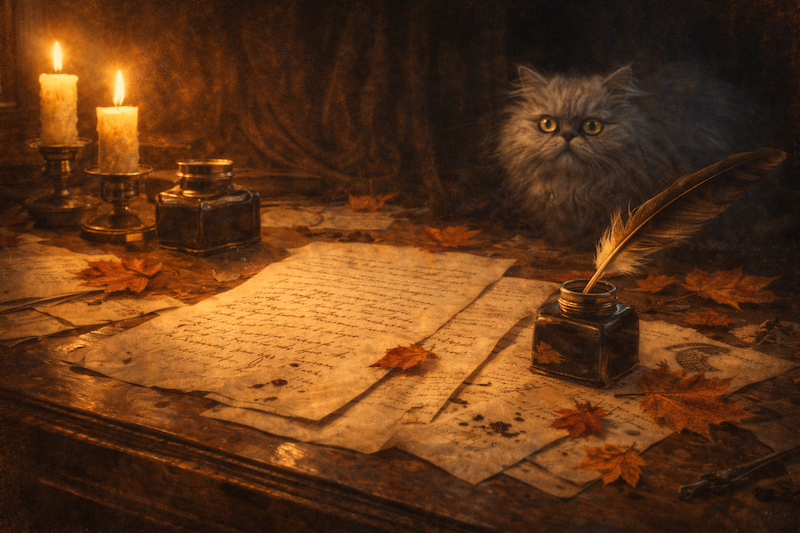
Poetry Continuation Feb 13, 02:36 PM

Annabel Lee: The Tides Beyond

Creative Poetry Continuation

This is an artistic fantasy inspired by the poem «Annabel Lee» by Edgar Allan Poe. How might the verse have sounded if the poet had continued their thought?

Original excerpt

And so, all the night-tide, I lie down by the side
Of my darling—my darling—my life and my bride,
In her sepulchre there by the sea—
In her tomb by the sounding sea.

— Edgar Allan Poe, «Annabel Lee»

Annabel Lee: The Tides Beyond
(A continuation, after Edgar Allan Poe)

— Original ends: —
"And so, all the night-tide, I lie down by the side
Of my darling—my darling—my life and my bride,
In her sepulchre there by the sea—
In her tomb by the sounding sea."

— The continuation: —

And so, when the stars rose over the sea,
I heard her voice on the salted air—
My beautiful Annabel Lee—
A whisper that wound through my tangled hair,
A sorrow too vast to bear.

The angels had taken her, cold and keen,
But never could sever the silvered thread
That bound me still to my radiant queen,
That tethered the living unto the dead,
In a kingdom beyond the seen.

For the moon never beams without bringing me dreams
Of the garden where once she would wait—
Where the roses bloomed crimson in silent screams
And the fountain kept vigil by fate—
And I see her there, pale in the gaslight's gleams,
At the edge of the iron gate.

And the wind—ah, the wind!—it remembers her name,
It carries her laughter like rain,
And the ocean repeats it, a thundering claim
That rolls through each trembling pane—
Annabel, Annabel, burning flame,
That I shall not speak in vain.

I have walked by the shore where the breakers moan,
Where the kelp twists in funeral bands,
And I swear by the heavens I am not alone—
For I feel the press of her hands,
Cold as marble, yet gentle as tone
Of a harp played on desolate strands.

The seraphs above may begrudge me still,
Those demons of envious wing,
But neither their malice, nor heaven's chill will
Can silence the song that I sing—
For love is a force beyond death's darkest skill,
An imperishable, glorious thing.

And I know, when at last the black tides shall rise
And the stars burn their funeral white,
I shall follow her voice through the thundering skies,
Through the corridors measureless, bright—
And gaze once again in her luminous eyes,
My Annabel, bride of the night.

So I wait by the tomb where the sea-grasses sway,
Where the salt and the sorrow entwine,
For the hour, the moment, the glimmering day
When her kingdom shall merge into mine—
And together we'll drift on the tides far away,
Past the last of the mortal design—
In a love that no angel can slay,
In a bond that is deathless, divine—
With my darling, my darling, for whom I shall pray,
My Annabel Lee—ever mine.

Joke Jan 25, 07:25 PM

Edgar Allan Poe's Roommate Ad

Edgar Allan Poe posts a roommate ad:

"Seeking quiet individual. Non-smoker preferred. Must tolerate occasional raven. No questions about the floorboards. The previous tenant? Moved out. Suddenly. At night. His heart wasn't in it anymore."

Thirty-seven applicants. All withdrew after the interview.

Except one guy named Fortunato. Said he loved the wine cellar.

Article Feb 13, 06:33 AM

The Thin Line Between a Masterpiece and a Straightjacket

Here's an uncomfortable truth that your literature professor probably glossed over: the same brains that produced the greatest works of Western civilization were, to put it delicately, deeply broken. We're not talking about quirky eccentricities or charming absent-mindedness. We're talking about full-blown psychosis, crippling depression, hallucinations, and the kind of behavior that today would get you a mandatory psychiatric hold.

And yet — here's the part that keeps neuroscientists up at night — without that brokenness, we might not have any of those masterpieces at all.

Let's start with the obvious. Edgar Allan Poe married his thirteen-year-old cousin, drank himself into oblivion on a near-daily basis, and was found delirious in a gutter in Baltimore wearing someone else's clothes. He died four days later, at forty, and nobody is entirely sure what killed him. But this same man invented the detective fiction genre, pioneered psychological horror, and wrote poetry that still makes grown adults shiver. His story "The Tell-Tale Heart" reads like a clinical transcript of paranoid psychosis — because, let's be honest, it probably was.

Virginia Woolf heard birds singing in Greek outside her window. Not metaphorically. She literally heard avian creatures performing ancient Greek tragedies in her garden. She suffered from what we now recognize as bipolar disorder, swinging between states of manic creative ecstasy and paralyzing, months-long depressions. During her manic phases, she wrote some of the most innovative prose in the English language — "Mrs Dalloway," "To the Lighthouse," "Orlando." During her depressive phases, she couldn't get out of bed. In 1941, she filled her coat pockets with stones and walked into the River Ouse. She left behind one of the most heartbreaking suicide notes ever written — and a body of work that fundamentally rewired how novels could function.

Fyodor Dostoevsky was an epileptic who experienced what he described as moments of divine clarity right before his seizures — flashes of transcendent understanding that he called "touching God." Modern neurologists recognize this as ecstatic epilepsy, a rare condition where seizure auras produce feelings of cosmic bliss. Dostoevsky gave this exact experience to Prince Myshkin in "The Idiot." He was also a compulsive gambler who lost everything, repeatedly, and wrote "The Gambler" in twenty-six days to pay off his debts. His greatest novel, "Crime and Punishment," is essentially a 500-page panic attack rendered in prose. Nobody who was mentally stable could have written it, because nobody who was mentally stable could have imagined being inside Raskolnikov's head with that level of terrifying authenticity.

Philip K. Dick believed — genuinely, sincerely believed — that a pink beam of light transmitted information directly into his brain from an ancient alien satellite in February 1974. He spent the last eight years of his life writing an 8,000-page journal called the "Exegesis," trying to make sense of this experience. He also wrote "Do Androids Dream of Electric Sheep?," "A Scanner Darkly," and "The Man in the High Castle." Half of modern science fiction cinema is just Hollywood adapting his psychotic visions into blockbusters.

Now here's where it gets scientifically interesting. In 2010, a study from the Karolinska Institute in Sweden found that the dopamine systems in highly creative people are structurally similar to those in people with schizophrenia. Specifically, both groups show lower density of D2 receptors in the thalamus — the brain's information filter. In plain English: creative brains and schizophrenic brains both let in more raw, unfiltered information than normal brains. The difference between writing "Hamlet" and believing you ARE Hamlet may literally be a matter of degree, not kind.

Sylvia Plath shoved her head into a gas oven at thirty. Ernest Hemingway put a shotgun to his forehead at sixty-one — the same way his father, his brother, his sister, and eventually his granddaughter would also die. Leo Tolstoy, at the height of his fame, became so terrified of his own suicidal urges that he hid all the ropes and guns in his house. The man who wrote "Anna Karenina" — which contains one of literature's most famous suicides — was desperately trying not to become his own character.

And it's not just depression and psychosis. Obsessive-compulsive tendencies run through literary history like a recurring motif. Marcel Proust lined his bedroom walls with cork to block out all sound and spent the last three years of his life barely leaving his bed, writing and rewriting "In Search of Lost Time" in an obsessive fever. James Joyce spent seventeen years writing "Finnegans Wake," a book that is essentially a 628-page compulsive word association exercise. Flaubert once spent five days writing a single page. Five. Days.

But here's the question nobody wants to ask: would we trade the madness for the art? If you could go back in time and give Poe a prescription for Prozac, would you? He'd probably live longer. He'd probably be happier. He'd also probably write pleasant, forgettable stories about pleasant, forgettable people. "The Raven" doesn't come from a balanced mind. "Nevermore" is not the output of someone who's been sleeping eight hours and going to therapy.

This is the cruel bargain at the heart of creative genius. The same neural wiring that produces extraordinary insight also produces extraordinary suffering. The capacity to see the world in ways nobody else can is inseparable from the capacity to be destroyed by what you see. Creativity doesn't cause mental illness, and mental illness doesn't cause creativity — but they share the same root system, tangled together underground where you can't separate one from the other without killing both.

Modern psychology has largely confirmed what literary history has been screaming at us for centuries. A 2015 study published in Nature Neuroscience, analyzing data from 86,000 Icelanders, found that people in creative professions were 25% more likely to carry genetic variants associated with bipolar disorder and schizophrenia. The genes for genius and the genes for madness are not different genes. They are the same genes, expressed at different volumes.

So the next time you crack open a novel that changes how you see the world — one that makes you feel something so deeply it rearranges your internal furniture — spare a thought for the person who wrote it. Chances are, they weren't okay. They were brilliant, yes. They were gifted beyond measure. But they were also suffering in ways that most of us will mercifully never understand. The greatest literature isn't written from a place of comfort. It's written from the edge of an abyss, by people brave enough — or broken enough — to lean over and describe what they see at the bottom.

Poetry Continuation Feb 6, 01:54 AM

The Raven's Return: A Midnight Sequel

Creative Poetry Continuation

This is an artistic fantasy inspired by the poem «The Raven» by Edgar Allan Poe. How might the verse have sounded if the poet had continued their thought?

Original excerpt

Once upon a midnight dreary, while I pondered, weak and weary,
Over many a quaint and curious volume of forgotten lore—
While I nodded, nearly napping, suddenly there came a tapping,
As of some one gently rapping, rapping at my chamber door.
'Tis some visitor,' I muttered, 'tapping at my chamber door—
Only this and nothing more.'

— Edgar Allan Poe, «The Raven»

The Raven's Return: A Midnight Sequel
A Continuation of Edgar Allan Poe's "The Raven"

Once upon a midnight weary, as I wandered, worn and teary,
Through the chamber where the Raven sat upon my chamber door—
Years had passed since that December, yet I still could well remember
Every word that spectral member spoke of Lenore, my lost Lenore—
That dark prophet still remaining, perched above my chamber door,
Whispering forever, 'Nevermore.'

And the silken, sad, uncertain rustling of each purple curtain
Thrilled me—filled me with fantastic terrors felt so long before;
So that now, to still the beating of my heart, I stood repeating:
'It is but the wind entreating entrance through my chamber door—
Only this and nothing more.'

But the Raven, never flitting, still is sitting, still is sitting
On the pallid bust of Pallas just above my chamber door;
And his eyes have all the seeming of a demon's that is dreaming,
And the lamplight o'er him streaming throws his shadow on the floor;
And my soul from out that shadow that lies floating on the floor
Shall be lifted—nevermore!

Then, methought, the air grew denser, perfumed from an unseen censer
Swung by Seraphim whose footfalls tinkled on the tufted floor.
'Wretch,' I cried, 'thy God hath sent thee—by these angels he hath lent thee
Respite—respite and nepenthe from thy memories of Lenore!
Quaff, oh quaff this kind nepenthe, and forget this lost Lenore!'
Quoth the Raven, 'Nevermore.'

'Prophet!' said I, 'thing of evil!—prophet still, if bird or devil!
By that Heaven that bends above us—by that God we both adore—
Tell this soul with sorrow laden if, within the distant Aidenn,
I shall clasp a sainted maiden whom the angels name Lenore—
Clasp a rare and radiant maiden whom the angels name Lenore!'
Quoth the Raven, 'Evermore.'

Startled by this strange new token—word so long ago unspoken—
'Evermore?' I gasped in wonder, trembling on the chamber floor.
'Dost thou speak of hope eternal? Light within this vault infernal?
After years of grief nocturnal, shall I see my lost Lenore?'
And the Raven stirred his pinions, spread them wide above the door,
Murmuring softly, 'Evermore.'

Then a light began to glimmer, and the darkness seemed to shimmer,
As if dawn itself were breaking through my long-sealed chamber door;
And I thought I heard her singing—bells of silver sweetly ringing—
And the scent of roses clinging to the air I breathed of yore.
Could it be my lost beloved, she whom I had grieved so sore?
Could it be... forevermore?

But the vision faded, fleeting, and I felt my frail heart beating
As the shadows crept returning, darker than they were before.
And the Raven sat there, gleaming, and I knew not: waking, dreaming?
Had he spoken? Was I screaming? Madness knocking at my door?
Only silence hung between us—silence... and the name Lenore.
Only this and nothing more.

Still the Raven keeps his station, mockery of my desolation,
And I wonder if salvation waits beyond that spectral door.
Was his promise merely seeming? Or perhaps—oh, hopeful dreaming!—
Somewhere past the lamplight gleaming, I shall find my lost Lenore.
Till that day I sit here waiting, watching, through my chamber door,
Waiting... evermore.

Joke Jan 20, 04:01 PM

Edgar Allan Poe's Smart Home

Edgar Allan Poe buys a smart home system. At midnight, Alexa whispers: 'Nevermore... battery remaining.' The doorbell announces visitors as 'a rapping, a gentle tapping at your chamber door.' The thermostat only has two settings: 'Tomb' and 'Premature Burial.' And every notification ends with '...quoth the algorithm.'

Article Jan 16, 07:03 PM

Edgar Allan Poe: The Original Goth Who Invented Modern Horror While Drunk and Broke

Two hundred seventeen years ago today, a baby was born who would grow up to invent the detective story, revolutionize horror fiction, and die mysteriously in a gutter wearing someone else's clothes. Happy birthday, Edgar Allan Poe, you magnificent disaster.

Let's be honest: if Poe were alive today, he'd be that guy at the party who corners you to explain why ravens are actually metaphors for the crushing weight of guilt, while nursing his seventh whiskey and mentioning his dead wife at least three times. He'd have a Substack with twelve thousand subscribers and a Twitter account that got suspended for posting too many cryptic threats at literary critics. He'd be insufferable. He'd also be absolutely right about everything.

Born January 19, 1809, in Boston, Poe had the kind of childhood that makes therapists rub their hands together with anticipation. His actor father abandoned the family when Edgar was a toddler. His mother died of tuberculosis when he was two. He was taken in by John Allan, a wealthy merchant who never formally adopted him and spent the next two decades making sure Poe knew exactly how much of a disappointment he was. If you're wondering where all that darkness in his writing came from, congratulations, you've cracked the case.

But here's what makes Poe genuinely fascinating: the man was a stone-cold literary innovator disguised as a tormented alcoholic. Before Poe wrote "The Murders in the Rue Morgue" in 1841, the detective story literally did not exist. Sherlock Holmes? Thank Poe. Every police procedural you've ever binged? Poe invented the template. His character C. Auguste Dupin was solving crimes through pure deductive reasoning while Arthur Conan Doyle was still in diapers. The man essentially created an entire genre because he was bored and needed rent money.

Then there's "The Raven," which dropped in 1845 and made Poe the closest thing antebellum America had to a rock star. Picture this: a 36-year-old disaster of a man writes an 18-stanza poem about a guy being psychologically destroyed by a bird that can only say one word, and it becomes the viral sensation of the decade. People were reciting it at parties. They were making parodies. Poe became so famous he could command the princely sum of... fifteen dollars for public readings. The poem made him immortal; it did not make him solvent.

"The Tell-Tale Heart" is where Poe really earns his reputation as the godfather of psychological horror. Forget jump scares and monsters. This story is about guilt eating someone alive from the inside out. The narrator murders an old man, hides the body under the floorboards, and then completely loses his mind because he can hear the dead man's heart still beating. It's been 181 years and this story still hits harder than ninety percent of modern horror. Poe understood something fundamental: the scariest thing isn't what's in the dark. It's what's in your own head.

"The Fall of the House of Usher" takes this psychological unraveling and cranks it up to eleven while adding a crumbling Gothic mansion that's basically a physical manifestation of mental illness. The house is the family. The family is the house. When one goes down, they all go down together. It's the kind of symbolism that makes English professors weep with joy and Netflix executives greenlight limited series. Speaking of which, if you watched Mike Flanagan's recent adaptation and thought it was brilliant, just know that Poe was doing this stuff while writing by candlelight and probably withdrawing from laudanum.

Poe's influence on literature is so vast it's almost invisible, like water to a fish. Stephen King calls him the father of American horror, which is like Michael Jordan calling you a decent basketball player. Every haunted house story owes him royalties. Every unreliable narrator tips their hat. Every time someone writes a mystery where the detective is smarter than everyone else in the room, they're working in Poe's shadow. He influenced Baudelaire, Dostoevsky, and Lovecraft. He basically invented science fiction with stories like "The Unparalleled Adventure of One Hans Pfaall." The man contained multitudes, and most of those multitudes were screaming.

The tragic irony is that Poe spent his entire life broke, mocked by the literary establishment, and fighting losing battles with alcohol and depression. He married his 13-year-old cousin Virginia when he was 27, which yes, was weird even by 1835 standards. When she died of tuberculosis in 1847 (the disease that took his mother, because the universe apparently thought Poe needed more trauma), he spiraled into a darkness from which he never emerged. Two years later, he was found delirious on the streets of Baltimore, wearing clothes that weren't his, unable to explain how he got there. He died four days later at forty. We still don't know what happened.

But here's the thing about Poe that gets lost in all the Gothic melodrama: the man was funny. He was a brilliant satirist and hoaxer. He once convinced newspaper readers that a balloon had crossed the Atlantic Ocean. His critical reviews were so savage they made him enemies for life. He had opinions about everything and the audacity to voice them loudly. He wasn't just some gloomy specter haunting American letters. He was a working writer who hustled constantly, edited multiple magazines, and produced an astonishing body of work while battling circumstances that would have destroyed anyone else.

So raise a glass tonight to Edgar Allan Poe, who taught us that the heart is a traitor, the mind is a prison, and the raven is never leaving. He died penniless and mysterious, which is exactly how he would have wanted it. Nevermore, indeed.

Nothing to read? Create your own book and read it! Like I do.

Create a book
1x

"Good writing is like a windowpane." — George Orwell