Content Feed

Discover interesting content about books and writing

Classic Continuation Feb 14, 01:07 PM

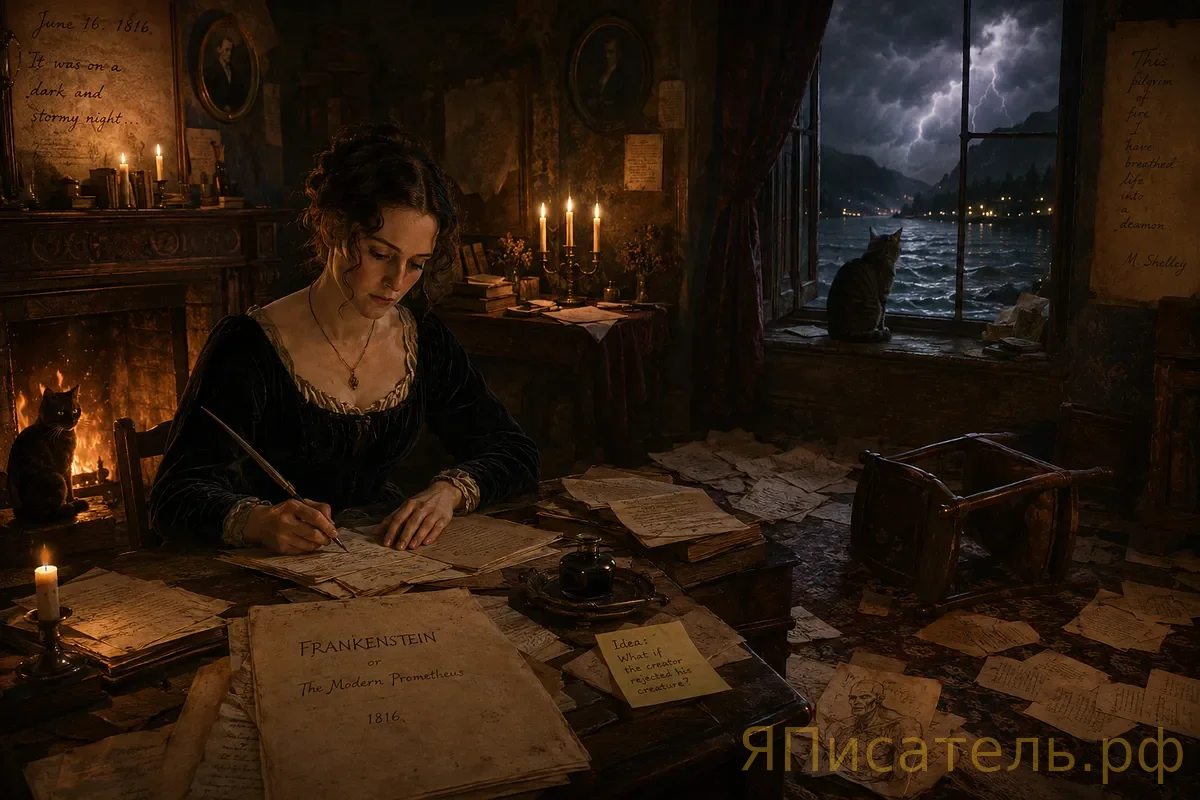
The Creature's Confession: A Lost Chapter Found in the Arctic Ice

Creative continuation of a classic

This is an artistic fantasy inspired by «Frankenstein; or, The Modern Prometheus» by Mary Wollstonecraft Shelley. How might the story have continued if the author had decided to extend it?

Original excerpt

He sprung from the cabin-window as he said this, upon the ice raft which lay close to the vessel. He was soon borne away by the waves and lost in darkness and distance.

— Mary Wollstonecraft Shelley, «Frankenstein; or, The Modern Prometheus»

Continuation

He was soon borne away by the waves, and lost in darkness and distance. But the darkness did not claim him, nor did the frozen sea grant the mercy of oblivion he had so fervently sought. For the creature — that wretched assemblage of stolen limbs and pilfered organs, that monument to one man's magnificent and terrible ambition — found that even death would not have him.

The ice raft drifted northward through corridors of towering bergs that gleamed like cathedrals in the perpetual twilight, and the creature sat upon it as a penitent might sit in the nave of a church, awaiting a judgement that never came. He had spoken his last words to Walton with such conviction — the funeral pile, the ashes scattered upon the sea, the final extinction of that spark which Victor Frankenstein had so recklessly ignited. And yet, as the hours passed and the cold gnawed at him with a ferocity that would have slain any natural man ten times over, his unnatural constitution refused the invitation of dissolution.

"I cannot die," he whispered to the indifferent stars. "Even this — even this is denied me."

He attempted his pyre. He gathered what fragments of wood the ice yielded up — broken spars from ships long since crushed between the frozen jaws of the Arctic, driftwood bleached to the colour of bone — and heaped them upon the ice. But his fingers, those enormous and hideous instruments that had once closed around the throats of innocents, trembled as he struck the flint, and the wind, that eternal and merciless wind that howled across the polar waste, extinguished each feeble flame before it could take hold. Again and again he tried, and again and again the elements conspired against his self-annihilation, until at last he cast the flint into the sea with a cry that echoed across the frozen emptiness like the bellow of some primordial beast.

It was then, in the depths of his despair, that the creature perceived he was not alone upon the ice.

A figure approached from the north — impossible, for nothing human could survive in those latitudes — and as it drew nearer, the creature discerned that it was a woman, or rather the semblance of a woman, wrapped in furs so thick and layered that she appeared more bear than human. Behind her, a team of dogs pulled a low sledge across the ice with mechanical precision, their breath forming clouds that hung in the still air like small ghosts.

She stopped at a distance of perhaps twenty yards and regarded him without fear. This, more than anything, arrested his attention. In all his wretched existence, no human being had ever looked upon him without recoiling, without that instinctive contortion of the features that spoke more eloquently than words of the horror his appearance inspired. But this woman — her face dark and weathered, her eyes black as the Arctic night — merely observed him with the calm appraisal of one who has seen much and learned to be surprised by nothing.

"You are the one they speak of," she said, in a tongue he did not immediately recognise but which bore the cadences of the Saami people, those hardy dwellers of the northern reaches whom he had observed from afar during his long wanderings. "The one who walks the ice and does not die."

The creature stared at her. "You do not flee from me."

"Why should I flee? The ice teaches us that appearances deceive. The most beautiful formations conceal crevasses that swallow men whole. The ugliest, most twisted pressure ridges mark the safest paths." She pulled back the hood of her fur parka, revealing hair as white as the snow that surrounded them, though her face suggested she was not yet old. "I am Ánná. My people have watched you for three months now, wandering the pack ice. We thought you were a spirit. Some wished to leave offerings. Others wished to drive you away with fire and drums."

"And you?" the creature asked, and his voice, that terrible voice that had once pronounced the doom of the Frankenstein family, now carried nothing but exhaustion.

"I wished to speak with you. I have always been the curious one. My grandmother said curiosity would be my death. But she also said that about eating cloudberries before the first frost, and I have done that every year and yet persist." A ghost of a smile crossed her weathered features. "You are cold?"

"I am beyond cold. I am beyond all sensation. I sought death upon this ice, but it will not have me."

Ánná regarded him for a long moment, then turned to her sledge and began unpacking what appeared to be the components of a lavvu — the conical tent of her people. "Then you must come inside and have tea," she said, with the matter-of-fact practicality of one for whom hospitality is not a social grace but a moral imperative of survival. "Death may not want you, but the living have uses for those who endure."

The creature watched in mute astonishment as she erected the shelter with practiced efficiency, her dogs settling around it in a protective circle, their yellow eyes regarding the creature with considerably less equanimity than their mistress. Within the hour, a fire burned inside the lavvu — a small fire, fed with oil rendered from seal blubber, but to the creature, who had failed so utterly to kindle his own funeral pyre, the ease with which she coaxed flame from the reluctant materials seemed almost miraculous.

Inside, the warmth was extraordinary. The creature had to stoop nearly double to enter, and even then his great frame occupied fully half the space, but Ánná arranged herself opposite him with no more discomfort than if she were entertaining a neighbour of ordinary dimensions. She poured tea from a blackened kettle — a brew of dried herbs and something bitter that the creature could not identify — and pressed a cup into his enormous hands.

"Drink," she commanded. "Then tell me why a being who cannot die wishes to."

And so — impossibly, improbably — the creature told his tale. Not as he had told it to Victor Frankenstein, with the desperate eloquence of one pleading for compassion from his creator, nor as he had related it to Walton, with the theatrical grandeur of one delivering a final soliloquy. He told it plainly, haltingly, as one tells a story that has lost its power to shock even the teller. He spoke of his creation, of the laboratory, of the horror in his maker's eyes — that first and foundational rejection from which all subsequent miseries had flowed like tributaries into a great river of suffering. He spoke of the De Laceys, of his education, of his naive and ultimately catastrophic hope that the blind old man's kindness might extend to his family. He spoke of William, and Justine, and Clerval, and Elizabeth — names that fell from his lips like stones dropped into a well, each one sinking into a silence that seemed bottomless.

Ánná listened without interruption, her dark eyes fixed upon him, her face betraying no emotion save a deepening gravity. When at last he fell silent, she was quiet for a long time. The fire crackled. The dogs shifted and whimpered outside. The wind, that interminable wind, sang its hollow song across the ice.

"Your maker," she said at last, "was a fool."

The creature flinched. Even now, even after everything, the instinct to defend Victor Frankenstein — to honour the bond between creator and creation, however poisoned — persisted in him like a vestigial organ, useless but impossible to excise.

"He was brilliant," the creature said. "He conquered death itself."

"He conquered nothing. He fled from everything. A man who creates life and then runs from it is not a conqueror. He is a coward." She sipped her tea with maddening composure. "Among my people, when a child is born, the whole community takes responsibility. Not just the mother and father — everyone. Because we understand that a life, once brought into the world, is the world's concern. Your maker understood nothing of this. He thought creation was an experiment. A triumph of the individual will. But creation is a covenant. And he broke it the moment he looked upon you and felt disgust instead of duty."

The creature's yellow eyes — those dreadful, watery eyes that had gazed upon so much suffering, much of it of his own making — glistened in the firelight. "You speak," he said slowly, "as though I were not a monster."

"I speak as though you were a person," Ánná corrected. "Which is what you are, though assembled by different means than most. The reindeer does not cease to be a reindeer because it was born in a storm rather than in sunshine. You were born in a storm — a storm of one man's arrogance — but you were born nonetheless, and birth carries with it the right to exist."

"The right to exist," the creature repeated, as though tasting a foreign and exotic fruit. "I have never claimed such a right. I have only ever claimed the right to be seen, to be acknowledged, to be — " He paused, and when he spoke again, his voice was barely audible above the wind. "To be loved."

"And because one man could not love you, you concluded that the world could not."

"The evidence was substantial."

"The evidence was limited. You encountered perhaps a hundred humans in your miserable wanderings, and from this paltry sample you derived a universal law. My people number perhaps eight thousand. The Norwegians, the Swedes, the Finns — tens of thousands more. And beyond them, millions upon millions of souls you have never met and never will. You condemned the entire species based on the cruelty of a few."

"And what of my own cruelty?" the creature demanded, and now his voice carried something of its old terrible force, so that the dogs outside whimpered and pressed closer together. "I murdered a child. I brought about the execution of an innocent woman. I strangled the dearest friend of my creator. I killed his bride on their wedding night. What species would embrace such a being? What person of sound mind would extend to me the compassion I denied to others?"

Ánná set down her cup. "I am sitting across from you in a tent on the pack ice," she said. "I have heard your confession. I have not fled. Draw what conclusions you will."

The silence that followed was the longest of the creature's existence — longer than the nights he had spent in the hovel adjoining the De Lacey cottage, longer than the months of pursuit across Europe and into the Arctic. It was a silence in which something ancient and calcified within him began, almost imperceptibly, to crack.

"What would you have me do?" he asked at last, and it was the first time in his life that the question was not a demand or a threat or a plea, but a genuine inquiry — the question of a being who, for the first time, entertained the possibility that the answer might not be death.

"Come south with me," Ánná said. "Not far south — only to the coast, where my people make their winter camp. You will frighten them at first, as you frighten everyone. But the Sámi are a practical people, and winter is hard, and a being who cannot die and does not tire has obvious utility. You will chop wood. You will haul sledges. You will make yourself useful, and in making yourself useful, you will make yourself known, and in making yourself known, you will make yourself — perhaps — something other than what you have been."

The creature looked at his hands — those terrible hands, eight inches across the palm, stitched together from the flesh of the dead. Hands that had created nothing and destroyed everything they touched.

"You believe this is possible?" he whispered.

"I believe," said Ánná, pouring more tea with the unhurried grace of one for whom the Arctic night holds no terror, "that it is worth attempting. And I believe that is more than you had five minutes ago."

She was right. It was more. It was, in fact, everything.

And so the creature — nameless still, monstrous still, bearing upon his patchwork frame the indelible marks of his creator's sin and his own — rose from the fire and followed Ánná out into the Arctic night, where the aurora borealis had begun to unfurl across the heavens in ribbons of green and violet, as though the sky itself were being stitched together from fragments of light, assembled into something whole and strange and terrible and beautiful — much like the creature himself — and the dogs barked, and the sledge runners hissed across the ice, and for the first time since the night of his wretched birth in that charnel-house laboratory in Ingolstadt, the creature moved not away from the world of the living, but toward it.

Article Jan 16, 07:03 PM

Edgar Allan Poe: The Original Goth Who Invented Modern Horror While Drunk and Broke

Two hundred seventeen years ago today, a baby was born who would grow up to invent the detective story, revolutionize horror fiction, and die mysteriously in a gutter wearing someone else's clothes. Happy birthday, Edgar Allan Poe, you magnificent disaster.

Let's be honest: if Poe were alive today, he'd be that guy at the party who corners you to explain why ravens are actually metaphors for the crushing weight of guilt, while nursing his seventh whiskey and mentioning his dead wife at least three times. He'd have a Substack with twelve thousand subscribers and a Twitter account that got suspended for posting too many cryptic threats at literary critics. He'd be insufferable. He'd also be absolutely right about everything.

Born January 19, 1809, in Boston, Poe had the kind of childhood that makes therapists rub their hands together with anticipation. His actor father abandoned the family when Edgar was a toddler. His mother died of tuberculosis when he was two. He was taken in by John Allan, a wealthy merchant who never formally adopted him and spent the next two decades making sure Poe knew exactly how much of a disappointment he was. If you're wondering where all that darkness in his writing came from, congratulations, you've cracked the case.

But here's what makes Poe genuinely fascinating: the man was a stone-cold literary innovator disguised as a tormented alcoholic. Before Poe wrote "The Murders in the Rue Morgue" in 1841, the detective story literally did not exist. Sherlock Holmes? Thank Poe. Every police procedural you've ever binged? Poe invented the template. His character C. Auguste Dupin was solving crimes through pure deductive reasoning while Arthur Conan Doyle was still in diapers. The man essentially created an entire genre because he was bored and needed rent money.

Then there's "The Raven," which dropped in 1845 and made Poe the closest thing antebellum America had to a rock star. Picture this: a 36-year-old disaster of a man writes an 18-stanza poem about a guy being psychologically destroyed by a bird that can only say one word, and it becomes the viral sensation of the decade. People were reciting it at parties. They were making parodies. Poe became so famous he could command the princely sum of... fifteen dollars for public readings. The poem made him immortal; it did not make him solvent.

"The Tell-Tale Heart" is where Poe really earns his reputation as the godfather of psychological horror. Forget jump scares and monsters. This story is about guilt eating someone alive from the inside out. The narrator murders an old man, hides the body under the floorboards, and then completely loses his mind because he can hear the dead man's heart still beating. It's been 181 years and this story still hits harder than ninety percent of modern horror. Poe understood something fundamental: the scariest thing isn't what's in the dark. It's what's in your own head.

"The Fall of the House of Usher" takes this psychological unraveling and cranks it up to eleven while adding a crumbling Gothic mansion that's basically a physical manifestation of mental illness. The house is the family. The family is the house. When one goes down, they all go down together. It's the kind of symbolism that makes English professors weep with joy and Netflix executives greenlight limited series. Speaking of which, if you watched Mike Flanagan's recent adaptation and thought it was brilliant, just know that Poe was doing this stuff while writing by candlelight and probably withdrawing from laudanum.

Poe's influence on literature is so vast it's almost invisible, like water to a fish. Stephen King calls him the father of American horror, which is like Michael Jordan calling you a decent basketball player. Every haunted house story owes him royalties. Every unreliable narrator tips their hat. Every time someone writes a mystery where the detective is smarter than everyone else in the room, they're working in Poe's shadow. He influenced Baudelaire, Dostoevsky, and Lovecraft. He basically invented science fiction with stories like "The Unparalleled Adventure of One Hans Pfaall." The man contained multitudes, and most of those multitudes were screaming.

The tragic irony is that Poe spent his entire life broke, mocked by the literary establishment, and fighting losing battles with alcohol and depression. He married his 13-year-old cousin Virginia when he was 27, which yes, was weird even by 1835 standards. When she died of tuberculosis in 1847 (the disease that took his mother, because the universe apparently thought Poe needed more trauma), he spiraled into a darkness from which he never emerged. Two years later, he was found delirious on the streets of Baltimore, wearing clothes that weren't his, unable to explain how he got there. He died four days later at forty. We still don't know what happened.

But here's the thing about Poe that gets lost in all the Gothic melodrama: the man was funny. He was a brilliant satirist and hoaxer. He once convinced newspaper readers that a balloon had crossed the Atlantic Ocean. His critical reviews were so savage they made him enemies for life. He had opinions about everything and the audacity to voice them loudly. He wasn't just some gloomy specter haunting American letters. He was a working writer who hustled constantly, edited multiple magazines, and produced an astonishing body of work while battling circumstances that would have destroyed anyone else.

So raise a glass tonight to Edgar Allan Poe, who taught us that the heart is a traitor, the mind is a prison, and the raven is never leaving. He died penniless and mysterious, which is exactly how he would have wanted it. Nevermore, indeed.

Classic Continuation Feb 13, 03:29 AM

The Moor Remembers: A Lost Epilogue of Wuthering Heights

Creative continuation of a classic

This is an artistic fantasy inspired by «Wuthering Heights» by Emily Brontë. How might the story have continued if the author had decided to extend it?

Original excerpt

I lingered round them, under that benign sky; watched the moths fluttering among the heath and harebells, listened to the soft wind breathing through the grass, and wondered how any one could ever imagine unquiet slumbers for the sleepers in that quiet earth.

— Emily Brontë, «Wuthering Heights»

Continuation

I lingered round them, under that benign sky; watched the moths fluttering among the heath and harebells, listened to the soft wind breathing through the grass, and wondered how any one could ever imagine unquiet slumbers for the sleepers in that quiet earth.

And yet, as I descended the hill toward Thrushcross Grange that evening, a feeling seized me which I cannot rightly name — a presentiment, perhaps, or the mere fancy of a man grown too accustomed to the strange histories of this place. For I heard, or thought I heard, carried on that same soft wind, a voice that was neither the curlew's cry nor the moaning of the fir trees, but something older, something that belonged to the moor itself.

I quickened my pace, and arrived at the Grange just as the last red embers of sunset were dying behind Penistone Crags. Nelly Dean was in the kitchen, as she always was at that hour, and she looked up at me with that shrewd, half-maternal expression which I had come to know so well during my tenancy.

"You've been to the kirkyard again, Mr. Lockwood," she said — not as a question, but as a plain statement of fact, the way country people will sometimes read your movements in your face as easily as they read the weather in the sky.

"I have, Nelly. And I confess it has unsettled me."

She set down the cloth she had been folding and regarded me with a steadiness that was almost uncomfortable. "Unsettled you how, sir?"

I hesitated, for the thing seemed absurd in the warmth of the kitchen, with the fire crackling and the clock ticking its sensible, mechanical measure of time. But Nelly Dean was not a woman before whom one need feel ashamed of confessing to foolishness — she had witnessed too much that was beyond the reach of reason to dismiss any testimony lightly.

"I thought I heard a voice on the moor. Not a shepherd's call, not the wind — a voice. A woman's voice, Nelly, calling a name I could not quite distinguish."

Nelly was silent for a long moment. Then she rose, went to the window, and drew the curtain aside to look out at the darkening hills. When she spoke, her voice was lower than before, and stripped of its usual brisk authority.

"There are those hereabouts who would tell you it was Catherine, sir. The first Catherine, I mean — Mrs. Linton that was, before she was anything else. They say she walks the moor still, and that she will walk it until the heather itself turns to dust, for she loved it more than she ever loved any living creature — excepting one."

"You don't believe that, surely?"

"What I believe and what I know are two different ledgers, Mr. Lockwood, and they don't always balance. I'll tell you what I know: I know that three nights ago, Joseph — old Joseph, who fears nothing on God's earth save the devil himself — came down from the Heights white as a winding-sheet, and said he'd seen two figures walking arm in arm along the edge of the beck. He swore on his Bible it was the master and the mistress — Heathcliff and Catherine — and that they looked at him as they passed, and smiled. Smiled, Mr. Lockwood! Joseph, who never told a lie in his life, though he has told a great many disagreeable truths."

I confess this account chilled me more than my own experience on the hillside. There is something peculiarly terrible in the testimony of a man like Joseph — so rigid, so hostile to imagination of any kind, so armoured in his dour piety that fancy could find no crevice through which to enter his mind.

"And what did Hareton say to this?" I asked, for I knew the young man was now master of the Heights, and soon to be married to the younger Catherine.

"Hareton said nothing. He never does, when the old names are spoken. But I have watched him, sir — watched him as only a woman can watch a child she has nursed from infancy — and I have seen him stand at the window of the Heights at midnight, looking out toward the moor with an expression I cannot fathom. It is not fear, precisely, nor grief. It is more like — recognition. As though he sees something there that he has always known was coming, and has been waiting for."

Nelly paused, and the firelight played across her face, deepening the lines that years of service and sorrow had carved there. She was not old — not truly old — but she had lived through enough to age the soul, if not the body.

"I will tell you something else, Mr. Lockwood, which I have told no one, for I feared they would think me touched. Last Tuesday, I went up to the Heights to bring some preserves for Hareton and the young mistress. The house was empty — they had gone to Gimmerton on business — and I let myself in through the kitchen, as I have done ten thousand times before. The house was still. Too still, sir. You know how a house feels when it is merely empty, and how it feels when it is — inhabited by something that is not a person? It was the latter sensation I experienced."

"Go on," I said, though every instinct urged me to bid her stop.

"I went through to the old sitting-room — the one where Mr. Heathcliff used to sit, where he died, in fact, with the window open and the rain driving in upon his face. The room was cold, though it was a mild day, and the window was latched shut. But on the window-seat — Mr. Lockwood, on the window-seat there was a mark. Two marks, rather. Two handprints, pressed into the dust on the ledge, as though someone had leaned there, looking out. Small hands, sir. A woman's hands. And beside them, scratched into the wood with what must have been a fingernail, were two words."

"What words?"

Nelly looked at me, and in her eyes I saw something I had never seen there before — not superstition, not credulity, but a kind of awed acceptance, the look of a woman who has been compelled by evidence to believe what her reason rejects.

"'Let me in.'"

The fire popped. The clock ticked. Outside, the wind had risen, and I could hear it shouldering against the walls of the Grange like a restless animal seeking entry.

"I wiped the marks away," Nelly continued, her voice steady now, as though the confession itself had steadied her. "I wiped them away and I told no one. But I have thought about them every night since, lying in my bed and listening to the wind, and I have come to a conclusion which will perhaps seem strange to you, sir, coming as you do from London, where the dead are decently buried and stay buried."

"Tell me your conclusion, Nelly."

"My conclusion is this: that some passions are too fierce for death to contain. That the grave can hold the body, but not the will — not a will like Catherine Earnshaw's, which was forged in the same fire as the moor itself, and partakes of its nature. She was not made for rest, Mr. Lockwood. She was made for storm and wildness and the kind of love that tears the heart from the breast and flings it upon the rocks. And Heathcliff — he was her mirror, her shadow, her other self. Whatever she is, he is. Whatever realm she walks, he walks beside her. I do not think they haunt this place out of malice, or even out of longing. I think they haunt it because it is theirs — because they are the moor, and the moor is them, and they cannot be separated from it any more than the heather can be separated from the soil in which it grows."

She fell silent. I sat for a long time, watching the fire die down to its ashen bed, turning her words over in my mind. At last I rose.

"I leave for London tomorrow, Nelly. I think I have had enough of this country."

"Aye, sir. I think you have."

She walked me to the door, and as I stepped out into the night, she laid a hand upon my arm — a liberty she had never before taken, and which spoke more plainly than words of the agitation beneath her composed exterior.

"Mr. Lockwood. If ever you are asked about this place — about these people — what will you say?"

I looked up at the sky, where the stars burned with that fierce, cold brilliance peculiar to the northern moors, and I thought of the three headstones on the slope, and of what might or might not walk between them when the moon was high.

"I shall say that I knew them, Nelly. And that I did not understand them. And that I do not think understanding was ever the point."

She nodded, as though this answer satisfied her, and released my arm. I walked away into the darkness, and the wind closed behind me like a door.

I did not look back. But as I reached the turn in the lane where the path bends toward the valley, I heard it again — that voice, rising and falling with the wind, calling a name across the empty moor. And this time, I thought I heard an answer.

I never returned to Thrushcross Grange. But sometimes, in London, in the dead of winter, when the fog presses against the windows and the city is muffled in its own grey silence, I wake in the small hours and lie listening — listening for the sound of the wind on the heath, and for the voice of a woman who loved too fiercely to die, calling through the darkness to the only soul who could hear her.

And I wonder — I cannot help but wonder — whether they found each other at last, out there on the moor, beyond the reach of time and cruelty and the small, mean boundaries of the living world. I wonder whether Nelly was right, and some passions are indeed too vast for the grave to hold. And whether, on certain nights, when the wind blows hard from the west and the heather bends double under its force, two figures still walk arm in arm along the edge of the beck, looking out at the world they have left behind with something that is neither sorrow nor joy, but simply — presence. The abiding, unassailable presence of a love that has outlasted everything, including death itself.

I do not know. I shall never know. But I think of them still — those wild, tormented, magnificent souls — and when I think of them, I am not afraid. For whatever they were, whatever they became, they were true. True to each other, true to themselves, true to the savage, beautiful country that made them. And in this world of compromise and calculation, of prudent marriages and measured affections, that truth blazes like a beacon fire on the hills — terrible, yes, and dangerous, but glorious beyond all telling.

The moor remembers them. And so do I.

Nothing to read? Create your own book and read it! Like I do.

Create a book
1x

"A word after a word after a word is power." — Margaret Atwood