Content Feed

Discover interesting content about books and writing

Poetry Continuation Feb 6, 01:54 AM

The Raven's Return: A Midnight Sequel

Creative Poetry Continuation

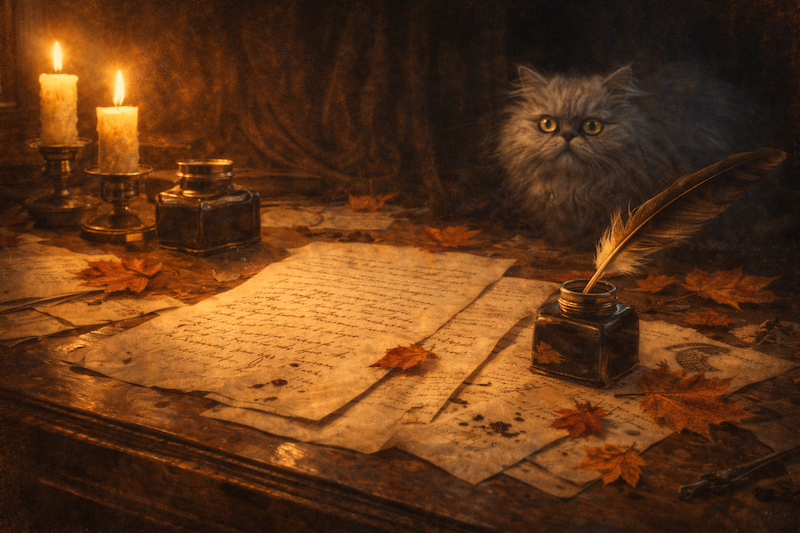
This is an artistic fantasy inspired by the poem «The Raven» by Edgar Allan Poe. How might the verse have sounded if the poet had continued their thought?

Original excerpt

Once upon a midnight dreary, while I pondered, weak and weary,
Over many a quaint and curious volume of forgotten lore—
While I nodded, nearly napping, suddenly there came a tapping,
As of some one gently rapping, rapping at my chamber door.
'Tis some visitor,' I muttered, 'tapping at my chamber door—
Only this and nothing more.'

— Edgar Allan Poe, «The Raven»

The Raven's Return: A Midnight Sequel
A Continuation of Edgar Allan Poe's "The Raven"

Once upon a midnight weary, as I wandered, worn and teary,
Through the chamber where the Raven sat upon my chamber door—
Years had passed since that December, yet I still could well remember
Every word that spectral member spoke of Lenore, my lost Lenore—
That dark prophet still remaining, perched above my chamber door,
Whispering forever, 'Nevermore.'

And the silken, sad, uncertain rustling of each purple curtain
Thrilled me—filled me with fantastic terrors felt so long before;
So that now, to still the beating of my heart, I stood repeating:
'It is but the wind entreating entrance through my chamber door—
Only this and nothing more.'

But the Raven, never flitting, still is sitting, still is sitting
On the pallid bust of Pallas just above my chamber door;
And his eyes have all the seeming of a demon's that is dreaming,
And the lamplight o'er him streaming throws his shadow on the floor;
And my soul from out that shadow that lies floating on the floor
Shall be lifted—nevermore!

Then, methought, the air grew denser, perfumed from an unseen censer
Swung by Seraphim whose footfalls tinkled on the tufted floor.
'Wretch,' I cried, 'thy God hath sent thee—by these angels he hath lent thee
Respite—respite and nepenthe from thy memories of Lenore!
Quaff, oh quaff this kind nepenthe, and forget this lost Lenore!'
Quoth the Raven, 'Nevermore.'

'Prophet!' said I, 'thing of evil!—prophet still, if bird or devil!
By that Heaven that bends above us—by that God we both adore—
Tell this soul with sorrow laden if, within the distant Aidenn,
I shall clasp a sainted maiden whom the angels name Lenore—
Clasp a rare and radiant maiden whom the angels name Lenore!'
Quoth the Raven, 'Evermore.'

Startled by this strange new token—word so long ago unspoken—
'Evermore?' I gasped in wonder, trembling on the chamber floor.
'Dost thou speak of hope eternal? Light within this vault infernal?
After years of grief nocturnal, shall I see my lost Lenore?'
And the Raven stirred his pinions, spread them wide above the door,
Murmuring softly, 'Evermore.'

Then a light began to glimmer, and the darkness seemed to shimmer,
As if dawn itself were breaking through my long-sealed chamber door;
And I thought I heard her singing—bells of silver sweetly ringing—
And the scent of roses clinging to the air I breathed of yore.
Could it be my lost beloved, she whom I had grieved so sore?
Could it be... forevermore?

But the vision faded, fleeting, and I felt my frail heart beating
As the shadows crept returning, darker than they were before.
And the Raven sat there, gleaming, and I knew not: waking, dreaming?
Had he spoken? Was I screaming? Madness knocking at my door?
Only silence hung between us—silence... and the name Lenore.
Only this and nothing more.

Still the Raven keeps his station, mockery of my desolation,
And I wonder if salvation waits beyond that spectral door.
Was his promise merely seeming? Or perhaps—oh, hopeful dreaming!—
Somewhere past the lamplight gleaming, I shall find my lost Lenore.
Till that day I sit here waiting, watching, through my chamber door,
Waiting... evermore.

Joke Jan 20, 04:01 PM

Edgar Allan Poe's Smart Home

Edgar Allan Poe buys a smart home system. At midnight, Alexa whispers: 'Nevermore... battery remaining.' The doorbell announces visitors as 'a rapping, a gentle tapping at your chamber door.' The thermostat only has two settings: 'Tomb' and 'Premature Burial.' And every notification ends with '...quoth the algorithm.'

Article Jan 16, 07:03 PM

Edgar Allan Poe: The Original Goth Who Invented Modern Horror While Drunk and Broke

Two hundred seventeen years ago today, a baby was born who would grow up to invent the detective story, revolutionize horror fiction, and die mysteriously in a gutter wearing someone else's clothes. Happy birthday, Edgar Allan Poe, you magnificent disaster.

Let's be honest: if Poe were alive today, he'd be that guy at the party who corners you to explain why ravens are actually metaphors for the crushing weight of guilt, while nursing his seventh whiskey and mentioning his dead wife at least three times. He'd have a Substack with twelve thousand subscribers and a Twitter account that got suspended for posting too many cryptic threats at literary critics. He'd be insufferable. He'd also be absolutely right about everything.

Born January 19, 1809, in Boston, Poe had the kind of childhood that makes therapists rub their hands together with anticipation. His actor father abandoned the family when Edgar was a toddler. His mother died of tuberculosis when he was two. He was taken in by John Allan, a wealthy merchant who never formally adopted him and spent the next two decades making sure Poe knew exactly how much of a disappointment he was. If you're wondering where all that darkness in his writing came from, congratulations, you've cracked the case.

But here's what makes Poe genuinely fascinating: the man was a stone-cold literary innovator disguised as a tormented alcoholic. Before Poe wrote "The Murders in the Rue Morgue" in 1841, the detective story literally did not exist. Sherlock Holmes? Thank Poe. Every police procedural you've ever binged? Poe invented the template. His character C. Auguste Dupin was solving crimes through pure deductive reasoning while Arthur Conan Doyle was still in diapers. The man essentially created an entire genre because he was bored and needed rent money.

Then there's "The Raven," which dropped in 1845 and made Poe the closest thing antebellum America had to a rock star. Picture this: a 36-year-old disaster of a man writes an 18-stanza poem about a guy being psychologically destroyed by a bird that can only say one word, and it becomes the viral sensation of the decade. People were reciting it at parties. They were making parodies. Poe became so famous he could command the princely sum of... fifteen dollars for public readings. The poem made him immortal; it did not make him solvent.

"The Tell-Tale Heart" is where Poe really earns his reputation as the godfather of psychological horror. Forget jump scares and monsters. This story is about guilt eating someone alive from the inside out. The narrator murders an old man, hides the body under the floorboards, and then completely loses his mind because he can hear the dead man's heart still beating. It's been 181 years and this story still hits harder than ninety percent of modern horror. Poe understood something fundamental: the scariest thing isn't what's in the dark. It's what's in your own head.

"The Fall of the House of Usher" takes this psychological unraveling and cranks it up to eleven while adding a crumbling Gothic mansion that's basically a physical manifestation of mental illness. The house is the family. The family is the house. When one goes down, they all go down together. It's the kind of symbolism that makes English professors weep with joy and Netflix executives greenlight limited series. Speaking of which, if you watched Mike Flanagan's recent adaptation and thought it was brilliant, just know that Poe was doing this stuff while writing by candlelight and probably withdrawing from laudanum.

Poe's influence on literature is so vast it's almost invisible, like water to a fish. Stephen King calls him the father of American horror, which is like Michael Jordan calling you a decent basketball player. Every haunted house story owes him royalties. Every unreliable narrator tips their hat. Every time someone writes a mystery where the detective is smarter than everyone else in the room, they're working in Poe's shadow. He influenced Baudelaire, Dostoevsky, and Lovecraft. He basically invented science fiction with stories like "The Unparalleled Adventure of One Hans Pfaall." The man contained multitudes, and most of those multitudes were screaming.

The tragic irony is that Poe spent his entire life broke, mocked by the literary establishment, and fighting losing battles with alcohol and depression. He married his 13-year-old cousin Virginia when he was 27, which yes, was weird even by 1835 standards. When she died of tuberculosis in 1847 (the disease that took his mother, because the universe apparently thought Poe needed more trauma), he spiraled into a darkness from which he never emerged. Two years later, he was found delirious on the streets of Baltimore, wearing clothes that weren't his, unable to explain how he got there. He died four days later at forty. We still don't know what happened.

But here's the thing about Poe that gets lost in all the Gothic melodrama: the man was funny. He was a brilliant satirist and hoaxer. He once convinced newspaper readers that a balloon had crossed the Atlantic Ocean. His critical reviews were so savage they made him enemies for life. He had opinions about everything and the audacity to voice them loudly. He wasn't just some gloomy specter haunting American letters. He was a working writer who hustled constantly, edited multiple magazines, and produced an astonishing body of work while battling circumstances that would have destroyed anyone else.

So raise a glass tonight to Edgar Allan Poe, who taught us that the heart is a traitor, the mind is a prison, and the raven is never leaving. He died penniless and mysterious, which is exactly how he would have wanted it. Nevermore, indeed.

Nothing to read? Create your own book and read it! Like I do.

Create a book
1x

"A word after a word after a word is power." — Margaret Atwood