Content Feed

Discover interesting content about books and writing

Article Feb 14, 10:02 AM

Harper Lee Wrote One Perfect Book — Then Silence Ate Her Alive

Harper Lee died ten years ago today, and we still can't figure her out. She wrote what might be the most beloved American novel of the twentieth century, then essentially told the entire literary world to go to hell. No interviews. No second act. No victory lap. Just decades of silence so loud it became its own legend.

In a culture that demands artists constantly produce, constantly perform, constantly tweet their hot takes, Lee's refusal to play the game feels almost alien — and maybe that's exactly why we can't stop thinking about her.

Let's get the obvious out of the way: To Kill a Mockingbird is a monster. Published in 1960, it has sold over 45 million copies worldwide. It sits on virtually every high school reading list in America. It won the Pulitzer Prize. It spawned a film that gave Gregory Peck the role of his career and made Atticus Finch a secular saint for lawyers who wanted to believe their profession was noble. The book didn't just enter the cultural conversation — it built the room the conversation happens in.

But here's what gets me. Lee was 34 when Mockingbird came out. She lived to be 89. That means she spent roughly 60 percent of her life as the woman who wrote that one book and then... didn't. Think about that for a second. Imagine being the person behind one of the defining texts of American literature and spending the next five and a half decades watching the world argue about what it means while you sit in Monroeville, Alabama, eating at the same diner, going to the same church, deflecting the same questions from journalists who never stopped circling.

The conventional wisdom is that Lee was terrified. Terrified that a second novel couldn't possibly live up to the first. There's probably some truth in that — the pressure would have been psychotic. But I think the real story is weirder and more interesting. Lee wasn't hiding from failure. She was hiding from success. She watched her childhood friend Truman Capote turn literary fame into a grotesque performance, a decades-long public unraveling fueled by booze, pills, and an insatiable need for attention. She saw what the spotlight did to him, and she chose the opposite. Not silence as cowardice. Silence as strategy.

And then, of course, there's the elephant in the room: Go Set a Watchman. Published in 2015, just a year before Lee's death, under circumstances that still make a lot of people deeply uncomfortable. Lee was 88, had suffered a stroke, was reportedly deaf and partially blind. Her protective older sister Alice — a lawyer who had guarded Harper's interests for decades — had died the year before. And suddenly, miraculously, a "lost manuscript" appears. The timing stinks, and a lot of literary observers said so at the time.

Watchman presented an Atticus Finch who attended a Klan meeting. Who spoke dismissively about Black citizens. Who was, in short, a racist — or at least far more complicated and compromised than the marble hero of Mockingbird. Readers were furious. They felt betrayed. Which is itself fascinating, because it reveals something uncomfortable about how we read: we had turned Atticus into a fantasy, a moral compass that pointed wherever we needed it to. The real Atticus — the one Lee originally wrote before her editor convinced her to reshape the manuscript into Mockingbird — was a product of his time and place. Messy. Human. Southern in ways that aren't comfortable.

That might be Lee's most lasting contribution to American literature, whether she intended it or not. She showed us that our heroes are constructs. That the stories we cling to for moral clarity are themselves acts of editing, of choosing which parts of the truth to amplify and which to bury. Mockingbird is a story about racism told from the safe vantage point of childhood innocence. Watchman is the adult version — uglier, more honest, less satisfying. Put them side by side and you get something that no single novel could deliver: the full arc of how Americans process race. First with fairy tales. Then, reluctantly, with truth.

Ten years after her death, the influence is everywhere, even when you can't see it. Every time a novelist tackles systemic injustice through the eyes of a child, they're walking in Lee's footsteps. Every time a courtroom drama uses a defense attorney as its moral center, it's channeling Atticus. Every time a Southern writer wrestles with the tension between loving a place and seeing its ugliness clearly, the ghost of Scout Finch is in the room. Aaron Sorkin's 2018 Broadway adaptation became the highest-grossing American play in history — a telling detail. We're still hungry for Mockingbird's particular brand of hope, even as we've grown more skeptical of its simplifications.

But I think what really endures isn't any specific scene or character. It's the radical idea that empathy can be taught. "You never really understand a person until you consider things from his point of view... until you climb into his skin and walk around in it." That line has been quoted so many times it's practically wallpaper, but strip away the familiarity and the instruction is genuinely revolutionary, especially for 1960, especially in the South, especially aimed at children. Lee wasn't asking readers to tolerate difference. She was asking them to inhabit it. There's a world of moral distance between those two things.

The cynics will tell you that Mockingbird is a white savior narrative, that Atticus swoops in to defend Tom Robinson while Black characters remain largely voiceless, that the book flatters white liberal guilt more than it challenges it. And the cynics aren't wrong, exactly. But they're not entirely right, either. The book was written by a white woman in Alabama in the 1950s. Expecting it to have the racial politics of 2026 is like expecting a covered wagon to have airbags. What matters is where it pointed. What it made possible. The conversations it started in classrooms and living rooms across a country that desperately needed to have them.

Here's my favorite Harper Lee fact, the one I keep coming back to. After Mockingbird's success, she helped Capote research In Cold Blood by charming the people of Holcomb, Kansas — the townspeople who wouldn't talk to Truman because he was too flamboyant, too obviously an outsider. Lee got them to open up. She sat in their kitchens and listened. She made herself invisible so someone else's story could be told. If that isn't the most Harper Lee thing imaginable, I don't know what is.

Ten years gone, and the mystery holds. One perfect book. One controversial manuscript. A lifetime of deliberate silence. Harper Lee gave American literature exactly what it needed and not a word more. In an age of oversharing, of literary celebrities who can't stop explaining themselves, her restraint feels less like absence and more like a dare. She bet that one story, told right, could be enough. Forty-five million copies later, it's hard to argue she was wrong.
Article Feb 13, 08:11 AM

Toni Morrison Won the Nobel — and America Still Hasn't Caught Up

Ninety-five years ago today, a girl named Chloe Wofford was born in Lorain, Ohio — a steel town where Black families lived in the kind of poverty that polite America pretended didn't exist. Nobody handed her a ticket to greatness. She forged it in fire, renamed herself Toni Morrison, and then did something unforgivable: she wrote novels so devastatingly brilliant that white literary gatekeepers had no choice but to bow.

Here's the uncomfortable truth about Morrison that still makes people squirm: she never wrote for white people. She said it plainly, repeatedly, without apology. In interviews, when asked why her novels didn't center white characters, she'd flip the question like a blade: "You've never asked that of any white author, have you?" And there it was — the emperor, suddenly naked. The assumption that literature must filter itself through whiteness to be "universal" crumbled every time she opened her mouth. She didn't just challenge the canon. She rewrote its operating system.

Let's talk about "Beloved," because if you haven't read it, you're walking around with a hole in your literary education. Published in 1987, it's based on the true story of Margaret Garner, an enslaved woman who killed her own daughter rather than let her be returned to slavery. Morrison took that historical footnote and turned it into a ghost story, a love story, a horror novel, and a meditation on memory — all at once. The ghost of the dead child literally shows up at the house. Not as a metaphor. As a flesh-and-blood woman who calls herself Beloved and eats all the food and demands all the love. It's one of the most terrifying and heartbreaking things ever written in the English language, and when it lost the National Book Award in 1987, forty-eight Black writers and critics signed an open letter of protest. The Pulitzer came the next year. Sometimes shame works.

But Morrison wasn't a one-hit wonder wielding trauma like a weapon. "Song of Solomon" (1977) is a sprawling, mythic adventure novel about a man named Milkman Dead — yes, that's his name, and no, Morrison didn't do subtle — who goes searching for gold and finds his family's history instead. It's got flying Africans, a secret society of avengers, and one of the most electrifying opening scenes in American fiction: a man standing on the roof of a hospital, promising to fly. The novel won the National Book Critics Circle Award and cemented Morrison as a force that wasn't going anywhere.

Then there's "The Bluest Eye" (1970), her debut — a slim, brutal book about an eleven-year-old Black girl named Pecola Breedlove who prays every night for blue eyes because she's been taught that whiteness equals beauty. It's the kind of novel that makes you physically sick with its clarity. Morrison wrote it because she wanted to examine the most devastating thing racism does: it makes you hate yourself. The book was banned in schools across America for decades. Of course it was. The truth always gets banned first.

What people forget — or never knew — is that Morrison had a whole other career before she became the Morrison. She was a senior editor at Random House for nearly twenty years, and she used that position like a battering ram. She edited books by Angela Davis, Muhammad Ali, Gayl Jones, and Toni Cade Bambara. She published "The Black Book" in 1974, a scrapbook-style history of African American life that was so comprehensive it basically invented a genre. She wasn't just writing the future of Black literature — she was actively building the infrastructure for it while working a day job and raising two sons as a single mother. Let that sink in next time you complain about not having enough time to write.

Morrison's prose style deserves its own paragraph because nothing else in American literature sounds like it. She wrote sentences that read like jazz — circling, doubling back, hitting notes you didn't expect, landing with devastating precision. "If there's a book that you want to read, but it hasn't been written yet, then you must write it," she said, and then she demonstrated what she meant with prose that felt ancient and modern simultaneously. Her sentences could be biblical. They could be bluesy. Sometimes they were both in the same paragraph. Critics who called her writing "difficult" were really saying they weren't used to literature that didn't center their experience. Morrison's response? She kept writing.

In 1993, she won the Nobel Prize in Literature. The first Black woman ever. The Swedish Academy praised her for novels "characterized by visionary force and poetic import." She showed up to Stockholm, collected her medal, and delivered a lecture about language and power that should be required reading in every school on the planet. "Oppressive language does more than represent violence," she told the audience. "It is violence." She was sixty-two years old and she looked like she was just getting started.

And she was. She published "Paradise" in 1998, "Love" in 2003, "A Mercy" in 2008, "Home" in 2012, and "God Help the Child" in 2015. Each one different in scope and setting, but all of them circling the same gravitational center: what does it mean to be Black, to be human, to carry the weight of history in your body? She never softened. She never simplified. She never once looked at the marketplace and thought, maybe I should write something more accessible.

Here's what burns me up: Morrison is still treated as a "Black writer" first and a "great writer" second by too many people. It's the last acceptable form of literary segregation. You'll find her in the African American Literature section of the bookstore, not next to Faulkner, where she belongs — or rather, where Faulkner would be honored to sit. Because let's be real: Morrison out-Faulknered Faulkner. She took the Southern Gothic, stripped it of its romantic nostalgia, and replaced it with truth. She did what he tried to do, but without the convenient escape hatch of being a white man writing about Black suffering from a safe distance.

Morrison died on August 5, 2019, at eighty-eight. She left behind eleven novels, several children's books, essay collections, plays, and a body of criticism that fundamentally altered how we think about race, art, and American identity. But more than that, she left behind a dare. Every one of her books is a dare: look at this. Don't flinch. Don't look away. See what happened, and see what it did to people, and then tell me this country doesn't owe a debt it can never repay.

Ninety-five years after her birth, Toni Morrison remains the writer America needs and the writer America doesn't deserve. If you haven't read her, start tonight. Start with "Beloved." Read it alone, read it slowly, and prepare to be ruined in the best possible way. Because that's what great literature does — it doesn't comfort you. It cracks you open. And nobody, in the history of American letters, cracked us open quite like Toni Morrison did.

Classic Continuation Feb 6, 08:27 AM

The Depths Speak Yet: An Epilogue to the Pequod's Voyage

Creative continuation of a classic

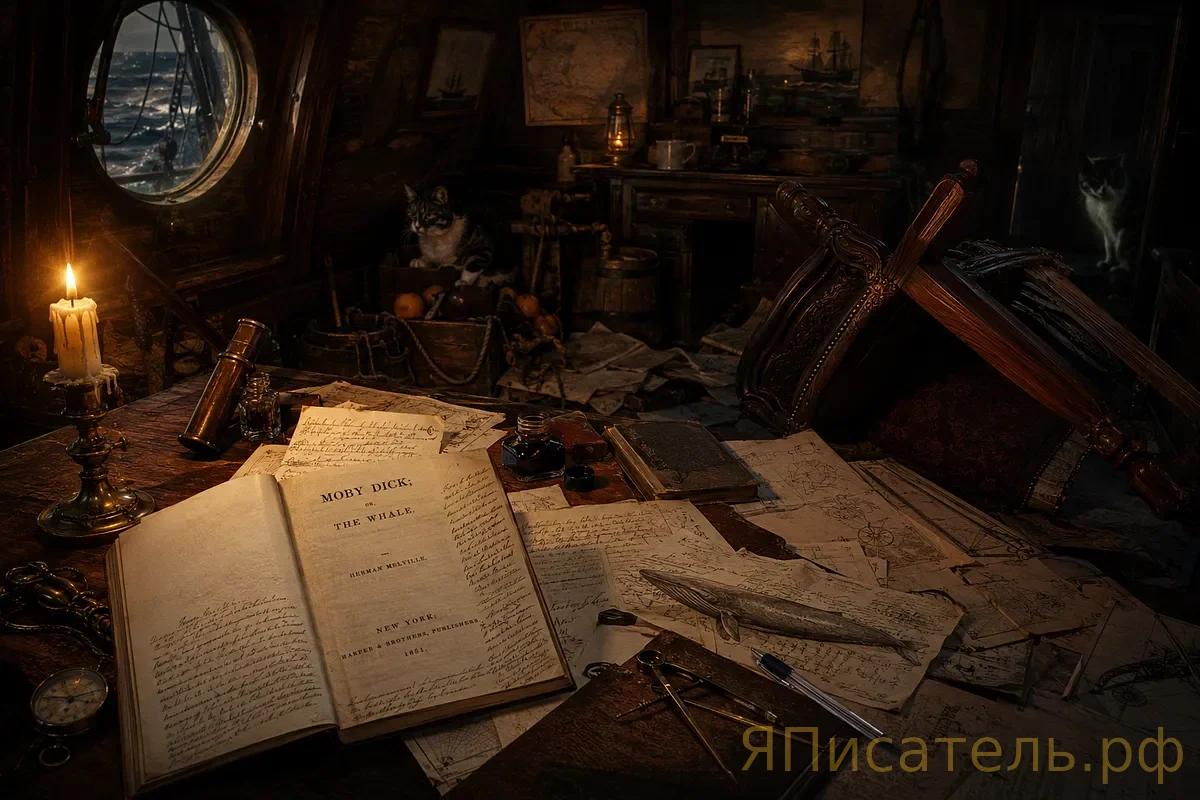
This is an artistic fantasy inspired by «Moby Dick; or, The Whale» by Herman Melville. How might the story have continued if the author had decided to extend it?

Original excerpt

The drama's done. Why then here does any one step forth?—Because one did survive the wreck. It was the devious-cruising Rachel, that in her retracing search after her missing children, only found another orphan.

— Herman Melville, «Moby Dick; or, The Whale»

Continuation

The drama's done. Why then here does any one step forth?—Because one did survive the wreck. It was the devious-cruising Rachel, that in her retracing search after her missing children, only found another orphan. Thus was I drawn from the sea, clinging to that coffin life-buoy which had once been meant for Queequeg, my savage friend whose spirit perhaps guided it to bear me up when all else had gone down into the vortex.

For three days I lay in fever upon the Rachel's deck, and in my delirium I saw again the white phantom rising from the deep, saw Ahab's arm beckoning from the hemp entanglements, saw the Pequod spiral downward like a wounded gull. The sailors thought me mad, and perhaps I was—perhaps I am still. For what is madness but the mind's attempt to comprehend that which defies all mortal understanding?

Captain Gardiner himself attended to my recovery, though his own grief was such as might have excused any neglect. His lost son—that boy of twelve whom he had sought so desperately—was never found. The sea had claimed him as surely as it had claimed all my shipmates, and in Gardiner's hollow eyes I saw reflected my own survivor's guilt, that peculiar torment of those who live when others perish.

"You were of the Pequod," he said to me on the fourth morning, when the fever had broken and I could sit upright upon a coil of rope. It was not a question.

"I was," said I. "Ishmael, formerly of Manhattan, now of nowhere in particular."

"And Ahab?"

"Gone down with his vengeance. The whale took him at the last—or he took himself to the whale. In truth, I cannot say which pursued which into that final embrace."

Gardiner was silent for a long moment. The Rachel creaked and groaned around us, her timbers speaking that ancient language of ships which only sailors understand. Above, the canvas bellied with a following wind, carrying us eastward, homeward, toward that civilization which now seemed to me as foreign and fantastical as any cannibal isle.

"I met Ahab once," Gardiner said at length. "Years ago, in Nantucket, before his first encounter with the white whale. He was different then—still proud, still driven, but there was warmth in him yet. He spoke of his young wife with such tenderness as I have rarely witnessed in any man."

"I saw that wife," I replied, "or rather, I saw her shadow pass across his face in rare unguarded moments. She haunted him even as the whale did, though in a gentler fashion. Two ghosts competing for possession of one tormented soul."

The Rachel bore me homeward across leagues of that same ocean which had swallowed my companions. Each night I stood at the taffrail and gazed into the phosphorescent wake, half-expecting to see Queequeg's tattooed face rise from the depths, or Starbuck's steady eyes, or even Ahab himself, still lashed to the whale's flank, still shaking his fist at an indifferent heaven. But the sea kept its secrets, as it always does, and showed me only the cold glitter of stars reflected in black water.

It was during these night watches that I began to write—first in my mind, where the words arranged themselves into something like prayer or confession, and later upon paper which the Rachel's mate kindly provided. I wrote of Ahab and his monomania, of Queequeg's noble savagery, of Starbuck's doomed conscience, of Stubb's gallows humor and Flask's simple courage. I wrote of the whale itself, that "grand hooded phantom," as I came to call it, swimming through my dreams and my waking hours alike.

But what was the whale? This question tormented me more than any other. Was it merely a brute beast, an "unexampled, intelligent malignity," as Ahab believed? Or was it something else entirely—a symbol, perhaps, of that ultimate blankness which terrifies us most? The whale was white, colorless, void of all chromatic character, and yet in that very absence of color lay its deepest horror. For what is whiteness but the visible absence of all things? What is the whale but nature itself, stripped of all the comfortable illusions by which we render it comprehensible?

I posed these questions to Gardiner one evening as we sat in his cabin, sharing a bottle of Madeira which he had been saving for his son's homecoming. The wine tasted of grief, but we drank it nonetheless.

"You think too much, young man," Gardiner said, not unkindly. "The whale is a whale. It killed your captain and your shipmates because that is what whales do when men pursue them with harpoons. There is no mystery in it, no cosmic meaning. Only the brute facts of the hunt."

"Perhaps you are right," I allowed. "And yet I cannot help but feel that in witnessing Ahab's destruction, I witnessed something larger—some eternal conflict between the human will and the forces arrayed against it. Ahab sought to strike through the mask, to pierce the visible world and reach whatever lies beyond. He failed, of course. But was his failure not more magnificent than most men's successes?"

Gardiner shook his head. "Magnificent? He led thirty men to their deaths in pursuit of a private grievance. He abandoned my son—my only son—to the sea rather than pause in his chase. Where is the magnificence in that?"

I had no answer. The truth was that I both admired and despised Ahab—admired his iron will, his refusal to yield before an uncaring universe, and yet despised the cruelty which that same will engendered. He was a great man and a terrible one, and in the end, I could not separate these qualities. Perhaps they were, in Ahab at least, the same quality viewed from different angles.

We made port in New Bedford on a gray November morning, the town shrouded in that peculiar New England mist which seems to emanate from the very stones. I had no money, no possessions save the clothes upon my back and the sheaf of papers upon which I had been writing. Gardiner pressed a few coins into my hand and wished me well, and I saw in his eyes that he was already preparing to face his wife with the news of their son's loss.

"What will you do now?" he asked.

"I shall write," I said. "I shall set down everything I saw and heard and felt aboard the Pequod, and perhaps in the writing I shall come to understand it. Or perhaps not. Perhaps understanding is not the point."

"What is the point, then?"

I considered the question as the mist swirled around us and the gulls cried their desolate cries overhead. "Witness," I said at last. "Someone must witness. Someone must remember. That is my task now—to remember the Pequod and all who sailed in her, to give their deaths whatever meaning words can provide."

I walked into New Bedford alone, a ghost among the living. The townspeople hurried past me on their quotidian errands, buying and selling, talking and laughing, utterly ignorant of the drama which had played out upon the waters they could see from their doorsteps. How strange, I thought, that such tremendous events should occur so near to ordinary life and yet remain so utterly separate from it. The whale might rise from the deep this very moment, might surface in New Bedford harbor itself, and these good citizens would scatter in confusion, unable to comprehend what they were seeing.

But the whale did not rise. The whale, I slowly came to understand, had no need to rise. It was already present—in the fog, in the cold, in the indifferent faces of strangers, in the silence between heartbeats. The whale was everywhere and nowhere, as all true terrors are.

I found lodgings in a cheap boarding house and began to write in earnest. The words poured from me like blood from a wound, unstoppable, uncontainable. I wrote of the Spouter-Inn and my first meeting with Queequeg. I wrote of Father Mapple's sermon and the Pequod's departure. I wrote of the masthead and the quarter-deck, of Fedallah's prophecies and Pip's madness, of the chase itself in all its terrible glory. And as I wrote, I felt the ghosts crowding around me—not threatening, not malevolent, but simply present, simply waiting to be acknowledged.

"We are here," they seemed to say. "We are still here. The sea could not silence us entirely."

And so I wrote on, through the long New England winter, through spring and into summer. I wrote until my fingers cramped and my eyes burned, until the candles guttered and the dawn light crept beneath my door. I wrote because I had to, because the dead demanded it, because in writing I kept them alive.

The book, when at last I finished it, was vast and strange and ungainly—a leviathan in its own right, full of digressions and meditations and passages of pure terror. I did not know if anyone would read it. I did not know if anyone could read it, so thoroughly had I saturated its pages with the salt and spray of my own obsession.

But I had borne witness. I had remembered. And in remembering, I had performed the only act of defiance available to those who survive—I had refused to let the dead be forgotten.

The whale still swims, somewhere in the deeps. Perhaps it will swim forever, or until the seas themselves run dry. But now there is a record of its passage, a chart of the damage it has done. Let those who come after me read these words and tremble. Let them understand that the hunt goes on, that it never truly ends, that each generation must face the white whale in its own way.

And let them remember the Pequod.

Call me Ishmael. I am the one who lived to tell the tale.

True or False? Jan 25, 07:02 AM

True or False?: Hemingway's Unusual Writing Habit

Ernest Hemingway wrote most of his famous works while standing up at a specially designed chest-high desk, believing it kept his prose lean and direct.

Is this true or false?

Article Feb 13, 08:03 AM

Harper Lee Wrote One Book and Beat Every Author Who Wrote Fifty

Ten years ago today, Harper Lee left this world. She published one real novel — just one — and it outsold, outclassed, and outlasted the entire catalogs of writers who churned out books like factory widgets. To Kill a Mockingbird has sold over 45 million copies, gets assigned in roughly 70% of American high schools, and remains the single most effective guilt trip about racism ever printed on dead trees. How did a quiet woman from small-town Alabama pull off the greatest one-hit wonder in literary history?

Let's get the uncomfortable part out of the way. Harper Lee died on February 19, 2016, in Monroeville, Alabama — the same tiny town where she was born in 1926. She was 89. She had spent the last decades of her life in near-total seclusion, refusing interviews, dodging cameras, and essentially telling the entire literary establishment to leave her alone. In an age when authors build personal brands and tweet about their breakfast, Lee's silence was practically an act of rebellion.

Now, about that book. To Kill a Mockingbird was published in 1960 and won the Pulitzer Prize in 1961. It tells the story of Atticus Finch, a small-town lawyer defending a Black man falsely accused of raping a white woman in Depression-era Alabama, all seen through the eyes of his young daughter Scout. That's the plot. The magic is in everything else — the way Lee captures childhood curiosity bumping against adult cruelty, the way humor and horror coexist on the same porch, the way Boo Radley becomes the novel's quiet thesis about empathy. It's a book that makes you laugh on one page and want to throw something on the next.

Here's what's wild: Lee almost didn't finish it. She was working as an airline reservation clerk in New York City — a job roughly as glamorous as it sounds — when her friends Michael and Joy Brown gave her a Christmas gift of a year's wages so she could write full-time. Think about that. The most influential American novel of the twentieth century exists because two people essentially said, "Quit your terrible job and go be a genius." If that's not the best argument for patronage of the arts, I don't know what is.

The book's impact was immediate and seismic. Within a year it was being translated into dozens of languages. By 1962, Gregory Peck had embodied Atticus Finch on screen and won an Oscar for it. Peck later said it was his favorite role, and Lee reportedly told him, "Gregory, in that film you were Atticus Finch." Surveys consistently rank Atticus as the greatest hero in American cinema. A fictional lawyer from Alabama became the moral compass of an entire nation — which says something both beautiful and deeply troubling about that nation's actual lawyers.

But here's where the story gets complicated, and where most anniversary pieces go soft. To Kill a Mockingbird has been challenged and banned in schools repeatedly — not just by the racists you'd expect, but by people who argue that the book centers a white savior narrative. That Atticus is the hero and Tom Robinson, the Black man on trial, is essentially a prop for white moral education. That the story reduces the Black experience to a plot device for a white child's coming of age. These are not frivolous complaints. They deserve to sit at the table alongside the praise, because a book this important should be argued about, not just worshipped.

And then there's the elephant in the literary room: Go Set a Watchman. Published in 2015, just a year before Lee's death, this so-called "sequel" was actually an early draft of Mockingbird. Its publication was controversial, to say the least. Lee had suffered a stroke, was reportedly deaf and partially blind, and many of her friends questioned whether she had truly consented to its release. The book portrayed Atticus Finch as an aging segregationist — a revelation that felt, to many readers, like finding out Santa Claus was running a sweatshop. Was it a brave literary truth or an exploitation of a vulnerable old woman? A decade later, that question still hasn't been settled.

What has been settled is the book's staying power in classrooms. Teachers keep assigning To Kill a Mockingbird not because it's a perfect novel — it's not — but because it does something extraordinarily difficult: it makes thirteen-year-olds care about justice. It sneaks moral philosophy into a coming-of-age story so deftly that kids absorb it before they realize what's happening. Scout Finch is the original Trojan horse of ethical education. You think you're reading about a girl's summer adventures and suddenly you're confronting the entire rotten scaffolding of institutional racism. That's not just good writing; that's literary sorcery.

Lee's influence radiates far beyond her own pages. You can trace a direct line from Mockingbird to novels like The Secret Life of Bees, The Help, and A Time to Kill. The template she created — racial injustice filtered through an innocent or outsider perspective — became its own genre. Whether that's a credit to her genius or a symptom of America's preference for comfortable narrators when dealing with uncomfortable subjects is a debate worth having over a drink or three.

There's also the Lee-Capote connection, which never stops being fascinating. Truman Capote was her childhood neighbor and best friend in Monroeville. She accompanied him to Kansas to research In Cold Blood and was instrumental in getting locals to talk to the flamboyant New Yorker. Some people whispered that Capote actually wrote Mockingbird — a claim so insulting and so thoroughly debunked that it barely deserves mention, except that it reveals how difficult the world finds it to believe that a quiet Southern woman could produce something this powerful on her first try.

What makes Lee's legacy uniquely strange is its lopsidedness. Most literary giants are measured by a body of work — Faulkner had a dozen novels, Toni Morrison had eleven, Hemingway had seven. Lee had one. Just one that counts. And yet she stands shoulder-to-shoulder with all of them in the American canon. It's as if someone walked into the Olympics, ran one race, broke the world record, and then went home to watch television for the rest of their life. There's something simultaneously admirable and maddening about it.

Ten years after her death, the question isn't whether Harper Lee matters — of course she does. The question is whether we're reading her book the right way. Are we using Mockingbird as a mirror or as a comfort blanket? Are we letting Atticus Finch challenge us, or are we using him to feel good about ourselves? The novel's greatest gift — and its greatest danger — is that it makes decency look simple. Just be like Atticus. Stand up for what's right. But Lee herself showed us, intentionally or not through Go Set a Watchman, that even Atticus was more complicated than we wanted him to be.

So here we are, a decade after Nelle Harper Lee slipped away as quietly as she had lived. One town, one book, one enormous silence. She gave American literature its conscience, then refused to take a bow. In a world drowning in content, sequels, franchises, and personal brands, there's something almost holy about a writer who said one perfect thing and then shut up. Maybe that's the real lesson of Harper Lee — not just that you should stand up for what's right, but that sometimes the bravest thing a writer can do is stop writing.

Article Feb 13, 05:42 AM

Toni Morrison Won the Nobel Prize — And America Still Wasn't Ready

In 1993, a Black woman from Lorain, Ohio, stood in Stockholm and accepted the Nobel Prize in Literature. The American literary establishment smiled politely and then went right back to pretending she was a 'niche' writer. Today marks 95 years since Toni Morrison was born, and we're still catching up to what she was trying to tell us.

Here's the thing about Morrison that nobody wants to admit: she didn't just write great novels. She burned down the house of American fiction and rebuilt it with the bones of the people who'd been locked in the basement. And she did it in prose so gorgeous that even the people who hated her message couldn't stop reading.

Born Chloe Ardelia Wofford on February 18, 1931, in a steel town in Ohio, Morrison grew up in a family that told ghost stories like they were grocery lists. Her father, George Wofford, was a welder who distrusted white people so profoundly that he once threw a white man down the stairs for coming to their door. Her mother, Ramah, sang in the church choir and played the numbers. This was the cocktail — rage and music, survival and defiance — that would eventually ferment into some of the most devastating sentences in the English language.

She was the first Black woman to be a senior editor at Random House, and let me tell you, that job alone would be enough for most people's obituary. At Random House in the 1960s and 70s, Morrison championed books by Angela Davis, Gayl Jones, and Muhammad Ali. She literally edited the radical Black literary canon into existence while the publishing world was still busy congratulating itself for printing one James Baldwin novel per decade. But editing other people's words was never going to be enough for someone who could write like fire.

Then came 'The Bluest Eye' in 1970. Morrison was 39 years old — a divorced mother of two, working full-time, writing between four and six in the morning before her kids woke up. The novel tells the story of Pecola Breedlove, a young Black girl who prays for blue eyes because the world has taught her that whiteness is beauty and she is ugly. It's a slender book, barely 200 pages, and it reads like swallowing broken glass. Critics were polite. Sales were modest. Morrison didn't care. She was just getting started.

By 1977, 'Song of Solomon' arrived and blew the doors off. It's a sprawling, mythic, absolutely bonkers novel about a man named Milkman Dead — yes, Milkman Dead, because Morrison named characters the way a jazz musician plays notes, with total freedom and zero apology. The book follows Milkman as he searches for gold and finds his family's history instead, climaxing with the legend of enslaved Africans who could fly. Oprah put it in her book club. College professors assigned it. It won the National Book Critics Circle Award. Morrison went from respected to unavoidable.

But 'Beloved' — published in 1987 — that's the one that split the atom. Based on the true story of Margaret Garner, an enslaved woman who killed her own daughter rather than let her be returned to slavery, 'Beloved' is the novel that makes people put the book down, stare at the wall, and question everything they thought they knew about America. The ghost of the murdered child returns, flesh and blood and hunger, and the house at 124 Bluestone Road becomes a war zone between the living and the dead, between memory and forgetting. When it didn't win the National Book Award, 48 prominent Black writers and critics published an open letter of protest in the New York Times. The next year, it won the Pulitzer. Sometimes shame works.

What made Morrison dangerous — and I use that word deliberately — was her absolute refusal to center whiteness. She said in interviews, repeatedly and without flinching, that she did not write for white people. She wrote for Black readers. This drove certain critics absolutely insane. They called her work 'parochial.' They said she was 'limited.' Meanwhile, Hemingway wrote exclusively about drunk white men fishing, and nobody called that parochial. Morrison saw this double standard, named it, dissected it, and then wrote another masterpiece just to prove the point.

Her Nobel lecture in 1993 remains one of the great pieces of American oratory. She told a story about an old blind woman and some young people who come to test her wisdom. 'I don't know whether the bird you are holding is living or dead,' the old woman says, 'but what I do know is that it is in your hands.' It was about language, about responsibility, about the violence of lazy words and the salvation of precise ones. If you haven't read it, stop reading this article and go find it. I'll wait.

After the Nobel, Morrison kept writing — 'Paradise,' 'Love,' 'A Mercy,' 'Home,' 'God Help the Child' — each one a different facet of the same obsession: what does it mean to be free when your history is captivity? What does love look like when it grows in poisoned soil? She also became the most quotable writer alive. 'If there's a book that you want to read, but it hasn't been written yet, then you must write it.' That one sentence has launched more writing careers than every MFA program combined.

She taught at Princeton for nearly two decades, where she was beloved by students and slightly terrifying to colleagues. There's a famous story about a Princeton administrator who suggested that Morrison's courses on African American literature were 'too specialized.' Morrison reportedly stared at the person until they left the room. That's the kind of energy that wins Nobel Prizes.

Morrison died on August 5, 2019, at 88. The outpouring of grief was extraordinary — from presidents to school kids, from Harlem barbershops to Stockholm concert halls. But here's what matters more than the grief: the work endures. 'Beloved' is still taught in high schools, and parents still try to ban it. That's how you know it's doing its job. A book that everyone is comfortable with is a book that isn't saying anything.

Ninety-five years after her birth, Toni Morrison's legacy isn't a museum piece under glass. It's a loaded weapon on the nightstand. Her novels don't comfort — they confront. They don't explain Black life to white audiences — they immerse you in it and dare you to swim. In a literary culture that still rewards politeness and palatability, Morrison remains the writer who proved that the most radical act in American letters is simply telling the truth, beautifully, without permission, and without apology. Pick up 'Beloved' tonight. Read it with the lights on. You'll need them.

Classic Continuation Jan 16, 10:02 PM

The Green Light Extinguished: A Lost Chapter of West Egg

Creative continuation of a classic

This is an artistic fantasy inspired by «The Great Gatsby» by F. Scott Fitzgerald. How might the story have continued if the author had decided to extend it?

Original excerpt

Gatsby believed in the green light, the orgastic future that year by year recedes before us. It eluded us then, but that's no matter—tomorrow we will run faster, stretch out our arms farther. . . . And one fine morning——So we beat on, boats against the current, borne back ceaselessly into the past.

— F. Scott Fitzgerald, «The Great Gatsby»

Continuation

I left West Egg on a morning thick with the promise of autumn, the leaves already beginning their slow surrender to colors that seemed, in their dying, more vivid than anything the summer had offered. The Buchanan house stood white and enormous across the bay, and I wondered if Tom and Daisy were at breakfast, careless as ever, letting others clean up the mess they had made of several lives.

The train carried me back toward the Middle West, and I watched Long Island recede like a dream one struggles to remember upon waking. There would be no more parties at Gatsby's mansion, no more orchestras playing through the blue gardens, no more faces drifting like moths among the whisperings and the champagne. The house itself would stand empty, I supposed, a monument to wanting, its windows dark as closed eyes.

I thought of Gatsby often in those first weeks home. The bond business seemed smaller somehow, the offices cramped with their modest ambitions, and I found myself looking east at night, toward where the green light had once burned at the end of a dock. My father asked few questions, sensing perhaps that I had returned from something that had marked me in ways I could not yet articulate. Over dinner, he would study my face with the quiet concern of a man who has learned that some silences are meant to be respected.

"You seem different, Nick," my mother said one evening, passing the roast with hands that had never known the peculiar exhaustion of keeping up appearances among the careless rich.

"I suppose I am," I told her, and that was all I could manage.

The days shortened, and with them came letters from Jordan Baker—brief, angular notes in her distinctive hand, full of tournament results and social observations that seemed to arrive from another planet entirely. I answered the first few with diminishing enthusiasm, then stopped altogether. What was there to say? We had seen something together, she and I, and she had looked away first, choosing the blindness that her world required of its inhabitants.

It was in late October that I received word of the fate of Gatsby's house. A letter from a lawyer informed me that, as the only person who had attended the funeral besides the servants and the owl-eyed man from the library, I had been named in a small codicil to Gatsby's estate. It was nothing much—a first edition of a book about the West that Gatsby had acquired, God knows where, and never read. The pages were still uncut.

But it was the accompanying note, found among his effects, that arrested me entirely. It was addressed to me, written in Gatsby's careful, almost childish hand:

"Old sport," it began—and I could hear his voice, that elaborate formality that had always seemed both touching and absurd—"if you're reading this, things didn't turn out the way I planned. But then, they never do, do they? I wanted you to know that our friendship was real, even if nothing else was. You were the only one who saw me clearly, and you didn't look away."

I sat with that letter for a long time, watching the sun set over fields that had nothing in common with the manicured lawns of Long Island. Gatsby had been right about one thing: I hadn't looked away. But I wondered now if seeing clearly was any kind of gift at all, or merely a burden that some of us are born to carry.

That winter, I took to walking the frozen streets of my hometown, past houses where I had played as a boy, past the church where I had been confirmed, past the cemetery where generations of my family lay in patient rows. It was a good place, I told myself, an honest place, where people said what they meant and meant what they said. But there was a part of me now that knew such places were becoming rare, that the whole country was moving toward something faster and brighter and more careless, something that would consume Gatsbys by the thousands and never pause to wonder at the cost.

In March, a notice appeared in the New York papers: the Gatsby estate had been purchased by a syndicate of businessmen who planned to tear down the house and subdivide the property. I read the article twice, searching for some mention of the green light, of the parties, of the man who had believed so completely in the future that he had willed it into being through sheer force of hope. There was nothing. History was already forgetting Jay Gatsby, as it forgets everyone eventually, the great and the small alike.

I thought of writing to Daisy then, some final communication that might bring closure to the whole sad business. But what would I say? That her carelessness had killed a man? She knew that already, and it hadn't mattered. That Gatsby had loved her with a purity that she could never deserve? She had known that too, and had chosen comfort over love, security over passion, the vast indifference of money over the transformative power of dreams.

No, there was nothing to say to Daisy, nothing that her world would allow her to hear.

Instead, I began to write. At first it was just notes, fragments of memory that I jotted down in a leather journal my sister had given me for Christmas. The way the lights looked from the water. The sound of Gatsby's voice when he spoke of the past. The expression on his face when he watched Daisy across a crowded room, as if she were not a woman at all but the embodiment of everything he had ever wanted.

The fragments became pages, and the pages became a manuscript, and by summer I had written something that might have been a book, though I wasn't sure anyone would want to read it. It was the story of a man who had invented himself, who had believed that the past could be recovered and improved upon, who had reached out toward a green light at the end of a dock and found only darkness.

It was, I realized, a very American story. We were all of us reaching for green lights, all of us convinced that the future would redeem the past, all of us running faster and faster toward something that receded even as we approached. Gatsby had merely done what the rest of us only dreamed of—he had given everything for his vision, and the fact that the vision was impossible made his sacrifice no less magnificent.

I returned to New York in the autumn of the following year, older now and warier, carrying my manuscript in a battered suitcase. The city had changed, or perhaps I had; the buildings seemed taller, the streets more crowded, the pace of life accelerated to a blur that left no room for contemplation. I found a small apartment on the East Side, far from the water and the memories it held, and I took a job with a publishing firm that specialized in books no one read.

But at night, when the city grew quiet and the lights of a thousand windows glittered like earthbound stars, I would sometimes walk down to the river and look out across the dark water toward Long Island. The green light was gone now, of course—Daisy and Tom had moved on to other houses, other lives, other casualties of their magnificent carelessness. But I could still see it in my mind's eye, burning with all the promise of the republic itself.

Gatsby had believed in that light, had organized his whole life around its distant gleam. And though his faith had been misplaced, though Daisy had proven unworthy of such devotion, there was something noble in the believing itself. We are not measured, finally, by what we achieve, but by what we are willing to risk for our dreams.

I thought of the Dutch sailors who had first seen this island, their eyes adjusting to a new world that seemed to offer everything. I thought of all the Gatsbys who had come after them, each one reaching for his own green light, each one certain that this time, this dream, this love would be different. And I understood at last that this was the American story—not success or failure, not wealth or poverty, but the eternal reaching itself, the belief that tomorrow we will run faster, stretch out our arms farther.

The green light was extinguished now, but others would take its place. They always did. And men like Gatsby would continue to reach for them, borne ceaselessly into a future that looked remarkably like the past, believing against all evidence that this time the dream would hold.

I finished my manuscript on a night when the first snow of winter was beginning to fall, covering the city in a blanket of white that made everything look new and possible. I sat for a long time with the final page in my hands, reading the last words I had written:

"So we beat on, boats against the current, borne back ceaselessly into the past."

It was Gatsby's epitaph, but it was also something more—it was a promise, a warning, a love letter to a country that was still young enough to believe in green lights. I set down the page and looked out at the falling snow, and I thought of Gatsby's smile, that rare smile with a quality of eternal reassurance in it.

Somewhere, I knew, another young man was standing at the end of a dock, looking out at a light that seemed to promise everything. And though I could have told him that the promise was false, that the light would only lead him deeper into darkness, I found that I didn't want to. Let him believe, I thought. Let him reach. That reaching was the best of us, even when—especially when—it broke our hearts.

Article Feb 8, 01:06 AM

The Man Who Told America It Was Ugly — And Won the Nobel for It

On February 7, 1885, a red-haired kid with acne-scarred skin was born in a tiny Minnesota town so boring it would later become the blueprint for everything wrong with America. His name was Sinclair Lewis, and he would grow up to be the first American to win the Nobel Prize in Literature — not by flattering his country, but by tearing it apart with a scalpel made of satire. If you think today's culture wars are brutal, buckle up.

Sauk Centre, Minnesota — population barely scraping two thousand — was the kind of place where everyone knew your business, judged your curtains, and considered reading novels a suspicious activity. Lewis hated it. Not quietly, not privately, but with the kind of volcanic, lifelong contempt that only a small-town misfit can truly cultivate. He tried to run away to serve in the Spanish-American War at age thirteen. Thirteen! The army, showing rare good judgment, sent him home. But that impulse — to flee the suffocating mediocrity of provincial America — would fuel everything he ever wrote.

Let's talk about "Main Street," published in 1920, because this is where Lewis basically invented the great American tradition of dunking on the suburbs before suburbs even properly existed. Carol Kennicott, a bright young woman, marries a small-town doctor and moves to Gopher Prairie, which is transparently Sauk Centre with a thin fake mustache. She tries to bring culture, beauty, and progressive ideas to the town. The town responds by crushing her spirit like a bug under a boot. The novel sold 180,000 copies in its first six months — a staggering number for the era — because apparently, half of America recognized their own town in the portrait and the other half enjoyed watching the first half squirm.

But here's the thing people forget: Lewis wasn't just mocking small towns. He was diagnosing something deeper — the peculiar American disease of conformity dressed up as virtue. The citizens of Gopher Prairie don't think they're narrow-minded. They think they're the backbone of the nation. They believe their philistinism is patriotism. Sound familiar? Lewis saw this a century ago, and the fact that "Main Street" still reads like a fresh wound tells you everything about how much America has changed. Which is to say: not enough.

Two years later came "Babbitt," and Lewis leveled up. George F. Babbitt is a real estate broker in the fictional city of Zenith — a middle-sized, middle-class, middle-everything American city. Babbitt is not evil. He's not stupid. He's just... hollow. He defines himself entirely through his possessions, his club memberships, his booster speeches about civic progress, and his desperate need to be considered a Regular Guy. Lewis wrote Babbitt so precisely that the character's name entered the English dictionary. A "Babbitt" became shorthand for a smug, materialistic conformist. When your fictional character becomes an actual word, you've done something either magnificent or terrifying. Possibly both.

Then came "Arrowsmith" in 1925, and Lewis pulled off something nobody expected — he wrote a genuinely idealistic novel. Martin Arrowsmith is a young doctor and researcher who actually wants to do science for science's sake, battling against the commercialization of medicine, the corruption of academic institutions, and the idiocy of public health bureaucracy. Lewis researched this novel with the help of Paul de Kruif, a real bacteriologist, and the result is so accurate it's been used in medical schools. The Pulitzer committee awarded it the prize. Lewis told them to shove it. Literally. He refused the Pulitzer, saying the prize was meant for novels that presented the "wholesome atmosphere of American life," and his books did nothing of the sort. The sheer audacity of that move still takes my breath away.

Five years later, in 1930, he accepted the Nobel Prize — because apparently Swedish judges had better taste than American ones. In his Nobel acceptance speech, Lewis roasted the entire American literary establishment with such cheerful venom that you can practically hear the audience's monocles popping off. He attacked the genteel tradition, praised Theodore Dreiser and other realists, and essentially told Europe that yes, American literature existed, and no, it wasn't just sentimental nonsense about wholesome farm life.

What made Lewis extraordinary was his method. The man was obsessed with research. Before writing a novel, he would spend months — sometimes years — immersing himself in the world he planned to dissect. For "Elmer Gantry," his savage takedown of evangelical hucksters, he attended revival meetings, interviewed preachers, and studied theology. The resulting novel was so devastating that it was banned in several cities and a preacher in Virginia actually suggested someone should shoot Lewis. When clergy want you dead, you know you've hit a nerve.

But Lewis's personal life was a slow-motion catastrophe. He was an alcoholic — not the charming, Hemingway-esque kind, but the ugly, embarrassing kind that made friends cross the street to avoid him. His first marriage collapsed. His second marriage to the brilliant journalist Dorothy Thompson — one of the most famous women in America at the time — also collapsed, partly because two enormous egos in one house is approximately one too many. Thompson once described living with Lewis as "living with a tornado in a telephone booth." His son Wells Lewis was killed in World War II, a blow from which he never recovered.

His later novels grew weaker, the satire duller, the research thinner. Critics who had once celebrated him began writing him off. He spent his final years wandering through Europe, drinking heavily, looking like a ghost of the man who had once terrified an entire nation with nothing but a typewriter and an attitude. He died in Rome in 1951, alone, of advanced alcoholism. He was sixty-five. His body was cremated and his ashes returned to Sauk Centre — the very town he had spent his entire career savaging. The irony is almost too perfect to be real, but Lewis's life was full of ironies too perfect to be real.

Here's what matters 141 years after his birth: Sinclair Lewis didn't just write novels. He invented a way of looking at America — clear-eyed, unsentimental, wickedly funny, and deeply angry. Every satirist who has taken aim at American complacency, from Joseph Heller to Don DeLillo to the writers of "The Simpsons," owes Lewis a debt. His central insight — that the greatest threat to American freedom isn't some foreign ideology but the comfortable, self-satisfied conformity of its own middle class — hasn't aged a day.

We live in an age of Babbitts who've traded their booster clubs for social media followers, of Gopher Prairies that stretch from coast to coast in an unbroken chain of identical strip malls, of Elmer Gantrys who've swapped revival tents for podcast studios. Lewis saw all of this coming. He tried to warn us. We gave him a Nobel Prize, and then we went right ahead and became everything he warned us about. If that isn't the most American thing imaginable, I don't know what is.

Article Feb 5, 05:01 AM

The Man Who Made Middle America Choke on Its Own Hypocrisy: Sinclair Lewis at 141

Imagine being the first American to win the Nobel Prize in Literature and using your acceptance speech to basically tell the entire literary establishment to go to hell. That was Sinclair Lewis—a gangly, red-faced Minnesotan with a talent for making respectable people deeply uncomfortable. Born 141 years ago today in the thrilling metropolis of Sauk Centre, Minnesota (population: not enough to matter), Lewis would go on to become America's most devastating satirist, holding up a mirror to the nation and watching it squirm.

Let's be honest: Sinclair Lewis was not a pleasant man. He was an alcoholic with a face that looked like it had been assembled from spare parts, a personality that could clear a room faster than a fire alarm, and a gift for burning bridges that would make Nero jealous. He married twice, failed spectacularly at both, and managed to alienate practically everyone who ever tried to love him. But my God, could that man write.

His 1920 novel "Main Street" hit American small-town life like a sledgehammer wrapped in silk. The story of Carol Kennicott, a bright young woman trapped in the suffocating conformity of Gopher Prairie, sold like contraband whiskey during Prohibition. Americans bought it by the hundreds of thousands, either recognizing their own towns in its pages or convinced Lewis was writing about their neighbors. The book made "Main Street" a synonym for provincial narrow-mindedness, and suddenly every smug little burg in America was looking nervously over its shoulder.

But Lewis was just warming up. Two years later came "Babbitt," and this time he wasn't just poking fun at small towns—he was eviscerating the entire American business class. George F. Babbitt became the template for every hollow, glad-handing, conformist businessman who ever lived. The novel gave us a new word: "Babbittry," meaning mindless devotion to business culture and middle-class values. Babbitt joins his clubs, mouths his platitudes, cheats on his wife with all the passion of a man ordering office supplies, and never once questions whether any of it means anything. Sound familiar? Lewis wrote this a century ago, and you can still find Babbitts at every Chamber of Commerce meeting in America.

Then came "Arrowsmith" in 1925, and Lewis proved he could do more than mock. This novel about an idealistic doctor fighting against the corruption and commercialization of medicine showed Lewis could create genuinely sympathetic characters while still skewering institutional hypocrisy. The book won the Pulitzer Prize, which Lewis promptly refused, calling the award too provincial. The man had the diplomatic skills of a hand grenade.

The Nobel Prize committee came calling in 1930, making Lewis the first American to receive literature's highest honor. His acceptance speech became legendary—not for its grace, but for its savage assault on American literary culture. He called out the American Academy of Arts and Letters as a body that "does not represent literary America." He praised Dreiser, Hemingway, and other writers the establishment considered vulgar. The Swedish audience sat in polite Nordic shock while Lewis essentially burned down the house on his way to collect the award.

What made Lewis so effective was his almost anthropological approach to American life. Before writing "Babbitt," he spent months researching real estate terminology, business jargon, and the daily rituals of the American businessman. He knew what these people read, what they ate for breakfast, what jokes they told at Rotary Club meetings. His satire worked because it was so devastatingly accurate. You couldn't dismiss it as the fantasy of some out-of-touch intellectual—this was clearly a man who had done his homework.

His later work never quite matched those early triumphs, though "It Can't Happen Here" (1935) has enjoyed a disturbing resurgence in relevance. This novel about a fascist takeover of America reads less like fiction with each passing year. Lewis understood that American democracy wasn't immune to authoritarian impulses—that the same conformity and anti-intellectualism he'd mocked in Gopher Prairie and Zenith could metastasize into something genuinely dangerous.

Lewis died in 1951 in Rome, alone, destroyed by alcohol, largely forgotten by the literary world that had once celebrated him. His final years were a catalog of humiliations—failed plays, rejected manuscripts, drunken scenes in restaurants. The man who had diagnosed American emptiness couldn't fill his own void.

But here's the thing about Sinclair Lewis: we still need him. Every generation produces its Babbitts, its Gopher Prairies, its confident mediocrity mistaking itself for virtue. The targets Lewis identified haven't disappeared—they've just updated their wardrobes and moved to the suburbs. That businessman spouting wellness buzzwords at the networking event? Babbitt with a Tesla. That small-town Facebook group attacking anyone who suggests change? Gopher Prairie with WiFi.

Lewis wasn't a great prose stylist like Fitzgerald, or a wounded romantic like Hemingway, or a technical innovator like Faulkner. What he was—what he remains—is essential. He looked at American self-satisfaction and refused to play along. He understood that the greatest threat to a democracy isn't external enemies but internal complacency, the comfortable assumption that our way of doing things is naturally the best way.

So raise a glass tonight to Harry Sinclair Lewis, born 141 years ago in a town he would immortalize by mocking it mercilessly. He was difficult, drunk, and impossible to love. He was also right about almost everything. America still hasn't forgiven him for that.

Article Jan 16, 07:03 PM

Edgar Allan Poe: The Original Goth Who Invented Modern Horror While Drunk and Broke

Two hundred seventeen years ago today, a baby was born who would grow up to invent the detective story, revolutionize horror fiction, and die mysteriously in a gutter wearing someone else's clothes. Happy birthday, Edgar Allan Poe, you magnificent disaster.

Let's be honest: if Poe were alive today, he'd be that guy at the party who corners you to explain why ravens are actually metaphors for the crushing weight of guilt, while nursing his seventh whiskey and mentioning his dead wife at least three times. He'd have a Substack with twelve thousand subscribers and a Twitter account that got suspended for posting too many cryptic threats at literary critics. He'd be insufferable. He'd also be absolutely right about everything.

Born January 19, 1809, in Boston, Poe had the kind of childhood that makes therapists rub their hands together with anticipation. His actor father abandoned the family when Edgar was a toddler. His mother died of tuberculosis when he was two. He was taken in by John Allan, a wealthy merchant who never formally adopted him and spent the next two decades making sure Poe knew exactly how much of a disappointment he was. If you're wondering where all that darkness in his writing came from, congratulations, you've cracked the case.

But here's what makes Poe genuinely fascinating: the man was a stone-cold literary innovator disguised as a tormented alcoholic. Before Poe wrote "The Murders in the Rue Morgue" in 1841, the detective story literally did not exist. Sherlock Holmes? Thank Poe. Every police procedural you've ever binged? Poe invented the template. His character C. Auguste Dupin was solving crimes through pure deductive reasoning while Arthur Conan Doyle was still in diapers. The man essentially created an entire genre because he was bored and needed rent money.

Then there's "The Raven," which dropped in 1845 and made Poe the closest thing antebellum America had to a rock star. Picture this: a 36-year-old disaster of a man writes an 18-stanza poem about a guy being psychologically destroyed by a bird that can only say one word, and it becomes the viral sensation of the decade. People were reciting it at parties. They were making parodies. Poe became so famous he could command the princely sum of... fifteen dollars for public readings. The poem made him immortal; it did not make him solvent.

"The Tell-Tale Heart" is where Poe really earns his reputation as the godfather of psychological horror. Forget jump scares and monsters. This story is about guilt eating someone alive from the inside out. The narrator murders an old man, hides the body under the floorboards, and then completely loses his mind because he can hear the dead man's heart still beating. It's been 181 years and this story still hits harder than ninety percent of modern horror. Poe understood something fundamental: the scariest thing isn't what's in the dark. It's what's in your own head.

"The Fall of the House of Usher" takes this psychological unraveling and cranks it up to eleven while adding a crumbling Gothic mansion that's basically a physical manifestation of mental illness. The house is the family. The family is the house. When one goes down, they all go down together. It's the kind of symbolism that makes English professors weep with joy and Netflix executives greenlight limited series. Speaking of which, if you watched Mike Flanagan's recent adaptation and thought it was brilliant, just know that Poe was doing this stuff while writing by candlelight and probably withdrawing from laudanum.

Poe's influence on literature is so vast it's almost invisible, like water to a fish. Stephen King calls him the father of American horror, which is like Michael Jordan calling you a decent basketball player. Every haunted house story owes him royalties. Every unreliable narrator tips their hat. Every time someone writes a mystery where the detective is smarter than everyone else in the room, they're working in Poe's shadow. He influenced Baudelaire, Dostoevsky, and Lovecraft. He basically invented science fiction with stories like "The Unparalleled Adventure of One Hans Pfaall." The man contained multitudes, and most of those multitudes were screaming.

The tragic irony is that Poe spent his entire life broke, mocked by the literary establishment, and fighting losing battles with alcohol and depression. He married his 13-year-old cousin Virginia when he was 27, which yes, was weird even by 1835 standards. When she died of tuberculosis in 1847 (the disease that took his mother, because the universe apparently thought Poe needed more trauma), he spiraled into a darkness from which he never emerged. Two years later, he was found delirious on the streets of Baltimore, wearing clothes that weren't his, unable to explain how he got there. He died four days later at forty. We still don't know what happened.

But here's the thing about Poe that gets lost in all the Gothic melodrama: the man was funny. He was a brilliant satirist and hoaxer. He once convinced newspaper readers that a balloon had crossed the Atlantic Ocean. His critical reviews were so savage they made him enemies for life. He had opinions about everything and the audacity to voice them loudly. He wasn't just some gloomy specter haunting American letters. He was a working writer who hustled constantly, edited multiple magazines, and produced an astonishing body of work while battling circumstances that would have destroyed anyone else.

So raise a glass tonight to Edgar Allan Poe, who taught us that the heart is a traitor, the mind is a prison, and the raven is never leaving. He died penniless and mysterious, which is exactly how he would have wanted it. Nevermore, indeed.

Nothing to read? Create your own book and read it! Like I do.

Create a book
1x

"Good writing is like a windowpane." — George Orwell