The Creature's Confession: A Lost Chapter Found in the Arctic Ice
Creative continuation of a classic
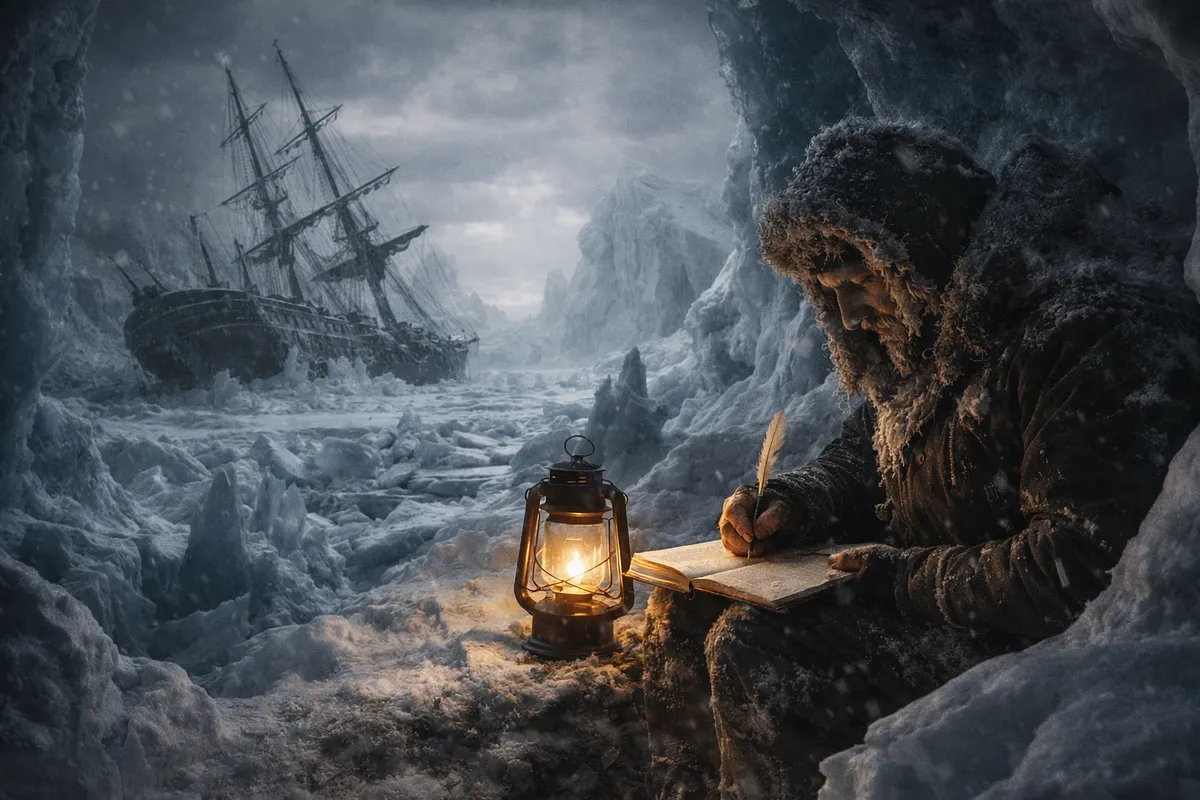
This is an artistic fantasy inspired by «Frankenstein; or, The Modern Prometheus» by Mary Wollstonecraft Shelley. How might the story have continued if the author had decided to extend it?
Original excerpt
He sprung from the cabin-window as he said this, upon the ice raft which lay close to the vessel. He was soon borne away by the waves and lost in darkness and distance.
Continuation
He was soon borne away by the waves, and lost in darkness and distance. But the darkness did not claim him, nor did the frozen sea grant the mercy of oblivion he had so fervently sought. For the creature — that wretched assemblage of stolen limbs and pilfered organs, that monument to one man's magnificent and terrible ambition — found that even death would not have him.
The ice raft drifted northward through corridors of towering bergs that gleamed like cathedrals in the perpetual twilight, and the creature sat upon it as a penitent might sit in the nave of a church, awaiting a judgement that never came. He had spoken his last words to Walton with such conviction — the funeral pile, the ashes scattered upon the sea, the final extinction of that spark which Victor Frankenstein had so recklessly ignited. And yet, as the hours passed and the cold gnawed at him with a ferocity that would have slain any natural man ten times over, his unnatural constitution refused the invitation of dissolution.
"I cannot die," he whispered to the indifferent stars. "Even this — even this is denied me."
He attempted his pyre. He gathered what fragments of wood the ice yielded up — broken spars from ships long since crushed between the frozen jaws of the Arctic, driftwood bleached to the colour of bone — and heaped them upon the ice. But his fingers, those enormous and hideous instruments that had once closed around the throats of innocents, trembled as he struck the flint, and the wind, that eternal and merciless wind that howled across the polar waste, extinguished each feeble flame before it could take hold. Again and again he tried, and again and again the elements conspired against his self-annihilation, until at last he cast the flint into the sea with a cry that echoed across the frozen emptiness like the bellow of some primordial beast.
It was then, in the depths of his despair, that the creature perceived he was not alone upon the ice.
A figure approached from the north — impossible, for nothing human could survive in those latitudes — and as it drew nearer, the creature discerned that it was a woman, or rather the semblance of a woman, wrapped in furs so thick and layered that she appeared more bear than human. Behind her, a team of dogs pulled a low sledge across the ice with mechanical precision, their breath forming clouds that hung in the still air like small ghosts.
She stopped at a distance of perhaps twenty yards and regarded him without fear. This, more than anything, arrested his attention. In all his wretched existence, no human being had ever looked upon him without recoiling, without that instinctive contortion of the features that spoke more eloquently than words of the horror his appearance inspired. But this woman — her face dark and weathered, her eyes black as the Arctic night — merely observed him with the calm appraisal of one who has seen much and learned to be surprised by nothing.
"You are the one they speak of," she said, in a tongue he did not immediately recognise but which bore the cadences of the Saami people, those hardy dwellers of the northern reaches whom he had observed from afar during his long wanderings. "The one who walks the ice and does not die."
The creature stared at her. "You do not flee from me."
"Why should I flee? The ice teaches us that appearances deceive. The most beautiful formations conceal crevasses that swallow men whole. The ugliest, most twisted pressure ridges mark the safest paths." She pulled back the hood of her fur parka, revealing hair as white as the snow that surrounded them, though her face suggested she was not yet old. "I am Ánná. My people have watched you for three months now, wandering the pack ice. We thought you were a spirit. Some wished to leave offerings. Others wished to drive you away with fire and drums."
"And you?" the creature asked, and his voice, that terrible voice that had once pronounced the doom of the Frankenstein family, now carried nothing but exhaustion.
"I wished to speak with you. I have always been the curious one. My grandmother said curiosity would be my death. But she also said that about eating cloudberries before the first frost, and I have done that every year and yet persist." A ghost of a smile crossed her weathered features. "You are cold?"
"I am beyond cold. I am beyond all sensation. I sought death upon this ice, but it will not have me."
Ánná regarded him for a long moment, then turned to her sledge and began unpacking what appeared to be the components of a lavvu — the conical tent of her people. "Then you must come inside and have tea," she said, with the matter-of-fact practicality of one for whom hospitality is not a social grace but a moral imperative of survival. "Death may not want you, but the living have uses for those who endure."
The creature watched in mute astonishment as she erected the shelter with practiced efficiency, her dogs settling around it in a protective circle, their yellow eyes regarding the creature with considerably less equanimity than their mistress. Within the hour, a fire burned inside the lavvu — a small fire, fed with oil rendered from seal blubber, but to the creature, who had failed so utterly to kindle his own funeral pyre, the ease with which she coaxed flame from the reluctant materials seemed almost miraculous.
Inside, the warmth was extraordinary. The creature had to stoop nearly double to enter, and even then his great frame occupied fully half the space, but Ánná arranged herself opposite him with no more discomfort than if she were entertaining a neighbour of ordinary dimensions. She poured tea from a blackened kettle — a brew of dried herbs and something bitter that the creature could not identify — and pressed a cup into his enormous hands.
"Drink," she commanded. "Then tell me why a being who cannot die wishes to."
And so — impossibly, improbably — the creature told his tale. Not as he had told it to Victor Frankenstein, with the desperate eloquence of one pleading for compassion from his creator, nor as he had related it to Walton, with the theatrical grandeur of one delivering a final soliloquy. He told it plainly, haltingly, as one tells a story that has lost its power to shock even the teller. He spoke of his creation, of the laboratory, of the horror in his maker's eyes — that first and foundational rejection from which all subsequent miseries had flowed like tributaries into a great river of suffering. He spoke of the De Laceys, of his education, of his naive and ultimately catastrophic hope that the blind old man's kindness might extend to his family. He spoke of William, and Justine, and Clerval, and Elizabeth — names that fell from his lips like stones dropped into a well, each one sinking into a silence that seemed bottomless.
Ánná listened without interruption, her dark eyes fixed upon him, her face betraying no emotion save a deepening gravity. When at last he fell silent, she was quiet for a long time. The fire crackled. The dogs shifted and whimpered outside. The wind, that interminable wind, sang its hollow song across the ice.
"Your maker," she said at last, "was a fool."
The creature flinched. Even now, even after everything, the instinct to defend Victor Frankenstein — to honour the bond between creator and creation, however poisoned — persisted in him like a vestigial organ, useless but impossible to excise.
"He was brilliant," the creature said. "He conquered death itself."
"He conquered nothing. He fled from everything. A man who creates life and then runs from it is not a conqueror. He is a coward." She sipped her tea with maddening composure. "Among my people, when a child is born, the whole community takes responsibility. Not just the mother and father — everyone. Because we understand that a life, once brought into the world, is the world's concern. Your maker understood nothing of this. He thought creation was an experiment. A triumph of the individual will. But creation is a covenant. And he broke it the moment he looked upon you and felt disgust instead of duty."
The creature's yellow eyes — those dreadful, watery eyes that had gazed upon so much suffering, much of it of his own making — glistened in the firelight. "You speak," he said slowly, "as though I were not a monster."
"I speak as though you were a person," Ánná corrected. "Which is what you are, though assembled by different means than most. The reindeer does not cease to be a reindeer because it was born in a storm rather than in sunshine. You were born in a storm — a storm of one man's arrogance — but you were born nonetheless, and birth carries with it the right to exist."
"The right to exist," the creature repeated, as though tasting a foreign and exotic fruit. "I have never claimed such a right. I have only ever claimed the right to be seen, to be acknowledged, to be — " He paused, and when he spoke again, his voice was barely audible above the wind. "To be loved."
"And because one man could not love you, you concluded that the world could not."
"The evidence was substantial."
"The evidence was limited. You encountered perhaps a hundred humans in your miserable wanderings, and from this paltry sample you derived a universal law. My people number perhaps eight thousand. The Norwegians, the Swedes, the Finns — tens of thousands more. And beyond them, millions upon millions of souls you have never met and never will. You condemned the entire species based on the cruelty of a few."
"And what of my own cruelty?" the creature demanded, and now his voice carried something of its old terrible force, so that the dogs outside whimpered and pressed closer together. "I murdered a child. I brought about the execution of an innocent woman. I strangled the dearest friend of my creator. I killed his bride on their wedding night. What species would embrace such a being? What person of sound mind would extend to me the compassion I denied to others?"
Ánná set down her cup. "I am sitting across from you in a tent on the pack ice," she said. "I have heard your confession. I have not fled. Draw what conclusions you will."
The silence that followed was the longest of the creature's existence — longer than the nights he had spent in the hovel adjoining the De Lacey cottage, longer than the months of pursuit across Europe and into the Arctic. It was a silence in which something ancient and calcified within him began, almost imperceptibly, to crack.
"What would you have me do?" he asked at last, and it was the first time in his life that the question was not a demand or a threat or a plea, but a genuine inquiry — the question of a being who, for the first time, entertained the possibility that the answer might not be death.
"Come south with me," Ánná said. "Not far south — only to the coast, where my people make their winter camp. You will frighten them at first, as you frighten everyone. But the Sámi are a practical people, and winter is hard, and a being who cannot die and does not tire has obvious utility. You will chop wood. You will haul sledges. You will make yourself useful, and in making yourself useful, you will make yourself known, and in making yourself known, you will make yourself — perhaps — something other than what you have been."
The creature looked at his hands — those terrible hands, eight inches across the palm, stitched together from the flesh of the dead. Hands that had created nothing and destroyed everything they touched.
"You believe this is possible?" he whispered.
"I believe," said Ánná, pouring more tea with the unhurried grace of one for whom the Arctic night holds no terror, "that it is worth attempting. And I believe that is more than you had five minutes ago."
She was right. It was more. It was, in fact, everything.
And so the creature — nameless still, monstrous still, bearing upon his patchwork frame the indelible marks of his creator's sin and his own — rose from the fire and followed Ánná out into the Arctic night, where the aurora borealis had begun to unfurl across the heavens in ribbons of green and violet, as though the sky itself were being stitched together from fragments of light, assembled into something whole and strange and terrible and beautiful — much like the creature himself — and the dogs barked, and the sledge runners hissed across the ice, and for the first time since the night of his wretched birth in that charnel-house laboratory in Ingolstadt, the creature moved not away from the world of the living, but toward it.

Loading comments...