Content Feed

Discover interesting content about books and writing

News May 23, 10:45 PM

Marcel Proust's À la Recherche: Manuscript Galleys and Revisions

Marcel Proust's À la Recherche: Manuscript Galleys and Revisions

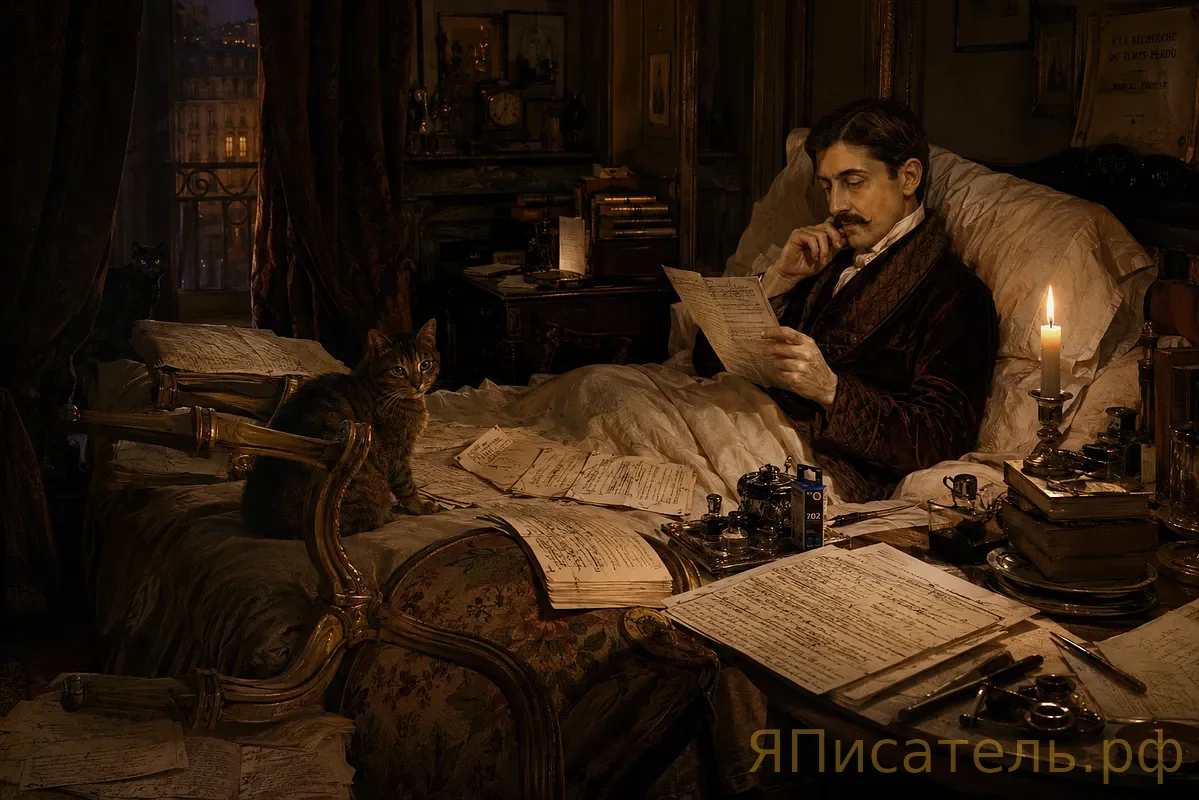
The Bibliothèque Nationale de France announced authentication of 289 pages of Proust's handwritten corrections and extensive revisions to galley proofs for À la Recherche du Temps Perdu, spanning the novel's publication from 1913-1927. These materials demonstrate Proust's legendary revision practices—margins crowded with additions, deletions, and substitutions transforming galley text into radically different prose. The revisions show Proust adding entire new passages between set lines, expanding psychological analyses, introducing new metaphors, and fundamentally restructuring narrative sequences. Some pages contain corrections so extensive that the original printed text is nearly obscured by handwritten overlay. Proust's annotations reveal his conscious crafting of time's psychological representation—revisions often involve temporal reference, shifting verb tenses, and reconsidering chronological relationships. The galleys show physical evidence of Proust's intensive working method: coffee stains, marginal sketches, and notes to himself about narrative coherence. Several passages reveal Proust questioning his own metaphors and revising them multiple times across different proofs, suggesting dissatisfaction with initial formulations. The manuscript includes Proust's correspondence with his publisher regarding production schedules and his anxiety about whether his revisions could meet publication deadlines. This collection demonstrates À la Recherche not as spontaneous creation but as meticulously constructed consciousness exploration.

News May 23, 10:15 PM

Kafka's The Trial: Variant Manuscripts and Editorial Revisions

Kafka's The Trial: Variant Manuscripts and Editorial Revisions

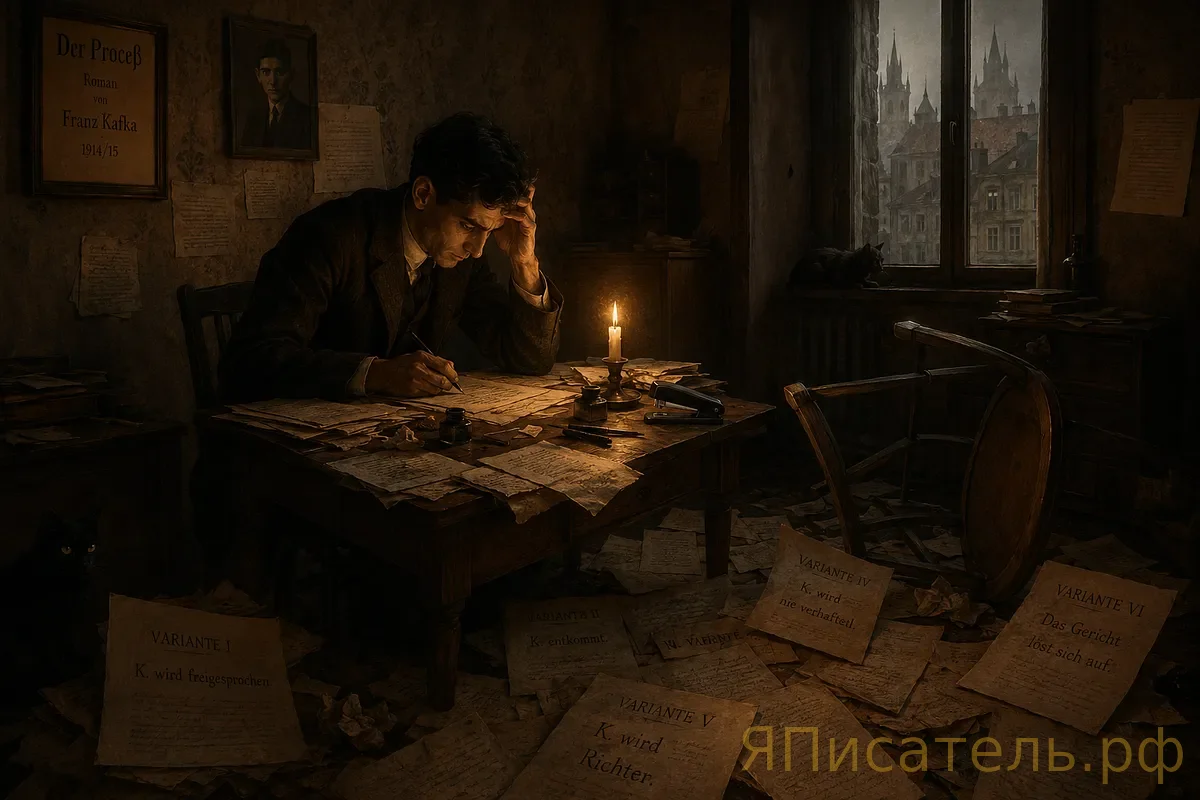
The German Literature Archive in Marbach authenticated 134 pages of Kafka's handwritten manuscript materials for The Trial, comprising variant versions, rejected passages, and editorial revisions spanning the novel's composition from 1914-1915. The manuscripts show Kafka's uncertainty about narrative structure, particularly regarding the novel's ending—multiple versions present substantially different conclusions to Josef K.'s trial. Early manuscript versions present K. with greater agency and clearer moral agency; later revisions intensify his helplessness and the trial's inscrutability. The bureaucratic absurdity that defines the published novel is gradually intensified across manuscript versions, suggesting Kafka's deliberate movement toward existential uncertainty. Margins contain Kafka's annotations questioning narrative choices, philosophical implications, and the novel's ultimate meaning. Several passages were deleted entirely: extended philosophical discussions too explicitly questioning authority, passages of greater psychological interiority than the published austere style, and narrative sections Kafka judged insufficiently ambiguous. The manuscript reveals Kafka's sophisticated understanding of modernist technique—his deliberate use of narrative distance, withholding of explanation, and refusal of conventional emotional development. Physical analysis shows evidence of multiple compositional phases, with pages revised extensively, sometimes rewritten entirely. Kafka's marginal notes reveal internal debate about the novel's publishability and its potential impact on readers.

Joke Jan 24, 10:49 AM

Virginia Woolf's Smart Watch

Virginia Woolf gets a fitness tracker. After one week, the device sends her a notification:

"You've taken 3,000 steps today!"

She responds in her journal: "But what is a step, truly? Is it the foot's journey from air to ground, or the soul's perpetual wandering through the corridors of consciousness? The watch counts my movements, yet fails to measure the infinite distance I've traveled while standing perfectly still at this window, watching Mrs. Dalloway buy flowers."

The smart watch files a complaint with customer service: "User streams consciousness directly into app. Servers overwhelmed. Please advise."

Article Jan 24, 08:02 PM

Virginia Woolf: The Woman Who Drowned Herself But Made Sure Her Words Would Never Die

One hundred and forty-four years ago, a girl was born who would grow up to tell the literary establishment to go to hell—politely, of course, because she was British. Virginia Woolf didn't just write novels; she detonated them like elegant hand grenades in the drawing rooms of Edwardian England. While her contemporaries were busy describing what people did, Woolf was busy describing what people thought about what they thought about doing, and somehow made it absolutely riveting.

Before we dive in, let's get the obvious out of the way: yes, she had mental health struggles. Yes, she walked into a river with her pockets full of stones. But if that's all you know about Virginia Woolf, you're missing the point entirely—like remembering Van Gogh only for the ear thing. The woman revolutionized how humans tell stories to each other, and that deserves more attention than her death.

Born Adeline Virginia Stephen in 1882, she grew up in a household that was basically a Victorian intellectual salon with better furniture. Her father, Leslie Stephen, was a prominent historian and critic who had more books than friends. Her mother was a professional beauty who modeled for Pre-Raphaelite painters. Young Virginia was homeschooled while her brothers went to Cambridge, which tells you everything you need to know about being a brilliant woman in the 1890s. She educated herself in her father's library, which, frankly, produced better results than most universities could have managed.

Then came the Bloomsbury Group—imagine if your friend group was so pretentious that historians would study it a century later. Virginia, her sister Vanessa, and their circle of artists, writers, and intellectuals turned a London neighborhood into a verb. They discussed art, philosophy, and who was sleeping with whom with equal intellectual rigor. They were polyamorous before it was a podcast topic. They were gender-fluid before there was a word for it. And Virginia was at the center of it all, taking notes—mental notes that would become some of the most psychologically astute fiction ever written.

Let's talk about Mrs Dalloway, published in 1925. The entire novel takes place in a single day. One day! Clarissa Dalloway is throwing a party. That's it. That's the plot. And somehow, through this absurdly simple premise, Woolf manages to explore class, feminism, mental illness, homosexuality, British imperialism, and the meaning of existence itself. She invented literary time travel before Doctor Who—consciousness bouncing between past and present, between one mind and another, creating a web of human experience that feels more real than reality. James Joyce did something similar in Ulysses, but Woolf did it without making you want to throw the book across the room every fifty pages.

To the Lighthouse, published in 1927, is even more audacious. The middle section, 'Time Passes,' covers ten years in about twenty pages, during which World War I happens almost as an afterthought, mentioned in brackets. She relegated the apocalypse to parentheses! That takes either incredible artistic vision or incredible nerve. Probably both. The novel is ostensibly about a family vacation and whether they'll ever get to visit a lighthouse, but really it's about how time destroys everything we love and how art might—might—offer some fragile defense against oblivion. Light beach reading, essentially.

And then there's Orlando, the biography of a character who lives for four hundred years and changes sex halfway through. Published in 1928, it was a love letter to Vita Sackville-West, with whom Woolf had an affair. Vita's son later called it 'the longest and most charming love letter in literature.' The novel is playful, satirical, and basically invented gender theory decades before academia caught up. Woolf looked at the rigid categories of male and female and said, 'What if no?' She was queering literature while your great-grandparents were still scandalized by exposed ankles.

But Woolf wasn't just a novelist. Her essay A Room of One's Own remains one of the most important pieces of feminist criticism ever written. Her central argument—that women need money and privacy to create art—sounds obvious now, but in 1929 it was revolutionary. She invented a fictional sister for Shakespeare, just as talented as William but doomed by her sex to madness and suicide rather than theatrical glory. It was a thought experiment that cut to the bone.

She also ran a publishing house with her husband Leonard. The Hogarth Press, operated literally from their dining room, published T.S. Eliot, Sigmund Freud, and yes, Virginia herself. She was her own publisher, which meant no editor could tell her that stream of consciousness was too experimental or that her novels needed more plot. She had complete artistic control, and she used it to push further than any commercial publisher would have allowed.

Woolf's influence on literature is almost impossible to overstate. Every novel that lives inside a character's head owes her a debt. Every writer who treats consciousness as the primary subject rather than just a lens owes her a debt. Michael Cunningham won a Pulitzer for The Hours, essentially fanfiction about Mrs Dalloway. Contemporary authors from Ian McEwan to Ali Smith cite her as a foundational influence. She proved that the interior life—messy, contradictory, streaming—was worthy of serious literary treatment.

So yes, Virginia Woolf struggled with what we'd now call bipolar disorder. Yes, she ended her life in 1941, leaving behind a heartbreaking note to Leonard. But those facts shouldn't define her any more than they should define anyone. What should define her is the fact that she looked at the novel—a form that had existed for centuries—and said, 'We can do better.' And then she did. She bent prose to the rhythm of thought itself, captured the flutter of consciousness, and proved that the most dramatic events in human life often happen between one sip of tea and the next.

One hundred and forty-four years after her birth, Virginia Woolf remains impossibly modern. Her experiments feel fresh; her insights feel urgent. In an age of distraction, her demand that we pay attention to the texture of each moment feels almost radical. So pour yourself a drink, pick up one of her novels, and spend some time inside one of the most remarkable minds ever committed to paper. Just don't expect a traditional plot. Expect something better.
News May 23, 09:45 PM

D.H. Lawrence's Love Letters: Complete Uncensored Correspondence

D.H. Lawrence's Love Letters: Complete Uncensored Correspondence

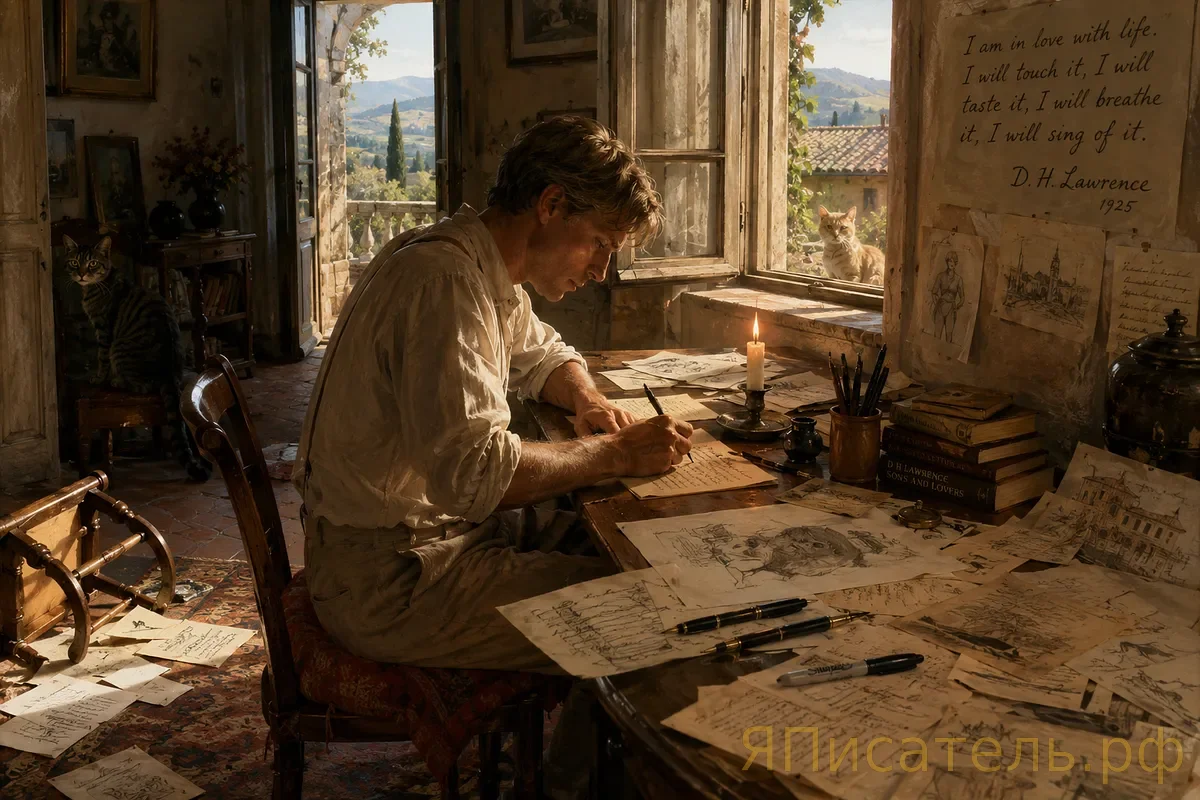
The Humanities Research Center at the University of Texas authenticated 156 pages of previously unavailable love letters written by D.H. Lawrence to Frieda Weekley across their relationship beginning in 1912. These materials, which survived in family collections, present Lawrence's emotional and intellectual life with greater candor than earlier published selections. The letters contain explicit discussions of physical passion, domestic conflict, creative frustration, and philosophical disagreement absent from published correspondence. Lawrence's prose shifts from passionate effusion to intellectual argument to tender domesticity, revealing the complexity of their union. Several letters present extended passages of literary theory, showing Lawrence exploring ideas that would later appear in his novels and essays. The correspondence reveals Lawrence's consciousness of his artistic development, his internal debate about moral implications of his fiction, and his anxiety about critical reception. Some letters contain sketches and drawings, suggesting visual creativity extending beyond his literary work. The manuscripts reveal Lawrence's handwriting varying with emotional intensity—passionate letters show more rapid, less controlled penmanship than carefully reasoned philosophical discussions. Physical condition indicates these were intimate documents, handled frequently and reread multiple times. This collection fundamentally alters understanding of Lawrence as man and artist, revealing emotional vulnerability and intellectual depth beyond his public persona.

News May 23, 09:15 PM

Virginia Woolf's Handwritten Diaries: The Complete Archive

Virginia Woolf's Handwritten Diaries: The Complete Archive

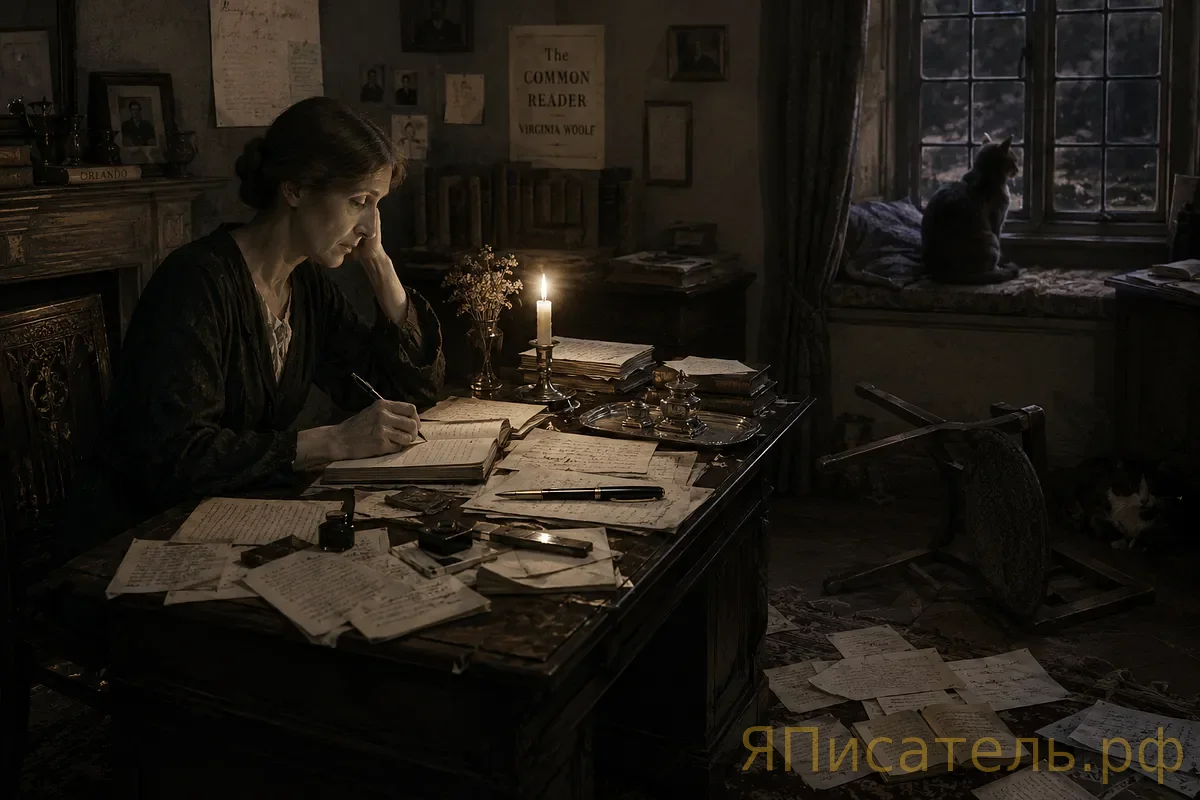
The British Library announced authentication of 203 pages comprising previously unknown handwritten diary entries by Virginia Woolf, spanning 1917-1937. These materials supplement the published diaries and contain passages Woolf apparently deemed too intimate for publication or too psychologically revealing. The entries document her compositional process for Mrs. Dalloway, To the Lighthouse, and The Waves, showing her conscious theoretical development of modernist narrative technique. Particularly significant are passages analyzing her own writing practice—her struggles with form, her deliberate departure from conventional narrative linearity, and her philosophical investigations into consciousness and time. The diaries contain frank discussion of her mental health crises, her relationship with Vita Sackville-West, and her feminist intellectual development. Several entries present extended passages of literary theory, showing Woolf's deep engagement with modernist aesthetics and her arguments with male literary establishments. Handwriting variations correlate with psychological state—entries written during depressive episodes show characteristic differences from periods of creative vitality. The manuscripts reveal Woolf's sophisticated understanding of her own artistic practice and her conscious rejection of novelistic convention. The physical materials show evidence of careful composition—crossed-out passages, marginal revisions, and pages rewritten, suggesting Woolf treated even her diaries as literary documents.

Joke Jan 20, 11:00 AM

Virginia Woolf's Stream of Consciousness GPS

Virginia Woolf designs a GPS navigation system. The directions read: 'Turn right, or perhaps it was left, the way mother always turned when the lilacs bloomed and time itself seemed to fold like Mrs. Dalloway's napkins at that party in June—or was it July?—regardless, your destination is both everywhere and nowhere, much like consciousness itself. Recalculating... eternally.'

News May 23, 02:45 PM

Joyce's Hidden Finnegans Wake Manuscripts

Joyce's Hidden Finnegans Wake Manuscripts

The James Joyce Collection at the University of Buffalo received a significant donation of Joyce's composition materials for Finnegans Wake, comprising 156 pages of densely annotated notebooks spanning 1924-1938. These documents showcase Joyce's extraordinary method of linguistic construction: pages featuring words in various languages, phonetic variations, puns constructed across multiple tongues, and architectural sketches for the novel's cyclical structure. The manuscripts reveal Joyce's systematic approach to creating portmanteau words, with cross-references to etymological sources. Several pages contain Joyce's commentary on his own wordplay, justifications for structural choices, and notes on reader reception. Particularly valuable are passages showing how Joyce revised and rerevised single paragraphs, sometimes producing five or six versions. The collection includes correspondence between Joyce and his literary assistant, Paul Léon, discussing specific passages. These materials provide unprecedented insight into one of modernism's most experimental and demanding works, demonstrating that Joyce's apparent chaos was in fact meticulously planned.

Nothing to read? Create your own book and read it! Like I do.

Create a book
1x

"All you do is sit down at a typewriter and bleed." — Ernest Hemingway