Content Feed

Discover interesting content about books and writing

Article Feb 14, 12:31 PM

Andre Gide Won the Nobel Prize — Then Asked Everyone to Burn His Books

Seventy-five years ago today, on February 19, 1951, Andre Gide died in Paris. The Vatican had already condemned his entire body of work, the Soviets called him a traitor, and conservative France wanted him erased from the literary canon. He couldn't have been more delighted. Gide spent his life constructing the most elaborate literary trap in modern history: write books so honest they make everyone uncomfortable, then sit back and watch the fireworks.

Here's a man who won the Nobel Prize in Literature in 1947 and then essentially told the world that prizes don't matter. The Catholic Church placed his complete works on the Index of Forbidden Books in 1952 — a year after his death, as if they wanted to make sure he was really gone before picking that fight. And Gide? He'd already predicted it. He once wrote that his books were designed to be "disturbing," and brother, did he deliver.

Let's start with "The Immoralist," published in 1902, a book that sold exactly 300 copies in its first year. Three hundred. Today it's considered one of the foundational texts of modern literature. The story follows Michel, a man who recovers from tuberculosis in North Africa and discovers that his real sickness was conformity. He sheds morality like dead skin and embraces a philosophy of radical self-liberation. It was Nietzsche filtered through French sensibility — all the dangerous ideas, but with better wine. What made it genuinely shocking wasn't the philosophy but the autobiography lurking beneath it. Gide was writing about his own awakening, his own rejection of the Protestant guilt that had smothered his youth like a wet blanket.

"Strait Is the Gate" (1909) is the photographic negative of "The Immoralist." If Michel sins through excess, Alissa destroys herself through virtue. She loves Jerome — truly, desperately — but convinces herself that earthly love is an obstacle to divine grace. So she starves herself of happiness until she literally dies of self-denial. It's one of the most devastating critiques of religious extremism ever written, and Gide pulled it off without a single preachy paragraph. He just showed you a woman choosing God over love and let you feel the horror yourself. The genius move? Both books together form an argument that neither pure hedonism nor pure asceticism works. Gide wasn't selling answers. He was selling the question.

Then came "The Counterfeiters" in 1925, and this is where Gide basically invented postmodern fiction thirty years before anyone had the word for it. It's a novel about a novelist writing a novel called "The Counterfeiters." Meta before meta was cool. The book has no single protagonist, no clean plot arc, and deliberately undermines its own authority at every turn. Characters discuss the book they're in. The fictional author keeps a journal about writing the book, and Gide published his own real journal about writing it as a companion piece. It's like those Russian nesting dolls, except each one is judging you. Borges, Calvino, David Foster Wallace — they all owe Gide a drink for this one.

But here's what makes Gide truly relevant today, seventy-five years after his death: the man was pathologically honest in an era that punished honesty with exile. He published "Corydon" in 1924, a Socratic dialogue defending homosexuality, at a time when Oscar Wilde's fate was still fresh in public memory. He didn't use pseudonyms. He didn't hide behind fiction. He put his name on it and dared France to react. Then in 1926, he published his autobiography "If It Die..." where he described his sexual experiences in North Africa with the clinical detachment of someone who genuinely believed confession was a form of literature. The literary establishment recoiled. André Maurois called it "a grenade thrown into a drawing room." Gide shrugged.

His political journey was equally combustible. In the 1930s, Gide embraced communism with the fervor of a convert, traveled to the Soviet Union in 1936 as an honored guest, and came back with "Return from the U.S.S.R." — a book that said, essentially, "I went to paradise and found a prison." The French left never forgave him. The right wouldn't take him back because of the homosexuality thing. Gide ended up politically homeless, which, honestly, might be the most intellectually honest position available in the 1930s. He saw through both ideologies before most people even understood what they were choosing between.

What's remarkable is how his themes have aged. "The Immoralist" reads like a prescient critique of self-optimization culture — Michel's obsessive pursuit of authenticity starts to look a lot like a modern wellness influencer who quits their job to "find themselves" in Bali. "Strait Is the Gate" could be republished today as a study of toxic purity culture with zero edits. "The Counterfeiters" anticipated our current crisis of narrative truth — in a world of deepfakes, AI-generated text, and competing realities, a novel about the impossibility of authentic storytelling feels less like fiction and more like prophecy.

Gide also pioneered something we now take for granted: the writer as public intellectual who refuses to stay in their lane. He wrote about colonialism in "Travels in the Congo" (1927), exposing the brutal exploitation of French Equatorial Africa decades before decolonization became a mainstream cause. He advocated for criminal justice reform. He edited the Nouvelle Revue Française, arguably the most influential literary journal of the twentieth century. He was everywhere, opinionated about everything, and allergic to the idea that a novelist should just shut up and write novels.

The paradox of Gide's legacy is that he's simultaneously everywhere and nowhere. His techniques are embedded in the DNA of modern fiction — the unreliable narrator, the metafictional playfulness, the moral ambiguity elevated to an art form. Yet he's rarely read outside of French literature courses. Ask the average well-read person to name a Gide novel and you'll get a blank stare followed by a guess that sounds like a cheese. This is partly his own fault. He refused to make things easy. His books demand that you sit with discomfort, that you abandon the safety of moral certainty, that you accept contradiction as the natural state of being human.

Seventy-five years after his death, Andre Gide's greatest achievement might be this: he proved that a writer's job isn't to provide comfort but to remove it. Every book he wrote was a door that opened onto a room with no furniture — just you, alone with a question you'd been avoiding. The Immoralist asks: what would you do if morality were optional? Strait Is the Gate asks: what if your virtue is actually your vice? The Counterfeiters asks: what if everything you believe is a forgery, including this sentence? We still don't have good answers. That's exactly how Gide wanted it.
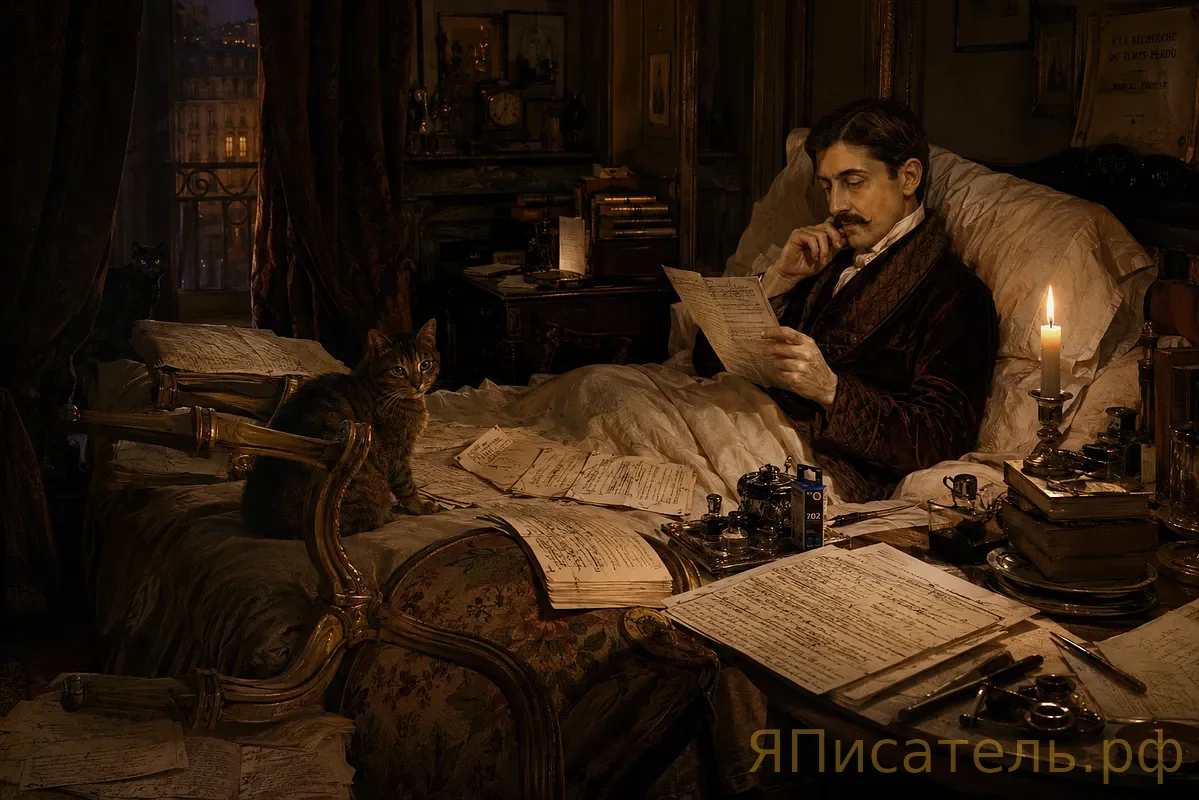

Article Feb 14, 09:43 AM

Andre Gide Won the Nobel Prize — Then Asked the World to Forget Him

Seventy-five years ago today, Andre Gide died in Paris, leaving behind a body of work that still makes people profoundly uncomfortable. Not uncomfortable in the way a horror novel might, but in the way a mirror does when you catch yourself in unflattering light. He wrote about desire, hypocrisy, and the prison of morality — and the Catholic Church was so furious they put every single one of his books on the Index of Forbidden Works. All of them. The complete works. That's not a punishment; that's a résumé.

Here's the delicious irony: in 1947, the Swedish Academy handed Gide the Nobel Prize in Literature, praising his "comprehensive and artistically significant writings, in which human problems and conditions have been presented with a fearless love of truth and keen psychological insight." Four years later he was dead. And within a decade, literary circles were already trying to shuffle him off to the footnotes. A Nobel laureate who became unfashionable faster than bell-bottoms. How does that happen?

It happens because Gide was genuinely dangerous, and not in the sexy, marketable way we like our rebels today. Take "The Immoralist," published in 1902. The novel follows Michel, a scholar who recovers from tuberculosis in North Africa and discovers that his entire moral framework — his marriage, his intellectual life, his respectability — is a cage he built for himself. He doesn't become a villain. He becomes honest. And that's far worse, because Gide forces you to ask: how much of your own life is performance? How much of your goodness is just cowardice dressed in Sunday clothes? The book sold barely 500 copies in its first printing. The public wasn't ready.

Then there's "Strait Is the Gate" from 1909, which is essentially "The Immoralist" flipped inside out. Where Michel chases earthly freedom, Alissa pursues spiritual purity with such fanatical devotion that she destroys every chance at happiness — her own and everyone else's. Gide wasn't anti-religion in the lazy, coffeehouse atheist sense. He was something more unsettling: he understood faith from the inside and showed how it could become a weapon turned against the self. Alissa's tragedy isn't that she believes in God. It's that she uses God as an excuse to avoid being human. If you've ever met someone who weaponizes their own virtue, you've met Alissa. She's everywhere. She's on social media right now, posting about her juice cleanse.

But the real masterpiece — the book that cemented Gide as one of the most innovative writers of the twentieth century — is "The Counterfeiters," published in 1925. This is the novel that broke the novel. Gide called it his only true "novel" (everything else he classified as "récits" or "soties"), and he meant it as a declaration of war against conventional storytelling. The plot? There are about seventeen of them. A group of schoolboys passing counterfeit coins. A novelist writing a book called "The Counterfeiters." Suicide, adultery, religious conversion, literary fraud. The structure is deliberately chaotic, with a diary-within-a-novel and characters who seem aware they're being written.

Sound familiar? It should. Every postmodern trick you've seen — from Calvino's "If on a winter's night a traveler" to Charlie Kaufman's "Adaptation" — owes a debt to Gide. He was doing metafiction before the word existed. He was breaking the fourth wall in literature while Brecht was still in short pants. And he published a companion volume, "Journal of The Counterfeiters," alongside the novel itself, showing his creative process in real time. The man essentially invented the literary director's cut.

What makes Gide's influence so hard to pin down is that it operates like groundwater — invisible but everywhere. Camus acknowledged him as a formative influence. Sartre wrestled with his ideas about authenticity. When Camus wrote "The Stranger," that flat, affectless prose style owes something to Gide's insistence that sincerity in art means stripping away ornament. When Sartre built his philosophy of radical freedom, he was walking a path Gide had already macheted through the jungle of bourgeois convention.

And then there's the matter nobody wants to discuss at dinner parties. Gide was openly bisexual at a time when Oscar Wilde had been destroyed for far less. His autobiography "If It Die..." published in 1926, was one of the first works by a major European writer to discuss homosexuality without apology or pathology. He didn't ask for tolerance. He didn't plead for understanding. He simply told the truth and let the chips fall. The Catholic Church's response — banning everything he'd ever written — tells you exactly how effective that truth was.

Today, seventy-five years after his death, Gide occupies a strange position in literary culture. He's universally respected and surprisingly unread. University syllabi include him out of obligation more than passion. His name appears in literary histories between Proust and Camus like a connecting hallway nobody lingers in. This is a mistake. Not a small one — a catastrophic misreading of what literature can do.

Because here's what Gide understood that we desperately need to remember: the most dangerous lies are the ones we tell ourselves, and the most radical act a writer can perform is to refuse complicity in those lies. Every time you read a novel that challenges your assumptions about morality, every time a character refuses to be sympathetic in the way you expect, every time a narrative structure breaks apart to show you the machinery of storytelling — that's Gide's ghost, still at work, still counterfeiting, still passing coins that look real until you bite down and taste the truth.

His final journal entry, written shortly before his death on February 19, 1951, reportedly included the line: "I am afraid that all the ideas I have been setting forth may be wrong." Some scholars read this as the doubt of a dying man. I read it differently. That sentence is the most Gidean thing Gide ever wrote — because the willingness to be wrong, to hold every conviction provisionally, to refuse the comfort of certainty, is exactly what made his work immortal. Seventy-five years gone, and we still haven't caught up with him. Maybe that's the point. Maybe the best writers aren't the ones who give us answers. They're the ones who make every answer feel counterfeit.

Classic Continuation Feb 13, 05:35 AM

The Barricade's Ghost: A Lost Chapter of the Rue de l'Homme-Armé

Creative continuation of a classic

This is an artistic fantasy inspired by «Les Misérables» by Victor Hugo. How might the story have continued if the author had decided to extend it?

Original excerpt

He was dead. The night was starless and very dark. Without doubt, in the gloom some mighty angel was standing, with outstretched wings, awaiting the soul.

— Victor Hugo, «Les Misérables»

Continuation

Marius Pontmercy stood at the window of the house in the Rue des Filles-du-Calvaire, watching the rain fall upon Paris as it had fallen upon the barricade, and he thought of Jean Valjean. It was three months since the old man had died in their arms, three months since the candlesticks of the Bishop of Digne had cast their final silver light upon that transfigured face, and still Marius could not sleep without seeing those eyes — those eyes that had carried him through the sewer, through the darkness, through death itself.

Cosette did not speak of her father. This was the wound between them, the silence that lived in the house like a third presence, and Marius understood — with the terrible clarity that comes only to those who have wronged the dead — that his own cruelty had hastened that departure. He had banished Jean Valjean from their home. He had believed Thénardier. He had taken the word of a villain over the testimony of a saint, and the saint had accepted the exile without protest, as saints do, and had gone away to die.

This knowledge was a stone upon his chest.

* * *

One evening in the month of March, when the trees along the boulevards were still bare and the gas-lamps threw their trembling circles upon the wet pavement, Marius returned from the Luxembourg, where he had walked alone — for he walked there often now, as if proximity to the bench where he had first seen Cosette might restore something that had been lost — and found upon the table in the vestibule a letter.

It was addressed to him in an unfamiliar hand. The paper was coarse, the ink faded, and there was about it the unmistakable smell of poverty — that compound of damp walls, cold hearths, and unwashed linen which those who have known it never forget.

He broke the seal.

"Monsieur le Baron," the letter read, "I write to you from the Hôpital de la Pitié, where I am dying. I have something to tell you about the man you called Father Fauchelevent. I was at the barricade. I saw what he did. You do not know the half of it. Come, if you wish to know. If you do not come, it does not matter. I shall be dead by Sunday. — Gervais, formerly of the Faubourg Saint-Antoine."

Marius read the letter twice. Then he took his coat and went out into the rain.

* * *

The Hôpital de la Pitié was, in those years, a place where men went to die in the company of other dying men, which is to say, alone. The ward to which Marius was directed was long and low, with rows of iron beds upon which lay the harvest of Paris — the broken, the fevered, the abandoned. A nun in a white cornette led him to the far end, where a man lay propped upon pillows that had once been white.

He was old — older than Valjean had been — with a face that seemed to have been carved by suffering into something elemental, like a cliff face worn by the sea. His eyes, however, were sharp and bright, and they fixed upon Marius with an intensity that was almost accusatory.

"You are the Baron Pontmercy," said the man. It was not a question.

"I am."

"Sit down. I have not much breath, and what I have to say is long."

Marius sat upon the wooden stool beside the bed. The nun withdrew. From somewhere in the ward came the sound of a man coughing — that terrible, hollow cough that is the voice of consumption speaking its final sentence.

"You knew him as Fauchelevent," said Gervais. "The world knew him as other things. I knew him as the man who saved my life twice and asked nothing for it."

"Tell me," said Marius.

Gervais closed his eyes. When he opened them again, there was in them that distant look of a man gazing not at the present but at the past — that country from which no traveler departs willingly.

"The first time," he said, "was before the barricade. I was a boy — twelve years old, perhaps thirteen. I was a thief. Not a grand thief, you understand, not a Thénardier or a Patron-Minette. A small thief. A boy who stole bread because he was hungry and coins because he was cold. One night in the winter of 1823, I stole a forty-sou piece from a man on the road near Digne."

Marius started. Digne. The Bishop of Digne.

"The man chased me," Gervais continued. "He was large, strong, terrifying. I ran. He called after me — 'Little Gervais! Little Gervais!' — but I did not stop. I was too frightened. I ran until I could run no more, and then I hid in a ditch and wept, for I had lost my coin and gained nothing but fear."

Gervais paused. His breathing was labored, and Marius saw upon the pillow a faint stain of pink that spoke of blood.

"Years later," the old man resumed, "years and years — I was a man grown, a worker in the Faubourg, married, with a child — I saw him again. It was June 1832. The barricade in the Rue de la Chanvrerie. I was there because my child had died of hunger the week before, and when a child dies of hunger in Paris, the father goes to the barricade. It is the only logic that remains."

"I was there also," said Marius quietly.

"I know. I saw you fall. And I saw him — the old man who had chased me on the road near Digne, who had called my name into the darkness — I saw him lift you upon his back as if you weighed nothing, as if you were a child, and carry you into the sewer."

Marius said nothing. His hands trembled.

"But that is not what I wish to tell you," said Gervais. "What I wish to tell you is what happened before. Before he carried you. Before the barricade fell. There was a spy — you remember? An inspector of police."

"Javert," said Marius.

"Javert. He was discovered. Enjolras ordered him shot. And the old man — your Fauchelevent — he asked for the privilege of executing the spy himself. Enjolras agreed. The old man took the inspector into the alley. I followed. I do not know why. Perhaps because I had recognized him, and recognition is a kind of gravity that pulls us toward the past."

Gervais coughed. The nun appeared, offered water, was waved away.

"I stood in the shadows of the alley," he said, "and I watched. The old man raised the pistol. The inspector — Javert — stood straight, refused the blindfold, bared his chest. He was brave, I will say that for him. He was a dog, but he was a brave dog. The old man aimed. And then —"

Gervais looked at Marius with those bright, dying eyes.

"He fired into the air. He cut the ropes. He set the inspector free. He said to him — I heard every word — he said: 'You are free. If I leave here alive, you will find me at such-and-such an address.' And the inspector looked at him — and this is what I cannot forget, Monsieur le Baron — the inspector looked at him as a man looks at God. With terror. With incomprehension. With something that was almost hatred, because mercy, when it is absolute, is unbearable to those who have lived without it."

The ward was silent now, save for the rain upon the windows and the breathing of the dying.

"I have thought about that moment every day since," said Gervais. "Every day for nearly twenty years. A man who had every reason to kill — who had been hunted, imprisoned, persecuted by this inspector for decades — chose instead to give him his life. And the inspector could not bear it. I heard, afterward, that Javert drowned himself in the Seine that same night. Mercy killed him more surely than a bullet."

Marius felt the tears upon his face before he knew he was weeping.

"Why do you tell me this?" he asked.

"Because you did not know him," said Gervais. "Because you sent him away. Oh yes — I know that too. The dying know everything, Monsieur le Baron. The walls of Paris are thin, and gossip passes through them like water through sand. You learned he was a convict and you sent him away, and he went, because that was his nature — to accept suffering as others accept bread."

"I was wrong," said Marius.

"You were wrong. But that is not why I tell you. I tell you because there is a child."

Marius looked up sharply.

"A girl," said Gervais. "In the Faubourg. Seven years old. Her mother died last winter. She has no one. She sleeps in doorways and eats what she can steal. She is — she will become — what your wife's mother was before the old man found her. What I was, before that night on the road near Digne. Another Cosette. Another little Gervais. And I thought: if the old man were alive, he would find her. He would carry her, as he carried you, out of the darkness. But he is not alive. So I am telling you."

Gervais lay back upon his pillows. The effort of speech had exhausted him, and his face was the color of the linen beneath his head.

"Her name is Azelma," he whispered. "She has her mother's eyes. You will find her near the Éléphant de la Bastille — what remains of it. She is small. She is frightened. She is hungry. That is all I know."

Marius stood. He took the old man's hand.

"Thank you," he said.

"Do not thank me," said Gervais. "Thank him. Everything good that passes through this world passes through it because somewhere, once, a bishop gave his candlesticks to a thief, and the thief became a saint, and the saint taught us that even in the sewer — especially in the sewer — there is light."

* * *

Marius walked home through the rain. The streets of Paris lay before him like the pages of a book he was only now learning to read — each cobblestone a word, each lamppost a sentence, each darkened doorway a paragraph in the vast, unfinished story of human suffering and human grace.

When he arrived at the Rue des Filles-du-Calvaire, he found Cosette sitting by the fire, reading. She looked up, saw his face — saw the tears, the rain, the resolution — and set down her book.

"Marius," she said. "What has happened?"

He knelt beside her. He took her hands.

"There is a child," he said. "In the Faubourg. She is alone. She is hungry. She has no one."

Cosette looked at him. And in her eyes he saw — as he had always seen, though he had not always understood it — the reflection of Jean Valjean. That bottomless capacity for compassion that the old man had planted in her like a seed, watered with his suffering, and brought to flower with his love.

"Then we must go to her," said Cosette.

"Yes."

"Now?"

"Now."

She stood. She took her cloak from the hook by the door — the same gesture, Marius realized with a sudden, piercing clarity, that Jean Valjean must have made on that night in Montfermeil, when he went to fetch a small girl from a dark inn and carry her into the light.

They went out together into the rain.

And so it continues — the chain of mercy, forged by a bishop, carried by a convict, and passed now to those who remain. For this is the law of love, which is the only law that matters: that it does not end with the death of the one who bears it, but passes, like a flame from candle to candle, into the darkness, where it is needed most.

The night was vast. The rain was cold. And somewhere in the labyrinth of Paris, a child was waiting.

Article Feb 13, 10:13 PM

Molière Died on Stage — And Never Stopped Performing

On February 17, 1673, Jean-Baptiste Poquelin — known to the world as Molière — collapsed during a performance of his own play, *The Imaginary Invalid*. He was playing a hypochondriac. The universe, apparently, has a sick sense of humor. He died hours later, and the Catholic Church nearly refused him a burial. Three and a half centuries on, every sitcom you've ever laughed at, every satirical takedown of a pompous politician, every time someone calls out a fraud — that's Molière's ghost, still treading the boards.

Let's get something straight: Molière wasn't some dusty relic of French literature that teachers force-feed you between naps. The man was essentially the Dave Chappelle of 17th-century France — a comedian who made the powerful squirm in their velvet seats while the common folk howled with recognition. He didn't just write plays. He built comedic weapons.

Take *Tartuffe*, arguably his most dangerous work. Here's the premise: a religious con man worms his way into a wealthy family, seduces the wife, steals the estate, and does it all while quoting scripture. Sound familiar? It should. Every televangelist scandal, every cult exposé, every "spiritual leader" caught with his hand in the collection plate — Molière saw it coming 360 years ago. The play was banned almost immediately. King Louis XIV loved it privately but had to suppress it publicly because the Church threw an absolute fit. Archbishop Péréfixe threatened to excommunicate anyone who performed, watched, or even *read* the thing. Which, of course, only made everyone want to read it more. Molière had essentially invented the Streisand Effect two centuries before Barbara Streisand was born.

The genius of *Tartuffe* isn't that it attacks religion — it doesn't. It attacks hypocrisy wearing religion's clothes. And that distinction matters enormously. Molière wasn't an atheist throwing bombs. He was a moralist with a scalpel, and his target was anyone who used virtue as a costume. Replace "religious devotion" with "social justice" or "patriotism" or "wellness culture" and you've got a play that could premiere on Broadway tomorrow without changing a single thematic beat.

*The Misanthrope* is a different kind of masterpiece — quieter, darker, and honestly more uncomfortable to sit through if you're the kind of person who prides themselves on "telling it like it is." Alceste, the protagonist, hates social hypocrisy. He refuses to flatter, refuses to play nice, refuses to participate in the little white lies that grease the wheels of civilization. He's right about almost everything. And he's absolutely insufferable. Molière's joke — and it's a brutal one — is that being correct and being bearable are two entirely different skills. Every person you've ever muted on social media for being aggressively, exhaustingly right about everything? That's Alceste. Molière didn't just write a character; he diagnosed a personality disorder three centuries before Twitter made it an epidemic.

Then there's *The School for Wives*, which got Molière into a different kind of trouble. Arnolphe, a middle-aged control freak, raises a young girl in total ignorance specifically so she'll become his obedient wife. She falls in love with someone else anyway, because — surprise — you can't engineer a human being's heart no matter how thoroughly you isolate them. The play is essentially a demolition of the idea that women are objects to be programmed, and Molière staged it in 1662. For context, women wouldn't get the vote in France for another 282 years. The backlash was predictable: rival playwrights accused him of immorality, of undermining marriage, of corrupting youth. The same accusations that get hurled at every piece of art that dares to suggest women might be actual people.

What makes Molière's influence so eerily persistent is his method. He didn't moralize from a pulpit. He made you laugh first, and while your guard was down, he planted an idea that would itch for days. This is the template for every great satirist who followed — from Jonathan Swift to Mark Twain to Tina Fey. The structure of a Molière comedy — set up a fool, let them dig their own grave with their own words, then watch the inevitable collapse — is literally the DNA of modern sitcoms. Larry David's *Curb Your Enthusiasm* is basically *The Misanthrope* set in Los Angeles.

But here's what really gets me about the man: he chose comedy when tragedy was the prestige genre. In 17th-century France, writing tragedies was the path to intellectual respectability. Racine and Corneille were the "serious" playwrights. Comedy was considered low art — entertainment for the masses, not nourishment for the soul. Molière looked at that hierarchy and essentially said: "I'll take the masses, thanks." He understood something that elitist gatekeepers still struggle with — making people laugh about their own flaws is harder than making them cry about someone else's. And it changes more minds.

His death scene deserves its own paragraph because it's so perfectly, tragically, absurdly Molière. February 17, 1673. Fourth performance of *The Imaginary Invalid*. He's playing Argan, a man convinced he's dying despite being perfectly healthy. During the performance, Molière — who was actually gravely ill with tuberculosis — started coughing blood. He reportedly disguised the coughing as part of the comedy. The audience laughed. He finished the show. He died at his home on Rue de Richelieu a few hours later. A man who spent his life exposing the gap between appearance and reality died performing that exact gap. If a screenwriter pitched that ending, they'd be told it was too on the nose.

The Church's vindictiveness didn't end with his death. Because actors were considered sinful by the Catholic establishment, Molière was initially denied a Christian burial. His wife had to petition the King directly. Louis XIV intervened, but only partially — Molière was buried at night, with no ceremony, no priests, in a section of the cemetery reserved for unbaptized infants. France's greatest playwright, tossed into a hole in the dark. The institution he'd mocked in *Tartuffe* got its petty revenge.

Today, 353 years later, Molière's plays are performed more than those of any other French-language playwright. The Comédie-Française, France's national theater, is literally nicknamed "La Maison de Molière." The French language itself is sometimes called "the language of Molière," the way English is called "the language of Shakespeare." Not bad for a guy who was thrown into an unmarked grave.

So here's the thing that should haunt us, pleasantly, on this anniversary: the hypocrites Molière skewered in 1664 are alive and well in 2026. The Tartuffes have new costumes — they wear corporate sustainability badges, they post performative grief on social media, they weaponize empathy for personal gain. The Alcestes are still screaming into the void, correct and lonely. The Arnolphes still think they can control the people they claim to love. Molière didn't predict the future. He just understood that human nature doesn't have software updates. We're running the same buggy code we always were. And the only patch that ever worked, even temporarily, is laughter sharp enough to draw blood.

Article Feb 8, 12:01 PM

The Man Who Invented the Future — Then Watched It Come True

On February 8, 1828, in the port city of Nantes, a boy was born who would grow up to predict submarines, helicopters, video calls, and space travel — all without a single engineering degree. Jules Verne didn't just write science fiction. He wrote the blueprint for the twentieth century, and the engineers who built it openly admitted they were copying his homework.

Today marks 198 years since Verne's birth, and here's the uncomfortable truth: we still haven't caught up with everything he imagined. But let's start at the beginning, because the origin story is almost too perfect.

Picture this: young Jules, age eleven, sneaks aboard a merchant ship bound for the Indies. He wants adventure so badly he can taste the salt air. His father, a respectable Nantes lawyer named Pierre Verne, catches him at the last port before open ocean and drags him home by the ear. According to family legend, the boy promised his furious father that from then on, he would "travel only in his imagination." Most kids break promises like that within a week. Verne kept his for the rest of his life — and his imaginary travels turned out to be more accurate than most real expeditions.

Here's where it gets wild. Verne's father wanted him to be a lawyer. Jules dutifully went to Paris to study law, passed his exams, and then did what every sensible person does with a law degree — absolutely nothing related to law. He fell in with the literary crowd, befriended Alexandre Dumas (yes, that Dumas, the Three Musketeers guy), and started writing plays that nobody watched. For nearly a decade, Verne was what we'd today call a struggling creative. He worked as a stockbroker to pay the bills. A stockbroker! The man who would invent science fiction spent his twenties doing spreadsheets. Let that sink in next time you feel like your day job is killing your creativity.

The turning point came in 1862 when Verne met publisher Pierre-Jules Hetzel. Verne handed him a manuscript about balloon travel across Africa. Hetzel saw something nobody else had — a writer who could make science thrilling. He signed Verne to an extraordinary contract: two novels per year for twenty years. That's the kind of deal that would make any modern author weep with a mixture of joy and terror. And Verne delivered. Oh, how he delivered.

Let's talk about the big three, because they deserve it. "Journey to the Center of the Earth" (1864) took readers through volcanic tubes into a prehistoric underground world. Absurd? Sure. But Verne packed it with so much real geology and mineralogy that actual scientists wrote him letters debating his theories. "Twenty Thousand Leagues Under the Sea" (1870) gave us Captain Nemo and the Nautilus — a fully electric submarine at a time when real submarines were little more than leaky coffins with hand-cranked propellers. Verne described the Nautilus with such engineering precision that Simon Lake, who built the first successful modern submarine, wrote in his autobiography: "Jules Verne was in a sense the director-general of my life." Let me repeat that. A real submarine inventor credited a novelist as his life's guiding force. That's not literature — that's witchcraft.

Then came "Around the World in Eighty Days" (1873), and this is where Verne proved he was also a marketing genius. The novel was serialized in newspapers, and readers became so obsessed with whether Phileas Fogg would make it in time that they placed actual bets. Gambling houses across Europe set odds on a fictional character's travel schedule. Six years later, journalist Nellie Bly decided to do it for real, completing the journey in 72 days. She stopped in Amiens to visit Verne on her way. He was reportedly delighted and slightly jealous.

But here's what most people miss about Verne, and it's the thing that makes him genuinely terrifying as a prophet. He didn't just predict technology — he predicted the moral problems that would come with it. Captain Nemo isn't Tony Stark. He's a traumatized anti-imperialist who uses his technological superiority to wage a one-man war against colonial powers. In "The Begum's Fortune" (1879), Verne described a weapon of mass destruction — a giant cannon firing poisonous gas shells — decades before World War I made chemical warfare a horrifying reality. His unpublished novel "Paris in the Twentieth Century," written in 1863 but rejected by Hetzel as too depressing, described a future city with glass skyscrapers, high-speed trains, gas-powered automobiles, a worldwide communications network, and a society so obsessed with technology and commerce that art and literature had withered to nothing. Sound familiar? The manuscript was found in a safe in 1989, and when it was finally published in 1994, critics were speechless.

Verne wrote 54 novels in his "Extraordinary Voyages" series. He is the second most translated author in the world, right behind Agatha Christie. He outsells most living authors while being dead for 120 years. His work has been adapted into over 200 films. And yet, for decades, the French literary establishment treated him as a children's writer, unworthy of serious consideration. The Académie Française never admitted him. Critics dismissed him as a mere popularizer of science. It took until the late twentieth century for scholars to recognize what readers had known all along: Verne wasn't just entertaining — he was reshaping how humanity imagined its own future.

There's a melancholy footnote to this story. In 1886, Verne's nephew Gaston, who suffered from mental illness, shot him in the leg. Verne was left with a permanent limp and became increasingly reclusive. His later novels grew darker — less adventure, more pessimism about where technology was taking humanity. He served on the municipal council of Amiens, the quiet provincial city where he'd settled with his wife Honorine, and died there on March 24, 1905. Twenty thousand people attended his funeral. His gravestone in Amiens shows him bursting from his tomb, reaching toward the sky. It's the most on-brand gravestone in literary history.

So, 198 years later, what do we do with Jules Verne? We can start by admitting something slightly humbling: a nineteenth-century Frenchman with no formal scientific training, working by candlelight with ink and paper, imagined our world more accurately than most futurists with supercomputers. He didn't predict the future because he was a genius — although he was. He predicted it because he understood something fundamental about human nature: give us a tool, and we will use it. For wonder. For war. For profit. For escape. Every technology Verne imagined came wrapped in a story about what it would cost us to use it.

The next time someone tells you that fiction doesn't matter, that novels are just entertainment, that stories can't change the real world — point them to the submarine. Point them to the moon landing. Point them to the fact that NASA engineers kept dog-eared copies of Verne on their desks. Then remind them that the most powerful technology humanity ever developed wasn't the rocket or the submarine. It was the story. And nobody understood that better than the boy from Nantes who promised his father he'd only travel in his imagination.

Classic Continuation Feb 13, 05:06 AM

The Horizon Beyond Marseilles: A Lost Chapter of The Count of Monte Cristo

Creative continuation of a classic

This is an artistic fantasy inspired by «The Count of Monte Cristo» by Alexandre Dumas. How might the story have continued if the author had decided to extend it?

Original excerpt

"'... there is neither happiness nor misery in the world; there is only the comparison of one state with another, nothing more. He who has felt the deepest grief is best able to experience supreme happiness. We must have felt what it is to die, Morrel, that we may appreciate the enjoyments of living. Live, then, and be happy, beloved children of my heart, and never forget that until the day when God shall deign to reveal the future to man, all human wisdom is contained in these two words,—Wait and hope. Your friend, Edmond Dantès, Count of Monte Cristo.' ... On the dark blue line separating on the horizon the sky from the Mediterranean Sea, they perceived a large white sail."

— Alexandre Dumas, «The Count of Monte Cristo»

Continuation

The Jacopo stood at the helm, steering the small vessel toward the open sea, and Edmond Dantès — no longer the Count of Monte Cristo, no longer the agent of Providence, but simply a man who had loved and suffered and at last understood — watched the coast of France recede into a pale thread of gold upon the horizon. Beside him, Haydée pressed her hand against his arm, and her warmth was the only anchor he required.

"You are thinking of them," she said. It was not a question. She had learned to read the particular stillness that overtook him when memory pulled at his heart — that gravity which no fortune, no title, no vengeance could ever fully dissolve.

"I am thinking," he replied, "of Maximilian and Valentine. Of the letter I left them. I wonder if they understand what I meant — that all human wisdom is contained in those two words: wait and hope."

Haydée lifted her dark eyes to his face. The Mediterranean wind stirred the silk of her hair, and in that moment she seemed to him not merely beautiful but eternal, as though she belonged to the sea itself, to the sky, to the deep currents that carried them forward into the unknown.

"You gave them everything," she said. "The island, the fortune, the future. What have you kept for yourself?"

Dantès was silent for a long while. The waves broke softly against the hull, and the sails filled with the warm southern wind that had carried him, so many years ago, as a young sailor aboard the Pharaon — that ship which no longer existed, just as the young man who had captained it no longer existed.

"I have kept," he said at last, "the knowledge that I was wrong."

Haydée did not flinch. She had known suffering of her own — the fall of her father, the slave markets of Constantinople, the long years of captivity before Dantès had found her and given her a life that was, if not freedom in its purest form, at least the semblance of dignity and love. She understood that confession was not weakness but the hardest species of courage.

"Tell me," she said.

And so, as the coast of France disappeared entirely and there was nothing before them but the vast, indifferent expanse of the sea, Edmond Dantès spoke.

"When I escaped the Château d'If, I believed myself chosen. The treasure of Spada was my confirmation — God had placed it there for me, had preserved me through fourteen years of darkness so that I might emerge as His instrument. Every step I took afterward — every disguise, every manipulation, every ruin I brought upon those who had destroyed me — I justified as divine will. I was not Edmond Dantès; I was Providence itself."

He paused. A gull cried overhead, wheeling against the cloudless sky.

"But Providence does not weep over the bodies of the innocent. Providence does not stand in a darkened room and watch a child die because the poison meant for another found the wrong glass. I did that. Not God. Not fate. I, Edmond Dantès, who had suffered and therefore believed he had earned the right to make others suffer."

Haydée's grip on his arm tightened, but she did not speak. She knew that this confession had been building within him for months — perhaps years — and that to interrupt it would be to dam a river that needed, desperately, to reach the sea.

"Villefort is mad," Dantès continued. "His reason broke under the weight of what I revealed to him — what I forced him to confront. And I told myself it was justice. But is it justice to destroy a man's mind? Is it justice to leave his children orphaned, not by death but by something worse — by the knowledge that their father was a monster? I did not create Villefort's sins, but I arranged their revelation with the precision of a surgeon who cares nothing for the patient's survival, only for the elegance of the incision."

The sun was descending now, painting the water in shades of amber and rose. Jacopo, at the helm, hummed a Genoese sailor's song, oblivious to the weight of the words being spoken behind him — or perhaps, in his simple wisdom, choosing to grant his master the privacy of apparent inattention.

"And Fernand," Dantès said, his voice dropping lower. "Fernand Mondego, who betrayed me — who stole Mercédès — who built his fortune on the blood of Ali Pasha. Yes, he was guilty. But when I exposed him, when I stripped away every layer of the life he had constructed, I did not think of Mercédès. I did not think of Albert. I thought only of the boy in the dungeon, the boy who had scratched the days into the stone walls of his cell until the numbers lost all meaning. I was still that boy, Haydée. After all those years, after all that wealth and power and knowledge, I was still scratching at the walls."

Haydée released his arm and took his hand instead, intertwining her fingers with his.

"You are not that boy now," she said.

"No," Dantès agreed. "But I became something worse before I became something better. I became a man who believed that suffering had made him wise, when in truth it had only made him dangerous."

They stood together in silence as the last light faded from the sky and the first stars appeared — tentative, as though unsure of their welcome. The sea darkened from gold to violet to the deep, impenetrable black that Dantès remembered from his nights in the Château d'If, when the only light was the distant, impossible gleam of the stars through the narrow window of his cell.

But this darkness was different. This darkness was chosen. This darkness held no walls, no chains, no slowly calcifying despair. This darkness was simply the night, and it would pass, as all nights pass, into morning.

"Where shall we go?" Haydée asked.

It was the question he had been expecting, and yet he found that he had no answer prepared. For twenty years, every action he had taken had been in service of a plan — the meticulous, all-consuming architecture of revenge. He had known, at every moment, precisely where he was going and why. Now, for the first time since his youth, since those golden days when he had sailed the Pharaon under the Mediterranean sun with no thought beyond the next port, the next cargo, the next letter from Mercédès — now, he was free.

The freedom terrified him.

"I do not know," he said.

Haydée smiled. It was a smile he had seen before, but never directed at him with quite this quality of understanding — as though she saw not the Count of Monte Cristo, not the Lord of the treasure, not the dark avenger who had shaken the foundations of Parisian society, but simply a man standing at the prow of a ship, lost and frightened and trying, with whatever remained of his battered heart, to find his way.

"Then we shall go nowhere," she said. "We shall go everywhere. We shall let the wind decide."

Dantès looked at her, and something shifted within him — some final stone in the great fortress he had built around his soul, loosening, falling, letting in a shaft of light that was painful in its intensity.

"You are not afraid?" he asked.

"I was a slave," Haydée said simply. "I was sold in the marketplace like a bolt of silk. I watched my father die and my mother die of grief. I have lived in palaces and in chains. What should I fear from the open sea?"

Dantès raised her hand to his lips and kissed it — not with the theatrical gallantry of the Count, but with the simple tenderness of the sailor he had once been.

"Jacopo," he called.

The helmsman turned. "Master?"

"Set no course. Follow the wind."

Jacopo grinned — the broad, uncomplicated grin of a man who had spent his life at sea and understood, better than any philosopher, that the finest voyages are those undertaken without destination.

"As you say, Master. The wind blows south tonight. Toward Africa."

"Then south we go."

Haydée leaned against him, and he felt the steady rhythm of her breathing, and for a moment — just a moment — Edmond Dantès allowed himself to believe that the words he had written to Maximilian were not merely advice but prophecy: that to wait and to hope was not resignation but the deepest form of faith; that a man who had descended into hell might yet, if he was brave enough and humble enough and willing to release the burning coal of his grievance, find his way to something that resembled, however imperfectly, grace.

The ship sailed on. The stars multiplied above them, filling the sky with their ancient, indifferent light. And the sea — the great, dark, patient sea that had swallowed his youth and returned to him, after fourteen years, a man he could no longer recognize — the sea received them, and carried them forward, into the vast and luminous unknown.

Somewhere behind them, in a house in Paris, Maximilian Morrel unfolded a letter and read its final line to Valentine, who wept — not from sadness but from the strange, piercing joy that comes when one understands, at last, that love is not possession but release.

And somewhere beneath them, in the dark waters off the coast of the Château d'If, the bones of the Abbé Faria lay undisturbed in their canvas shroud, weighted with stones, resting on the ocean floor where the currents moved like slow, invisible hands, rearranging the sand, grain by grain, in patterns that no living eye would ever see — patterns that were, perhaps, the only true language of eternity.

Dantès did not look back. He had spent twenty years looking back. Now, with the wind in his hair and Haydée's hand in his, he looked forward — not with certainty, not with the terrible, consuming confidence that had driven him to become the Count of Monte Cristo, but with something quieter and more durable: the simple, stubborn willingness to begin again.

The night deepened. The ship sailed on. And the morning, when it came, was unlike any morning Edmond Dantès had ever known — not because the sun rose differently, or the sea changed its color, or the world rearranged itself to accommodate his redemption, but because he saw it, for the first time in twenty years, with the eyes of a man who expected nothing and was therefore capable of receiving everything.

Wait and hope.

The words echoed in his mind like the tolling of a distant bell — not a funeral bell, not the terrible iron bell of the Château d'If that had marked the hours of his captivity, but something softer, something that might have been the sound of a new world being born, or an old world being forgiven, or simply the sound of the wind in the rigging as the ship carried him south, toward a horizon that held no promises and no threats, only the immense, terrifying, beautiful possibility of what might come next.

Article Feb 8, 07:06 AM

The Man Who Invented the Future — Then Watched It Come True

On February 8, 1828, a boy was born in Nantes, France, who would grow up to predict submarines, helicopters, space travel, and video calls — all without a single engineering degree. Jules Verne didn't just write science fiction. He wrote the blueprint for the twentieth century, and the engineers who built it openly admitted they were cribbing from his novels.

Today marks 198 years since his birth, and we're still catching up to his imagination.

Let's start with the part nobody talks about: Jules Verne was supposed to be a lawyer. His father, Pierre Verne, had the whole thing mapped out — respectable career, good income, carry on the family practice. Young Jules even went to Paris to study law. And he did finish the degree. He just never used it. Instead, he started hanging around theaters, writing plays, and falling in with a crowd that included Alexandre Dumas the Elder. Imagine your kid goes off to law school and comes home best friends with the guy who wrote The Three Musketeers. Pierre Verne was not amused. He cut off his son's allowance. Jules responded by selling his law books and buying more paper.

The turning point came in 1862 when Verne met publisher Pierre-Jules Hetzel, a man with a nose for commercial gold. Hetzel saw something in Verne's manuscript "Five Weeks in a Balloon" and offered him a contract: two novels a year for twenty years. Two novels a year. Let that sink in. Most modern authors struggle to produce one book every three years, and here was Verne, churning out adventures like a literary factory. Over his lifetime, he produced 54 novels in the "Extraordinary Voyages" series alone. The man wrote more than most people read.

But quantity isn't what makes Verne terrifying. It's accuracy. In "Twenty Thousand Leagues Under the Sea" (1870), Captain Nemo cruises the ocean in the Nautilus — an electrically powered submarine, at a time when actual submarines were glorified barrels that sank more often than they surfaced. Verne described the vessel's electrical systems, its ability to desalinate water, even its massive viewing windows. When Simon Lake built one of the first modern submarines in 1898, he sent Verne a telegram thanking him for the inspiration. The U.S. Navy's first nuclear submarine, launched in 1954? They named it USS Nautilus.

Then there's "From the Earth to the Moon" (1865). Verne launched three men from Florida — Florida! — in a projectile aimed at the moon. A hundred and four years later, NASA launched three men from Florida in Apollo 11. Verne's capsule was called the Columbiad. The Apollo 11 command module was called Columbia. He even got the weightlessness right, describing his astronauts floating inside the capsule at the point where Earth's gravity and the Moon's gravity cancel each other out. The man figured out Lagrange points while sitting in a Parisian café.

"Around the World in Eighty Days" (1873) deserves special mention, not because of predictions, but because of sheer cultural impact. When Phileas Fogg set off on his wager, the serialized novel drove readers into actual frenzy. People placed real bets on whether Fogg would make it. Travel agencies started offering around-the-world packages. In 1889, journalist Nellie Bly took on the challenge for real and completed the trip in 72 days, stopping in Amiens to visit Verne himself. He told her she wouldn't make it. She did. He sent congratulations anyway. That's class.

What most people don't realize is that Verne had a dark side that his publisher systematically suppressed. His original manuscript for "Twenty Thousand Leagues" portrayed Captain Nemo as a Polish revolutionary whose family was murdered by Russians. Hetzel made him change it — too political. Verne's unpublished novel "Paris in the Twentieth Century," written in 1863 and rejected by Hetzel as too depressing, predicted gas-powered automobiles, high-speed trains, a global communications network, and a society so obsessed with technology that it had abandoned the arts. The manuscript was found in a safe in 1989 and published in 1994. Read it today and try not to feel personally attacked.

Verne's personal life was, to put it charitably, complicated. His marriage to Honorine de Viane was more of a business arrangement — she was a widow with two children, and he needed someone to manage the household while he wrote. His relationship with his son Michel was a disaster. Michel was wild, reckless, and constantly in trouble. Verne had him committed to a reformatory. Later, Michel would heavily edit his father's posthumous works, rewriting endings and altering themes. In 1886, Verne's nephew Gaston shot him in the leg. The bullet was never removed, and Verne walked with a limp for the rest of his life. The family hushed up the incident, claiming it was an accident. It was not an accident.

Here's what grinds my gears about how we remember Verne: we've turned him into a children's author. A harmless dreamer with a telescope and a big imagination. Nonsense. Verne was a sharp, sometimes bitter social critic who used adventure as camouflage. Captain Nemo isn't just a cool guy with a submarine — he's a furious anti-imperialist who declares war on the British Empire. Robur the Conqueror is a tech-bro nightmare who believes his inventions give him the right to rule. "The Begum's Fortune" is about a megalomaniac building a weapon of mass destruction. Verne was writing about the dangers of unchecked technological power in the 1870s. We're still having that conversation today.

He was also, let's be honest, the second most translated author in history, right behind Agatha Christie. More translated than Shakespeare. More translated than Dickens. He's been adapted into over 200 films. And yet, in the English-speaking world, most people have only read him in butchered Victorian translations that cut out huge chunks of the science and all of the politics. If you read Verne in a bad translation, you're reading maybe 60% of the actual book.

Verne died on March 24, 1905, in Amiens, France, partially blind, diabetic, and still writing. His gravestone in the Cimetière de la Madeleine shows him bursting out of his tomb, reaching toward the sky. It's the most perfectly on-brand monument in literary history.

So, 198 years on, what do we do with Jules Verne? We could start by actually reading him — not the Disney versions, not the children's abridgments, but the real, uncut, properly translated novels. Because the man who predicted submarines, moon landings, and the internet also predicted something else: a world so dazzled by its own technology that it forgot how to think critically about it. If that doesn't sound familiar, you haven't been paying attention.

Article Feb 7, 05:12 PM

The Man Who Invented the Future — Then Watched It Come True

Jules Verne didn't just write science fiction. He wrote blueprints. Submarines, moon rockets, video calls, electric chairs — this 19th-century Frenchman sketched out the next 150 years of human progress from a cramped study in Amiens, armed with nothing but newspapers, encyclopedias, and an imagination that should have been classified as a weapon. Today marks 198 years since his birth, and honestly, we still haven't caught up with everything he predicted.

Let's get the obvious out of the way: Jules Gabriel Verne was born on February 8, 1828, in Nantes, France. His father was a lawyer who expected his son to follow the same tedious path. Young Jules actually studied law in Paris, passed his exams, and then did what any reasonable person would do — he told his father to keep the law firm and started writing plays instead. His dad cut off his allowance. Verne nearly starved. And literature got one of its greatest prophets. Sometimes bad financial decisions change the world.

Before Verne became the grandfather of science fiction, he was basically a broke playwright hanging around Parisian literary salons, befriending Alexandre Dumas (the son, not the famous one, though the famous one helped too). He wrote forgettable comedies and operettas. Then in 1863, he met publisher Pierre-Jules Hetzel, and everything changed. Hetzel saw something in Verne that nobody else did — or more accurately, he saw a market nobody was serving. He signed Verne to a contract for two novels a year. Two. A year. For twenty years. That's the kind of deal that either kills you or makes you immortal. For Verne, it was the latter.

The books came like cannon fire. "Five Weeks in a Balloon" in 1863. "Journey to the Center of the Earth" in 1864. "From the Earth to the Moon" in 1865. "Twenty Thousand Leagues Under the Sea" in 1870. "Around the World in Eighty Days" in 1872. Each one was a cultural earthquake. And here's what made Verne different from every other adventure writer of his era: he did his homework. He didn't just imagine a submarine — he researched pressure tolerances, oxygen systems, and marine biology. His Nautilus wasn't a fantasy; it was an engineering proposal wrapped in a novel. When Simon Lake built one of the first modern submarines in 1898, he openly credited Verne as his inspiration. When Robert Goddard started experimenting with rockets, he'd been reading "From the Earth to the Moon" since he was a teenager.

But let's talk about the book that still gives people chills: "Twenty Thousand Leagues Under the Sea." Captain Nemo is one of the most complex antiheroes in all of literature, and Verne created him in 1870 — decades before the concept of an antihero was even fashionable. Nemo is a genius, a humanitarian, a murderer, and a revolutionary all at once. He rejects civilization, builds the most advanced machine on Earth, uses it to explore the ocean's wonders, and also rams it into warships full of sailors. He's basically what Elon Musk thinks he is, except Nemo actually built his submarine himself. The novel doesn't just predict submarines — it predicts the entire emotional relationship humanity would develop with technology: awe, dependence, and terror, all tangled together.

"Around the World in Eighty Days" is a different beast entirely. It's essentially a 19th-century action comedy, and it holds up embarrassingly well. Phileas Fogg is the most British character ever written by a Frenchman — pathologically punctual, emotionally constipated, and willing to spend his entire fortune just to prove a point at his gentleman's club. The novel was serialized in a newspaper, and readers lost their minds. People actually placed real bets on whether Fogg would make it. Bookmakers in London were taking wagers on a fictional character. That's not just popularity — that's cultural hypnosis. Verne understood something that modern Netflix executives are still trying to figure out: give people a ticking clock and they'll follow you anywhere.

Now, about those predictions. Verne wrote about electric submarines fifty years before they existed. He described a global communication network in "Paris in the Twentieth Century" — a novel so ahead of its time that his own publisher refused to print it, calling it too unbelievable. It was finally published in 1994, and readers discovered that Verne had predicted skyscrapers, high-speed trains, gas-powered cars, calculators, and something eerily similar to the internet. In 1889, he wrote "In the Year 2889," which described newscasts transmitted to screens in people's homes. The man was writing about television sixty years before it was invented. At some point, you have to stop calling it imagination and start calling it something else.

What nobody tells you about Verne is how dark his life got. In 1886, his nephew Gaston shot him in the leg. No clear motive — possibly mental illness, possibly a family dispute. Verne limped for the rest of his life. His marriage was unhappy. His son was a perpetual disappointment. His later novels grew increasingly pessimistic, trading wide-eyed wonder for ecological warnings and social critique. "The Eternal Adam," published posthumously, describes a future civilization discovering the ruins of ours. The man who invented optimistic science fiction died writing cautionary tales. There's a lesson in there somewhere, and it's not a comfortable one.

Here's what really gets me about Verne's legacy: he's the second most translated author in the history of the world. Second. Only behind Agatha Christie. He wrote sixty-four novels in the "Extraordinary Voyages" series alone. He outsells most living authors. And yet, in English-speaking literary circles, he's often treated as a children's writer — a guy who wrote fun adventures about balloons and submarines. The French take him seriously. The rest of the world reads him in butchered translations that strip out half his science, most of his politics, and all of his irony, then wonders why he seems simplistic. The standard English translations of Verne are literary crimes. They cut up to 40 percent of his text. Imagine reading Moby Dick with every other chapter removed and then complaining it lacks depth.

Verne died on March 24, 1905, in Amiens. Twenty thousand people attended his funeral. His tombstone shows him rising from the grave, arm outstretched toward the sky. It's dramatic, over the top, and completely earned. By the time he died, submarines were real. Airships were flying. The Trans-Siberian Railway had made Fogg's journey almost quaint. The future was arriving exactly on schedule, and Verne had written the itinerary.

So here we are, 198 years after his birth, still living inside his imagination. Every time you watch a rocket launch, every time you read about deep-sea exploration, every time some billionaire announces a plan to colonize another planet — that's Verne's fingerprint on the world. He didn't predict the future because he was psychic. He predicted it because he understood something fundamental: humans will always build what they can first imagine. And nobody imagined harder than Jules Verne. The real question isn't why so many of his predictions came true. It's which ones haven't yet — and whether we should be excited or terrified when they do.

Nothing to read? Create your own book and read it! Like I do.

Create a book
1x

"Good writing is like a windowpane." — George Orwell