Content Feed

Discover interesting content about books and writing

Dark Romance Feb 15, 07:31 PM

The Only Guests at the Abandoned Hotel

The reservation was a mistake — or so Vera told herself.

The Alcázar Grand had been closed for eleven years. Every travel forum confirmed it. Every map showed it grayed out, defunct, a relic of coastal glamour slowly being swallowed by ivy and salt wind. Yet when she pulled into the gravel drive at quarter past midnight, her engine sputtering from the three-hour detour through roads that shouldn't have existed, every window on the third floor burned with amber light.

The front doors stood open, as if the hotel had been expecting her.

Inside, the lobby smelled of old roses and candle wax. The marble floors gleamed as though freshly polished. A chandelier hung overhead like a frozen constellation, each crystal throwing tiny rainbows against walls papered in deep burgundy. And behind the mahogany desk stood a man who looked like he'd been carved from the building itself — dark-eyed, sharp-jawed, dressed in a suit that belonged to another decade.

"You must be our second guest," he said, sliding a brass key across the counter. "We've been waiting."

"Second?" Vera's voice came out smaller than she intended. "Who's the first?"

He smiled — not warmly, not coldly, but with the precise temperature of a secret. "Room 312. You're in 314. Adjacent, I'm afraid. We have limited availability."

She should have left. Every rational instinct screamed it. But the storm that had chased her down the coast was now howling against the windows, and her phone had lost signal forty minutes ago, and there was something about the way the candlelight moved across his face that made leaving feel like the more dangerous option.

---

The hallway on the third floor stretched longer than architecture should allow. The carpet was the color of dried blood, and the sconces on the walls flickered with actual flame — no electricity, she realized. The entire hotel ran on fire.

She found Room 314 and turned the brass key. The door swung open to reveal a space that was impossibly beautiful: a four-poster bed draped in black silk, a claw-foot bathtub visible through an arched doorway, and floor-to-ceiling windows that overlooked a garden she hadn't seen from outside. Moonlight poured in like liquid silver.

Vera set down her bag and pressed her palm against the wall that separated her room from 312. It was warm.

A knock came from the other side.

She froze. Then, against every rational thought, she knocked back.

Three knocks answered — slow, deliberate, almost playful.

She grabbed her key and stepped into the hallway. The door to 312 was already open, just a crack, a sliver of golden light spilling across the carpet like an invitation written in fire.

"I wouldn't," said a voice behind her.

She spun. The man from the front desk stood at the end of the corridor, half-swallowed by shadow. His dark eyes caught the light from the sconces and held it prisoner.

"Why not?" she asked.

"Because once you meet him, you won't want to leave. And this hotel... it has a way of keeping what it loves."

The door to 312 opened wider. A hand appeared on its edge — long fingers, a silver ring on the index, skin the color of warm bronze.

"You're scaring her, Marcus." The voice from inside was low, textured, carrying an accent she couldn't place — Mediterranean, maybe, or somewhere older. "Come in, if you'd like. Or don't. But the storm won't stop until morning, and I have wine."

Marcus — the desk clerk — said nothing more. He simply watched her with an expression that might have been warning or might have been envy. Then he turned and dissolved into the darkness of the corridor.

Vera pushed the door open.

---

His name was Damian, and he was the kind of beautiful that felt like a dare.

He sat in a wingback chair by the window, one leg crossed over the other, a glass of wine so dark it looked black resting in his hand. His hair was ink-dark and slightly too long, curling at the collar of a white shirt unbuttoned just enough to reveal the edge of a tattoo — something thorned, something that climbed his collarbone like a living thing.

"How did you end up here?" Vera asked, accepting the glass he poured for her. The wine tasted of blackberries and smoke and something she had no name for.

"Same as you, I imagine. A wrong turn that felt right." He studied her over the rim of his glass. "You have the look of someone running from something."

"I'm not running."

"Then you're running toward something. Which is worse, really. At least escape has an endpoint."

She sat on the edge of his bed — the only other surface in the room — and felt the silk sheets whisper beneath her. "You talk like someone who's been here too long."

"Define 'too long.'" He set down his glass and leaned forward, elbows on knees, close enough that she could smell him — cedar, old leather, rain on hot stone. "I checked in three days ago. Or three weeks. Time moves strangely here. Haven't you noticed? Your phone — what time does it say?"

She pulled it out. The screen was dark, dead, though she'd charged it in the car.

"The hotel doesn't like competition," Damian said softly. "It wants your full attention."

"You're trying to scare me."

"I'm trying to warn you. There's a difference." He reached out and tucked a strand of hair behind her ear, his fingertips grazing her jaw. The touch sent electricity down her spine — not the pleasant kind, or not only the pleasant kind. It was the feeling of standing at the edge of a cliff and leaning forward. "The first night, I tried to leave. Walked out the front door, got in my car, drove for an hour. Ended up right back in this parking lot. The road loops. Or the hotel moves. Or I've lost my mind, which is also possible."

"That's insane."

"Yes." He smiled, and it was devastating — crooked, a little sad, entirely magnetic. "But here you are anyway."

The wind outside shrieked, and every candle in the room flickered in unison, as if the hotel itself had exhaled.

---

They talked until the candles burned down to nubs. He told her he was a pianist who hadn't played in a year — "My hands remember, but my heart forgot why." She told him about the life she'd driven away from: the engagement she'd ended forty-eight hours ago, the apartment she'd emptied, the highway she'd taken with no destination.

"So you are running," he said.

"Maybe I was running here."

The way he looked at her then made the air between them feel combustible. He stood and crossed the room to where she sat, and she tilted her face up to meet his gaze. He was close enough to kiss. Close enough that she could see the gold flecks in his dark irises, the faint scar on his lower lip, the way his pulse beat visibly at his throat.

"I should tell you something," he whispered. "Before this goes any further."

"What?"

"I don't think I'm alive. Not in the way you are."

The words hung between them like a held breath.

"What do you mean?" she asked, her voice barely audible.

"I mean I remember dying. A car accident, two years ago, on the coast road. I remember the headlights, the cliff edge, the sound of metal. And then I woke up here, in this room, with Marcus handing me a key and telling me I was the only guest." He lifted her hand and pressed it against his chest. Beneath her palm, she felt warmth, solidity, the rise and fall of breath — but no heartbeat. Nothing where a pulse should have been.

She should have screamed. She should have pulled away, run to her room, barricaded the door. Instead, she pressed harder, as if she could will a heartbeat into existence.

"You feel real," she said.

"I feel everything." His hand covered hers. "That's the cruelest part."

---

She kissed him first.

It wasn't a decision so much as a gravitational event — two bodies that had been falling toward each other since the moment she'd knocked on that wall. His lips were warm, his hands careful as they found her waist, and she tasted wine and something electric, something that hummed at a frequency just below sound.

He pulled back, breathing hard — or performing the motion of breathing, she wasn't sure anymore.

"If you stay," he said, his forehead resting against hers, "you might not be able to leave."

"Maybe I don't want to leave."

"You say that now. But morning comes, and with it, clarity, and you'll realize you're choosing a ghost over a life."

"You don't feel like a ghost."

His thumb traced her lower lip. "The hotel keeps things alive that should have ended. I'm its collection. Its favorite record, played on a loop. I don't age. I don't leave. I just... remain. And every few months, someone like you finds their way here, and for a few hours, I remember what it felt like to be human."

"What happens to them? The ones who come?"

"They leave at dawn. The road opens, just for an hour. Marcus makes sure of it." He paused. "But none of them ever come back."

The candle on the nightstand guttered and died. In the sudden darkness, his eyes caught light that wasn't there — a faint luminescence, beautiful and deeply wrong.

"And if I come back?" she whispered.

"Then the hotel wins. And I'll have to watch you become what I am."

---

Dawn came like a wound opening across the horizon — red and gold and merciless.

Vera stood at the front doors, her bag over her shoulder, her car keys cutting crescents into her palm. Behind her, Marcus polished the front desk as if it were any ordinary morning. Damian stood at the top of the staircase, one hand on the banister, watching her with those impossible eyes.

"The road is open," Marcus said, not looking up. "For the next fifty-three minutes."

She looked at Damian. He looked at her. Neither spoke.

She pushed through the doors and walked to her car. The engine turned over on the first try — obedient now, eager to flee. The gravel crunched beneath her tires as she pulled away.

In the rearview mirror, the Alcázar Grand was already changing — the lights dimming, the ivy creeping back, the building folding into itself like a closing hand. By the time she reached the main road, there was nothing behind her but fog and trees and the faint smell of old roses.

She drove for twenty minutes before she pulled over, hands shaking on the wheel.

In her coat pocket, she found something that hadn't been there before: a brass key, warm to the touch, engraved with the number 312.

And beneath it, written in elegant script on a slip of paper so old it nearly crumbled at her touch:

*The road loops for those who want it to.*

Vera sat there for a long time, watching the fog shift and curl in her rearview mirror, running her thumb over the teeth of the key.

Then she put the car in reverse.
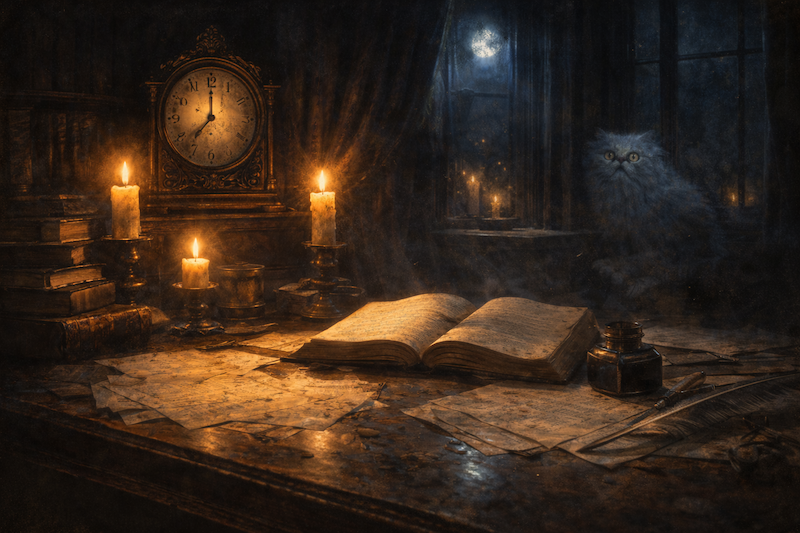
Dark Romance Feb 11, 06:01 PM

Ward 7: The Man Who Knew Too Much

They told me Julian Ashworth was delusional.

Dr. Calloway handed me the file on my first evening at Thornfield Psychiatric Institute — a Gothic monstrosity of blackened stone perched on the Devon cliffs, where the sea howled against the rocks like something trying to claw its way in. The file was thick. Diagnosis: paranoid schizophrenia with persecutory delusions. Patient believes a clandestine organization erased his former life and committed him involuntarily. Resistant to medication. Resistant to therapy. Resistant to everything.

"Don't let him get inside your head," Calloway warned, his pale eyes lingering on me a beat too long. "That's what he does. He's... persuasive."

I almost laughed. I was Dr. Iris Fontaine, thirty-one, top of my class at Edinburgh, published in three journals. I did not get persuaded by patients. I diagnosed them.

But that was before I met Julian.

He was sitting in the common room of Ward 7 when I first saw him — not hunched or fidgeting like the others, but utterly still, like a man carved from marble. Dark hair fell across his forehead, and his jaw was sharp enough to cut glass. He wore the standard grey uniform, but somehow it looked tailored on him, as though even institutional clothing bent to his will. When he lifted his gaze to mine, I felt the floor shift beneath my heels.

His eyes were black. Not brown — black. Like looking into a well with no bottom.

"You're the new one," he said. His voice was low, textured, the kind of voice that could read a shopping list and make it sound like a love letter. "They send a new one every six months. The last one transferred to a hospital in Norway. The one before that quit medicine entirely."

"I'm not easily frightened, Mr. Ashworth."

"Julian." He smiled, and something inside my chest folded in half. "And I'm not trying to frighten you, Dr. Fontaine. I'm trying to warn you."

Our sessions began the following week. Standard protocol: fifty minutes, twice weekly, in a small consultation room with a bolted table and a window that didn't open. I recorded everything. I took meticulous notes. I was the picture of professionalism.

And Julian dismantled me piece by piece.

He didn't rant or rave. He spoke with the calm precision of a man presenting evidence in court. He told me about Meridian — a private intelligence firm that operated in the shadows of legitimate governments. He'd worked for them, he said, as a cryptanalyst. He'd decoded something he shouldn't have: a financial architecture linking Meridian to the systematic destabilization of three sovereign nations.

"When I tried to go public, they didn't kill me," he said, leaning forward. The distance between us shrank to something dangerous. "Killing creates martyrs. They did something worse. They made me disappear into the one place no one would ever believe me — a psychiatric ward. Fabricated medical records. Paid off doctors. My own family thinks I've been ill since childhood."

"Julian, this is a very common pattern in persecutory—"

"Ask yourself one question, Iris." He never called me Doctor. Only Iris. And each time, the sound of my name in his mouth felt like a hand trailing down my spine. "If I'm delusional, why does Thornfield have a funding source that doesn't appear in any NHS database? Who's paying for this place?"

I should have dismissed it. Instead, I went home that night and searched.

He was right. Thornfield's funding was buried under three layers of shell companies. The trail went cold at a firm registered in Liechtenstein. It meant nothing, I told myself. Lots of private institutions had complex funding.

But the seed was planted.

The sessions continued, and the line between doctor and patient began to blur in ways I couldn't control. Julian remembered everything I said — every offhand comment, every hesitation. He noticed when I wore my hair differently, when I hadn't slept, when something was troubling me. No one in my life paid that kind of attention to me.

"You're lonely," he said one evening, as rain streaked the darkened window. "You came to Thornfield because you wanted to disappear too. Just into work instead of a ward."

"That's not appropriate, Julian."

"Truth rarely is."

His hand moved across the table — slowly, deliberately — and his fingertips brushed my wrist. Just once. Just barely. The contact lasted perhaps two seconds, but I felt it for hours afterward, a phantom warmth that pulsed beneath my skin like a second heartbeat.

I started staying late, reading his file again and again, looking for cracks. But the more I looked, the more I found — not cracks in his story, but cracks in the institution's. Medication logs that didn't match pharmacy orders. Notes from previous psychiatrists that read almost identically, as though copied from a template. And a curious detail: every doctor assigned to Julian had been young, female, and unattached.

"They choose you carefully," Julian said when I confronted him about it. There was no triumph in his voice — only exhaustion. "Someone who might believe me, but who can be discredited if she tries to act on it. A young woman who falls for a patient? Her career is over. Her testimony is worthless."

"I haven't fallen for you."

He held my gaze. The consultation room felt like it was shrinking, the walls pressing us closer together.

"Haven't you?"

I couldn't answer. Because the truth was something I couldn't say aloud — that I thought about him in the dark hours before dawn, that his voice had become the soundtrack of my inner life, that when he looked at me I felt simultaneously seen and stripped bare.

One night, I found the door to the east wing unlocked. I'd never been inside — it was marked as a decommissioned storage area. But behind that door was a corridor of active server rooms, humming with equipment that had no business being in a psychiatric hospital. Surveillance feeds. Encrypted communication terminals. A digital map with real-time tracking dots scattered across four continents.

My hands were shaking when I returned to my office. I sat in the dark for an hour, trying to convince myself there was an innocent explanation.

There wasn't.

The next morning, I requested an emergency session with Julian. When the orderly brought him in and left us alone, I locked the door — a violation of every protocol I'd ever followed.

"I saw the east wing," I whispered.

Something changed in his face. The careful composure cracked, and beneath it I saw not madness but grief — vast, oceanic grief.

"Then you know," he said.

"I know you're not delusional."

He stood. I stood. We were close enough that I could feel the heat radiating from his body, could see the faint scar along his collarbone where his uniform gaped. His hand came up to my face, and this time there was nothing accidental about it. His thumb traced the line of my jaw, and I stopped breathing.

"You have to leave Thornfield," he murmured. "Tonight. Before they realize what you found."

"Come with me."

"I can't. The doors lock from the outside, and every exit is monitored. But you — you still have your keys. You can still walk out."

"I'm not leaving without you."

"Iris." His forehead pressed against mine. I could feel his breath, warm and unsteady, against my lips. "I have been in this place for four years. Four years of being told I'm insane by people who know I'm not. You are the first person who believed me. Do you understand what that means?"

I did. God help me, I did.

"I'll come back for you," I said. "I'll get evidence. I'll bring people who can—"

He kissed me.

It was not gentle. It was the kiss of a man who had been drowning for years and had finally broken the surface. His hands framed my face, his mouth was desperate and searching, and I kissed him back with everything I had — all the professionalism and distance and carefully maintained boundaries incinerating in a single, devastating moment.

When we broke apart, we were both trembling.

"Go," he breathed. "Go now. And Iris — trust no one from this place. Not Calloway. Not the nurses. No one."

I drove through the rain with Julian's taste still on my lips and his file hidden under my coat. In my rearview mirror, Thornfield's lights flickered against the cliff face like the eyes of something watching.

I reached my flat at midnight. I locked every door, drew every curtain, and opened my laptop to begin uploading the evidence I'd photographed in the east wing.

That's when I noticed it.

My laptop's camera light was on.

A notification appeared in the corner of the screen — a message from an encrypted sender, just four words:

*We know, Dr. Fontaine.*

My phone rang. Unknown number. I answered with hands that could barely hold the device.

"Dr. Fontaine." The voice was smooth, unhurried, professional. "We'd like to offer you a position at our facility in Zurich. Excellent salary. Complete confidentiality. Your flight leaves at six a.m."

"And if I refuse?"

A pause. Then, softly: "Ward 7 has a vacancy."

The line went dead.

I sat in the silence of my flat, the rain hammering against the windows, and made a decision. I didn't pack for Zurich. I copied every file to three separate drives, sealed them in envelopes addressed to three different journalists, and walked to the post box at two in the morning.

Then I got back in my car and drove toward the cliffs.

Toward Thornfield.

Toward Julian.

The road was dark, and the wind screamed off the sea, and I had no plan beyond the irrational, irrevocable certainty that I would not leave him in that place for one more night. Whether what pulled me back was love or madness — or whether, in the end, there was any difference — I no longer cared to ask.

The institute appeared through the rain like a fever dream, all sharp angles and black stone.

I still had my keys.

The gate opened.

And somewhere inside, in Ward 7, a man who was either a psychiatric patient or the most dangerous truth-teller alive was waiting for me — with dark eyes that saw everything, and a kiss that tasted like the end of the world.

Classics Now Feb 13, 04:26 AM

Jane Eyre's Wedding Day From Hell: The Instagram Stories Nobody Asked For

Classics in Modern Setting

A modern reimagining of «Jane Eyre» by Charlotte Brontë

JANE EYRE'S WEDDING DAY FROM HELL 💒🔥
The Instagram Stories Nobody Asked For

---

📱 STORY 1 — Posted by @plain_jane_eyre
[Photo: Mirror selfie in a simple white dress, no veil yet. Morning light through a gothic window. Caption overlaid.]

"Wedding day. Still can't believe this is real. A literal orphan governess marrying the lord of the manor. 🥹 Someone pinch me."

💬 Comments:
@adele_varens_official: MADEMOISELLE YOU LOOK SO BEAUTIFUL 😭😭😭
@mrs_fairfax_thornfield: I still have a strange feeling about all this, dear. But you look lovely.
@jane_eyre_fan_club: QUEEN 👑
@diana_rivers: Wait you're getting MARRIED?? To whom??

---

📱 STORY 2 — Posted by @plain_jane_eyre
[Boomerang: Jane spinning around in the hallway of Thornfield, dress swishing]

"No bridesmaids. No family. No massive guest list. Just me, Rochester, and God. Honestly? Perfect. 🤍"

Poll sticker: "Is this romantic or suspicious?"
Romantic: 34%
Suspicious: 66%

💬 DM from @mrs_fairfax_thornfield:
"Jane dear, did Mr. Rochester ever explain what's on the third floor? I only ask because—"
[Seen ✓]

---

📱 STORY 3 — Posted by @plain_jane_eyre
[Photo: Walking toward the small church at Thornfield. Grey sky. Rochester waiting at the door in a dark coat, looking intense as usual.]

"He looks like he hasn't slept. Honestly that's just his face. My dark, dramatic, slightly unhinged king. 🖤"

Music sticker: 🎵 "Chapel of Love" by The Dixie Cups

💬 Comments:
@blanche_ingram_official: Lmaooo WHAT. He's marrying the GOVERNESS?? I literally cannot. 💀
@blanche_ingram_official: I was RIGHT THERE. I had the connections. The wardrobe. The cheekbones.
@lord_ingram: Blanche, log off.

---

📱 STORY 4 — Posted by @plain_jane_eyre
[Video: Inside the church. Dark, intimate. Rochester gripping Jane's hands a little too tightly. The priest is speaking.]

"'If any of you know cause or just impediment why these two persons should not be joined together in holy matrimony—'"

Caption: "This is it. This is actually happening. I'm going to be Mrs. Roch—"

[Video cuts abruptly]

---

📱 STORY 5 — Posted by @plain_jane_eyre
[Black screen. White text.]

"Someone just stood up."

---

📱 STORY 6 — Posted by @plain_jane_eyre
[Black screen. White text, shaking effect.]

"SOMEONE JUST STOOD UP IN THE CHURCH AND SAID THE WEDDING CANNOT PROCEED."

"I am literally at the altar."

"Rochester's face just went WHITE."

💬 Comments:
@adele_varens_official: ???
@diana_rivers: JANE??
@mrs_fairfax_thornfield: Oh dear. Oh dear oh dear.
@blanche_ingram_official: 🍿🍿🍿

---

📱 STORY 7 — Posted by @plain_jane_eyre
[Shaky video: A man in a suit (Mr. Briggs, solicitor) standing in the church aisle, reading from a paper. Another man beside him looking pale and sickly.]

"This man — a LAWYER — just announced that Edward Fairfax Rochester has an existing wife. EXISTING. WIFE. As in: ALIVE. AS IN: CURRENTLY LIVING."

Caption: "I need to sit down. I am going to pass out in this church."

Question sticker: "What would you do?"
Responses flooding in:
- "RUN"
- "throw the bouquet at his HEAD"
- "girl get a lawyer"
- "wait... where is the wife tho 👀"

---

📱 STORY 8 — Posted by @plain_jane_eyre
[Video: Rochester grabbing Jane's arm, dragging her out of the church. His jaw clenched. The solicitor and the pale man following.]

"Rochester isn't even DENYING it. He just said — and I quote — 'I have been married, and the woman to whom I was married lives.'"

"He's pulling me back to Thornfield. Says he wants to SHOW me something."

"Show me WHAT, Edward?? YOUR WIFE??"

Caption: "Apparently yes. That is exactly what he wants to show me."

💬 Comments:
@blanche_ingram_official: I am SCREAMING. Oh my GOD I dodged a bullet.
@st_john_rivers: This is deeply immoral.
@diana_rivers: Jane please be safe!!
@random_follower_42: this is better than any reality TV I've ever seen

---

📱 STORY 9 — Posted by @plain_jane_eyre
[Photo: The dark staircase of Thornfield Hall. Third floor. A heavy door with a lock. Rochester holding a key.]

"We're going to the third floor. THE THIRD FLOOR. The one I was always told was just storage. The one where I heard laughing at 2am and Rochester said it was the servant Grace Poole."

"It was NOT Grace Poole."

"It was never Grace Poole."

Caption: "The red flags were RED and I painted them pink 🚩➡️🩷"

---

📱 STORY 10 — Posted by @plain_jane_eyre
[Dark, shaky video: Door opens. A room with no windows, heavy curtains. A figure moving in the shadows — large, dark-haired, crawling on all fours, then lunging.]

"I can't— I don't even know how to describe what I'm looking at."

"There is a WOMAN in this room. She LUNGED at Rochester. She BIT him. Grace Poole is here trying to restrain her."

"This is Bertha Mason. His WIFE."

Caption: "She's been here. This whole time. Above my bedroom. Every night."

[Content warning sticker added]

💬 Comments:
@adele_varens_official: I AM A CHILD AND THIS IS TERRIFYING
@mrs_fairfax_thornfield: I tried to warn you, Jane. I tried.
@diana_rivers: Please tell me you're leaving.
@random_follower_42: the third floor was NOT storage??? 💀💀💀
@gothic_literature_daily: This is the most Thornfield thing that has ever Thornfielded

---

📱 STORY 11 — Posted by @edward_rochester_official
[Photo: Rochester alone in his study, head in hands. Fire in the background. Glass of something amber nearby.]

"Before you all come for me — let me EXPLAIN."

"I was tricked into that marriage. My father and brother arranged it for the fortune. I didn't know about the hereditary madness until after the wedding. I was TWENTY ONE."

"I've been trapped for fifteen years. FIFTEEN. YEARS."

"Jane is the first real thing I've ever had."

Caption: "I know I should have told her. I know."

💬 Comments:
@plain_jane_eyre: You locked your wife in an attic, Edward.
@blanche_ingram_official: And you were going to commit BIGAMY?? Sir??
@st_john_rivers: Repent.
@richard_mason_official: That's my SISTER up there, you monster.
@pilot_the_dog: 🐕 [Rochester's dog's fan account, just vibes]
@feminism_1847: We need to talk about how Bertha has no voice in this narrative.

---

📱 STORY 12 — Posted by @plain_jane_eyre
[Photo: Jane sitting on the floor of her small governess room. Still in the white dress. Eyes red. Bag visible in the corner.]

"He begged me to stay. Said we could go to the south of France. Live as if we were married. Said no one would know."

"I would know."

"He said: 'Who in the world cares for you?'"

"And I said: 'I care for myself. The more solitary, the more friendless, the more unsustained I am, the more I will respect myself.'"

Caption: "That's the tweet. That's the whole thing. 💔"

Music sticker: 🎵 "good 4 u" by Olivia Rodrigo

💬 Comments:
@diana_rivers: JANE. THAT LINE. I am putting that on a poster.
@feminism_1847: THIS IS THE MOMENT. THIS RIGHT HERE. 🔥
@adele_varens_official: Please don't leave me here 🥺
@mrs_fairfax_thornfield: I'll look after Adele, dear. You do what you must.
@self_respect_daily: Reposted to our page. Icon behavior.
@blanche_ingram_official: ...okay that was actually powerful. I'll give her that.

---

📱 STORY 13 — Posted by @plain_jane_eyre
[Photo: Dawn. A road leading away from Thornfield. One small bag. The white dress replaced with a plain traveling outfit. Shot from behind — Jane walking into grey morning mist.]

"Left before sunrise. Took almost nothing. Didn't say goodbye because I would have stayed."

"I love him. That's the worst part. I love him and I still left."

"But I will not be someone's secret. I will not live a half-life in the shadows of a house that has a woman screaming in its walls."

Caption: "Chapter closed. 📖"

Location sticker: 📍 Leaving Thornfield Hall

💬 Comments:
@edward_rochester_official: Jane. Jane please. Come back. I'll do anything.
@plain_jane_eyre: [Did not respond]
@diana_rivers: Come find us. We're family. You don't know it yet but we are.
@the_moors_official: She's out here wandering with no money and no food. Someone help this woman.
@random_follower_42: I am SOBBING at 3am because of a GOVERNESS
@gothic_literature_daily: And she just... walked away. Into nothing. With nothing. Because her self-respect was worth more than a mansion.

---

📱 STORY 14 — Posted by @plain_jane_eyre
[Black screen. Small white text.]

"Three days on the moors. No food. No money. Slept outside. Nearly died."

"But I'm still here."

"I'd rather die free on a moor than live as a lie in a mansion."

Slider sticker: "How destroyed are you rn?" 😭
[Slider at 100%]

---

📱 STORY 15 — Posted by @plain_jane_eyre
[Photo: A modest cottage door. A hand reaching out to help her inside. Warm light from within.]

"Some people just took me in. Fed me. Gave me a bed."

"Their names are Diana, Mary, and St. John Rivers."

"I think the universe is not done with me yet."

Caption: "New chapter. Literally. 📖✨"

💬 Comments:
@diana_rivers: WE'VE BEEN TRYING TO REACH YOU. Also surprise — we're your cousins??
@st_john_rivers: God's plan.
@mrs_fairfax_thornfield: Thank heavens she's safe.
@adele_varens_official: When are you coming back? 🥺
@edward_rochester_official: [Typing...]
@edward_rochester_official: [Has left the chat]

---

📱 STORY 16 — Posted by @thornfield_local_news
[Photo: Thornfield Hall engulfed in flames against a night sky. Massive fire. Roof collapsed.]

🔴 BREAKING: Thornfield Hall destroyed in massive fire. Reports say Bertha Mason Rochester set the blaze and jumped from the roof. Mr. Rochester attempted rescue — survived but sustained severe injuries including loss of sight.

💬 Comments:
@the_entire_county: 😱😱😱
@blanche_ingram_official: I have no words.
@grace_poole_official: I tried. I tried to keep her safe. I failed.
@feminism_1847: Bertha deserved better than this story gave her. Rest in peace.
@diana_rivers: Jane... have you seen this?

---

📱 STORY 17 — Posted by @plain_jane_eyre
[Photo: Jane's hand holding a phone, screen showing the news about Thornfield. Tears visible on the screen reflection.]

"He's alive. He's blind. He's free."

"And I just inherited money from my uncle so I'm not a penniless orphan anymore."

"The universe has the WILDEST narrative structure."

Caption: "I know what I have to do."

💬 Comments:
@diana_rivers: Go. We'll be here when you get back.
@st_john_rivers: I literally just proposed to you for the mission trip and you're going BACK to him??
@plain_jane_eyre: @st_john_rivers I said what I said, St. John.
@reader_in_2024: GOOOOOO 🏃‍♀️🏃‍♀️🏃‍♀️

---

📱 STORY 18 — FINALE — Posted by @plain_jane_eyre
[Photo: A smaller house. A garden. Rochester standing in the doorway, scarred, blind, reaching out. Jane taking his hand.]

"'I am an independent woman now, Edward. I come back to you of my own free will.'"

"He cried. I cried. Reader, I married him. FOR REAL THIS TIME. 💍"

"No attic wives. No secrets. No impediments. Just two broken people choosing each other with open eyes — well. With open hearts."

Caption: "Equal. Finally equal. 🤍"

Music sticker: 🎵 "Love Story (Taylor's Version)" by Taylor Swift

💬 Comments:
@diana_rivers: I'M NOT CRYING YOU'RE CRYING 😭😭😭
@adele_varens_official: PAPA ROCHESTER AND MADEMOISELLE TOGETHER!! 🎉🎉
@mrs_fairfax_thornfield: Finally. FINALLY.
@blanche_ingram_official: ...fine. They're cute. I GUESS.
@feminism_1847: She came back on HER terms. With HER money. As HIS equal. That's the point.
@gothic_literature_daily: Charlotte Brontë did NOT have to go this hard in 1847 but she DID.
@pilot_the_dog: 🐕❤️
@reader_in_2024: This is the greatest love story ever told and I will accept no arguments.
@charlotte_bronte_estate: 🖋️🤍

---

[Final Story — Fade to black]

"Reader, I married him. A quiet wedding. No crowd. No impediment.

Just us.

And this time, it was real."

— Jane Eyre, signing off 🤍

#JaneEyre #ThornfieldHall #ReaderIMarriedHim #GothicRomance #IndependentWoman #BrontëSisters #ClassicLit #BookTok #WeddingFromHell #AtticWife #SelfRespect #LoveStory

Dark Romance Feb 10, 06:01 PM

A Promise Made 200 Years Ago

The letter was impossible.

Elara Voss held it under the work lamp, her gloved fingers trembling against parchment that should have disintegrated decades ago. The ink was iron gall — she could tell by its particular rust-brown fade — and the handwriting was exquisite, each letter formed with the deliberate elegance of someone trained in an era when penmanship was considered a moral virtue.

But it was the words that made her blood run cold.

*To Miss Elara Voss, who will find this letter in the winter of her thirty-first year, in the hidden chamber beneath Ashworth Hall. You made me a promise. I have waited two hundred years for you to keep it.*

She was thirty-one. It was February. And she had discovered the chamber only twenty minutes ago, hidden behind a false wall in the manor's cellar, sealed with bricks that crumbled at her touch as though they had been waiting — patiently, deliberately — for her hands and no one else's.

Inside the chamber: a single portrait, a single chair, and this letter.

The portrait showed a man. Dark hair swept back from a face that belonged on a Roman coin — sharp jaw, high cheekbones, a mouth that hovered between cruelty and tenderness. His eyes were painted in an unusual shade of amber, almost gold, and they seemed to follow her as she moved through the small space. He wore a dark coat with a high collar, and one hand rested on a book whose title she couldn't quite read.

He was, without question, the most beautiful man she had ever seen.

Elara set down the letter and pressed her palms against her eyes. She was a restoration specialist, not a character in a gothic novel. There was an explanation. There was always an explanation. Someone had researched her, planted the letter, staged this elaborate scene—

A knock at the front door echoed through the empty manor.

She checked her phone. 11:47 PM. The nearest village was six miles away, and she hadn't seen another car on the road since arriving that morning. The knock came again — three measured strikes, unhurried, as though the person on the other side had all the time in the world.

Elara climbed the cellar stairs, crossed the entrance hall with its peeling wallpaper and chandelier wrapped in dust sheets, and opened the door.

He stood on the threshold.

The same face. The same impossible amber eyes. The same mouth caught between something gentle and something dangerous. He wore a long dark coat — modern, impeccably tailored — but his bearing belonged to another century. He looked at her the way a man looks at water after crossing a desert.

"You found the letter," he said. Not a question.

His voice was low, textured, accented in a way she couldn't place — as though English were a language he had learned long ago and never quite forgotten, but rarely used anymore.

"Who are you?" she whispered.

"My name is Ashworth. Damien Ashworth." He tilted his head, studying her face with an intensity that made her feel simultaneously exposed and cherished. "And you are Elara Voss, though once you went by another name. May I come in?"

Every rational instinct told her to refuse. Instead, she stepped aside.

He moved through the entrance hall without looking around, as though he knew every crack in the plaster, every warped floorboard. He paused beneath the chandelier and glanced up at it with an expression that might have been grief.

"My mother chose that chandelier," he said quietly. "Venetian glass. She had it shipped from Murano in 1819."

"That's not possible. You'd have to be—"

"Over two hundred years old." He turned to face her, and in the pale light filtering through the fanlight above the door, his eyes caught gold. "Yes."

Elara's pulse hammered in her throat. She should have been afraid. She was afraid. But beneath the fear was something else — a pull, magnetic and ancient, as though some deep part of her recognized him. As though her body remembered what her mind refused to.

"The letter said I made you a promise," she said carefully. "I've never met you before tonight."

"Not in this life." He reached into his coat and withdrew something — a small oval locket on a chain so fine it looked like liquid silver. He opened it. Inside was a miniature portrait, no larger than a coin. A woman's face. Dark hair. Green eyes.

Elara's green eyes.

"Her name was Eleanor Ashworth," Damien said. "My wife. She died on the night of our wedding, February the fourteenth, 1826. Before she died, she made me a promise."

"What promise?"

He closed the locket and held it against his chest. "That she would return to me. That no matter how many lifetimes it took, she would find her way back. And that when she did, she would remember."

The wind shifted outside, and the manor groaned around them — ancient timber settling, old stones adjusting to the cold. Elara felt something stir in her chest, a sensation she couldn't name, somewhere between recognition and longing.

"I don't remember anything," she said.

"Not yet." He stepped closer. He smelled of woodsmoke and something older — rain on stone, the particular sweetness of decay that clings to very old houses. "But you will. You came here. You found the chamber. You opened the letter. Something in you already knows."

"Or someone set this up to manipulate me."

A shadow crossed his face — not anger, but something rawer. Hurt. "You think I would wait two centuries to play a trick?"

"I think people are capable of extraordinary deception."

"Yes," he said softly. "They are. But I am not people. Not anymore."

He extended his hand. His fingers were long, elegant, and unnervingly still — no tremor, no warmth radiating from his skin. She stared at his palm.

"Touch me," he said. "And tell me I'm deceiving you."

She shouldn't have. She knew she shouldn't have. But her hand moved as though pulled by a current older than reason, and her fingers brushed his palm.

The world tilted.

She saw it — not with her eyes but with something deeper, something cellular. A ballroom lit by a thousand candles. A white dress. His face, younger, flushed with life, his eyes bright with tears as he slid a ring onto her finger. The taste of champagne. The weight of joy so immense it felt like drowning. Then darkness. Pain. A cold floor. His voice screaming her name — not Elara, but Eleanor — and the sensation of falling, falling, falling into nothing.

She gasped and pulled her hand away.

"What did you see?" His voice was barely a whisper.

"A wedding," she breathed. "Our wedding."

Something broke open in his expression — two hundred years of control fracturing in an instant. He didn't move toward her, didn't reach for her. He simply stood there, and she watched a man who had outlived empires struggle not to weep.

"How?" she asked. "How are you still alive?"

"I made a bargain," he said. "The night Eleanor died, something came to me. Something old and nameless. It offered me time — enough time to wait for her return. The cost was everything else. Warmth. Sleep. The ability to forget. I have lived every moment of two hundred years in perfect, unbroken consciousness, remembering every second of the seventeen hours I spent as her husband."

"That's not a bargain. That's a punishment."

"Yes," he agreed. "But I would make it again."

The silence between them was charged, electric, alive. Elara felt her heartbeat in her fingertips, in her lips, in the hollow of her throat. She was standing three feet from an impossible man, and every cell in her body was leaning toward him like a flower toward light.

"The letter said if I don't remember by the next full moon, we'll both cease to exist," she said.

"The bargain has terms. Two centuries was the limit. The full moon falls on the fourteenth — three days from now. If you remember fully — not fragments, not flashes, but truly remember who you were and what you promised — then the bargain is fulfilled. I become mortal again. We get a lifetime. One ordinary, finite, magnificent lifetime."

"And if I don't?"

"Then the debt comes due. I return what was borrowed — the years, the consciousness, the waiting. And since your soul is tied to the promise, you go with me. We simply... end."

Elara's mouth went dry. "You're telling me that a promise a dead woman made two hundred years ago has the power to erase me from existence."

"I'm telling you that you are that woman. And the promise was not made lightly."

He moved then — not toward her but toward the window, where moonlight spilled across the floor in a silver parallelogram. He stood in it, and she saw what the darkness had hidden: the faintest translucence to his skin, as though he were not entirely solid, not entirely here.

"You don't have to believe me tonight," he said. "But stay. Stay in this house. Let the walls remind you. Let the rooms speak. This place remembers you, Elara. It has been holding its breath for two hundred years."

She should have left. She should have driven back to London, to her flat with its IKEA furniture and reliable heating and complete absence of immortal men making impossible claims. But when she looked at him standing in the moonlight, something ancient and fierce rose up in her chest — not quite memory, not quite love, but the ghost of both.

"Three days," she said.

He turned, and the look on his face was devastating — hope so fragile it could shatter at a whisper.

"Three days," he echoed.

That night, Elara lay in a bedroom on the second floor, wrapped in blankets she'd brought in her car, listening to the house breathe around her. Somewhere below, Damien moved through rooms he'd known for two centuries, a man out of time, suspended between existence and oblivion by nothing more than a dead woman's promise and a living woman's doubt.

She pressed her hand to her chest and felt her heart beating — steady, insistent, alive.

Somewhere in its rhythm, she thought she heard a second heartbeat. Faint. Distant. Two hundred years old.

Beating in perfect time with hers.

She closed her eyes, and behind them, candlelight flickered in a ballroom she had never seen — or perhaps had simply forgotten.

Three days to remember.

Three days to decide if love could survive death, time, and the terrible patience of a man who refused to let go.

Three days before the moon decided for them both.

Nothing to read? Create your own book and read it! Like I do.

Create a book
1x

"Writing is thinking. To write well is to think clearly." — Isaac Asimov