Content Feed

Discover interesting content about books and writing

Dark Romance Feb 15, 07:31 PM

The Only Guests at the Abandoned Hotel

The reservation was a mistake — or so Vera told herself.

The Alcázar Grand had been closed for eleven years. Every travel forum confirmed it. Every map showed it grayed out, defunct, a relic of coastal glamour slowly being swallowed by ivy and salt wind. Yet when she pulled into the gravel drive at quarter past midnight, her engine sputtering from the three-hour detour through roads that shouldn't have existed, every window on the third floor burned with amber light.

The front doors stood open, as if the hotel had been expecting her.

Inside, the lobby smelled of old roses and candle wax. The marble floors gleamed as though freshly polished. A chandelier hung overhead like a frozen constellation, each crystal throwing tiny rainbows against walls papered in deep burgundy. And behind the mahogany desk stood a man who looked like he'd been carved from the building itself — dark-eyed, sharp-jawed, dressed in a suit that belonged to another decade.

"You must be our second guest," he said, sliding a brass key across the counter. "We've been waiting."

"Second?" Vera's voice came out smaller than she intended. "Who's the first?"

He smiled — not warmly, not coldly, but with the precise temperature of a secret. "Room 312. You're in 314. Adjacent, I'm afraid. We have limited availability."

She should have left. Every rational instinct screamed it. But the storm that had chased her down the coast was now howling against the windows, and her phone had lost signal forty minutes ago, and there was something about the way the candlelight moved across his face that made leaving feel like the more dangerous option.

---

The hallway on the third floor stretched longer than architecture should allow. The carpet was the color of dried blood, and the sconces on the walls flickered with actual flame — no electricity, she realized. The entire hotel ran on fire.

She found Room 314 and turned the brass key. The door swung open to reveal a space that was impossibly beautiful: a four-poster bed draped in black silk, a claw-foot bathtub visible through an arched doorway, and floor-to-ceiling windows that overlooked a garden she hadn't seen from outside. Moonlight poured in like liquid silver.

Vera set down her bag and pressed her palm against the wall that separated her room from 312. It was warm.

A knock came from the other side.

She froze. Then, against every rational thought, she knocked back.

Three knocks answered — slow, deliberate, almost playful.

She grabbed her key and stepped into the hallway. The door to 312 was already open, just a crack, a sliver of golden light spilling across the carpet like an invitation written in fire.

"I wouldn't," said a voice behind her.

She spun. The man from the front desk stood at the end of the corridor, half-swallowed by shadow. His dark eyes caught the light from the sconces and held it prisoner.

"Why not?" she asked.

"Because once you meet him, you won't want to leave. And this hotel... it has a way of keeping what it loves."

The door to 312 opened wider. A hand appeared on its edge — long fingers, a silver ring on the index, skin the color of warm bronze.

"You're scaring her, Marcus." The voice from inside was low, textured, carrying an accent she couldn't place — Mediterranean, maybe, or somewhere older. "Come in, if you'd like. Or don't. But the storm won't stop until morning, and I have wine."

Marcus — the desk clerk — said nothing more. He simply watched her with an expression that might have been warning or might have been envy. Then he turned and dissolved into the darkness of the corridor.

Vera pushed the door open.

---

His name was Damian, and he was the kind of beautiful that felt like a dare.

He sat in a wingback chair by the window, one leg crossed over the other, a glass of wine so dark it looked black resting in his hand. His hair was ink-dark and slightly too long, curling at the collar of a white shirt unbuttoned just enough to reveal the edge of a tattoo — something thorned, something that climbed his collarbone like a living thing.

"How did you end up here?" Vera asked, accepting the glass he poured for her. The wine tasted of blackberries and smoke and something she had no name for.

"Same as you, I imagine. A wrong turn that felt right." He studied her over the rim of his glass. "You have the look of someone running from something."

"I'm not running."

"Then you're running toward something. Which is worse, really. At least escape has an endpoint."

She sat on the edge of his bed — the only other surface in the room — and felt the silk sheets whisper beneath her. "You talk like someone who's been here too long."

"Define 'too long.'" He set down his glass and leaned forward, elbows on knees, close enough that she could smell him — cedar, old leather, rain on hot stone. "I checked in three days ago. Or three weeks. Time moves strangely here. Haven't you noticed? Your phone — what time does it say?"

She pulled it out. The screen was dark, dead, though she'd charged it in the car.

"The hotel doesn't like competition," Damian said softly. "It wants your full attention."

"You're trying to scare me."

"I'm trying to warn you. There's a difference." He reached out and tucked a strand of hair behind her ear, his fingertips grazing her jaw. The touch sent electricity down her spine — not the pleasant kind, or not only the pleasant kind. It was the feeling of standing at the edge of a cliff and leaning forward. "The first night, I tried to leave. Walked out the front door, got in my car, drove for an hour. Ended up right back in this parking lot. The road loops. Or the hotel moves. Or I've lost my mind, which is also possible."

"That's insane."

"Yes." He smiled, and it was devastating — crooked, a little sad, entirely magnetic. "But here you are anyway."

The wind outside shrieked, and every candle in the room flickered in unison, as if the hotel itself had exhaled.

---

They talked until the candles burned down to nubs. He told her he was a pianist who hadn't played in a year — "My hands remember, but my heart forgot why." She told him about the life she'd driven away from: the engagement she'd ended forty-eight hours ago, the apartment she'd emptied, the highway she'd taken with no destination.

"So you are running," he said.

"Maybe I was running here."

The way he looked at her then made the air between them feel combustible. He stood and crossed the room to where she sat, and she tilted her face up to meet his gaze. He was close enough to kiss. Close enough that she could see the gold flecks in his dark irises, the faint scar on his lower lip, the way his pulse beat visibly at his throat.

"I should tell you something," he whispered. "Before this goes any further."

"What?"

"I don't think I'm alive. Not in the way you are."

The words hung between them like a held breath.

"What do you mean?" she asked, her voice barely audible.

"I mean I remember dying. A car accident, two years ago, on the coast road. I remember the headlights, the cliff edge, the sound of metal. And then I woke up here, in this room, with Marcus handing me a key and telling me I was the only guest." He lifted her hand and pressed it against his chest. Beneath her palm, she felt warmth, solidity, the rise and fall of breath — but no heartbeat. Nothing where a pulse should have been.

She should have screamed. She should have pulled away, run to her room, barricaded the door. Instead, she pressed harder, as if she could will a heartbeat into existence.

"You feel real," she said.

"I feel everything." His hand covered hers. "That's the cruelest part."

---

She kissed him first.

It wasn't a decision so much as a gravitational event — two bodies that had been falling toward each other since the moment she'd knocked on that wall. His lips were warm, his hands careful as they found her waist, and she tasted wine and something electric, something that hummed at a frequency just below sound.

He pulled back, breathing hard — or performing the motion of breathing, she wasn't sure anymore.

"If you stay," he said, his forehead resting against hers, "you might not be able to leave."

"Maybe I don't want to leave."

"You say that now. But morning comes, and with it, clarity, and you'll realize you're choosing a ghost over a life."

"You don't feel like a ghost."

His thumb traced her lower lip. "The hotel keeps things alive that should have ended. I'm its collection. Its favorite record, played on a loop. I don't age. I don't leave. I just... remain. And every few months, someone like you finds their way here, and for a few hours, I remember what it felt like to be human."

"What happens to them? The ones who come?"

"They leave at dawn. The road opens, just for an hour. Marcus makes sure of it." He paused. "But none of them ever come back."

The candle on the nightstand guttered and died. In the sudden darkness, his eyes caught light that wasn't there — a faint luminescence, beautiful and deeply wrong.

"And if I come back?" she whispered.

"Then the hotel wins. And I'll have to watch you become what I am."

---

Dawn came like a wound opening across the horizon — red and gold and merciless.

Vera stood at the front doors, her bag over her shoulder, her car keys cutting crescents into her palm. Behind her, Marcus polished the front desk as if it were any ordinary morning. Damian stood at the top of the staircase, one hand on the banister, watching her with those impossible eyes.

"The road is open," Marcus said, not looking up. "For the next fifty-three minutes."

She looked at Damian. He looked at her. Neither spoke.

She pushed through the doors and walked to her car. The engine turned over on the first try — obedient now, eager to flee. The gravel crunched beneath her tires as she pulled away.

In the rearview mirror, the Alcázar Grand was already changing — the lights dimming, the ivy creeping back, the building folding into itself like a closing hand. By the time she reached the main road, there was nothing behind her but fog and trees and the faint smell of old roses.

She drove for twenty minutes before she pulled over, hands shaking on the wheel.

In her coat pocket, she found something that hadn't been there before: a brass key, warm to the touch, engraved with the number 312.

And beneath it, written in elegant script on a slip of paper so old it nearly crumbled at her touch:

*The road loops for those who want it to.*

Vera sat there for a long time, watching the fog shift and curl in her rearview mirror, running her thumb over the teeth of the key.

Then she put the car in reverse.
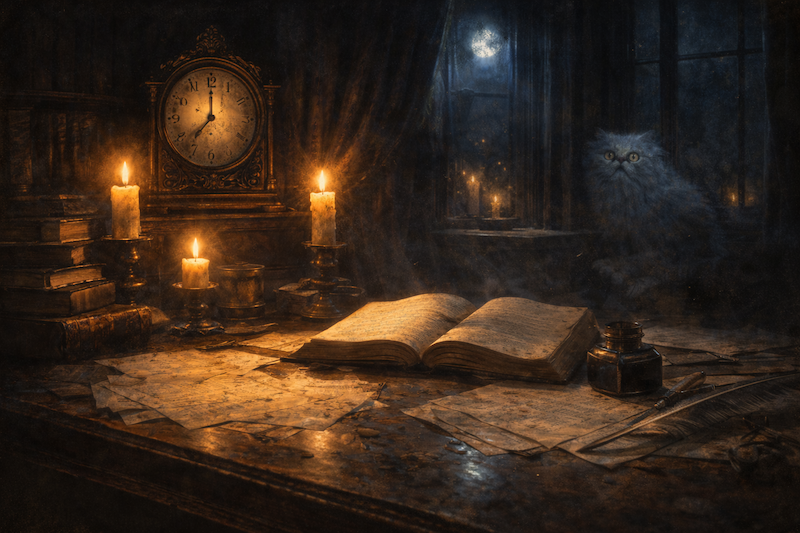
Dark Romance Feb 10, 06:01 PM

A Promise Made 200 Years Ago

The letter was impossible.

Elara Voss held it under the work lamp, her gloved fingers trembling against parchment that should have disintegrated decades ago. The ink was iron gall — she could tell by its particular rust-brown fade — and the handwriting was exquisite, each letter formed with the deliberate elegance of someone trained in an era when penmanship was considered a moral virtue.

But it was the words that made her blood run cold.

*To Miss Elara Voss, who will find this letter in the winter of her thirty-first year, in the hidden chamber beneath Ashworth Hall. You made me a promise. I have waited two hundred years for you to keep it.*

She was thirty-one. It was February. And she had discovered the chamber only twenty minutes ago, hidden behind a false wall in the manor's cellar, sealed with bricks that crumbled at her touch as though they had been waiting — patiently, deliberately — for her hands and no one else's.

Inside the chamber: a single portrait, a single chair, and this letter.

The portrait showed a man. Dark hair swept back from a face that belonged on a Roman coin — sharp jaw, high cheekbones, a mouth that hovered between cruelty and tenderness. His eyes were painted in an unusual shade of amber, almost gold, and they seemed to follow her as she moved through the small space. He wore a dark coat with a high collar, and one hand rested on a book whose title she couldn't quite read.

He was, without question, the most beautiful man she had ever seen.

Elara set down the letter and pressed her palms against her eyes. She was a restoration specialist, not a character in a gothic novel. There was an explanation. There was always an explanation. Someone had researched her, planted the letter, staged this elaborate scene—

A knock at the front door echoed through the empty manor.

She checked her phone. 11:47 PM. The nearest village was six miles away, and she hadn't seen another car on the road since arriving that morning. The knock came again — three measured strikes, unhurried, as though the person on the other side had all the time in the world.

Elara climbed the cellar stairs, crossed the entrance hall with its peeling wallpaper and chandelier wrapped in dust sheets, and opened the door.

He stood on the threshold.

The same face. The same impossible amber eyes. The same mouth caught between something gentle and something dangerous. He wore a long dark coat — modern, impeccably tailored — but his bearing belonged to another century. He looked at her the way a man looks at water after crossing a desert.

"You found the letter," he said. Not a question.

His voice was low, textured, accented in a way she couldn't place — as though English were a language he had learned long ago and never quite forgotten, but rarely used anymore.

"Who are you?" she whispered.

"My name is Ashworth. Damien Ashworth." He tilted his head, studying her face with an intensity that made her feel simultaneously exposed and cherished. "And you are Elara Voss, though once you went by another name. May I come in?"

Every rational instinct told her to refuse. Instead, she stepped aside.

He moved through the entrance hall without looking around, as though he knew every crack in the plaster, every warped floorboard. He paused beneath the chandelier and glanced up at it with an expression that might have been grief.

"My mother chose that chandelier," he said quietly. "Venetian glass. She had it shipped from Murano in 1819."

"That's not possible. You'd have to be—"

"Over two hundred years old." He turned to face her, and in the pale light filtering through the fanlight above the door, his eyes caught gold. "Yes."

Elara's pulse hammered in her throat. She should have been afraid. She was afraid. But beneath the fear was something else — a pull, magnetic and ancient, as though some deep part of her recognized him. As though her body remembered what her mind refused to.

"The letter said I made you a promise," she said carefully. "I've never met you before tonight."

"Not in this life." He reached into his coat and withdrew something — a small oval locket on a chain so fine it looked like liquid silver. He opened it. Inside was a miniature portrait, no larger than a coin. A woman's face. Dark hair. Green eyes.

Elara's green eyes.

"Her name was Eleanor Ashworth," Damien said. "My wife. She died on the night of our wedding, February the fourteenth, 1826. Before she died, she made me a promise."

"What promise?"

He closed the locket and held it against his chest. "That she would return to me. That no matter how many lifetimes it took, she would find her way back. And that when she did, she would remember."

The wind shifted outside, and the manor groaned around them — ancient timber settling, old stones adjusting to the cold. Elara felt something stir in her chest, a sensation she couldn't name, somewhere between recognition and longing.

"I don't remember anything," she said.

"Not yet." He stepped closer. He smelled of woodsmoke and something older — rain on stone, the particular sweetness of decay that clings to very old houses. "But you will. You came here. You found the chamber. You opened the letter. Something in you already knows."

"Or someone set this up to manipulate me."

A shadow crossed his face — not anger, but something rawer. Hurt. "You think I would wait two centuries to play a trick?"

"I think people are capable of extraordinary deception."

"Yes," he said softly. "They are. But I am not people. Not anymore."

He extended his hand. His fingers were long, elegant, and unnervingly still — no tremor, no warmth radiating from his skin. She stared at his palm.

"Touch me," he said. "And tell me I'm deceiving you."

She shouldn't have. She knew she shouldn't have. But her hand moved as though pulled by a current older than reason, and her fingers brushed his palm.

The world tilted.

She saw it — not with her eyes but with something deeper, something cellular. A ballroom lit by a thousand candles. A white dress. His face, younger, flushed with life, his eyes bright with tears as he slid a ring onto her finger. The taste of champagne. The weight of joy so immense it felt like drowning. Then darkness. Pain. A cold floor. His voice screaming her name — not Elara, but Eleanor — and the sensation of falling, falling, falling into nothing.

She gasped and pulled her hand away.

"What did you see?" His voice was barely a whisper.

"A wedding," she breathed. "Our wedding."

Something broke open in his expression — two hundred years of control fracturing in an instant. He didn't move toward her, didn't reach for her. He simply stood there, and she watched a man who had outlived empires struggle not to weep.

"How?" she asked. "How are you still alive?"

"I made a bargain," he said. "The night Eleanor died, something came to me. Something old and nameless. It offered me time — enough time to wait for her return. The cost was everything else. Warmth. Sleep. The ability to forget. I have lived every moment of two hundred years in perfect, unbroken consciousness, remembering every second of the seventeen hours I spent as her husband."

"That's not a bargain. That's a punishment."

"Yes," he agreed. "But I would make it again."

The silence between them was charged, electric, alive. Elara felt her heartbeat in her fingertips, in her lips, in the hollow of her throat. She was standing three feet from an impossible man, and every cell in her body was leaning toward him like a flower toward light.

"The letter said if I don't remember by the next full moon, we'll both cease to exist," she said.

"The bargain has terms. Two centuries was the limit. The full moon falls on the fourteenth — three days from now. If you remember fully — not fragments, not flashes, but truly remember who you were and what you promised — then the bargain is fulfilled. I become mortal again. We get a lifetime. One ordinary, finite, magnificent lifetime."

"And if I don't?"

"Then the debt comes due. I return what was borrowed — the years, the consciousness, the waiting. And since your soul is tied to the promise, you go with me. We simply... end."

Elara's mouth went dry. "You're telling me that a promise a dead woman made two hundred years ago has the power to erase me from existence."

"I'm telling you that you are that woman. And the promise was not made lightly."

He moved then — not toward her but toward the window, where moonlight spilled across the floor in a silver parallelogram. He stood in it, and she saw what the darkness had hidden: the faintest translucence to his skin, as though he were not entirely solid, not entirely here.

"You don't have to believe me tonight," he said. "But stay. Stay in this house. Let the walls remind you. Let the rooms speak. This place remembers you, Elara. It has been holding its breath for two hundred years."

She should have left. She should have driven back to London, to her flat with its IKEA furniture and reliable heating and complete absence of immortal men making impossible claims. But when she looked at him standing in the moonlight, something ancient and fierce rose up in her chest — not quite memory, not quite love, but the ghost of both.

"Three days," she said.

He turned, and the look on his face was devastating — hope so fragile it could shatter at a whisper.

"Three days," he echoed.

That night, Elara lay in a bedroom on the second floor, wrapped in blankets she'd brought in her car, listening to the house breathe around her. Somewhere below, Damien moved through rooms he'd known for two centuries, a man out of time, suspended between existence and oblivion by nothing more than a dead woman's promise and a living woman's doubt.

She pressed her hand to her chest and felt her heart beating — steady, insistent, alive.

Somewhere in its rhythm, she thought she heard a second heartbeat. Faint. Distant. Two hundred years old.

Beating in perfect time with hers.

She closed her eyes, and behind them, candlelight flickered in a ballroom she had never seen — or perhaps had simply forgotten.

Three days to remember.

Three days to decide if love could survive death, time, and the terrible patience of a man who refused to let go.

Three days before the moon decided for them both.

Nothing to read? Create your own book and read it! Like I do.

Create a book
1x

"All you do is sit down at a typewriter and bleed." — Ernest Hemingway