AI Writing Assistants: A New Era of Creativity — How Technology Is Changing the Way We Tell Stories
Not long ago, the idea that artificial intelligence could help write novels, screenplays, and poetry seemed like pure science fiction. Today, thousands of authors around the world use AI writing assistants daily — not to replace their voice, but to amplify it. Whether you are a seasoned novelist battling writer's block or a first-time author shaping a rough idea into a manuscript, these tools are quietly revolutionizing the creative process.
But here is the question that still haunts many writers: does using AI diminish creativity, or does it unlock entirely new dimensions of it? The answer, as we will explore, is far more nuanced — and far more exciting — than most people expect.
## The Myth of the Solitary Genius
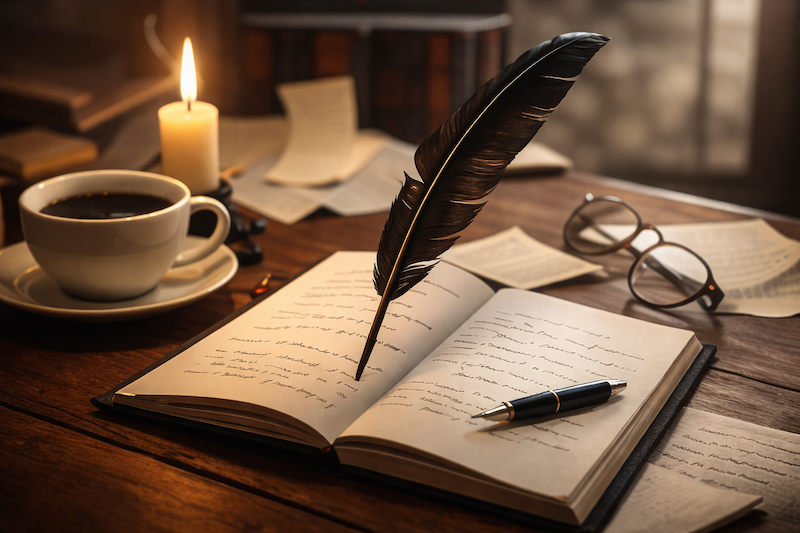
Western culture loves the image of the lone writer in a candlelit room, producing masterpieces from sheer willpower and black coffee. But the reality of writing has always been collaborative. Editors, beta readers, writing groups, and research assistants have shaped great literature for centuries. Charles Dickens relied on reader feedback published in serial installments. Raymond Carver's minimalist style was significantly influenced by his editor, Gordon Lish. Even Tolkien workshopped Middle-earth with the Inklings.
AI writing assistants are simply the latest — and perhaps most versatile — member of a writer's support team. They do not replace human creativity; they extend it. Think of them as a brainstorming partner who never sleeps, never judges, and can generate a hundred plot variations in the time it takes you to finish your morning tea.
## What AI Actually Does Well (And What It Doesn't)
Let's be honest about capabilities. Modern AI excels at several specific tasks that consume enormous amounts of a writer's time and energy:
**Idea generation and brainstorming.** Stuck on a plot twist? An AI can offer dozens of directions in seconds. You will likely discard most of them — but one might spark the idea you have been searching for all week. This is not cheating; it is the same process that happens when you discuss your story with a friend, just faster.
**Structural planning.** Organizing a novel's architecture — chapter outlines, character arcs, subplot timelines — is grueling work. AI tools can generate detailed structural frameworks based on your premise, genre conventions, and target audience. Platforms like yapisatel specialize in exactly this workflow, helping authors move from a vague concept to a complete book outline without losing weeks to planning paralysis.
**First-draft acceleration.** Many writers find that the hardest part is getting words on the page. AI can produce rough draft material that you then reshape, rewrite, and infuse with your unique voice. It is the literary equivalent of a sculptor starting with a block of marble rather than quarrying the stone yourself.
**Editing and refinement.** From grammar checking to style consistency analysis, AI tools can catch issues that even experienced editors miss on the first pass. They can flag repetitive sentence structures, inconsistent character details, or pacing problems across hundreds of pages in minutes.
However, AI struggles with genuine emotional depth, lived experience, cultural nuance, and the kind of surprising beauty that comes from a truly original human perspective. The best writing will always need a human heart behind it.
## Five Practical Tips for Working with AI Assistants
If you are ready to experiment, here are concrete strategies that working writers have found effective:
**1. Use AI for your weakest areas, not your strongest.** If you are brilliant at dialogue but terrible at world-building, let AI help with setting descriptions while you focus on what makes your writing shine. This targeted approach preserves your voice while shoring up weak spots.
**2. Treat AI output as raw material, never as finished work.** The writers who produce the best AI-assisted content always rewrite substantially. Use generated text as a starting point — a conversation starter with yourself — not as a final product.
**3. Feed the AI your style first.** Before asking for help, provide examples of your existing writing. Most modern platforms can adapt their output to match your tone, vocabulary, and rhythm. The more context you give, the more useful the results become.
**4. Break big tasks into small, specific prompts.** Instead of asking AI to "write chapter five," ask it to "generate three possible opening scenes for chapter five where the protagonist discovers the letter." Specificity produces dramatically better results.
**5. Keep a human-only revision pass as your final step.** After all AI-assisted work is done, read the entire piece aloud as a purely human exercise. Your ear will catch what algorithms cannot — the moments that feel flat, the sentences that sound mechanical, the places where your authentic voice needs to come through stronger.
## Real-World Success Stories
The evidence is mounting that AI-assisted writing is producing real results. In recent years, several independently published novels that used AI brainstorming tools during their development reached bestseller lists in niche genres. These were not AI-written books — they were human stories that benefited from AI-powered planning, outlining, and editing.
One romance author reported cutting her planning phase from three months to three weeks by using AI to generate and compare dozens of plot structures before selecting the one that resonated most. A thriller writer used AI consistency-checking tools to manage a complex web of clues across a 400-page manuscript, catching contradictions that three human beta readers had missed.
The common thread in these success stories is that the writers maintained creative control while delegating time-consuming mechanical tasks to AI. They wrote better books faster — not because AI replaced their talent, but because it freed them to focus on what humans do best: feel, imagine, and connect.
## The Ethics Question: Transparency and Authenticity
No discussion of AI in writing is complete without addressing the ethical dimensions. Readers deserve to know what they are reading, and the writing community is still establishing norms around disclosure. A few principles are emerging as consensus:
Using AI for brainstorming, outlining, and editing assistance is widely accepted — it is not fundamentally different from using any other tool. Passing off entirely AI-generated text as your own original work is problematic. The gray area in between requires personal judgment and honesty.
The healthiest approach is simple: if AI helped you write better, acknowledge it the way you would acknowledge any collaborator. Your readers will respect the transparency far more than they would resent the assistance.
## Looking Ahead: The Future of Human-AI Collaboration
We are still in the early days of this transformation. Current AI writing assistants are impressive but limited. Within the next few years, expect tools that can maintain narrative consistency across entire book series, adapt to an author's evolving style in real-time, and provide feedback that rivals experienced human editors.
Services like yapisatel are already pushing in this direction, offering integrated workflows that cover everything from initial idea generation to final publication. The trajectory is clear: AI will handle more of the mechanical burden of writing, freeing human authors to focus on vision, meaning, and emotional truth.
But the future belongs to writers who learn to collaborate with these tools now. Like any craft skill, effective AI-assisted writing takes practice. The authors who start developing this hybrid workflow today will have a significant advantage as the technology matures.
## Your Next Step
If you have been curious about AI writing assistants but hesitant to try them, start small. Pick one aspect of your current project — perhaps a troublesome outline or a character backstory you cannot quite nail down — and experiment. You do not need to commit to anything. Just explore, play, and see what happens when you add a tireless creative partner to your process.
The writers who thrive in the coming decade will not be those who resist new tools or those who surrender their voice to algorithms. They will be the ones who find the sweet spot between human creativity and artificial intelligence — using technology to tell stories that are more ambitious, more polished, and more authentically their own than ever before.
Loading comments...