Content Feed

Discover interesting content about books and writing

Article Feb 14, 06:19 PM

AI Writing Assistants: A New Era of Creativity — How Technology Is Reshaping the Way We Tell Stories

There was a time when writing a novel meant locking yourself in a cabin for months, surviving on coffee and sheer willpower. That romantic image still holds charm, but the reality of modern storytelling has shifted. Artificial intelligence has entered the creative arena — not as a replacement for the human imagination, but as a collaborator that can help unlock ideas you never knew you had.

Whether you are a first-time author struggling with a blank page or a seasoned novelist looking for fresh ways to refine your craft, AI writing assistants are offering tools that genuinely change the game. Let's explore what this new era of creativity looks like, what it can do for you, and how to use it wisely.

## The Blank Page Problem — And How AI Solves It

Every writer knows the terror of the blank page. You have a vague sense of what you want to say, but the words refuse to come. This is where AI shines brightest — not by writing your book for you, but by getting the conversation started. Modern AI tools can generate plot outlines, suggest character backstories, or propose alternative directions for a scene that feels stuck. Think of it as brainstorming with a tireless partner who has read millions of books and can draw on patterns across every genre imaginable.

Here is a practical tip: instead of asking AI to write chapter one, try asking it to give you five possible opening scenarios for your thriller set in 1920s Paris. You remain the decision-maker, but now you have raw material to shape. The creative authority stays with you — the speed and breadth of ideation simply multiply.

## From Idea to Structure: Building a Book Faster

One of the most time-consuming stages of writing is structuring a book. How many chapters should it have? Where does the midpoint twist land? How do subplots weave together? AI writing assistants can analyze your premise and generate a chapter-by-chapter outline in minutes. This does not mean the outline is final — it is a starting scaffold you can tear apart, rearrange, and rebuild.

Consider the case of independent author Elena Marsh, who used AI tools during NaNoWriMo last year. She fed her AI assistant a two-paragraph synopsis of her fantasy novel and received a detailed 24-chapter outline. She ended up rewriting half of it, merging chapters, and adding entirely new arcs — but the structure gave her momentum. She finished her 80,000-word draft in 28 days, something she had never accomplished in five previous attempts.

## Editing and Refinement: The Hidden Superpower

Writing is rewriting, as the old saying goes. AI assistants have become remarkably effective at identifying weak dialogue, inconsistent character behavior, pacing issues, and overused phrases. Unlike a human beta reader who might take weeks, an AI reviewer can analyze your manuscript in minutes and flag dozens of areas for improvement — complete with suggestions.

Platforms like yapisatel take this a step further by offering specialized AI agents that review your text across multiple dimensions simultaneously: plot coherence, character depth, scene dynamics, stylistic consistency, and even originality. Instead of sending your manuscript to five different editors, you get a comprehensive review in one pass. The key is treating these suggestions as a second opinion, not as gospel. The best writers use AI feedback to ask better questions about their own work.

## What AI Cannot Do (And Why That Matters)

Let's be honest about the limitations. AI does not understand what it means to grieve, to fall in love, or to stand at the edge of a cliff wondering whether to jump. It can simulate the language of emotion convincingly, but the lived experience behind great writing — that is yours alone. AI cannot replace your unique voice, your cultural perspective, or the specific pain and joy that make your stories resonate with readers.

This is actually liberating. It means AI handles the mechanical, structural, and analytical heavy lifting while you focus on what matters most: the human truth at the heart of your story. The future of writing is not human versus machine. It is human plus machine, each doing what it does best.

## Five Practical Ways to Use AI in Your Writing Today

If you are curious but unsure where to start, here are five concrete approaches that working authors are already using successfully. First, use AI for character development — feed it a basic character sketch and ask for contradictions, hidden motivations, or backstory elements that could create conflict. Second, generate dialogue variations: write a scene, then ask the AI to rewrite the dialogue in three different emotional registers — angry, melancholic, darkly humorous. Compare and pick what works.

Third, use AI to stress-test your plot. Describe your story arc and ask the tool to identify logical holes or missed opportunities. Fourth, overcome writer's block by asking AI to continue a scene from a completely unexpected angle — you will rarely use its suggestion directly, but it often jolts your own creativity back to life. Fifth, use AI for research summaries. If your historical novel requires knowledge of 18th-century naval warfare, AI can give you a digestible overview in seconds, which you can then verify with primary sources.

## The Democratization of Storytelling

Perhaps the most exciting aspect of AI writing tools is how they lower the barrier to entry. Not everyone has access to expensive writing workshops, MFA programs, or professional editors. A first-generation college student in a small town now has access to sophisticated story-structuring tools, style analysis, and editorial feedback through platforms like yapisatel — tools that were previously available only to authors with publishing contracts and literary agents.

This does not mean quality is guaranteed. A bad idea processed through AI is still a bad idea. But a good idea in the hands of a motivated writer who lacks traditional resources? That is where AI becomes genuinely transformative. We are entering an era where the deciding factor is not your connections or your budget — it is the quality of your imagination and your willingness to do the work.

## Looking Ahead: The Future of Human-AI Collaboration

The technology is evolving rapidly. Within the next few years, we can expect AI assistants that understand narrative on a much deeper level — tools that can track emotional arcs across hundreds of pages, suggest thematic resonances, and even adapt their feedback style to match your specific creative goals. The writers who thrive will be those who learn to collaborate with these tools early, developing a workflow that amplifies their strengths.

But technology alone is never the answer. The future belongs to writers who combine AI efficiency with human authenticity. The readers of tomorrow will still crave stories that feel true, characters that breathe, and endings that linger. No algorithm can manufacture that. It comes from you — the writer — sitting down, caring deeply, and telling a story only you can tell.

If you have been thinking about writing that book — the one that has been living quietly in the back of your mind for years — there has never been a better time to start. The tools are ready. The question is: are you?
Article Feb 14, 04:09 AM

AI Writing Assistants: A New Era of Creativity — How Technology Is Changing the Way We Tell Stories

Not long ago, the idea that artificial intelligence could help write novels, screenplays, and poetry seemed like pure science fiction. Today, thousands of authors around the world use AI writing assistants daily — not to replace their voice, but to amplify it. Whether you are a seasoned novelist battling writer's block or a first-time author shaping a rough idea into a manuscript, these tools are quietly revolutionizing the creative process.

But here is the question that still haunts many writers: does using AI diminish creativity, or does it unlock entirely new dimensions of it? The answer, as we will explore, is far more nuanced — and far more exciting — than most people expect.

## The Myth of the Solitary Genius

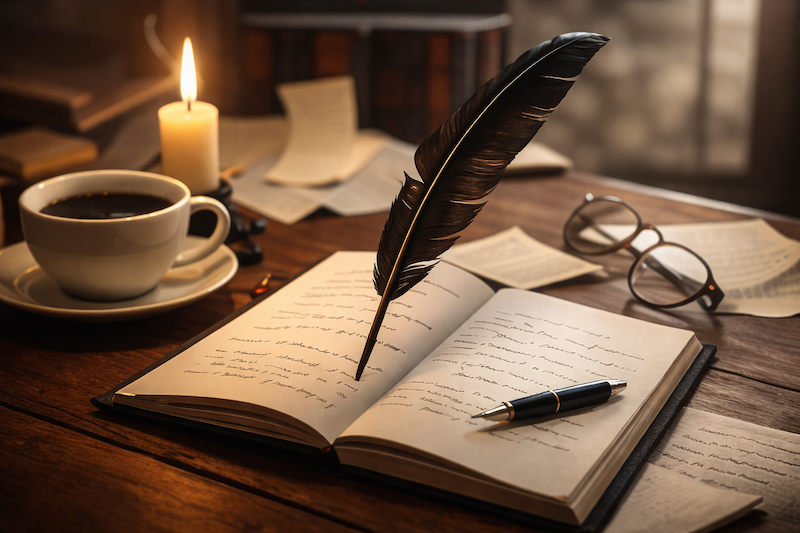
Western culture loves the image of the lone writer in a candlelit room, producing masterpieces from sheer willpower and black coffee. But the reality of writing has always been collaborative. Editors, beta readers, writing groups, and research assistants have shaped great literature for centuries. Charles Dickens relied on reader feedback published in serial installments. Raymond Carver's minimalist style was significantly influenced by his editor, Gordon Lish. Even Tolkien workshopped Middle-earth with the Inklings.

AI writing assistants are simply the latest — and perhaps most versatile — member of a writer's support team. They do not replace human creativity; they extend it. Think of them as a brainstorming partner who never sleeps, never judges, and can generate a hundred plot variations in the time it takes you to finish your morning tea.

## What AI Actually Does Well (And What It Doesn't)

Let's be honest about capabilities. Modern AI excels at several specific tasks that consume enormous amounts of a writer's time and energy:

**Idea generation and brainstorming.** Stuck on a plot twist? An AI can offer dozens of directions in seconds. You will likely discard most of them — but one might spark the idea you have been searching for all week. This is not cheating; it is the same process that happens when you discuss your story with a friend, just faster.

**Structural planning.** Organizing a novel's architecture — chapter outlines, character arcs, subplot timelines — is grueling work. AI tools can generate detailed structural frameworks based on your premise, genre conventions, and target audience. Platforms like yapisatel specialize in exactly this workflow, helping authors move from a vague concept to a complete book outline without losing weeks to planning paralysis.

**First-draft acceleration.** Many writers find that the hardest part is getting words on the page. AI can produce rough draft material that you then reshape, rewrite, and infuse with your unique voice. It is the literary equivalent of a sculptor starting with a block of marble rather than quarrying the stone yourself.

**Editing and refinement.** From grammar checking to style consistency analysis, AI tools can catch issues that even experienced editors miss on the first pass. They can flag repetitive sentence structures, inconsistent character details, or pacing problems across hundreds of pages in minutes.

However, AI struggles with genuine emotional depth, lived experience, cultural nuance, and the kind of surprising beauty that comes from a truly original human perspective. The best writing will always need a human heart behind it.

## Five Practical Tips for Working with AI Assistants

If you are ready to experiment, here are concrete strategies that working writers have found effective:

**1. Use AI for your weakest areas, not your strongest.** If you are brilliant at dialogue but terrible at world-building, let AI help with setting descriptions while you focus on what makes your writing shine. This targeted approach preserves your voice while shoring up weak spots.

**2. Treat AI output as raw material, never as finished work.** The writers who produce the best AI-assisted content always rewrite substantially. Use generated text as a starting point — a conversation starter with yourself — not as a final product.

**3. Feed the AI your style first.** Before asking for help, provide examples of your existing writing. Most modern platforms can adapt their output to match your tone, vocabulary, and rhythm. The more context you give, the more useful the results become.

**4. Break big tasks into small, specific prompts.** Instead of asking AI to "write chapter five," ask it to "generate three possible opening scenes for chapter five where the protagonist discovers the letter." Specificity produces dramatically better results.

**5. Keep a human-only revision pass as your final step.** After all AI-assisted work is done, read the entire piece aloud as a purely human exercise. Your ear will catch what algorithms cannot — the moments that feel flat, the sentences that sound mechanical, the places where your authentic voice needs to come through stronger.

## Real-World Success Stories

The evidence is mounting that AI-assisted writing is producing real results. In recent years, several independently published novels that used AI brainstorming tools during their development reached bestseller lists in niche genres. These were not AI-written books — they were human stories that benefited from AI-powered planning, outlining, and editing.

One romance author reported cutting her planning phase from three months to three weeks by using AI to generate and compare dozens of plot structures before selecting the one that resonated most. A thriller writer used AI consistency-checking tools to manage a complex web of clues across a 400-page manuscript, catching contradictions that three human beta readers had missed.

The common thread in these success stories is that the writers maintained creative control while delegating time-consuming mechanical tasks to AI. They wrote better books faster — not because AI replaced their talent, but because it freed them to focus on what humans do best: feel, imagine, and connect.

## The Ethics Question: Transparency and Authenticity

No discussion of AI in writing is complete without addressing the ethical dimensions. Readers deserve to know what they are reading, and the writing community is still establishing norms around disclosure. A few principles are emerging as consensus:

Using AI for brainstorming, outlining, and editing assistance is widely accepted — it is not fundamentally different from using any other tool. Passing off entirely AI-generated text as your own original work is problematic. The gray area in between requires personal judgment and honesty.

The healthiest approach is simple: if AI helped you write better, acknowledge it the way you would acknowledge any collaborator. Your readers will respect the transparency far more than they would resent the assistance.

## Looking Ahead: The Future of Human-AI Collaboration

We are still in the early days of this transformation. Current AI writing assistants are impressive but limited. Within the next few years, expect tools that can maintain narrative consistency across entire book series, adapt to an author's evolving style in real-time, and provide feedback that rivals experienced human editors.

Services like yapisatel are already pushing in this direction, offering integrated workflows that cover everything from initial idea generation to final publication. The trajectory is clear: AI will handle more of the mechanical burden of writing, freeing human authors to focus on vision, meaning, and emotional truth.

But the future belongs to writers who learn to collaborate with these tools now. Like any craft skill, effective AI-assisted writing takes practice. The authors who start developing this hybrid workflow today will have a significant advantage as the technology matures.

## Your Next Step

If you have been curious about AI writing assistants but hesitant to try them, start small. Pick one aspect of your current project — perhaps a troublesome outline or a character backstory you cannot quite nail down — and experiment. You do not need to commit to anything. Just explore, play, and see what happens when you add a tireless creative partner to your process.

The writers who thrive in the coming decade will not be those who resist new tools or those who surrender their voice to algorithms. They will be the ones who find the sweet spot between human creativity and artificial intelligence — using technology to tell stories that are more ambitious, more polished, and more authentically their own than ever before.

Article Feb 13, 05:28 PM

AI Writing Assistants: A New Era of Creativity — How Technology Is Reshaping the Craft of Storytelling

For centuries, the writer's journey has been solitary — a blank page, a flickering cursor, and the weight of imagination pressed into words one sentence at a time. But something remarkable is happening right now. Artificial intelligence is stepping into the creative process not as a replacement for the human voice, but as a collaborator that amplifies it. Whether you are a seasoned novelist battling the dreaded middle-of-the-book slump or a first-time author who cannot seem to get past chapter one, AI writing assistants are opening doors that were previously locked behind years of craft mastery and sheer persistence.

The conversation around AI and creativity often swings between two extremes: utopian excitement and existential dread. The truth, as usual, lives somewhere in the middle. AI does not dream. It does not feel the sting of a breakup and channel it into a heartbreaking poem. What it does, and does remarkably well, is pattern recognition, structural analysis, and rapid ideation. Think of it less as a ghostwriter and more as the most well-read writing partner you have ever had — one who has absorbed millions of texts and can suggest what might work next.

So how are real writers actually using these tools today? Let us break it down into the areas where AI delivers the most practical value.

**Breaking Through Writer's Block**

Every author knows the paralysis of staring at an empty document. AI assistants can generate multiple plot directions, character backstories, or opening lines in seconds. You are not obligated to use any of them verbatim. The magic lies in the spark — one suggestion triggers your own idea, which triggers another, and suddenly the dam breaks. Research from a 2024 study published in Science found that writers who used AI brainstorming tools produced first drafts 37% faster without any measurable loss in originality as rated by blind reviewers.

**Structuring Complex Narratives**

Plotting a novel with multiple timelines, subplots, and character arcs is an organizational nightmare. AI tools can help you outline chapter-by-chapter structures, flag pacing issues before you write yourself into a corner, and ensure that every subplot has a satisfying resolution. Platforms like yapisatel take this a step further by offering dedicated content generation agents that build summaries and chapter outlines collaboratively with the author, turning a chaotic cloud of ideas into a clear roadmap.

**Editing and Self-Review**

Here is where AI truly shines. Human writers are notoriously blind to their own weaknesses. We fall in love with sentences that should be cut, overlook inconsistencies, and repeat our favorite words without realizing it. AI-powered review tools can analyze your manuscript across dozens of criteria simultaneously — plot coherence, character development, pacing, style consistency, worldbuilding logic, and even legal compliance for sensitive content. Getting this kind of multi-dimensional feedback used to require hiring several beta readers and a professional editor. Now a first pass can happen in minutes.

**Five Practical Tips for Working with AI Assistants**

First, always start with your own vision. Write a rough paragraph describing your book's core emotion, theme, or conflict before asking AI for help. This anchors the collaboration in your creative intent. Second, use AI for quantity, then apply human judgment for quality. Ask it to generate ten plot twists, then pick the one that resonates and rewrite it in your voice. Third, do not skip the editing loop. Generate a draft, review it with AI analysis tools, revise it yourself, and then run it through review again. Each cycle tightens the work. Fourth, experiment with genre constraints. Tell the AI you want a mystery ending that avoids the top five clichés, or a romance subplot that subverts expectations. Constraints breed creativity — for humans and algorithms alike. Fifth, keep a "rejected ideas" file. Some AI suggestions that seem wrong today might be perfect for a future project.

**The Fear Factor: Will AI Replace Writers?**

This question deserves an honest answer. No — but it will change what it means to be a writer. The authors who thrive in the coming decade will be those who learn to direct AI the way a film director works with a talented crew. The vision, the emotional truth, the specific human perspective — these remain irreplaceably yours. AI handles the scaffolding so you can focus on the soul. Consider how photography did not kill painting; it freed painters to explore impressionism, abstraction, and entirely new forms. AI is doing the same for writing.

**Success Stories Worth Knowing**

Independent authors are already reporting tangible results. A fantasy writer who had been stuck on her trilogy for three years used AI outlining tools to restructure her entire second book in a weekend. A retired teacher published his memoir after using AI to help organize forty years of journal entries into a coherent narrative. A young screenwriter used AI brainstorming to pitch six original concepts to a production company — two were optioned. These are not stories about AI writing books for people. They are stories about people writing books they otherwise might never have finished.

**Choosing the Right Tools**

Not all AI writing assistants are created equal. Some focus narrowly on grammar correction, while others offer comprehensive creative support from ideation through publication. When evaluating platforms, look for tools that support the full writing lifecycle: idea generation, structural planning, draft writing, multi-criteria review, and editing. On platforms such as yapisatel, authors can move through the entire pipeline — from initial concept to polished chapter — within a single integrated environment designed specifically for book creation rather than generic text generation.

**The Future Is Already Here**

We are living in the early chapters of a revolution in creative writing. The tools available today are impressive, but they represent only the beginning. Within the next few years, AI assistants will understand narrative tension the way they currently understand grammar. They will anticipate pacing problems before you encounter them and suggest scene transitions that feel invisible. The writers who start learning to collaborate with these tools now will have an enormous advantage — not because the AI gives them a shortcut, but because the practice of directing AI sharpens their own understanding of craft.

If you have been thinking about writing a book, a short story collection, or even a screenplay, there has never been a better time to start. The blank page is no longer as intimidating when you have a thoughtful collaborator sitting beside you. Explore the AI tools available, experiment without pressure, and let your creativity lead. The technology is here to serve your story — not the other way around.

Article Feb 9, 12:01 AM

AI Writing Assistants: A New Era of Creativity — How Technology Is Reshaping the Way We Tell Stories

For centuries, writing has been a solitary craft — a blank page, a restless mind, and the slow alchemy of turning thoughts into words. But something remarkable is happening right now. Artificial intelligence has entered the creative space, not as a replacement for the human imagination, but as a powerful collaborator that can unlock potential many writers never knew they had.

Whether you are a seasoned novelist battling the dreaded second-act slump or a first-time author struggling to organize a flood of ideas, AI writing assistants are changing the rules of the game. And the shift is far bigger than most people realize.

## Why Writers Are Turning to AI — and Why It Works

Let's start with a truth every honest writer will admit: the hardest part of writing is rarely the writing itself. It's everything around it — generating ideas that feel fresh, structuring a story so it holds together across three hundred pages, keeping characters consistent, catching plot holes before a reader does. These are the tasks that consume enormous mental energy and often lead to burnout or abandoned manuscripts.

AI assistants excel precisely in these areas. Think of them as a tireless brainstorming partner who has read millions of books and can spot structural weaknesses in seconds. They don't replace your voice — they amplify it. A 2024 survey by the Alliance of Independent Authors found that 62% of indie writers who used AI tools reported finishing their manuscripts faster, while 71% said the final quality of their work actually improved.

## Five Practical Ways AI Can Elevate Your Writing Today

Here's where things get concrete. If you've been curious about AI but aren't sure where to start, consider these five proven approaches:

**1. Idea Generation and World-Building.** Stuck on your next plot? AI can generate dozens of premise variations in minutes. Feed it a genre, a theme, and a mood, and you'll get back story seeds you can cultivate into something uniquely yours. One fantasy author described the process as "having a conversation with the most well-read librarian in the world."

**2. Structural Outlining.** Many writers are "pantsers" — they write by the seat of their pants. That's a valid approach, but it often leads to messy rewrites. AI tools can help you build a solid chapter-by-chapter outline before you write a single scene, giving you a roadmap that still leaves room for spontaneous creativity.

**3. Character Consistency Checks.** In longer works, it's shockingly easy to give a character blue eyes in chapter two and brown eyes in chapter twenty. AI can scan your manuscript and flag these inconsistencies, saving you from embarrassing errors that pull readers out of the story.

**4. Style and Tone Refinement.** Want your prose to feel more literary? More conversational? More suspenseful? AI can analyze your text against stylistic benchmarks and suggest specific edits — not to make your writing generic, but to help you achieve the effect you're aiming for more precisely.

**5. First-Draft Acceleration.** Perhaps the most controversial use: generating raw text that you then rewrite and polish. Many authors use this as a way to defeat the blank-page paralysis. The AI provides clay; the writer sculpts the statue.

## The Creative Partnership in Action: A Real Example

Consider the case of Maria, a schoolteacher from Portugal who had been trying to write her debut novel for seven years. She had the characters, the setting, even the ending — but she could never get the middle right. The story kept collapsing under its own weight around chapter ten.

Using an AI writing platform, Maria generated three different structural outlines for her story's middle section. None of them were perfect on their own, but elements from each combined to form a framework she had never considered. She finished her first draft in four months. The book — a literary thriller set in Lisbon — went on to win a regional fiction prize. "The AI didn't write my book," Maria said in an interview. "It helped me see the book that was already inside me."

## Choosing the Right Tools for Your Process

Not all AI writing platforms are created equal. Some focus narrowly on grammar correction. Others offer comprehensive suites that cover everything from initial brainstorming to final manuscript review. The key is finding a tool that fits your specific workflow.

Modern platforms like yapisatel provide an end-to-end approach — from generating ideas for plots and characters to editing, improving, and even publishing your finished work. This kind of integrated environment is especially valuable for authors who want to keep their entire creative process in one place rather than juggling five different tools.

When evaluating any AI assistant, ask yourself three questions: Does it let me maintain creative control? Does it handle the tedious parts so I can focus on the art? And does it help me grow as a writer, rather than making me dependent on it?

## Common Fears — and Why Most of Them Are Overblown

The most frequent objection is obvious: "Won't AI make all writing sound the same?" The evidence suggests the opposite. Because AI handles mechanical tasks, writers actually spend more time on the elements that make their work distinctive — voice, emotional depth, thematic complexity. The tool does the scaffolding; the artist does the decorating.

Another concern is originality. Can something be truly creative if a machine was involved? Consider this: no one questions a musician's artistry because they used a synthesizer, or a filmmaker's vision because they relied on CGI. Tools evolve. The creativity remains human.

## The Future Is Already Here

The publishing industry is adapting quickly. Major literary agencies now accept manuscripts that were developed with AI assistance, provided the creative vision and final decisions belong to the author. Amazon's Kindle Direct Publishing has seen a significant increase in new titles since AI writing tools became mainstream, and reader satisfaction scores have remained stable — proof that more books doesn't mean worse books.

For writers who have always dreamed of finishing that novel, building that series, or simply telling the story that's been living in their head for years, AI assistants represent something genuinely new: a way to close the gap between ambition and execution.

## Your Next Step

If you've been sitting on an idea — even a half-formed one — there has never been a better time to start. Open a document. Write one sentence about the story you want to tell. Then let an AI assistant like yapisatel help you explore where it could go. You might be surprised how quickly a single sentence becomes a chapter, a chapter becomes a manuscript, and a manuscript becomes the book you always knew you could write.

The blank page doesn't have to be intimidating anymore. It can be an invitation.

Article Feb 8, 07:08 PM

AI Writing Assistants: A New Era of Creativity — How Technology Is Reshaping the Way We Tell Stories

There was a time when the blank page was every writer's greatest enemy. The cursor blinked, the clock ticked, and inspiration refused to arrive. Today, artificial intelligence has quietly stepped into the writer's studio — not as a replacement, but as an unlikely creative partner. Whether you're a novelist wrestling with a tangled plot, a blogger searching for the right hook, or a first-time author who has always dreamed of finishing a book, AI writing assistants are opening doors that used to feel permanently locked.

But let's be honest: the conversation around AI and creativity is clouded by hype, fear, and misunderstanding. Some people imagine robots churning out soulless bestsellers. Others dismiss the technology entirely, convinced it can only produce generic filler. The truth, as usual, lives somewhere in the middle — and it's far more interesting than either extreme.

## What AI Writing Assistants Actually Do

At their core, AI writing tools are pattern engines trained on vast libraries of human text. They understand structure, tone, grammar, and narrative flow. But here's the crucial distinction: they don't have stories to tell. You do. The AI is the instrument; you remain the musician. Think of it the way a photographer thinks about a camera — the technology captures the image, but the eye behind the lens decides what matters.

In practical terms, modern AI assistants can help you brainstorm character backstories, generate chapter outlines, suggest plot twists you hadn't considered, tighten flabby prose, and even flag inconsistencies across a 400-page manuscript. That last point alone used to require a professional editor and weeks of painstaking work.

## Five Ways Writers Are Using AI Right Now

First, **breaking through creative blocks**. When you're stuck on chapter twelve, you can describe your situation to an AI assistant and receive three or four possible directions. You won't use them verbatim — but one of them will spark the idea you actually need. It's structured brainstorming, and it works remarkably well.

Second, **world-building at scale**. Fantasy and science fiction authors often spend months constructing consistent universes. AI tools can help generate geography, political systems, cultural norms, and timelines — giving you a scaffold to build on rather than starting from nothing.

Third, **dialogue testing**. Paste a conversation between two characters into an AI tool and ask it to evaluate whether the voices sound distinct. You'll get feedback in seconds that might take a critique group days to deliver.

Fourth, **structural editing**. Modern platforms like yapisatel allow writers to generate chapter-by-chapter outlines, review them for pacing issues, and refine the structure before committing a single word of prose. This "plan first, write second" approach has helped countless authors avoid the dreaded 60-percent rewrite.

Fifth, **speed without sacrifice**. First drafts that once took six months can now be completed in weeks — not because the AI writes the book for you, but because it eliminates the dead time between ideas. You spend more hours actually writing and fewer hours staring at the ceiling.

## The Creativity Question: Will AI Make Writing Generic?

This is the fear that keeps many writers away from AI tools, and it deserves a serious answer. Yes, if you simply ask an AI to "write a thriller," you'll get something competent but forgettable. That's because the tool is averaging patterns from millions of texts. Averages are, by definition, unremarkable.

But creativity has never been about the first draft. It's about the choices you make — the details you add, the clichés you reject, the weird little observations that could only come from your life. AI gives you raw material. Your taste, experience, and voice transform that material into art. The writers who use AI most effectively treat it as a collaborator they constantly argue with: "No, that's too predictable. Give me something stranger. What if the villain is sympathetic? What if the ending is ambiguous?"

The result is often more creative than what the writer would have produced alone — not because the AI is brilliant, but because the friction between human intuition and machine suggestion pushes the work into unexpected territory.

## Practical Tips for Getting Started

If you're curious about integrating AI into your writing process, here are some grounded recommendations. Start small. Use an AI tool for a single task — say, generating ten possible titles for your next chapter — and see how it feels. Don't overhaul your entire workflow on day one.

Be specific in your prompts. "Help me write a scene" will produce mediocre results. "Write a tense dialogue between a retired detective and her estranged daughter in a hospital waiting room, with undertones of guilt" will produce something you can actually work with.

Always edit aggressively. AI-generated text is a starting point, never a finished product. Read every sentence out loud. Cut anything that sounds like it could appear in any book by any author. Your job is to make it sound like it could only appear in yours.

Finally, use platforms designed for long-form writing rather than general-purpose chatbots. Tools built specifically for authors — such as yapisatel — understand the difference between writing a marketing email and writing the climax of a novel. They offer features like chapter planning, consistency checking, and iterative revision that generic AI tools simply don't provide.

## The Future Is Already Here

The publishing industry is changing faster than most people realize. Self-published authors are using AI-assisted workflows to release high-quality books at a pace that traditional publishing houses can't match. Indie writers who once struggled to finish a single manuscript are now building catalogs of three, five, even ten books — each one better than the last, because the AI helps them learn from their own patterns.

This doesn't mean the market is about to be flooded with low-quality content. Readers are sophisticated. They can tell the difference between a book that was thoughtfully crafted and one that was lazily generated. The writers who thrive in this new era will be the ones who use AI to amplify their strengths while remaining ruthlessly honest about their weaknesses.

## Your Move

If you've been sitting on a novel idea for years, waiting for the perfect moment, consider this: the tools available to you today are better than anything professional authors had access to even five years ago. The barrier between "aspiring writer" and "published author" has never been lower.

You don't need to be a tech expert. You don't need to abandon your creative instincts. You just need to be willing to try something new — to sit down with an AI assistant, describe the story only you can tell, and start building it one chapter at a time. The blank page doesn't have to be your enemy anymore. It can be the beginning of a conversation.

Article Feb 5, 12:17 PM

AI Writing Assistants: A New Era of Creativity

The blank page has haunted writers for centuries. That blinking cursor, the weight of infinite possibilities, the paralyzing fear that your next word might be wrong—these experiences unite storytellers across generations. But something remarkable is happening in the literary world right now. Artificial intelligence has evolved from a futuristic concept into a practical creative partner, fundamentally changing how stories come to life.

This shift isn't about replacing human imagination. Instead, AI writing assistants are emerging as collaborative tools that amplify creativity, break through mental blocks, and help authors achieve what they've always dreamed of: finishing their books. The future of writing isn't human versus machine—it's human enhanced by machine.

Consider the statistics that reveal a sobering truth: approximately 97% of people who start writing a book never finish it. The reasons vary—life gets busy, inspiration fades, plot holes seem insurmountable, or the sheer magnitude of the task becomes overwhelming. AI assistants address these exact pain points by providing structure, suggestions, and momentum when creative energy wanes.

One of the most powerful applications of AI in writing is idea generation and brainstorming. When you're stuck on a character's motivation or need a plot twist that feels organic yet surprising, AI can offer dozens of possibilities in seconds. This doesn't diminish your role as the author—you still choose which ideas resonate, which directions fit your vision, and how to weave suggestions into your unique narrative voice. Think of it as having a tireless brainstorming partner available at 3 AM when inspiration strikes.

Character development represents another area where AI assistance proves invaluable. Creating consistent, multi-dimensional characters across a 300-page novel challenges even experienced authors. AI tools can help track character traits, speech patterns, and emotional arcs, flagging inconsistencies before they become problems. They can suggest dialogue variations that match established personalities or propose backstory elements that deepen motivations.

Platforms like yapisatel have emerged specifically to address these creative challenges, offering writers AI-powered assistance throughout the entire book creation process. From generating initial plot outlines to refining dialogue and identifying pacing issues, these tools function as sophisticated creative partners that adapt to individual writing styles and project needs.

The editing and revision process also transforms with AI involvement. Grammar and spelling corrections represent just the beginning. Modern AI assistants analyze sentence rhythm, identify overused words, suggest stronger verbs, and even evaluate emotional resonance within scenes. They can highlight passages where tension drops or point out chapters that might benefit from additional conflict. This feedback, once available only through expensive professional editors or patient critique partners, now comes instantly.

Critics sometimes worry that AI-assisted writing produces generic, soulless content. The reality proves more nuanced. AI learns from vast libraries of human creativity, but it cannot replicate the specific experiences, perspectives, and emotional truths that individual authors bring to their work. Your childhood memories, your heartbreaks, your unique way of seeing morning light through kitchen windows—these remain irreplaceably yours. AI simply helps you express these truths more effectively.

Successful authors are already incorporating AI into their workflows with impressive results. Some use it primarily for research, gathering historical details or technical information that adds authenticity to their fiction. Others rely on it for first-draft speed, then heavily revise with their personal voice. Still others use AI mainly for structural analysis, ensuring their plots maintain proper tension curves and satisfying resolutions.

The key to effective AI collaboration lies in understanding its role as a tool rather than a replacement. A carpenter doesn't feel diminished by using power tools instead of hand tools—they feel empowered to build more ambitious projects. Similarly, writers who embrace AI assistance often find themselves tackling larger, more complex stories than they previously attempted.

Practical tips for integrating AI into your writing process start with experimentation. Try different prompts and approaches to discover what works for your creative style. Use AI for tasks you find tedious while maintaining direct control over elements you love. Set clear boundaries—perhaps you want AI help with plot structure but prefer crafting dialogue yourself. These boundaries can shift as you develop confidence with the technology.

The publishing landscape is evolving alongside these tools. On platforms such as yapisatel, authors can not only write with AI assistance but also navigate the entire journey from initial concept to published book. This democratization of publishing means more voices can share their stories, more perspectives can reach readers, and more dreams of authorship can become reality.

Looking toward the future, AI writing assistants will likely become more sophisticated, more personalized, and more integrated into creative workflows. They'll learn individual author preferences, remember project-specific details across sessions, and offer increasingly nuanced suggestions. But the fundamental equation remains unchanged: human creativity plus artificial intelligence equals expanded possibilities.

The writers who thrive in this new era will be those who view AI as an opportunity rather than a threat. They'll experiment boldly, maintain their unique voices, and use every available tool to bring their stories to life. The blank page still waits, but now it waits with an intelligent assistant ready to help transform that intimidating emptiness into something meaningful.

If you've been dreaming of writing a book, there's never been a better time to start. The tools exist, the barriers have lowered, and the future of creativity beckons. Your story deserves to be told—and now, you have more help than ever in telling it.

Nothing to read? Create your own book and read it! Like I do.

Create a book
1x

"All you do is sit down at a typewriter and bleed." — Ernest Hemingway