Content Feed

Discover interesting content about books and writing

Night Horrors Feb 7, 10:31 PM

The Staircase That Grew

Our new house had seventeen stairs leading to the second floor. I counted them the day we moved in because my daughter Lily insisted. She was six, and counting things was her favorite game. Seventeen stairs. I remember because she sang each number as she climbed, her small hand gripping the oak banister, her voice echoing in the bare hallway.

That was a Saturday.

By Wednesday, there were eighteen.

I didn't notice at first. You don't count stairs every day. But Lily noticed. She always noticed. She came to me in the kitchen, tugging at my sleeve, her face scrunched in that way she had when a puzzle didn't fit together.

"Daddy, the stairs are wrong."

"What do you mean, sweetheart?"

"There's one more. There's eighteen now."

I laughed. I actually laughed. I told her she must have miscounted the first time. She shook her head with the absolute certainty that only children possess, but I ruffled her hair and went back to unpacking boxes. The house was old—built in 1891, the realtor had said—and old houses settle. They creak. They shift. They do not, however, grow additional stairs.

Except ours did.

By Friday, there were nineteen. I counted them myself this time, standing at the bottom with my coffee going cold in my hand. Nineteen. I went back down and counted again. Nineteen. The new stairs weren't obvious. They didn't look new. They had the same dark oak, the same worn edges, the same faint groove in the center where a century of footsteps had softened the wood. They looked as though they had always been there.

But they hadn't.

I called a contractor. He came out on Monday, a thick-necked man named Dale who smelled like sawdust and chewing tobacco. He measured the staircase, consulted the original blueprints I'd found in the basement, and frowned.

"Plans say seventeen," he said. "I'm counting twenty."

"Twenty?" My stomach dropped. It had been nineteen two days ago.

"Could be a renovation that wasn't documented," Dale offered, but he didn't sound convinced. He kept running his hand along the banister, feeling the wood. "Thing is, these stairs are all original. Same wood, same joinery, same finish. Nobody added these later. These have been here since 1891."

"They weren't here last week."

Dale looked at me for a long time. Then he packed up his tools, refused payment, and left without another word. He didn't return my calls after that.

I started keeping a journal. Every morning, before anything else, I would count the stairs.

Monday: 20
Tuesday: 20
Wednesday: 21
Thursday: 21
Friday: 23

Two in one day. They were accelerating.

The staircase itself didn't look longer. That was the part that made my skin crawl. The distance from the first floor to the second floor hadn't changed. The ceiling was the same height. But somehow, more stairs fit into the same space. Each step was just slightly shorter, slightly narrower than the day before. The angle of ascent steepened so gradually that you wouldn't notice unless you were paying attention.

But your body noticed. By the time there were twenty-five stairs, climbing to the second floor left me slightly winded. Not from the extra steps—there was no extra distance—but from something else. A heaviness that settled on your shoulders around step fifteen and grew with each subsequent stair. Like the air was thicker up there. Like something was pressing down on you, testing how much weight you could carry.

Lily stopped counting the stairs. She stopped singing when she climbed them. She would stand at the bottom, staring up, her small body rigid, and then she would run—fast, panicked, taking two at a time until she reached the top, where she would gasp and shake like a wet cat.

"I don't like the middle part," she whispered one night when I was tucking her in.

"What about the middle part?"

"It listens."

I told myself she was being imaginative. Children are imaginative. But that night, I stood in the middle of the staircase—step sixteen of what was now twenty-seven—and I held still. I held my breath. The house was quiet. The street outside was quiet. Everything was quiet except for a sound so faint I might have imagined it.

Breathing.

Not mine. I was holding my breath. Not Lily's—her room was at the far end of the hall. This breathing came from the stairs themselves. From beneath them, or within them, or between them—from some space that shouldn't exist but somehow did, a space that was growing every day, step by step, making room for itself inside the geometry of my home.

I ran. I'm not ashamed to admit it. I ran up the remaining stairs and shut myself in my bedroom and sat on the edge of the bed with the lights on until dawn.

Thirty stairs by the following Tuesday.

I called the previous owners. The number was disconnected. I called the realtor, who said the house had been empty for eleven years before I bought it. I asked why.

"The family moved out suddenly," she said. "Left most of their things. It happens sometimes."

"Did they say why?"

A pause. "The wife said the house was getting bigger inside. We assumed she meant it felt spacious." Another pause. "She was very insistent about the phrasing, though. Not that it felt bigger. That it was getting bigger. That it was making room."

"Making room for what?"

"She didn't say. They moved to Arizona. I think she wanted to live somewhere flat."

Somewhere flat. Somewhere without stairs.

I started sleeping downstairs. I moved Lily down too, set up a mattress in the living room, told her it was an adventure, like camping. She didn't argue. She hadn't gone upstairs voluntarily in a week.

But here's the thing about avoidance: it only works if the thing you're avoiding stays where it is.

Thirty-five stairs now. And the staircase was no longer content to remain between the first and second floors.

I found a new step at the bottom—below the first floor. It went down into what should have been the foundation but was instead a darkness so complete it seemed to have texture, like velvet, like fur. I shone a flashlight into it and the beam didn't penetrate. It just stopped, as if the darkness had a surface.

And the breathing was louder.

Not just from the stairs anymore. From the walls. From the space behind the plaster, which I now understood was not insulation and wooden framing but something else—an architecture that existed parallel to my own, growing inside it like a vine inside a tree, and the stairs were not stairs at all but a spine, and the house was not a house but a shell, and what lived inside the shell was waking up, step by step, and each new stair was a vertebra clicking into place.

Forty stairs.

I write this from a motel room sixty miles away. Lily is asleep beside me. We left everything behind. I don't care. Let it have the furniture, the clothes, the boxes we never finished unpacking.

But I need to tell you something, and I need you to understand that I am not crazy and I am not making this up.

Before we left, I stood in the front yard and looked at the house. Our house. And the roofline was higher than it should have been. Not by much. Maybe a foot. Maybe two. As if the house was slowly straightening, slowly standing up, and the stairs inside were the reason—each new step pushing the structure upward, like something unfolding, something that had been crouched and compressed for a very long time and was now, finally, stretching.

We've been at the motel for three days.

This morning, Lily pulled at my sleeve.

"Daddy."

"What is it, sweetheart?"

"Count the stairs."

The motel is one story. There are no stairs. There is no staircase. There is no second floor.

But Lily was pointing at the wall beside the bathroom. And I looked. And at the base of the wall, where the carpet met the baseboard, there was a step.

One small, dark oak step.

With a faint groove worn in its center.

As though someone—or something—had been walking on it for a very, very long time.
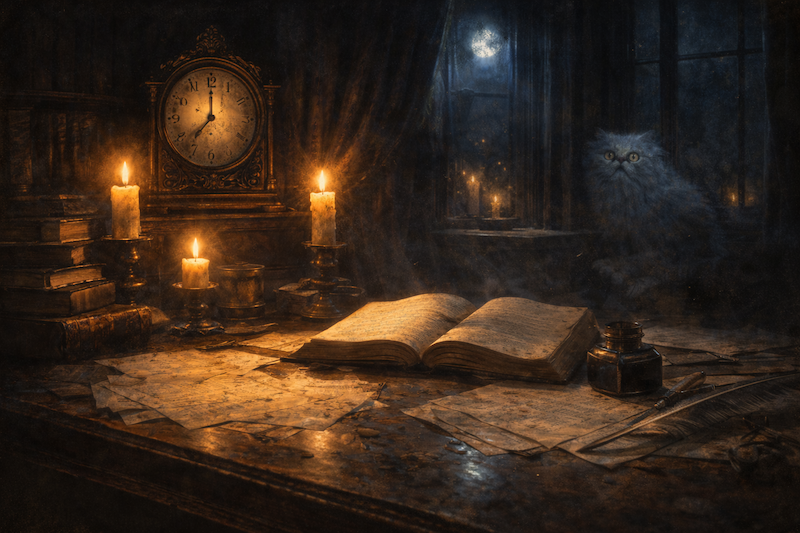
Night Horrors Feb 6, 09:01 PM

The Mirror Shows Tomorrow

I bought the antique mirror at an estate sale for twenty dollars. The old woman running the sale looked relieved when I handed her the money, almost grateful, as if I'd taken something terrible off her hands. "It belonged to my mother," she said, not meeting my eyes. "She stopped looking into it three days before she died." I should have asked why. I should have walked away. Instead, I loaded it into my car and brought it home to hang in my bedroom, directly across from my bed.

The first night, I noticed nothing unusual. The mirror reflected my room perfectly—the rumpled sheets, the stack of unread books on my nightstand, the cat sleeping at the foot of my bed. But on the second night, I woke at exactly 3:17 AM with the inexplicable certainty that something was wrong.

Moonlight streamed through my curtains, illuminating the mirror's surface. I sat up and looked at my reflection. Everything seemed normal at first. My own face, pale and sleep-creased, stared back at me. My bedroom behind me, ordinary and still.

Then I noticed the book.

On my nightstand, I had three books stacked. But in the mirror's reflection, there were only two. The third—a novel I'd been reading for weeks—was gone. I turned to look at my actual nightstand. Three books, exactly as I'd left them.

I told myself it was a trick of the light. The angle. My tired eyes playing games in the darkness. I went back to sleep.

The next morning, I couldn't find the book anywhere. I searched my entire apartment, under the bed, behind the furniture, in rooms I hadn't even entered in days. It had simply vanished. I remembered the missing reflection and felt the first cold finger of unease trace down my spine.

That night, I stayed awake, watching the mirror. At 3:17 AM, I saw it happen. My reflection moved before I did. Just slightly—a turn of the head, a shift of the shoulders—while I remained perfectly still. And in the mirror's version of my room, the lamp on my dresser was lying on its side, broken.

I looked at my actual lamp. Intact. Upright. Fine.

I couldn't sleep after that. I sat rigid in my bed, staring at that lamp until dawn bled through my curtains. When I finally allowed myself to relax, to move, to breathe, I stood up too quickly and my elbow caught the lamp, sending it crashing to the floor.

The shade dented. The bulb shattered. It lay on its side, broken, exactly as the mirror had shown.

The mirror didn't reflect the present. It showed what would happen next.

I should have destroyed it then. I should have smashed it into a thousand pieces and buried the fragments. But I was curious. Foolishly, dangerously curious. I began checking the mirror every night at 3:17, comparing its reflection to my reality, cataloging the differences.

Small things at first. A coffee cup that would break the next day. A drawer left open that I would forget to close. My cat sleeping in a different spot. Each time, within twenty-four hours, reality caught up to the reflection.

Then the differences became larger.

One night, I looked into the mirror and saw a crack running across my bedroom window. The next afternoon, a bird struck the glass at full speed, leaving that exact fracture behind. Another night, the mirror showed my front door standing wide open. I woke the next morning to discover I'd forgotten to lock it, and it had blown open in the wind.

I became obsessed with checking the mirror, with knowing what was coming. It felt like power—the ability to see the future, even if only in fragmentary glimpses. I stopped sleeping. I stopped eating properly. I stopped leaving my apartment. All I did was wait for 3:17 AM and stare into that antique glass.

Two weeks after I bought the mirror, I looked into it and saw something that stopped my heart.

My reflection was gone.

The bedroom was there—the bed, the books, the curtains, everything in its proper place. But where I should have been standing, there was only empty space. A bedroom without an occupant. A bed that would go unslept in.

I stumbled backward, gasping. When I looked again, my reflection had returned, pale and terrified, mirroring my panic perfectly. But I had seen it. The empty room. The space where I should have been.

The mirror was showing me tomorrow. And tomorrow, I wouldn't be there.

I tried to leave. I grabbed my keys, my coat, anything I could carry, and ran for the door. But my hands shook so badly I couldn't work the lock. My legs felt weak, disconnected from my body. A wave of dizziness crashed over me, and I collapsed against the door, sliding to the floor.

I must have passed out. When I opened my eyes, I was back in my bedroom. In bed. As if I had never moved at all.

The clock on my nightstand read 3:16 AM.

I sat up slowly, my entire body trembling. The mirror hung on the wall, its surface dark and still. One minute until the reflection would change. One minute until I would see what tomorrow held.

I didn't want to look. I couldn't look. But my body moved without my permission, swinging my legs over the side of the bed, standing, walking toward that terrible glass.

3:17 AM.

I looked into the mirror and saw my bedroom, perfect in every detail. The rumpled sheets. The stack of books. The lamp on my dresser, whole and unbroken.

And standing behind my reflection, close enough to touch, was a figure I didn't recognize. Tall. Thin. Its face obscured by shadow, but its posture unmistakable—the posture of something that had been waiting a very, very long time.

In the mirror, it placed one long-fingered hand on my reflection's shoulder.

I felt the pressure. Real and solid and cold.

I couldn't turn around. I couldn't look away from the mirror. I could only watch as my reflection's face contorted in terror, as its mouth opened in a scream I couldn't hear.

The figure leaned close to my reflection's ear. Its lips moved, whispering something I couldn't understand. And then, slowly, it turned its head.

It looked directly at me. Not at my reflection. At me, watching from outside the glass.

And it smiled.

The mirror shows tomorrow. But tomorrow hasn't happened yet. I'm writing this now, at 3:47 AM, still feeling the cold pressure on my shoulder, still unable to turn around and face what stands behind me.

The reflection showed what would happen next. But it didn't show how long I would have to wait.

My cat has disappeared under the bed. She refuses to come out. She keeps making that low, frightened sound cats make when they sense something we cannot see.

The hand on my shoulder has started to squeeze.

I think tomorrow is almost here.

Night Horrors Feb 4, 09:01 PM

The Photograph That Breathed

Marcus found the old photograph at the bottom of a box he'd inherited from his grandmother. A sepia portrait of a woman he didn't recognize, standing in what appeared to be this very house—his house now. Her eyes seemed to follow him as he carried it to the living room, but that was just a trick of the light. Everyone said that about old photographs.

It wasn't until he hung it on the wall that he noticed her chest was moving.

At first, he convinced himself it was an optical illusion. The way the lamplight played across the aged surface. The exhaustion of a long day unpacking boxes. He made himself look away, counted to thirty, and looked back.

The woman's chest rose. Fell. Rose again.

Marcus stood frozen in the center of his living room, the hammer still in his hand. The floorboards creaked beneath his feet as his weight shifted involuntarily backward. The sound seemed impossibly loud in the silence.

He approached the photograph. Up close, he could see the fine cracks in its surface, the foxing along the edges. The woman wore a high-collared dress, black, with a cameo at her throat. Her hair was pulled back severely from a pale, angular face. And those eyes—gray, unblinking, fixed on something just past the camera.

Fixed on him.

The breathing continued. Slow. Deliberate. As if she had all the time in the world.

Marcus reached out to touch the glass covering the photograph. His finger left a smudge on its surface. The woman's eyes shifted.

He yanked his hand back so fast he dropped the hammer. It struck the wooden floor with a crack that echoed through the empty house. When he looked at the photograph again, the woman's gaze had returned to its original position. But something else had changed.

Her lips were parted now. Just slightly. Just enough to show the darkness behind them.

Marcus grabbed the frame and pulled it off the wall. The nail came with it, leaving a ragged hole in the plaster. He carried the photograph at arm's length, like something diseased, through the kitchen and out the back door. The night air hit him like cold water. The moon hung fat and orange above the tree line, casting long shadows across the overgrown yard.

He walked to the firepit his grandmother had built decades ago. Dead leaves crunched under his feet. Something small skittered away into the darkness—probably one of the feral cats that had colonized the property.

Marcus knelt and placed the photograph face-down on the ash-covered stones. He gathered kindling from the woodpile, arranged it carefully, struck a match. The flame caught. Spread. He watched the fire grow until it was tall enough to consume the portrait.

He flipped the photograph over.

The woman was smiling now. A wide, impossible smile that split her face nearly in half. And she was no longer looking past the camera.

She was looking directly at him.

Marcus threw the photograph into the flames. The fire roared, turned blue for a moment, then settled back to orange. The smell of burning chemicals filled the air as the old photo paper curled and blackened. He watched until there was nothing left but ash.

The walk back to the house felt longer than it should have. The shadows seemed deeper. The windows of his inherited home stared down at him like empty eye sockets. He almost turned around. Almost got in his car and drove away. But where would he go? This was his home now. His grandmother had left it to him because there was no one else.

Inside, he locked the back door. Then checked it twice. Then checked all the other doors and windows. The house was old, full of drafts and settling noises, and every creak made him jump.

He poured himself a whiskey. Drank it. Poured another.

By midnight, he had almost convinced himself that he'd imagined the whole thing. Exhaustion. Stress. The unsettling experience of going through a dead relative's belongings. He'd read about this—how the mind plays tricks when you're grieving, when you're in unfamiliar surroundings.

He climbed the stairs to the bedroom. The same bedroom his grandmother had slept in. The same bedroom, he realized with growing unease, that appeared in the background of the photograph.

The bed was old, iron-framed, covered in quilts that smelled of mothballs and lavender. Marcus pulled back the covers and stopped.

There was something under the pillow.

The edge of a photograph.

His hands trembled as he lifted the pillow. The sepia portrait stared up at him. Unburned. Unmarked. The woman in the black dress, standing in this very room.

But she was no longer alone in the photograph.

Behind her, barely visible in the shadows of the bedroom doorway, stood a figure. Tall. Thin. Its face was obscured, but its posture suggested anticipation. Hunger.

Marcus's throat closed around a scream that wouldn't come.

The floorboard behind him creaked.

He spun around. The bedroom doorway was empty. Just shadows. Just the darkness of the hallway beyond.

But the air had changed. It felt heavier. Colder. And there was a smell now—something old and sweet and wrong. Like flowers left too long in stagnant water.

Slowly, fighting every instinct that screamed at him to run, Marcus turned back to the photograph.

The shadowy figure was no longer in the doorway.

The woman's smile had grown wider.

And behind Marcus, in the bedroom where he stood, something began to breathe.

Slow. Deliberate. As if it had all the time in the world.

Marcus couldn't move. Couldn't turn around. Could only stare at the photograph as, inch by inch, a shadow crept across its surface. A shadow that had no source. A shadow that moved against the light.

The breathing grew louder. Closer. He could feel it now—a cold exhalation against the back of his neck.

In the photograph, the woman raised one pale hand and pressed it against the glass from the inside.

The glass began to crack.

Marcus found his voice at last. The scream tore from his throat as he dropped the photograph and ran—out of the bedroom, down the stairs, through the kitchen, out into the night.

He didn't stop until he reached his car. Didn't look back until he was a mile down the road.

He never returned to the house. Not to collect his belongings. Not to sign the papers to sell it. The property sat empty for years, slowly returning to the earth, until a fire of unknown origin reduced it to ash one October night.

The firefighters found nothing in the wreckage except a single photograph, somehow untouched by the flames.

A sepia portrait of a woman in a black dress.

She wasn't smiling anymore.

But now there were two figures standing behind her in the shadows.

One of them looked remarkably like the property's last owner.

And both of them were breathing.

Nothing to read? Create your own book and read it! Like I do.

Create a book
1x

"Start telling the stories that only you can tell." — Neil Gaiman