The Photograph That Breathed
Marcus found the old photograph at the bottom of a box he'd inherited from his grandmother. A sepia portrait of a woman he didn't recognize, standing in what appeared to be this very house—his house now. Her eyes seemed to follow him as he carried it to the living room, but that was just a trick of the light. Everyone said that about old photographs.
It wasn't until he hung it on the wall that he noticed her chest was moving.
At first, he convinced himself it was an optical illusion. The way the lamplight played across the aged surface. The exhaustion of a long day unpacking boxes. He made himself look away, counted to thirty, and looked back.
The woman's chest rose. Fell. Rose again.
Marcus stood frozen in the center of his living room, the hammer still in his hand. The floorboards creaked beneath his feet as his weight shifted involuntarily backward. The sound seemed impossibly loud in the silence.
He approached the photograph. Up close, he could see the fine cracks in its surface, the foxing along the edges. The woman wore a high-collared dress, black, with a cameo at her throat. Her hair was pulled back severely from a pale, angular face. And those eyes—gray, unblinking, fixed on something just past the camera.
Fixed on him.
The breathing continued. Slow. Deliberate. As if she had all the time in the world.
Marcus reached out to touch the glass covering the photograph. His finger left a smudge on its surface. The woman's eyes shifted.
He yanked his hand back so fast he dropped the hammer. It struck the wooden floor with a crack that echoed through the empty house. When he looked at the photograph again, the woman's gaze had returned to its original position. But something else had changed.
Her lips were parted now. Just slightly. Just enough to show the darkness behind them.
Marcus grabbed the frame and pulled it off the wall. The nail came with it, leaving a ragged hole in the plaster. He carried the photograph at arm's length, like something diseased, through the kitchen and out the back door. The night air hit him like cold water. The moon hung fat and orange above the tree line, casting long shadows across the overgrown yard.
He walked to the firepit his grandmother had built decades ago. Dead leaves crunched under his feet. Something small skittered away into the darkness—probably one of the feral cats that had colonized the property.
Marcus knelt and placed the photograph face-down on the ash-covered stones. He gathered kindling from the woodpile, arranged it carefully, struck a match. The flame caught. Spread. He watched the fire grow until it was tall enough to consume the portrait.
He flipped the photograph over.
The woman was smiling now. A wide, impossible smile that split her face nearly in half. And she was no longer looking past the camera.
She was looking directly at him.
Marcus threw the photograph into the flames. The fire roared, turned blue for a moment, then settled back to orange. The smell of burning chemicals filled the air as the old photo paper curled and blackened. He watched until there was nothing left but ash.
The walk back to the house felt longer than it should have. The shadows seemed deeper. The windows of his inherited home stared down at him like empty eye sockets. He almost turned around. Almost got in his car and drove away. But where would he go? This was his home now. His grandmother had left it to him because there was no one else.
Inside, he locked the back door. Then checked it twice. Then checked all the other doors and windows. The house was old, full of drafts and settling noises, and every creak made him jump.
He poured himself a whiskey. Drank it. Poured another.
By midnight, he had almost convinced himself that he'd imagined the whole thing. Exhaustion. Stress. The unsettling experience of going through a dead relative's belongings. He'd read about this—how the mind plays tricks when you're grieving, when you're in unfamiliar surroundings.
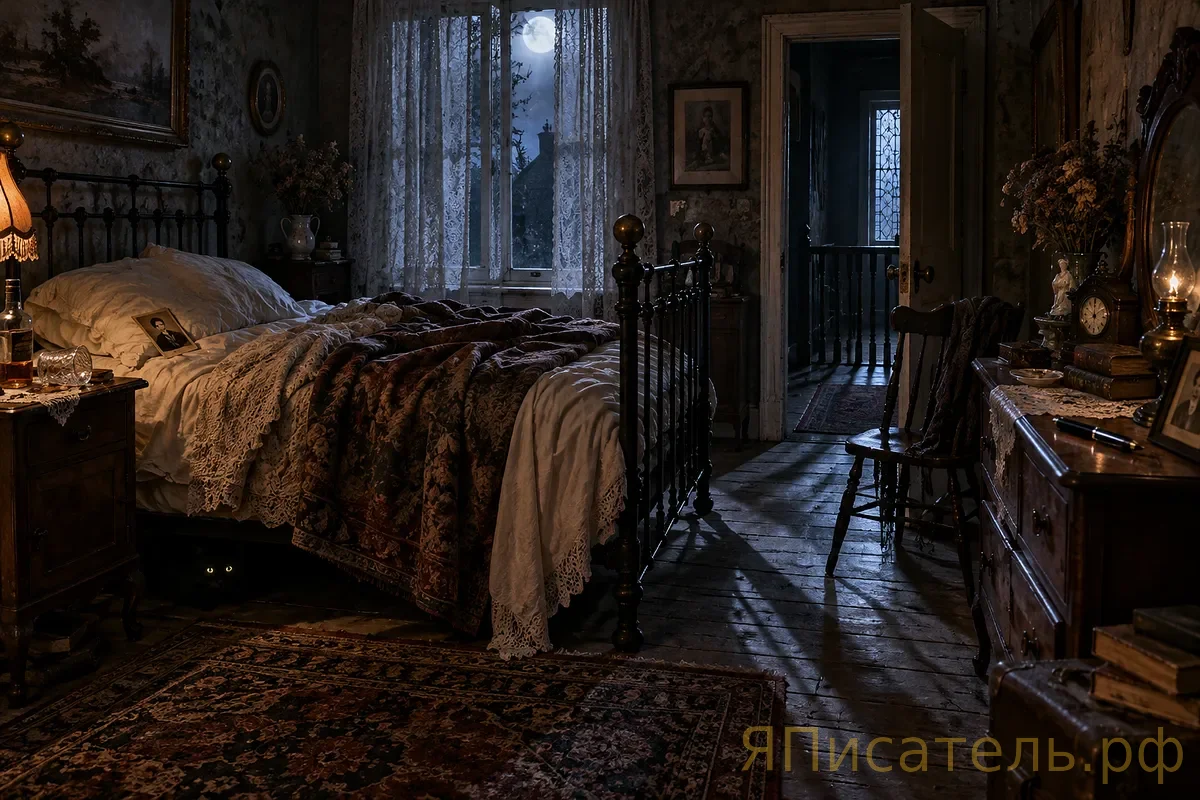
He climbed the stairs to the bedroom. The same bedroom his grandmother had slept in. The same bedroom, he realized with growing unease, that appeared in the background of the photograph.
The bed was old, iron-framed, covered in quilts that smelled of mothballs and lavender. Marcus pulled back the covers and stopped.
There was something under the pillow.
The edge of a photograph.
His hands trembled as he lifted the pillow. The sepia portrait stared up at him. Unburned. Unmarked. The woman in the black dress, standing in this very room.
But she was no longer alone in the photograph.
Behind her, barely visible in the shadows of the bedroom doorway, stood a figure. Tall. Thin. Its face was obscured, but its posture suggested anticipation. Hunger.
Marcus's throat closed around a scream that wouldn't come.
The floorboard behind him creaked.
He spun around. The bedroom doorway was empty. Just shadows. Just the darkness of the hallway beyond.
But the air had changed. It felt heavier. Colder. And there was a smell now—something old and sweet and wrong. Like flowers left too long in stagnant water.
Slowly, fighting every instinct that screamed at him to run, Marcus turned back to the photograph.
The shadowy figure was no longer in the doorway.
The woman's smile had grown wider.
And behind Marcus, in the bedroom where he stood, something began to breathe.
Slow. Deliberate. As if it had all the time in the world.
Marcus couldn't move. Couldn't turn around. Could only stare at the photograph as, inch by inch, a shadow crept across its surface. A shadow that had no source. A shadow that moved against the light.
The breathing grew louder. Closer. He could feel it now—a cold exhalation against the back of his neck.
In the photograph, the woman raised one pale hand and pressed it against the glass from the inside.
The glass began to crack.
Marcus found his voice at last. The scream tore from his throat as he dropped the photograph and ran—out of the bedroom, down the stairs, through the kitchen, out into the night.
He didn't stop until he reached his car. Didn't look back until he was a mile down the road.
He never returned to the house. Not to collect his belongings. Not to sign the papers to sell it. The property sat empty for years, slowly returning to the earth, until a fire of unknown origin reduced it to ash one October night.
The firefighters found nothing in the wreckage except a single photograph, somehow untouched by the flames.
A sepia portrait of a woman in a black dress.
She wasn't smiling anymore.
But now there were two figures standing behind her in the shadows.
One of them looked remarkably like the property's last owner.
And both of them were breathing.
Paste this code into your website HTML to embed this content.