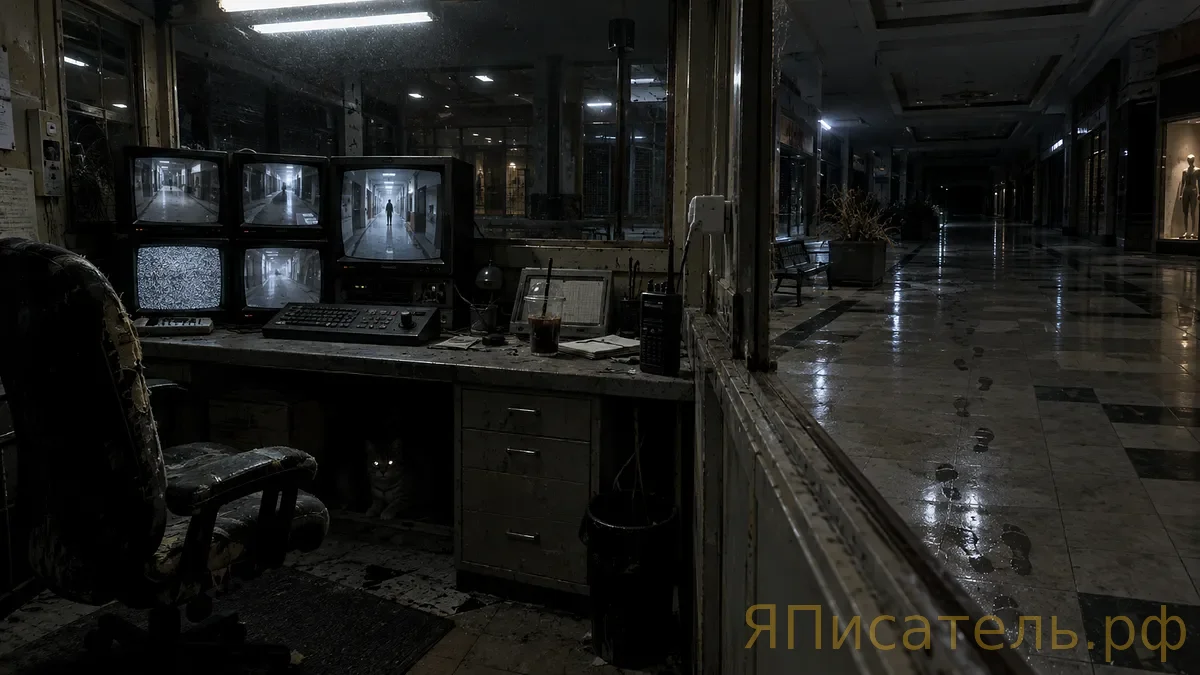
The Night Shift Knows Your Face
I took the security job at the abandoned mall because it paid well and required nothing but sitting in a booth watching monitors. The previous guard quit without notice, they said. Left his keys on the desk and never came back for his last paycheck. I should have asked more questions.
The first week was uneventful. Empty corridors, flickering fluorescent lights, the occasional rat scurrying past camera three. The mall had been closed for renovations that never happened, trapped in that peculiar limbo of commercial real estate. My job was simple: watch the screens, do hourly rounds, report anything unusual.
But on the eighth night, I noticed something on monitor seven—the one showing the old food court. A figure standing perfectly still between the plastic chairs.
I leaned forward, squinting at the grainy footage. The image was poor, all shadows and static, but the shape was unmistakably human. Tall. Motionless. Facing the camera.
I grabbed my flashlight and radio, heart already climbing into my throat. Probably just a homeless person who'd found a way in. It happened sometimes, they'd warned me during orientation. Nothing to worry about.
The food court was on the second floor, a five-minute walk through corridors that seemed longer in the dark. My footsteps echoed off the tile floors, bouncing between shuttered storefronts with their faded sale signs still hanging in dusty windows. The air smelled of old grease and something else—something metallic and wrong.
When I reached the food court, it was empty.
I swept my flashlight across the space, illuminating overturned chairs, a collapsed umbrella from one of the old café setups, a child's shoe abandoned near the fountain that hadn't worked in years. No figure. No one.
I checked behind the counters of the old Burger Palace, inside the kitchen of Chen's Noodle House. Nothing.
Back at my booth, I rewound the footage. There it was again—the figure, standing motionless at 1:47 AM. I watched myself enter the frame at 1:52 AM, flashlight cutting through the darkness. And the figure was still there. Standing three feet to my left. I had walked right past it.
My blood went cold.
I rewound again, watching more carefully. The figure never moved, never reacted to my presence. It just stood there, facing the camera, while I searched the entire food court oblivious.
I told myself it was a glitch. Old equipment, bad wiring. The mall's electrical system was ancient. But I couldn't stop staring at the screen, couldn't stop noticing how the figure's proportions seemed wrong—too long in the torso, arms hanging at angles that made my eyes hurt.
The next night, I found it on monitor three.
This time it was in the corridor outside the old department store, standing beneath a dead exit sign. Same posture. Same impossible stillness. And this time, when I made my rounds, I brought a camera.
I photographed every inch of that corridor. Took thirty-seven pictures. When I checked them later, the figure appeared in exactly one—standing directly behind me in frame twenty-three, close enough to touch.
I didn't sleep that day. Couldn't. Every time I closed my eyes, I saw that image burned into my retinas. The shape. The wrongness of it. The way it seemed to be leaning toward me, like it was studying the back of my head.
I should have quit. Anyone sensible would have quit.
But I went back. I needed to understand.
On the tenth night, I set up a system. I placed markers throughout the mall—strips of tape, coins balanced on doorframes, flour scattered in doorways. If something was moving through this building, I would find evidence.
At 2 AM, I began my rounds.
The flour in the east corridor was undisturbed. The coins still balanced. The tape unbroken. But when I reached the old movie theater on the third floor, I found something new.
Written on the dusty ticket counter, in letters traced by a finger: YOUR FACE
I stood there for a long moment, flashlight trembling in my grip. The words made no sense. Your face. What about my face?
I backed away slowly, eyes scanning the darkness beyond the counter. The theater's double doors hung open, revealing a void that my flashlight couldn't penetrate. I had the sudden, terrible certainty that something was watching me from inside.
I ran.
Back in my booth, I locked the door and watched the monitors with desperate intensity. Nothing moved. Nothing appeared. Just empty corridors and dead storefronts and that terrible, waiting darkness.
At 3:33 AM, monitor twelve flickered.
The camera showed the hallway directly outside my security booth. And standing at the end of it, half-hidden in shadow, was the figure.
But this time, it was different.
This time, I could see its face.
It was my face.
Not a mask or a projection or a trick of the light. It was my face—my exact features, my specific arrangement of eyes and nose and mouth—attached to that wrong, elongated body. And as I watched, frozen in horror, it smiled. My smile. My teeth. But stretched too wide, pulled back too far, until the expression became something that had never existed on a human face.
The lights in my booth flickered.
I looked up from the monitor, and there was a knock on the door.
Three soft taps, almost polite.
I didn't answer. Didn't breathe. Just stared at that door, at the small reinforced window set into its surface, waiting for something to appear on the other side.
Another knock. Louder this time.
And then a voice—my voice, but wrong, like it was being played backward and forward at the same time—speaking from just outside:
"I know your face now. I've been learning it. I've been practicing."
The doorknob began to turn.
I don't remember leaving. Don't remember the drive home or the explanations I gave my wife about why I was shaking, why I couldn't stop checking the mirrors. I never went back to that mall. Never collected my last paycheck.
But sometimes, late at night, I catch myself staring at security cameras. The one at the bank. The one at the grocery store. The one mounted above my neighbor's garage.
And I wonder if something is watching those monitors too.
Learning faces.
Practicing.
Last week, I saw a news story about the old mall. They're finally tearing it down. In the photograph accompanying the article, I could see my old security booth through a broken window.
And standing in the doorway, barely visible in the shadows, was a figure with its hand raised.
Waving.
With my hand.
I've started covering the mirrors in my house. My wife thinks I'm having a breakdown. Maybe I am. But every time I pass a reflective surface, I see my face looking back at me, and I can't stop wondering:
Is that still mine?
Or has it learned enough to take it?
Paste this code into your website HTML to embed this content.