Content Feed

Discover interesting content about books and writing

News Feb 13, 10:28 AM

A Poet Left 200 Verses Carved into Forest Trees — They Took 80 Years to Find

What began as a routine timber survey in Sweden's Blekinge province has turned into one of the most extraordinary literary discoveries of the decade. Forestry workers mapping old-growth birch stands near the village of Olofström noticed strange, regular patterns in the bark of several trees. Upon closer inspection, they realized the marks were letters — deeply carved verses, warped and stretched by eighty years of natural growth.

Experts from Lund University have now confirmed that the carvings are the work of Harry Martinson, the Swedish poet and novelist who won the Nobel Prize in Literature in 1974. Martinson, who spent his impoverished childhood as a parish ward wandering the countryside of Blekinge, is believed to have carved the poems during the early 1940s, when he frequently returned to the forests of his youth.

"The trees literally grew around his words," said Dr. Astrid Lindqvist, the dendrochronologist leading the reconstruction effort. "Some letters have stretched to three times their original size. Others have been swallowed entirely as the bark healed over. It's like reading poetry through a funhouse mirror."

So far, her team has identified 214 individual poems across 73 trees spread over a four-kilometer stretch of forest. The verses appear to form a single, interconnected cycle about orphanhood, nature, and belonging — themes that defined Martinson's celebrated works like "Aniara" and "Flowering Nettle." However, these forest poems are rawer and more personal than anything in his published canon.

The discovery has reignited scholarly interest in Martinson's complicated legacy. Despite his Nobel Prize, Martinson faced vicious criticism from Swedish cultural commentators who considered the award politically motivated. The attacks contributed to a deep depression, and he died in 1978. For decades, his reputation remained overshadowed by controversy.

"These poems change everything," said Professor Erik Sandström of Uppsala University's Department of Literature. "They show a Martinson we never knew — writing not for publishers or prizes, but for the trees themselves. He never intended anyone to read them. The forest was his private journal."

The Swedish Academy of Letters has announced emergency funding to document every surviving tree before the carvings deteriorate further. A team of 3D scanners and bark-imaging specialists is already on site. Preliminary transcriptions of 40 poems are expected to be published this autumn by Bonniers, Martinson's original Swedish publisher.

Perhaps most poignantly, several trees bearing his verses have been marked for commercial logging in upcoming harvests. The Blekinge County Council has now declared the entire grove a protected cultural heritage site — ensuring that Martinson's living library will continue to grow, word by distorted word, for centuries to come.

News Feb 13, 04:30 AM

A 19th-Century Novel Was Written by Two Rivals Who Never Met — Their Publisher Faked It All

A stunning discovery in the archives of the National Library of Scotland has upended one of Victorian literature's most enduring mysteries. Scholars have found a cache of 47 letters proving that John Blackwood, the influential Edinburgh publisher, orchestrated an extraordinary literary deception: he secretly commissioned two rival authors — Margaret Oliphant and Dinah Mulock Craik — to each write alternating chapters of what was published in 1866 as a single anonymous novel titled 'The Wavering Light.'

The novel, long attributed to an unknown author and largely forgotten by mainstream readers, was a modest commercial success in its day. But what makes the discovery remarkable is the elaborate system Blackwood devised to keep the two writers ignorant of each other's involvement. According to the letters, he provided each author with detailed summaries of the chapters written by the other, presenting them as his own editorial outlines.

'What's astonishing is how seamlessly the two voices blend,' said Dr. Fiona Galbraith, the University of Edinburgh researcher who discovered the letters while cataloguing uncategorized materials in the Blackwood Papers. 'Oliphant and Craik had famously different styles — Oliphant was sardonic and psychologically acute, while Craik leaned toward moral sentimentalism. Yet in this novel, they seem to push each other toward something entirely new.'

The rivalry between Oliphant and Craik was well documented. Both were prolific, commercially successful women writers competing for the same readership, and surviving correspondence shows mutual professional jealousy. Blackwood, it appears, deliberately exploited this tension.

In one letter dated March 1865, Blackwood wrote to his brother: 'I have set two fine hounds upon the same fox, and neither knows the other runs. The sport is in watching which pulls harder.'

When the novel was published, both authors reportedly demanded to know the identity of the anonymous writer. Blackwood deflected for months before finally confessing in a dinner attended by both women in December 1866. According to a witness account found among the letters, the revelation produced 'a silence of approximately two minutes, followed by Mrs. Craik requesting a very large glass of sherry.'

Remarkably, neither author publicly acknowledged her involvement, and the novel drifted into obscurity. Dr. Galbraith is now preparing a critical edition that will identify which chapters were written by which author, using stylometric analysis alongside the archival evidence.

'This changes how we think about authorship, collaboration, and the Victorian publishing industry,' Galbraith noted. 'Blackwood essentially invented a blind collaborative method 150 years before it became a concept in experimental literature.'

The annotated edition of 'The Wavering Light' is expected to be published by Edinburgh University Press in autumn 2026, with both Oliphant and Craik finally credited on the cover — 160 years after the book first appeared.

News Feb 8, 07:11 PM

A Dead Poet's Parrot Memorized His Final Unpublished Poems — Scholars Are Transcribing Them

In a cramped Lisbon apartment that time seemed to have forgotten, an extraordinary literary discovery has unfolded — not in a dusty archive or a locked trunk, but from the beak of a 92-year-old African grey parrot named Álvaro.

The bird, named after Pessoa's famous heteronym Álvaro de Campos, was inherited through a chain of caretakers stretching back to the poet's own household. African grey parrots can live over a century and are renowned for their ability to memorize and reproduce human speech with startling fidelity. When Dr. Mariana Esteves, a linguist from the University of Coimbra, visited the parrot's current owner — an elderly widow in Lisbon's Alfama district — she was astonished to hear the bird reciting lines in archaic Portuguese that bore the unmistakable cadence of Pessoa's verse.

"At first I thought it was quoting from 'Message' or one of the known works," Dr. Esteves told reporters at a press conference held at the Pessoa House museum on February 5th. "But when I transcribed the fragments and cross-referenced them against the complete published and archived works, nothing matched. These appear to be entirely new compositions."

Over the past three months, a team of five scholars has conducted over two hundred recording sessions with Álvaro. The parrot produces fragments ranging from single lines to passages of eight or nine verses, often triggered by specific sounds — rainfall, fado music, or the clinking of a coffee cup. So far, the team has reconstructed what they believe to be portions of at least four distinct poems, possibly composed by Pessoa in the autumn of 1935, just weeks before his death on November 30th of that year.

The verses are remarkable. One recurring fragment, tentatively titled 'The Seventy-Third Mask,' contains lines that scholars say read like a meditation on the dissolution of identity — a theme central to Pessoa's life work of writing through dozens of invented literary personalities. Another fragment appears to reference Lisbon's Tagus River in a way that echoes the style of heteronym Ricardo Reis, raising the tantalizing possibility that Pessoa was still creating through his alter egos in his final days.

Not everyone is convinced. Professor João Almeida of the University of Porto has urged caution. "Parrots are mimics, not archivists," he said. "The bird could be recombining phrases from readings of Pessoa's published works that previous owners recited aloud."

Dr. Esteves acknowledges the skepticism but points to computational linguistic analysis suggesting the fragments contain syntactic patterns statistically distinct from Pessoa's published corpus, yet consistent with his known stylistic evolution in his final years.

The Pessoa House museum in Lisbon has announced plans to host a special exhibition in April, featuring audio recordings of Álvaro's recitations alongside scholarly commentary. A preliminary academic paper is expected in March.

Meanwhile, Álvaro the parrot continues his daily routine of sunflower seeds and saudade, apparently indifferent to his newfound fame — though his owner reports he has recently taken to repeating one particular line with increasing frequency: 'I am what I forgot to write.'

News Jan 14, 08:01 PM

Lost Collection of Agatha Christie's Unpublished Short Stories Discovered in English Countryside Estate

In what literary historians are calling one of the most significant discoveries in decades, a collection of 14 unpublished short stories by Agatha Christie has been unearthed at Greenway Estate in Devon, the beloved holiday home where the Queen of Crime spent many summers.

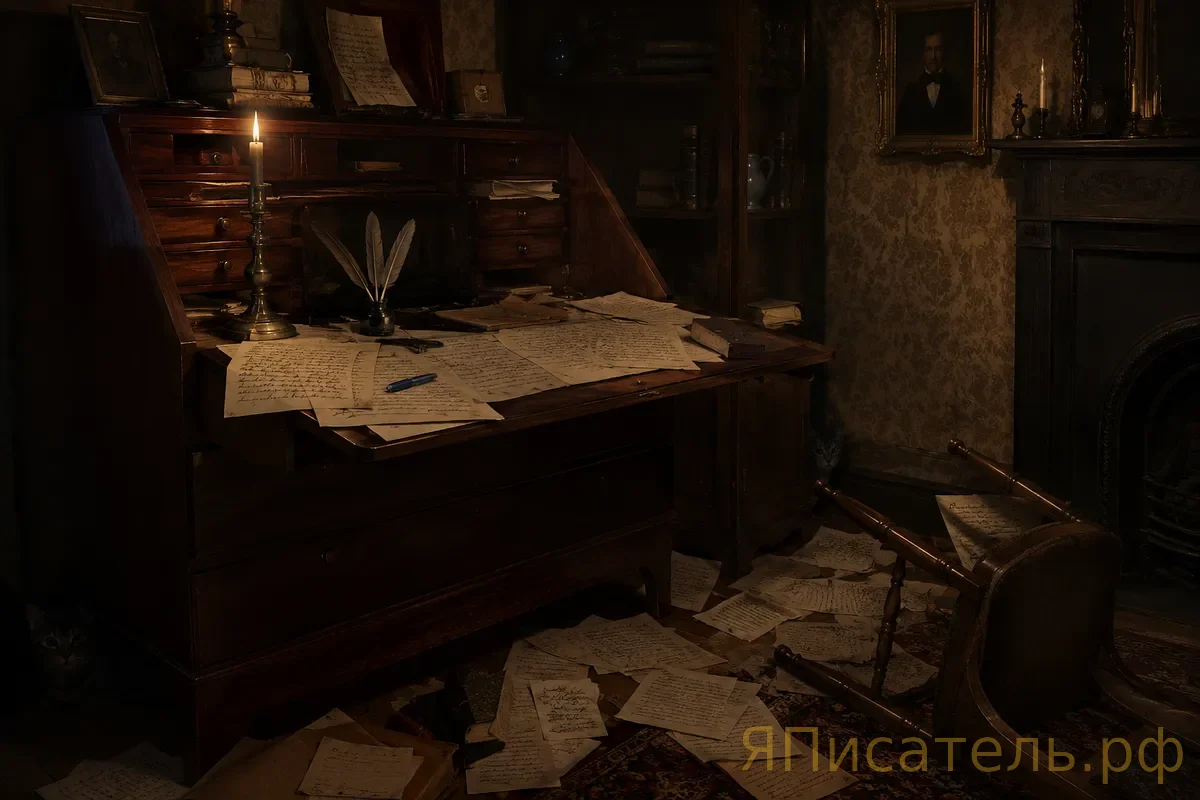
The manuscripts were discovered last month by restoration specialists working on an antique Regency writing desk that had been in storage since the 1970s. Hidden within a cleverly concealed compartment beneath a false drawer bottom, the yellowed pages contained handwritten stories in Christie's distinctive script, along with typed carbon copies bearing her editorial notes in red ink.

Dr. Eleanor Whitfield, Director of the Christie Archive Trust, confirmed the authenticity of the find after extensive analysis. "The paper, ink, and typewriter font are all consistent with Christie's wartime writing period. More importantly, the narrative voice and plotting techniques are unmistakably hers," Dr. Whitfield stated at a press conference in London.

The collection, tentatively titled "The Wartime Mysteries," includes seven Hercule Poirot cases and five Miss Marple investigations, along with two standalone psychological thrillers. Literary analysts suggest Christie may have written these stories during the evenings after her volunteer shifts at University College Hospital's dispensary during World War II, where she famously gained her knowledge of poisons.

Perhaps most intriguing is a story titled "The Belgian's Last Bow," which appears to be an alternative ending for Poirot that Christie ultimately abandoned. "This gives us unprecedented insight into how Christie grappled with her most famous character's fate decades before 'Curtain' was published," noted Professor James Harrington of Oxford University.

HarperCollins, Christie's longtime publisher, has announced plans to release the collection in autumn 2026, coinciding with what would have been the author's 136th birthday. First editions will include facsimiles of the original handwritten pages.

Christie's great-grandson, James Prichard, Chairman of Agatha Christie Limited, expressed the family's astonishment: "My great-grandmother was famously private about her work. That she kept these stories hidden for so long suggests they held special personal significance. We're honored to finally share them with the millions of readers who continue to love her work."

The discovery has already sparked renewed interest in Christie's catalog, with sales of her existing titles reportedly surging 40% in the week following the announcement. Literary tourism to Greenway Estate has seen booking requests triple, with the National Trust planning extended hours to accommodate visitors hoping to see the famous writing desk now on special display.

Nothing to read? Create your own book and read it! Like I do.

Create a book
1x

"Writing is thinking. To write well is to think clearly." — Isaac Asimov