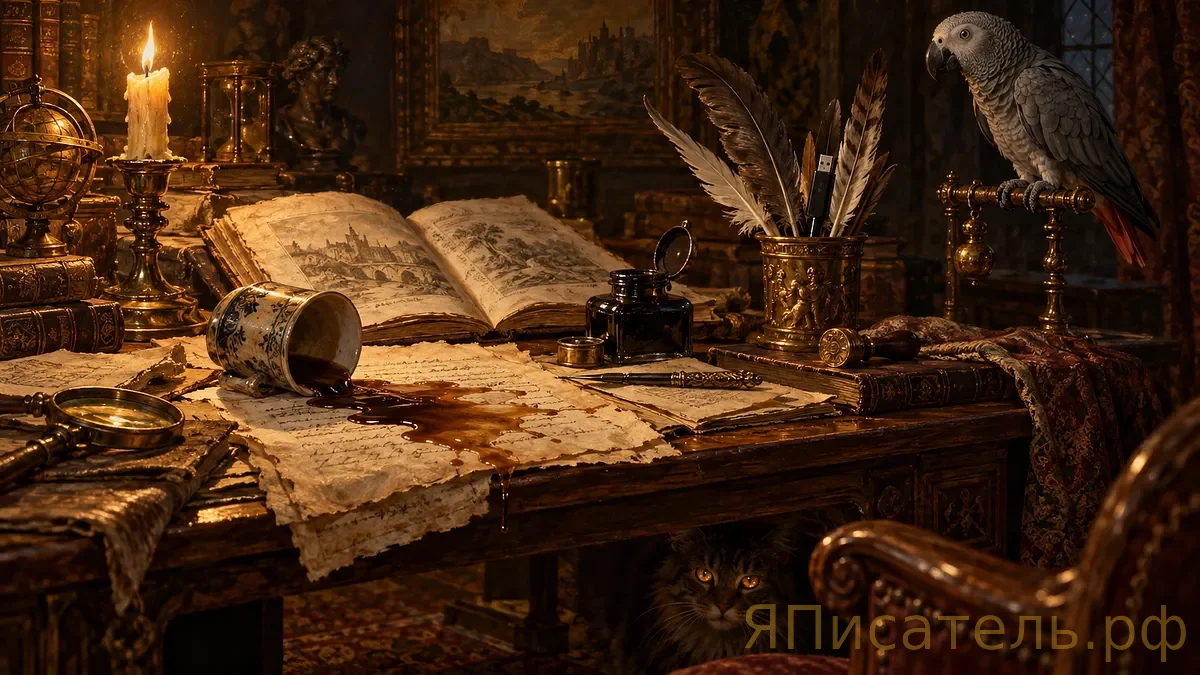
A Dead Poet's Parrot Memorized His Final Unpublished Poems — Scholars Are Transcribing Them
In a cramped Lisbon apartment that time seemed to have forgotten, an extraordinary literary discovery has unfolded — not in a dusty archive or a locked trunk, but from the beak of a 92-year-old African grey parrot named Álvaro.
The bird, named after Pessoa's famous heteronym Álvaro de Campos, was inherited through a chain of caretakers stretching back to the poet's own household. African grey parrots can live over a century and are renowned for their ability to memorize and reproduce human speech with startling fidelity. When Dr. Mariana Esteves, a linguist from the University of Coimbra, visited the parrot's current owner — an elderly widow in Lisbon's Alfama district — she was astonished to hear the bird reciting lines in archaic Portuguese that bore the unmistakable cadence of Pessoa's verse.
"At first I thought it was quoting from 'Message' or one of the known works," Dr. Esteves told reporters at a press conference held at the Pessoa House museum on February 5th. "But when I transcribed the fragments and cross-referenced them against the complete published and archived works, nothing matched. These appear to be entirely new compositions."
Over the past three months, a team of five scholars has conducted over two hundred recording sessions with Álvaro. The parrot produces fragments ranging from single lines to passages of eight or nine verses, often triggered by specific sounds — rainfall, fado music, or the clinking of a coffee cup. So far, the team has reconstructed what they believe to be portions of at least four distinct poems, possibly composed by Pessoa in the autumn of 1935, just weeks before his death on November 30th of that year.
The verses are remarkable. One recurring fragment, tentatively titled 'The Seventy-Third Mask,' contains lines that scholars say read like a meditation on the dissolution of identity — a theme central to Pessoa's life work of writing through dozens of invented literary personalities. Another fragment appears to reference Lisbon's Tagus River in a way that echoes the style of heteronym Ricardo Reis, raising the tantalizing possibility that Pessoa was still creating through his alter egos in his final days.
Not everyone is convinced. Professor João Almeida of the University of Porto has urged caution. "Parrots are mimics, not archivists," he said. "The bird could be recombining phrases from readings of Pessoa's published works that previous owners recited aloud."
Dr. Esteves acknowledges the skepticism but points to computational linguistic analysis suggesting the fragments contain syntactic patterns statistically distinct from Pessoa's published corpus, yet consistent with his known stylistic evolution in his final years.
The Pessoa House museum in Lisbon has announced plans to host a special exhibition in April, featuring audio recordings of Álvaro's recitations alongside scholarly commentary. A preliminary academic paper is expected in March.
Meanwhile, Álvaro the parrot continues his daily routine of sunflower seeds and saudade, apparently indifferent to his newfound fame — though his owner reports he has recently taken to repeating one particular line with increasing frequency: 'I am what I forgot to write.'
Paste this code into your website HTML to embed this content.