The Chapter Austen Never Wrote: Pemberley's First Winter
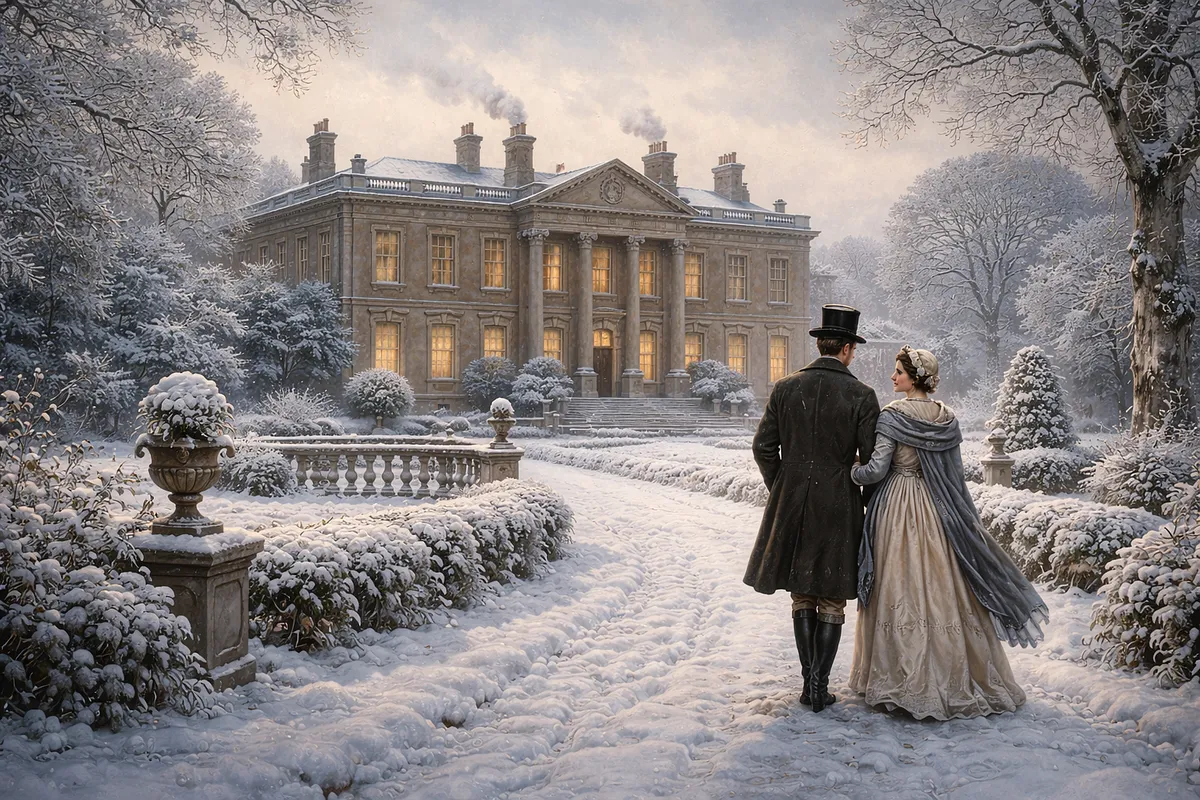
Creative continuation of a classic
This is an artistic fantasy inspired by «Pride and Prejudice» by Jane Austen. How might the story have continued if the author had decided to extend it?
Original excerpt
Happy for all her maternal feelings was the day on which Mrs. Bennet got rid of her two most deserving daughters. With what delighted pride she afterwards visited Mrs. Bingley, and talked of Mrs. Darcy, may be guessed. I wish I could say, for the sake of her family, that the accomplishment of her earnest desire in the establishment of so many of her children produced so happy an effect as to make her a sensible, amiable, well-informed woman for the rest of her life; though perhaps it was lucky for her husband, who might not have relished domestic felicity in so unusual a form, that she still was occasionally nervous and invariably silly.
Continuation
The first winter at Pemberley brought with it such a transformation of domestic felicity as Elizabeth had scarcely dared to imagine during those tumultuous months of misunderstanding and prejudice. She found herself, on a particularly crisp December morning, seated in the library—that magnificent room which had first begun to soften her heart toward its master—composing letters to her beloved sister Jane, whilst Mr. Darcy attended to correspondence of his own at the adjacent escritoire.
Their companionable silence was of that variety which speaks more eloquently of true affection than any profusion of words might accomplish. Elizabeth glanced up from her paper to observe her husband's profile, still marvelling at the extraordinary circumstances which had brought so proud a gentleman and so spirited a lady to such perfect understanding.
"You are staring, Mrs. Darcy," said he, without raising his eyes from his letter, though the corner of his mouth betrayed the slightest inclination toward a smile.
"I am merely contemplating whether your present expression indicates vexation with your correspondent or concentration upon some matter of great import," Elizabeth replied with characteristic archness. "The furrow of your brow suggests the former, yet I know you to be too well-bred to permit such feelings to manifest themselves so openly."
Darcy set down his pen and turned to face her fully. "You have found me out, I confess. I have received intelligence from Town which I fear may not be entirely agreeable to you."
"Pray, do not keep me in suspense. My imagination, left to its own devices, will conjure misfortunes far exceeding any reality."
"Your mother writes to inform us that she and your father intend to visit Pemberley for the Christmas season, accompanied by your younger sisters."
Elizabeth's countenance underwent several rapid alterations—surprise, followed by something approaching dismay, before settling into an expression of determined cheerfulness. "Well! We knew such a visitation must occur eventually. I had merely hoped... that is to say, I had imagined we might enjoy somewhat more tranquility before..."
"Before your mother could catalogue the precise value of every furnishing in Pemberley and communicate her findings to the whole of Hertfordshire?" Darcy's tone was dry, but his eyes held genuine warmth.
"Fitzwilliam! You must not—" Elizabeth began, but found herself unable to suppress a laugh. "Oh, it is very bad of you to say what I was thinking. Though I confess the prospect of Mary's moral observations upon the grandeur of our situation, combined with Kitty's raptures over the officers stationed in Lambton, does present certain challenges to my equanimity."
"Shall I compose a civil refusal? The roads are treacherous this time of year, and concern for their safety would provide adequate excuse."
Elizabeth considered this offer with more seriousness than perhaps it deserved, before shaking her head with resolution. "No, indeed. We must receive them. Papa, at least, will provide rational conversation, and I have not seen Jane since her confinement began. She writes that she is perfectly well, but I should like to judge for myself whether she merely wishes to spare me worry."
"Then Bingley and Jane shall be invited as well. I had already written to Charles proposing as much, suspecting you would wish for your sister's company."
The look Elizabeth bestowed upon her husband in that moment contained such a mixture of gratitude and affection as to occasion a softening of even his habitually reserved countenance. "You are too good," she said quietly.
"On the contrary, I am entirely selfish. Your happiness is essential to my own comfort, and your happiness requires your sister. The arithmetic is quite simple."
"Such romantic sentiment! I hardly know what to make of such effusions from Mr. Darcy of Pemberley."
"Mock me if you will, but you shall not provoke me into coldness. I have learnt, through considerable difficulty, to value warmth above dignity."
Elizabeth rose from her seat and crossed to where he sat, placing her hand upon his shoulder with easy familiarity. "The student has exceeded the teacher, I think. I intended only to teach you to be laughed at, yet you have somehow learnt to laugh at yourself—a far more valuable accomplishment."
Their tender exchange was interrupted by the entrance of Mrs. Reynolds, whose respectful knock preceded her announcement that Miss Georgiana requested an audience with her brother on a matter of some urgency.
Georgiana appeared moments later, her usually serene countenance displaying signs of considerable agitation. At nineteen, she had blossomed under Elizabeth's sisterly influence into a young woman of quiet confidence, though her natural reserve still manifested in moments of uncertainty.
"Brother, Elizabeth," she began, twisting her hands in a manner reminiscent of her former shyness, "I must speak with you both on a subject of great delicacy."
"Pray, sit down, dearest," Elizabeth said with gentle encouragement. "Whatever the matter, we shall face it together."
Georgiana settled herself upon the settee, gathering her courage visibly before speaking. "I have received a letter. From Colonel Fitzwilliam."
Darcy's expression sharpened. "Richard? What does he write?"
"He writes... that is to say, he expresses..." Georgiana paused, colour rising to her cheeks. "He has written to declare his attachment to me and to request permission to pay his addresses."
The silence which followed this announcement was profound. Elizabeth observed her husband's face with keen attention, watching as surprise gave way to consideration, and consideration to something she could not quite decipher.
"Richard," Darcy repeated slowly. "Our cousin Richard."
"I know it must seem strange," Georgiana rushed to say. "He is our cousin, and considerably older than myself, and as a younger son, his prospects are not—"
"Georgiana." Darcy's voice was firm but not unkind. "You need not catalogue Richard's deficiencies. I am well acquainted with them. What I wish to know is this: what are your feelings on the matter?"
The question appeared to surprise Georgiana, as though she had not expected it to be posed. "My feelings?"
"Yes. Do you return his attachment?"
Georgiana looked from her brother to Elizabeth, finding in her sister's countenance only encouragement. "I... I believe I do. He has been so kind to me, always. Even when—" She broke off, unable to speak of that painful episode which still shadowed her memories. "He never treated me differently afterward. He never looked at me with pity or censure. He simply remained Richard—steady and true and good."
Elizabeth reached for her husband's hand, knowing this moment required her silent support. Darcy's relationship with his cousin had always been marked by genuine affection, yet the prospect of entrusting Georgiana to any man must occasion the most careful consideration.
"Richard's circumstances are not what I had imagined for you," Darcy said at length. "As a younger son, he has only his commission and his portion. You would not live as you have been accustomed."
"I care nothing for that," Georgiana said with surprising firmness. "My fortune is sufficient for both of us, and Richard has proved his worth in ways that transcend material considerations. He is honourable, brother. Truly honourable."
Darcy was silent for a long moment. When he spoke again, his voice was gruff with emotion he could not entirely conceal. "You are much changed from the girl who could not speak her own mind. I find I am glad of it, though it means I must relinquish my role as your protector sooner than I had anticipated."
"Then... you consent?"
"I consent to his paying his addresses. The rest shall depend upon what passes between you. But Georgiana—" He rose and crossed to where she sat, taking her hands in his own. "You have my blessing, if Richard can secure your happiness. God knows he has been a better friend to me than I have often deserved."
Georgiana's eyes filled with tears as she embraced her brother, and Elizabeth found herself obliged to dab at her own eyes with her handkerchief. The scene before her—proud Mr. Darcy displaying such tender affection for his sister—confirmed what she had long suspected: that beneath his austere exterior beat a heart capable of the deepest feeling.
The weeks which followed brought the promised invasion of Bennets to Pemberley's stately halls. Mrs. Bennet's raptures upon viewing the house exceeded even Elizabeth's worst imaginings, whilst Mr. Bennet retreated to the library with a frequency which suggested he found its comforts preferable to his wife's society—a preference Elizabeth could not find it in her heart to condemn.
Jane's arrival brought with it the peculiar radiance of expectant motherhood, and the sisters found much to discuss during long afternoons before the fire. Bingley, ever amiable, proved an invaluable ally in managing the more trying elements of the family gathering, his good humour providing a buffer against Mrs. Bennet's excesses.
Colonel Fitzwilliam arrived on Christmas Eve, his usual ease somewhat diminished by the gravity of his purpose. Elizabeth watched with secret amusement as the brave soldier who had faced Napoleon's forces with unwavering courage appeared nearly undone by the prospect of a private interview with young Miss Darcy.
The interview, conducted in the music room whilst the family gathered in the drawing room, lasted above an hour. When Georgiana emerged, her face bore an expression of such luminous happiness as to render words unnecessary. Colonel Fitzwilliam followed, his own countenance displaying relief and joy in equal measure.
"I believe congratulations are in order," Elizabeth said warmly, as Darcy rose to shake his cousin's hand.
"You have secured the greatest treasure in England," Darcy told him, his voice betraying the depth of his feeling. "See that you prove worthy of her."
"I shall endeavour to do so every day of my life," Richard replied with unwonted solemnity. "She has made me the happiest of men."
Mrs. Bennet, upon learning of the engagement, declared it to be the most fortunate match of the season—a pronouncement which required considerable forbearance from all present, given that she had made identical declarations regarding the unions of both Jane and Elizabeth. Mr. Bennet merely observed that if his daughters continued to marry at such a rate, he should soon find himself related to half the nobility of England, and retreated once more to his sanctuary among the books.
As the family gathered for Christmas dinner, Elizabeth surveyed the assembly with a heart full of gratitude. Jane, blooming with health and happiness beside her devoted Bingley; Georgiana, her hand clasped in Richard's beneath the table; even Mary, Kitty, and her mother, for all their follies, represented the ties of family which she had once feared to lose in her elevation to mistress of Pemberley.
And Darcy—her Darcy—watching her from across the table with an expression which spoke of shared understanding and deep contentment.
"What are you thinking, Mrs. Darcy?" he asked later that evening, when the guests had retired and they stood alone before the great windows, watching snow fall softly upon Pemberley's grounds.
"I am thinking," Elizabeth replied, "that I was a fool to ever believe I could judge a man's character upon brief acquaintance. I am thinking that pride and prejudice are equally to be guarded against, and that happiness, when it comes, often arrives in forms we never expected."
"And are you happy?"
She turned to face him, her expression softening into something approaching reverence. "I am more happy than I have words to express. Though I shall endeavour to express it nonetheless, for I find I am become quite fond of the sound of my own voice."
Darcy laughed—that rare, genuine laugh which she had worked so diligently to earn. "Then I am content. For your voice, Elizabeth, is the sweetest music I know."
Outside, the snow continued to fall, blanketing Pemberley in winter white, whilst within, the fire crackled cheerfully and two hearts, once divided by misunderstanding, beat now in perfect harmony—a testament to the transformative power of love, honestly acknowledged and mutually bestowed.
Loading comments...