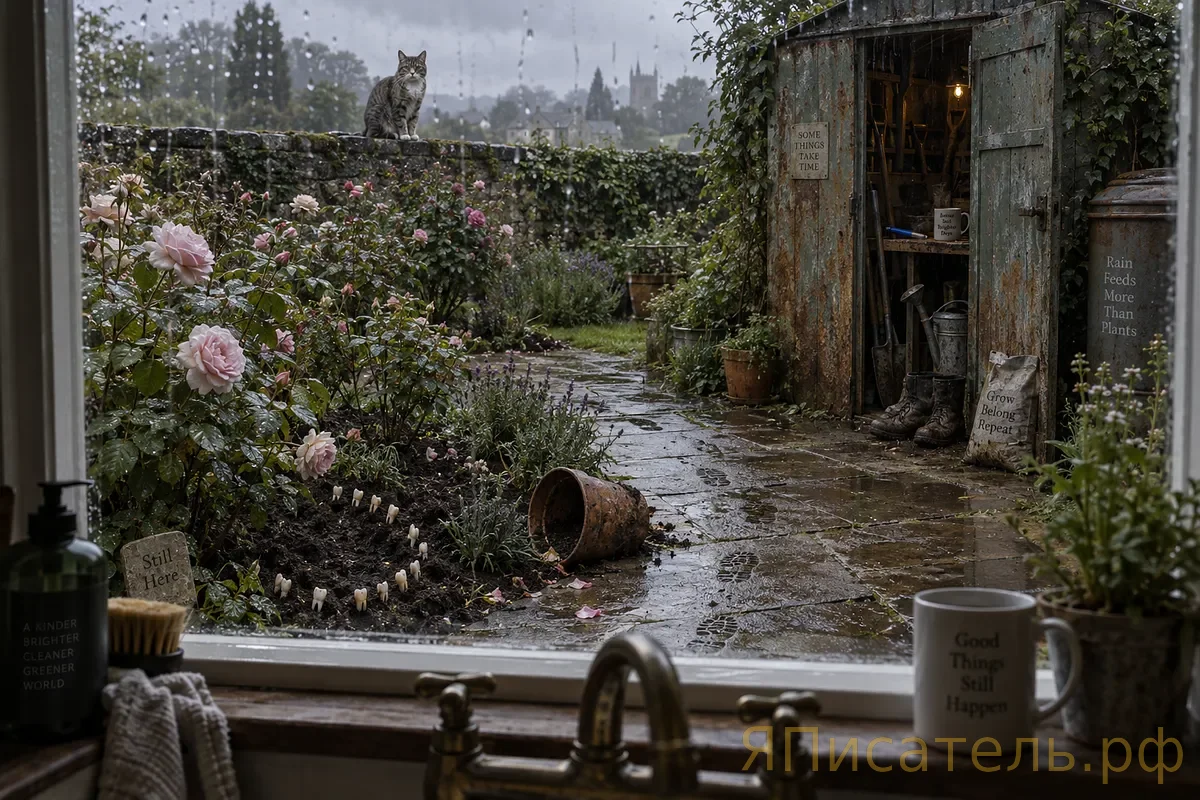
The Teeth in the Garden
Margaret found the first tooth on a Tuesday morning, half-buried in the soil beside her rose bushes. A human molar, perfectly white, roots still intact. She assumed a neighborhood child had lost it and tossed it in the bin without a second thought.
By Thursday, there were seven more.
By Saturday, the garden was full of them — rows and rows of teeth pushing up through the earth like pale, glistening seeds that had finally found the courage to sprout.
She knelt on the garden path, her knees pressing into the cold flagstones, and stared at the impossible crop. They were arranged in neat arcs, she realized. Not scattered randomly. Curved lines, like the inside of a jaw. As if something enormous beneath the soil was smiling up at her.
Margaret told no one. Who would she tell? Her husband Graham had been dead for four years. Her daughter lived in another country and called once a month, always in a hurry. The neighbors on Birch Lane kept to themselves — hedges trimmed high, curtains drawn. That was the way of things. That was why she'd loved this house.
On Sunday she tried to pull one out. She gripped a canine — unmistakably a canine, long and sharp — and tugged. It didn't budge. She pulled harder. The tooth held firm, rooted deep, and she could have sworn she felt something pull back.
She let go and didn't touch them again.
Monday brought rain, and the teeth grew. Not taller — wider. New ones appeared in the lawn, in the flower beds, between the paving stones of the patio. Some were small, like a child's milk teeth. Others were large, discolored, cracked — old teeth, teeth that had seen decades of use. She found one with a gold filling near the garden shed.
That night, Margaret couldn't sleep. She lay in bed listening to the rain against the windows and thought about the teeth. She thought about how the garden had always been Graham's domain. How he'd spent hours out there, digging, planting, turning the soil. How he'd built the raised beds himself, mixed his own compost, refused to let anyone else tend to it. How, near the end, he'd go out at strange hours — two, three in the morning — and she'd hear the shovel from the bedroom window.
"Just turning the compost," he'd say when she asked.
She never checked.
On Tuesday — exactly one week since the first tooth — Margaret made herself a cup of tea and sat at the kitchen table, looking out at the garden through the rain-streaked glass. The teeth were everywhere now. Hundreds of them. The garden looked like it was covered in hail that refused to melt. And the pattern was clearer from up here, from this height, looking down.
Not one smile. Many. Overlapping. Dozens of curved arcs, dozens of jaws, pressed together in the earth like a crowd of faces looking up from just below the surface.
Her tea went cold.
That afternoon, she went to the shed to find Graham's old gardening journal. He'd kept meticulous records — planting dates, soil pH, rainfall measurements. She found it on the shelf beside a rusted trowel and a pair of secateurs. The entries were mundane until the last year. The handwriting changed. Tighter. More cramped. The entries grew shorter.
April 14: Planted new section. Deep.
May 2: Turned soil. Added calcium.
June 19: Another addition. The roses love it.
July 3: She asked about the digging. Must be more careful.
August: The garden has never been so beautiful.
The journal ended there. Graham died in September.
Margaret closed the journal. Her hands were steady. She was surprised by that. She set it down on the workbench and noticed something she'd never seen before — a seam in the shed floor. A square of plywood, slightly different in color from the rest, covered by a bag of potting soil she had to drag aside.
She didn't lift it. Not yet.
Instead, she went back inside, locked the door, and sat in the hallway where there were no windows facing the garden. She sat there until the light under the front door turned from gray to dark.
The teeth were growing at night. She could hear them. A faint clicking from the garden, like someone tapping porcelain on porcelain. She pressed her palms over her ears and hummed an old song she couldn't remember the words to.
At midnight, she called her daughter. It rang five times and went to voicemail.
"Fiona," she said. "I need you to come home. Something's wrong with the garden. Your father — I think your father did something. I think—"
She stopped. What would she say? That teeth were growing in the garden? That Graham's journal read like a confession? That she was afraid to look under the shed floor because she already knew — had perhaps always known — what she'd find?
"Never mind," she said. "I'm fine. Call me when you can."
She hung up.
Wednesday. Margaret woke in the hallway, stiff and cold, still in yesterday's clothes. Pale morning light seeped under the front door. She stood, stretched her aching back, and walked to the kitchen.
The garden had changed overnight.
The teeth had broken through the patio. They'd cracked the flagstones, pushed up through the concrete, spread to the base of the house itself. And they were no longer white. They were moving. Slowly, almost imperceptibly, but moving — rocking back and forth in their sockets like loose baby teeth being worried by a tongue.
And the soil between them was shifting. Rising and falling. Gently. Rhythmically.
Like breathing.
Margaret backed away from the window. She bumped into the kitchen table. Her cold tea from yesterday fell and shattered on the floor and she barely noticed.
The clicking was louder now. Not just clicking — grinding. The sound of teeth against teeth, molars working, jaws clenching and unclenching beneath the earth. And under the grinding, something else. A hum. Low and resonant, like a voice trying to form words through a mouthful of soil.
She looked at the kitchen floor.
There — between the tiles, in the grout lines — something white was pushing through.
Margaret backed into the hallway. She grabbed her coat, her keys, her shoes. She would leave. She would drive somewhere, anywhere, and she would never come back to this house and its impossible garden and whatever Graham had planted in it.
She opened the front door.
The front path was teeth. Every paving stone had been replaced — or pushed aside — by rows of them, gleaming wet in the morning drizzle. They covered the driveway. They lined the edges of the street. They went as far as she could see.
And they were all pointing toward her.
Every tooth, every crown, every root — oriented like compass needles, aimed at where she stood in the doorway. As if whatever was beneath them was not just smiling.
It was looking at her.
Margaret stepped back inside. She closed the door very gently, as though afraid of waking something. She sat down on the hallway floor again and pulled her knees to her chest.
The grinding sound grew louder. The floor beneath her began to vibrate.
And from somewhere deep below the house — deeper than the foundation, deeper than the pipes and the wiring, deeper than Graham could possibly have dug — she heard a sound that made every nerve in her body go silent.
A swallow.
As if the earth itself had been chewing for a very long time.
And was finally ready to eat.
Вставьте этот код в HTML вашего сайта для встраивания контента.