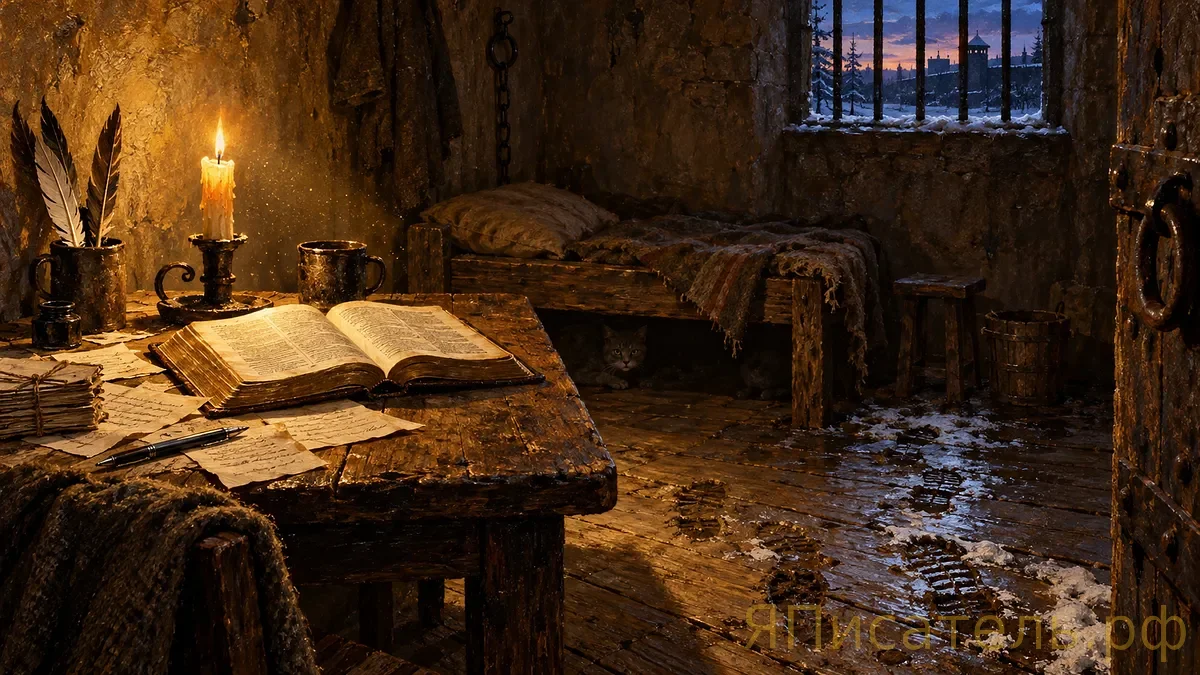
The Resurrection of Rodion Raskolnikov: A Lost Epilogue
Творческое продолжение классики
Это художественная фантазия на тему произведения «Crime and Punishment» автора Fyodor Dostoevsky. Как бы мог продолжиться сюжет, если бы писатель решил его развить?
Оригинальный отрывок
But that is the beginning of a new story—the story of the gradual renewal of a man, the story of his gradual regeneration, of his passing from one world into another, of his initiation into a new unknown life. That might be the subject of a new story, but our present story is ended.
Продолжение
The gradual renewal of a man, the gradual regeneration, his gradual passing from one world to another, his acquaintance with a new, hitherto unknown reality—these things seemed to Raskolnikov like the beginning of a new story, the story of his gradual awakening.
Yet the spring that came to Siberia brought with it not merely the thawing of frozen rivers, but strange disturbances in Raskolnikov's soul that he had not anticipated. Seven years of penal servitude still stretched before him like the endless steppe, but something had fundamentally altered in his perception of this sentence. The convicts who had once despised him—who had nearly killed him that terrible day when they fell upon him crying "You're an atheist! You don't believe in God!"—now regarded him with a different expression, one that puzzled him greatly.
It was on a morning in late April, when the Irtysh had finally broken free of its winter prison and flowed with renewed vigor, that Sonia came to him during the afternoon rest period with a letter from his mother's old friend, Praskovya Pavlovna.
"Rodya," Sonia said softly, her pale face illuminated by a shaft of weak sunlight that penetrated the prison workshop, "there is news from Petersburg."
He took the letter from her thin fingers, those fingers that had known such degradation and yet remained somehow pure. How strange it was that he could now look upon her without that former terrible mixture of contempt and admiration, that he could simply see her—Sonia, the woman who had followed him into exile, who had sacrificed everything.
"Read it to me," he said, though he was perfectly capable of reading it himself. He wanted to hear her voice.
Sonia's lips trembled slightly as she unfolded the paper. "'Dear Rodion Romanovich,'" she began, "'It is with a heavy heart that I write to inform you of circumstances that have recently come to light regarding the case which brought you to your present situation. A man named Nikolai Dementiev, a house-painter whom you may recall was once suspected of your crime, has made a deathbed confession to the priest at the Church of the Assumption...'"
Raskolnikov felt the blood drain from his face. Nikolai—poor, simple Nikolai, who had wished to "take suffering upon himself." What could he possibly have confessed?
"Continue," he whispered.
"'Nikolai confessed that on the night of the murder, he had indeed been in the building, hiding in an empty apartment on the fourth floor. He had witnessed—'"
Sonia stopped. Her hands were shaking so violently that the paper rustled like autumn leaves.
"He had witnessed what, Sonia?"
"He had witnessed you, Rodya. He saw you descend the stairs with the axe. He saw everything."
The silence that followed was absolute. In the distance, a guard called out something to another, and the sound of hammering resumed in the workshop next door. But in this small space, between Raskolnikov and Sonia, there existed only the weight of this revelation.
"And yet he said nothing," Raskolnikov finally spoke. "He tried to take the blame upon himself. Why? In God's name, why would any man do such a thing?"
Sonia carefully folded the letter. "The letter says that Nikolai believed you would confess on your own, that he saw something in your face—some terrible suffering—and he wanted to give you time. When you finally did confess, he kept silent because he thought his testimony was no longer needed. But on his deathbed, he felt compelled to tell the whole truth."
Raskolnikov laughed—a harsh, bitter sound that seemed to come from somewhere outside himself. "So there was a witness all along. My great crime, my act of a 'Napoleon,' my stepping over—and a simple house-painter watched it all from behind a door like a man observing a rat in a trap."
"Rodya, don't—"
"Don't what? Don't recognize the absurdity of it? Don't see how pathetic the whole thing was from the very beginning?" He stood abruptly, pacing the narrow confines of the room. "I tortured myself with questions of whether I was a Napoleon or a louse, whether I had the right to transgress, whether extraordinary men exist above ordinary morality—and all the while, an ordinary man, the most ordinary man imaginable, watched and chose to suffer in my place. Who, then, was the extraordinary one? Who transgressed the boundaries of normal human selfishness?"
Sonia rose and placed her hand on his arm. Her touch, once unbearable to him, now felt like an anchor to reality.
"Perhaps," she said quietly, "that is precisely what you needed to understand. That there are no extraordinary men in the way you imagined them. There are only men who love and men who do not. Nikolai loved—he loved humanity, he loved suffering, he loved God. And you, Rodya..."
"And I loved only my idea," he finished. "My beautiful, terrible idea."
They stood together in silence. Outside, the Siberian spring continued its slow, inexorable work of transformation. The ice melted. The rivers flowed. And somewhere in the depth of Raskolnikov's consciousness, something that had been frozen for years—perhaps for his entire life—began at last to thaw.
***
That evening, Raskolnikov could not sleep. He lay on his plank bed in the prison barracks, surrounded by the breathing and snoring of forty other convicts, and stared into the darkness. The revelation about Nikolai had opened something within him, some door he had believed forever sealed.
He thought of Porfiry Petrovich, the examining magistrate who had pursued him with such terrible psychological precision. How Porfiry had told him, almost casually, that he believed Raskolnikov would "offer his suffering" of his own accord. Had Porfiry known about Nikolai? Had he understood, even then, that the greatest punishment for Raskolnikov would not be the gallows or the prison, but the slow, agonizing recognition of his own ordinariness?
And what of Svidrigailov, that strange, corrupt man who had taken his own life rather than face the emptiness of his existence? Raskolnikov had once feared that he and Svidrigailov were cut from the same cloth, that his crime had revealed him to be capable of the same bottomless depravity. But now he wondered. Svidrigailov had known no remorse—his conscience was dead. But Raskolnikov's conscience had never been dead; it had merely been sick, diseased with pride and intellectual vanity.
"You are not sleeping, Raskolnikov."
The voice came from the darkness beside him. It belonged to an old convict named Petrov, a former soldier who had killed his commanding officer in a fit of rage twenty years ago and had since become something of a patriarch among the prisoners.
"No," Raskolnikov admitted. "I cannot."
"The letter from your woman troubled you."
"You know about it?"
"Everyone knows everything here. There are no secrets in Siberia—only frozen ones, waiting for the thaw." Petrov's voice was dry, almost amused. "What did you learn that disturbs your rest?"
"That I was seen. That my crime was witnessed by another man who said nothing."
"Ah." Petrov was silent for a moment. "And this troubles you why? Because you were not as clever as you believed? Because your great secret was never truly a secret?"
"Because he suffered for me. This man—he was ready to die for a crime he did not commit, simply because he saw the suffering in my face and wished to give me time to find my own way to confession."
Petrov laughed softly. "You intellectuals. You think suffering is something to be earned, like a university degree. But suffering simply is. It comes to those who open themselves to it, and it transforms them, and that is all. This house-painter—he understood this. Do you?"
Raskolnikov did not answer. But something in Petrov's words echoed what Sonia had told him, what the New Testament she had given him seemed to whisper from beneath his pillow where he kept it hidden.
"Sleep, young man," Petrov said. "Tomorrow the work continues. And the day after that. And the day after that. Seven years is a long time, but it is not forever. And when you emerge from this place, you will either be a man who has learned to live, or a man who has merely survived. The choice is yours."
***
Three days later, Raskolnikov asked Sonia to read to him from the Gospel of John—the story of the raising of Lazarus that she had once read to him in her cramped little room in Petersburg, on that terrible night when he had first revealed his crime to her. He had listened then with the ears of a man already dead, a man entombed in his own intellectual constructions. Now he listened differently.
"'Jesus said unto her, I am the resurrection, and the life: he that believeth in me, though he were dead, yet shall he live...'" Sonia's voice was steady, almost musical. "'And whosoever liveth and believeth in me shall never die. Believest thou this?'"
"Stop," Raskolnikov said.
Sonia looked up, alarm in her pale eyes.
"I want to answer," he said slowly. "For years, I would have said no. I believed only in myself, in my own reason, in my own judgment of what was permitted and what was forbidden. I made myself into a god—a small, pathetic god who could not even commit a murder without bungling it, without killing an innocent woman along with the guilty one, without leaving a trail of evidence that any competent investigator could follow."
He paused, struggling to articulate what was happening within him.
"But now... now I am not certain. Something has changed. When I look at you, Sonia, I see someone who believes, truly believes, and that belief has given you the strength to endure things that would have destroyed me. When I think of Nikolai, I see a man whose faith led him to accept suffering for a stranger. And when I look at myself..."
"What do you see, Rodya?"
"I see a man who is beginning to wonder if there might be something beyond his own understanding. A man who is beginning to suspect that his great theories were simply walls he built to keep out the terrifying possibility that he might be wrong about everything."
Sonia set down the Testament and took his hands in hers. Her eyes were shining with tears, but her voice remained steady.
"That is the beginning, Rodya. That is how it begins. Not with certainty, but with doubt—doubt in oneself, which opens the door to faith in something greater."
Outside the prison walls, the Siberian evening was settling into its long twilight. The rivers flowed toward the Arctic, carrying with them the last remnants of winter ice. And in the small visiting room where Raskolnikov sat with the woman who had followed him into exile, something new was being born—something fragile and uncertain, but undeniably alive.
He did not yet believe. He could not yet pray. But for the first time in his life, Rodion Romanovich Raskolnikov was willing to admit that there might be things beyond the reach of his intellect, truths that could not be grasped through reason alone.
And that, perhaps, was miracle enough for one Siberian spring.
***
The remaining years of his sentence would not be easy. There would be setbacks, moments of despair, nights when the old pride would rear up like a wounded beast. But Sonia would be there, patient and steadfast, and slowly, painfully, Raskolnikov would learn what it meant to live among other human beings—not as a Napoleon, not as an extraordinary man standing above the common herd, but as one soul among millions, each precious, each capable of love and suffering and redemption.
The story of his resurrection had begun. It would be, as Dostoevsky himself wrote, the subject of a new story—but that new story was no longer deferred to some hypothetical future. It was happening now, in the thawing Siberian spring, in the touch of Sonia's hand, in the gradual awakening of a man who had been dead and was learning, at last, how to live.
Вставьте этот код в HTML вашего сайта для встраивания контента.