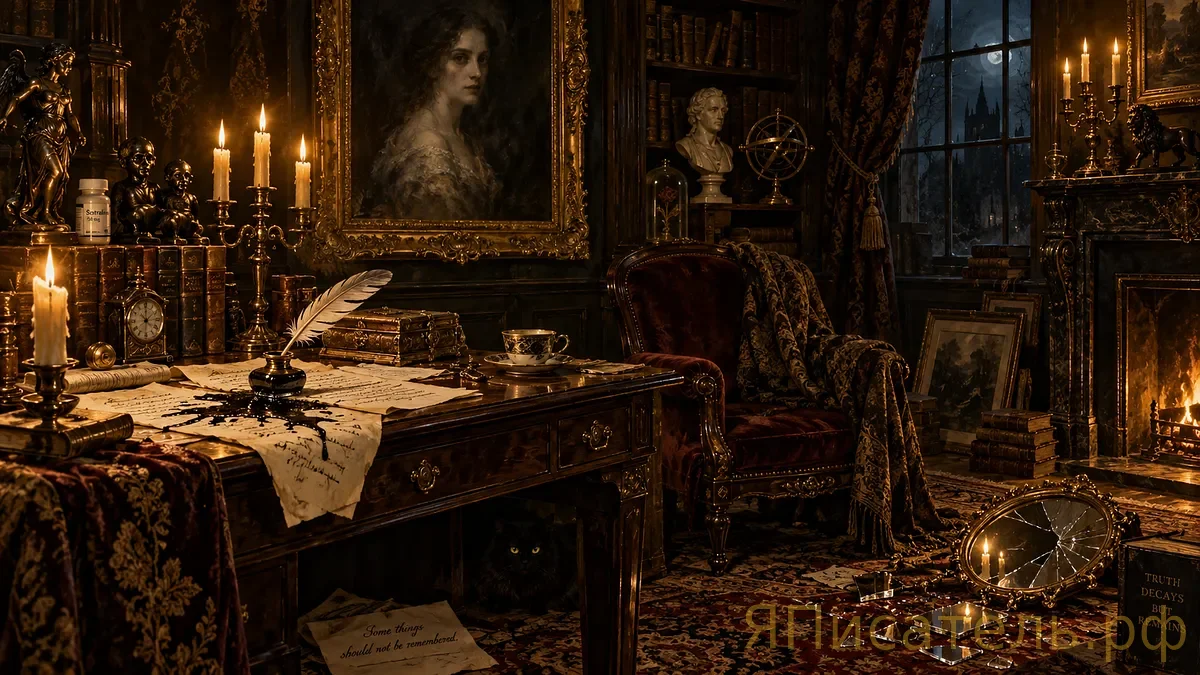
The Portrait Restored: A Lost Chapter of Dorian Gray
Творческое продолжение классики
Это художественная фантазия на тему произведения «The Picture of Dorian Gray» автора Oscar Wilde. Как бы мог продолжиться сюжет, если бы писатель решил его развить?
Оригинальный отрывок
When they entered, they found hanging upon the wall a splendid portrait of their master as they had last seen him, in all the wonder of his exquisite youth and beauty. Lying on the floor was a dead man, in evening dress, with a knife in his heart. It was not until they had examined the rings that they recognised who it was.
Продолжение
When they entered, they found hanging upon the wall a splendid portrait of their master as they had last seen him, in all the wonder of his exquisite youth and beauty. Lying on the floor was a dead man, in evening dress, with a knife in his heart. It was not until they had examined the rings that they recognised who it was.
Yet in the days that followed, strange whispers began to circulate through London's drawing rooms—whispers that the servants of the Gray household dared not repeat, save in the most confidential of circumstances. For the portrait, that miraculous testament to Basil Hallward's genius, had begun to change once more.
It was Francis, the butler, who first observed the alteration. He had been instructed by the authorities to keep the schoolroom locked until the inquest had concluded, yet something compelled him to peer through the keyhole on the third morning after that dreadful discovery. What he saw caused him to stumble backward, his aged face draining of what little colour it possessed.
The portrait no longer showed Dorian Gray in the flush of his youth. A shadow had crept across those perfect features—not the hideous corruption that the servants whispered of in their quarters, but something far more subtle. The eyes, those remarkable violet eyes that had captivated all of London, now held within them a depth of sorrow that seemed almost unbearable to behold.
"It is merely the light," Francis told himself, though his hands trembled as he descended the stairs. "The dust upon the window. Nothing more."
But London society, that great organism of gossip and speculation, was not so easily satisfied with rational explanations. Lady Narborough, who had known Dorian in his earliest days of social conquest, was perhaps the first to speak openly of what others only dared to think.
"There was always something unnatural about him," she declared to her assembled guests one evening, her diamonds catching the candlelight as she gestured with characteristic theatricality. "A man cannot remain so impossibly beautiful for so many years without some... arrangement having been made."
"An arrangement with whom, precisely?" inquired Lord Henry Wotton, who reclined in his customary position near the fire, a cigarette smouldering between his elegant fingers. His voice carried that familiar note of amused detachment, yet those who knew him well might have detected something else beneath it—a weariness, perhaps, or the faintest tremor of genuine emotion.
"With forces that a respectable woman does not discuss in mixed company," Lady Narborough replied, lowering her voice to a whisper that carried perfectly to every corner of the room.
Lord Henry smiled, but it was a smile that did not reach his eyes. He had been thinking of Dorian constantly since receiving word of his death—if death it could properly be called. The circumstances were so extraordinary, so utterly beyond the pale of normal experience, that even his considerable powers of cynicism had failed to provide adequate defence against the horror of it.
He remembered their first meeting as if it had occurred only yesterday: the golden youth standing in Basil's studio, so achingly perfect that he had seemed less a human being than a work of art given miraculous life. And he remembered, too, his own words—those clever, poisonous words that he had scattered like seeds, never dreaming what monstrous flowers they might produce.
"Youth is the one thing worth having," he had told the boy. "When your youth goes, your beauty will go with it, and then you will suddenly discover that there are no triumphs left for you."
Had he known, even then, what he was doing? Had some part of him understood that he was not merely educating an innocent, but corrupting one? Lord Henry had always prided himself on his self-knowledge, yet now he found that he could not answer these questions with any certainty.
The inquest was held on a grey Tuesday morning, in a courtroom that smelled of dust and old misery. The verdict was suicide whilst temporarily insane—a merciful fiction that allowed for proper burial and spared the family name from the worst excesses of scandal. Yet everyone present knew that the official explanation fell far short of accounting for the facts.
How had a man of twenty years become, in the space of a single evening, a withered creature whose age could not be less than seventy? The coroner had dismissed this question with studied indifference, attributing the servants' testimony to hysteria and the effects of poor lighting. But there were those in attendance who had seen the body before it was removed, and their silence on the matter spoke more eloquently than any words.
Among the spectators sat a young man whom no one recognized—a pale, earnest figure with the look of a scholar about him. He took copious notes throughout the proceedings, and when the verdict was announced, he slipped away before anyone could question his presence.
This was Adrian Singleton's younger brother, Edmund, who had traveled from Cambridge upon hearing of Dorian Gray's death. Adrian himself had perished some years before, destroyed by opium and despair, and Edmund had long harbored suspicions about the role Dorian had played in his brother's ruin. Now, watching the machinery of justice grind out its comfortable lies, he felt those suspicions harden into certainty.
"I shall discover the truth," he murmured to himself as he walked through the rain-slicked streets. "Whatever it may cost me."
His investigations led him, inevitably, to Lord Henry Wotton's residence in Mayfair. He presented his card with trembling hands, uncertain of what reception he might receive.
Lord Henry received him in the library, that magnificent room lined with first editions and objets d'art. He looked older than Edmund had expected—the famous wit showing signs, at last, of the mortality he had always affected to despise.
"You wish to speak of Dorian," Lord Henry said, before his visitor could utter a word. "They all do, these days. It has become quite the fashionable topic of conversation."
"I wish to understand what happened to him," Edmund replied. "And what happened to my brother."
Lord Henry's expression flickered—a momentary crack in the polished facade. "Your brother was a weak man who made weak choices. Dorian merely... illuminated those weaknesses."
"You speak as though he were a force of nature rather than a human being."
"Perhaps he was." Lord Henry rose and moved to the window, gazing out at the rain. "Or perhaps he was something else entirely—an experiment, if you will. An experiment in living according to certain principles, taken to their logical conclusion."
"Whose principles?"
The silence that followed was answer enough.
"I was young once," Lord Henry said at last, his voice barely above a whisper. "Young and clever and utterly convinced of my own superiority. I believed that beauty was the highest good, that experience was its own justification, that morality was merely a convention designed to constrain those too timid to pursue their desires. And I found, in Dorian Gray, the perfect vessel for these ideas."
"You corrupted him."
"I taught him to see the world as I saw it. Whether that constitutes corruption depends, I suppose, upon one's perspective." Lord Henry turned to face his visitor, and Edmund was startled to see something glistening in the older man's eyes. "But I have had cause, lately, to question that perspective. The portrait, you see..."
"The portrait?"
Lord Henry hesitated, as though wrestling with some internal prohibition. "I was there, the day Basil painted it. I watched Dorian look upon his own image and wish—wish with all the fervor of youth—that he might remain forever young while the portrait aged in his stead. It was I who planted that wish in his mind, though I meant it merely as a jest. A clever observation about the nature of beauty and time."
"And the wish came true?"
"So it would appear. Though at what cost..." Lord Henry shuddered. "I have seen the portrait now. The servants permitted me into the schoolroom, after the inquest. It hangs there still, beautiful as the day it was painted. But when I look upon it, I see something in those eyes—a knowledge, an awareness—that was never there before. It is as though the portrait has absorbed not merely Dorian's sins, but his soul itself."
Edmund felt a chill run through him that had nothing to do with the weather. "What are you saying?"
"I am saying, Mr. Singleton, that there are more things in heaven and earth than are dreamt of in our philosophy. And I am saying that I have spent my life teaching young men to pursue pleasure without consequence, never believing that the universe might exact its own price for such teachings." Lord Henry's laugh was hollow, haunted. "The joke, it seems, was on me all along."
They stood in silence for a long moment, two men united by their connection to a tragedy neither fully understood.
"What will you do now?" Edmund asked finally.
"I shall do what I have always done," Lord Henry replied. "I shall attend parties and make clever remarks and pretend that nothing has changed. It is the only response to horror that civilization permits." He paused, then added, almost to himself: "But I shall never look upon another beautiful young man without remembering. And I shall never speak another careless word without wondering what seeds I may be planting."
Edmund left the house with more questions than answers, but with something else as well—a strange sense of completion, as though he had witnessed the final act of a drama that had been playing out long before he entered the theater.
The portrait of Dorian Gray remained in the schoolroom for many years, a source of endless fascination for those few who were permitted to view it. Some claimed that it continued to change, showing now sorrow, now peace, now something that might almost be called hope. Others dismissed such reports as mere fancy.
But late at night, when the house was quiet and the candles burned low, the servants sometimes heard a sound emanating from behind the locked door—a sound that might have been the wind, or the settling of old timbers, or something else entirely.
It sounded, they said, very much like weeping.
And in the great drawing rooms of London, where wit and beauty still held sway, the name of Dorian Gray passed gradually from scandal into legend, and from legend into that peculiar form of immortality reserved for those whose stories capture something essential about the human condition. He had wished to remain forever young, and in a sense, his wish had been granted. For as long as men dreamed of escaping the consequences of their actions, as long as they yearned for beauty without sacrifice and pleasure without price, the tale of Dorian Gray would endure—a warning, perhaps, or merely a mirror in which each generation might glimpse its own reflection.
Lord Henry Wotton died some years later, peacefully in his sleep, having never written the memoirs that so many had urged upon him. His last words, according to his valet, were simply these: "How curious. I had not expected it to be so bright."
What he meant by this, no one could say. But those who had known him best thought they detected, in his final expression, something that he had spent a lifetime hiding beneath layers of wit and cynicism—something that looked very much like wonder.
Вставьте этот код в HTML вашего сайта для встраивания контента.