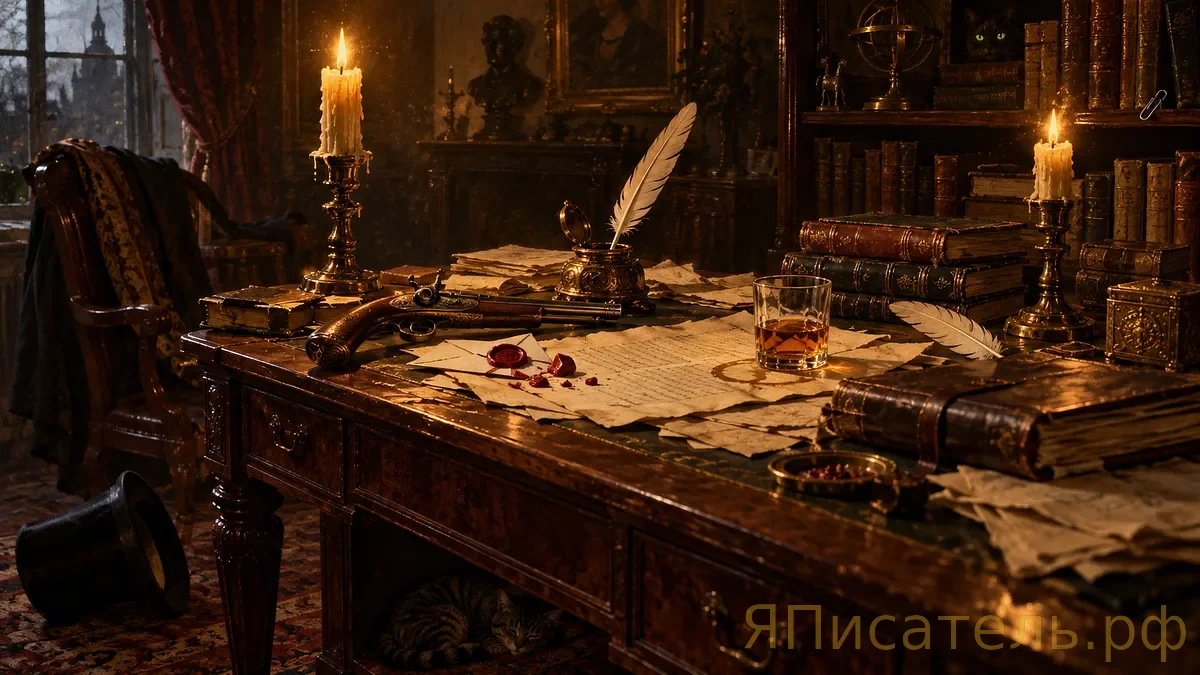
Pushkin Died in a Duel at 37 — And Still Outsmarted Us All
On February 10, 1837, Alexander Pushkin bled out on a couch after taking a bullet to the abdomen in a duel over his wife's honor. He was thirty-seven. That's younger than most people when they finally get around to writing their first novel. And yet, 189 years later, this man's fingerprints are smeared across everything — from Russian rap lyrics to Hollywood adaptations, from Tchaikovsky's operas to the way an entire nation thinks about love, fate, and the terrifying randomness of a card game.
Here's the uncomfortable truth: most of us will live twice as long as Pushkin and produce approximately nothing that anyone remembers past next Tuesday. Meanwhile, this guy cranked out *Eugene Onegin*, *The Captain's Daughter*, *The Queen of Spades*, and about four hundred other things — poems, plays, fairy tales, critical essays — while simultaneously getting exiled by the Tsar, gambling away his money, and managing a love life so chaotic it would make reality TV producers weep with joy.
Let's talk about *Eugene Onegin* first, because it's arguably the most influential novel you've never read. Yes, I said novel. It's written entirely in verse — 389 stanzas of iambic tetrameter with a rhyme scheme Pushkin invented himself. The man literally created his own poetic form because the existing ones bored him. The story is deceptively simple: a bored aristocrat rejects a young woman's love, kills his best friend in a duel (Pushkin had a thing about duels, clearly), then years later realizes the woman was the love of his life — only to be rejected in return. It's the original "you don't know what you've got till it's gone" story, except Pushkin told it with enough irony, wit, and self-awareness to make it feel like it was written yesterday.
Here's what's wild: Tchaikovsky turned it into an opera in 1879. It became the backbone of Russian literary identity. Dostoevsky worshipped it. Nabokov spent years translating it into English and wrote a commentary four times longer than the original text — because of course he did. And the so-called "Onegin stanza" influenced poets for two centuries. Every time a Russian songwriter writes about unrequited love with a smirk instead of a tear, they're channeling Pushkin whether they know it or not.
*The Queen of Spades* is a different beast entirely — and honestly, it might be Pushkin's most modern work. Published in 1834, it's a tight, almost hallucinatory short story about a military engineer named Hermann who becomes obsessed with learning the secret of three winning cards from an old countess. He sneaks into her bedroom at night, threatens her with a pistol, and she literally dies of fright. Then her ghost shows up and gives him the cards anyway. He bets everything. Wins twice. And on the third bet — the queen of spades winks at him from the table, and he loses his mind. Literally. He ends up in an asylum.
Read that again and tell me it doesn't sound like a pitch for a psychological thriller on Netflix. The story influenced everything from Dostoevsky's *The Gambler* to Tchaikovsky's opera of the same name, to countless films. Hermann is essentially the prototype for every obsessive, self-destructive protagonist in modern fiction — the guy who's so convinced he's found the system, the cheat code, the loophole, that he destroys himself reaching for it. Sound familiar? Every crypto bro who went all-in on a meme coin is basically Hermann without the ghost.
Then there's *The Captain's Daughter*, which Pushkin published in 1836, just a year before his death. Set during the Pugachev Rebellion of 1773-1775, it's a historical novel disguised as a love story — or a love story disguised as a historical novel. A young officer named Pyotr Grinyov gets posted to a remote fortress, falls in love with the captain's daughter Masha, and gets swept up in a massive peasant uprising led by the charismatic rebel Pugachev. What makes the novel brilliant isn't the plot — it's Pushkin's refusal to simplify. Pugachev is terrifying and generous. The government forces are brutal and legitimate. Love is real but not enough to fix anything.
Historians actually credit *The Captain's Daughter* with shaping how Russians understand the Pugachev Rebellion to this day. Pushkin didn't just write a novel — he wrote history's rough draft. He traveled to the Ural region, interviewed survivors, and studied government archives before putting pen to paper. The result is a work that feels like journalism filtered through poetry. Tolstoy later admitted that *The Captain's Daughter* influenced *War and Peace*. Let that sink in. Pushkin influenced the book that most people consider the greatest novel ever written.
But here's what really gets me about Pushkin's legacy: he didn't just write great literature. He essentially created the modern Russian literary language. Before Pushkin, Russian prose was stiff, formal, drowning in Church Slavonic constructions that nobody actually spoke. Pushkin took the language people used in the streets, in love letters, in arguments at dinner parties, and turned it into art. He proved you could be sophisticated without being stuffy. Every Russian writer who came after — Gogol, Turgenev, Chekhov, Bulgakov — is building on the linguistic foundation Pushkin laid.
And his influence reaches well beyond Russia. *Eugene Onegin* is a direct ancestor of the self-aware, meta-fictional novel. Pushkin constantly interrupts his own story to comment on it, joke about literary conventions, and address the reader directly. Sound familiar? That's because every postmodern novelist from John Barth to Zadie Smith has been doing the same thing — most of them without knowing they owe a debt to a Russian poet who died before the telegraph was widely adopted.
The dueling culture that killed Pushkin is long gone, but his questions haven't aged a day. What do you do when you realize too late that you've thrown away the best thing in your life? How far will obsession take you before it takes everything? Can love survive when history is literally burning down around you? These aren't 19th-century questions. These are 3 AM questions. These are the questions that keep you staring at your phone screen, scrolling through someone's old photos, wondering where it all went sideways.
So today, 189 years after a bullet ended the life of a thirty-seven-year-old genius, raise a glass — preferably of something strong and Russian — and consider this: Pushkin had less time than most of us get, and he used every minute of it to write things that still punch us in the gut. The real question isn't why we still read Pushkin. The real question is what the hell we're doing with the extra decades he never got.
Вставьте этот код в HTML вашего сайта для встраивания контента.