Pushkin Died in a Duel at 37 — And Still Outsmarted Every Writer Since
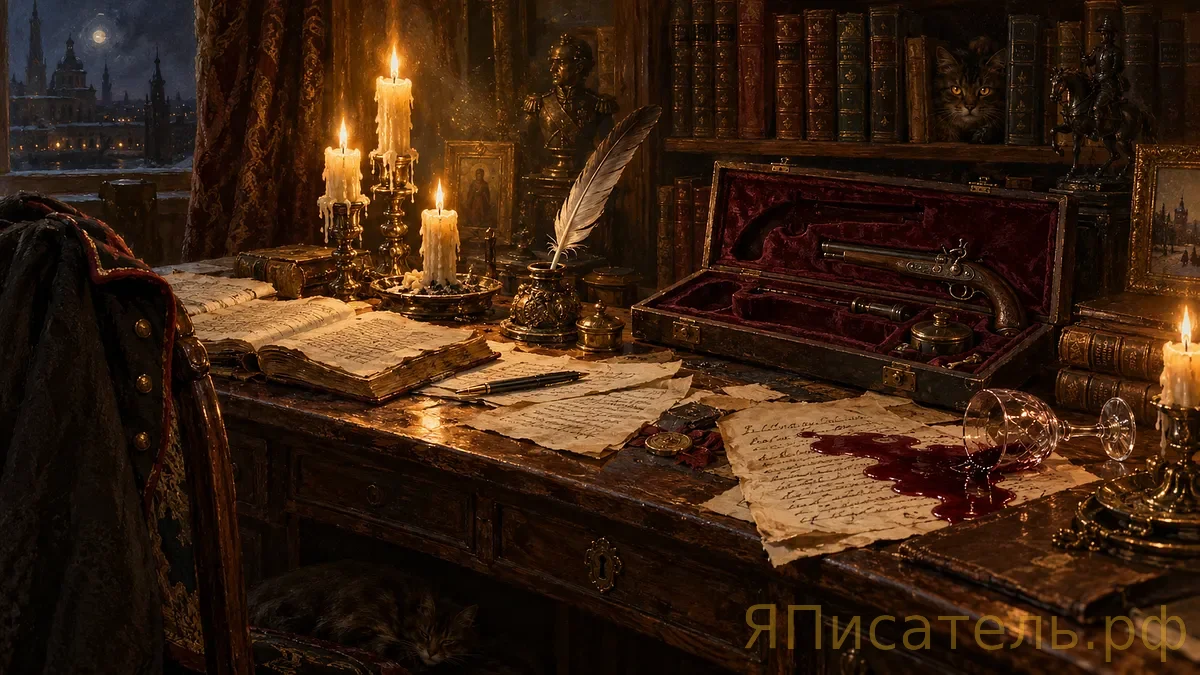
Here's a fun fact to ruin your morning coffee: the man who essentially invented modern Russian literature, who gave an entire civilization its literary voice, died because some French pretty boy was flirting with his wife. Alexander Pushkin took a bullet to the gut on January 27, 1837, and bled out two days later. He was thirty-seven. Most of us at thirty-seven are still figuring out our Netflix queue.
But here's what's truly maddening — 189 years after his death, Pushkin's fingerprints are everywhere, and most of the Western world barely knows his name. If you've read Dostoevsky, Tolstoy, Chekhov, Nabokov — congratulations, you've been reading Pushkin's children. Every single one of them pointed back to him as the source. Dostoevsky literally said, "Pushkin is everything." Not "Pushkin is great." Everything. Let that sink in.
Let's talk about *Eugene Onegin*, arguably the most influential novel nobody outside Russia has actually read. Published between 1825 and 1832, written entirely in verse — yes, a novel in poetry, because apparently Pushkin thought prose was too easy — it tells the story of a bored aristocrat who rejects the love of a sincere young woman, Tatiana, only to realize years later that he's made the catastrophic mistake of his life. Sound familiar? It should. This is the DNA of every romantic tragedy you've ever consumed. Every brooding male lead in every period drama who realizes too late that he blew it with the good one? That's Onegin's ghost haunting your screen.
What makes *Eugene Onegin* genuinely revolutionary isn't just the love story. It's the tone. Pushkin invented a narrative voice that's simultaneously inside the story and mocking it from the outside. He's the narrator who digresses about his own feet, who interrupts a dramatic scene to talk about ice cream, who winks at the reader while his characters suffer. This is metafiction — in 1825. Laurence Sterne did something similar, sure, but Pushkin weaponized it. He made irony the default setting of the Russian novel. Without this move, you don't get Nabokov's playfulness, you don't get Bulgakov's absurdism, you arguably don't get half of postmodern literature.
Now, *The Captain's Daughter* — or *Kapitanskaya Dochka* if you want to sound impressive at parties. Published in 1836, just a year before Pushkin's death, it's a historical novel set during the Pugachev Rebellion of 1773. On the surface, it's a straightforward adventure: young officer falls in love, gets caught up in a peasant uprising, faces moral choices. But underneath, Pushkin is doing something subversive. He's writing about political rebellion and making the rebel leader, Pugachev, genuinely charismatic and human. In Tsarist Russia. Under censorship. The man had brass ones, let's be honest. Walter Scott was the king of historical fiction at the time, and Pushkin basically took Scott's template, stripped out the bloat, injected psychological complexity, and produced something tighter and more dangerous. Tolstoy later admitted that *The Captain's Daughter* influenced *War and Peace*. Let me repeat: the longest novel most people will never finish was inspired by one of the shortest novels you could read in an afternoon.
*The Queen of Spades* is where Pushkin gets genuinely creepy. Written in 1834, this short story about a young officer obsessed with a gambling secret held by an ancient countess is basically the blueprint for psychological horror in Russian literature. Hermann — the protagonist — isn't evil. He's just consumed by the idea that there's a system, a hidden pattern, a shortcut to wealth. He stalks an old woman, terrifies her to death, and then her ghost appears to give him the winning card combination. Except she lies. Or does she? Pushkin leaves it beautifully ambiguous. Is Hermann insane? Is the supernatural real? Does the universe punish greed, or is it all just dumb luck? Dostoevsky's entire gambling obsession, his novel *The Gambler*, Tchaikovsky's opera — all downstream from this thirty-page story. Hollywood has been recycling this plot for decades without even knowing the source.
Here's what connects all three works, and what makes Pushkin feel disturbingly modern 189 years later: he understood that people are fundamentally terrible at knowing what they want. Onegin wants freedom until he doesn't. Grinev in *The Captain's Daughter* wants adventure until real violence arrives. Hermann wants certainty in a world that runs on chaos. These aren't 19th-century problems. Open any self-help book, scroll through any social media feed, and you'll find millions of people making exactly the same mistakes. Pushkin diagnosed the human condition with surgical precision, then wrapped the diagnosis in stories so entertaining that you barely notice you're being dissected.
The tragedy of Pushkin's Western obscurity is partly a translation problem. His genius lives in the Russian language itself — the rhythm, the compression, the way he could pack an entire emotional arc into four lines of verse. Translating Pushkin is like trying to explain a joke in a different language: you can convey the meaning, but the magic evaporates. Nabokov spent years on a hyper-literal translation of *Eugene Onegin* and produced four volumes of commentary for a text that's about 200 pages. His translation is accurate and completely unreadable as poetry. Other translators sacrifice accuracy for music. Nobody wins.
But here's the thing — you don't need to read Russian to feel Pushkin's influence. Every time a novel uses an unreliable narrator with a sense of humor, every time a short story leaves you unsettled without cheap jump scares, every time a historical novel treats rebels as humans rather than villains, Pushkin is in the room. He built the operating system. Everyone else is just writing apps.
The man died in a pointless duel, defending his wife's honor against a man who probably wasn't worth the bullet. He left behind a body of work so foundational that an entire literary tradition — one that produced Gogol, Turgenev, Dostoevsky, Tolstoy, Chekhov, Bulgakov, and Nabokov — considers him the starting point. He did this in roughly fifteen years of serious writing. At thirty-seven, he was done. Not retired. Dead.
So the next time someone asks you who the greatest writer you've never read is, you have your answer. Alexander Pushkin has been dead for 189 years, and he's still the most modern writer in the room. The rest of us are just catching up.
Вставьте этот код в HTML вашего сайта для встраивания контента.