Carmilla
Предпросмотр книги
Автор
Joseph Sheridan Le Fanu
Жанр
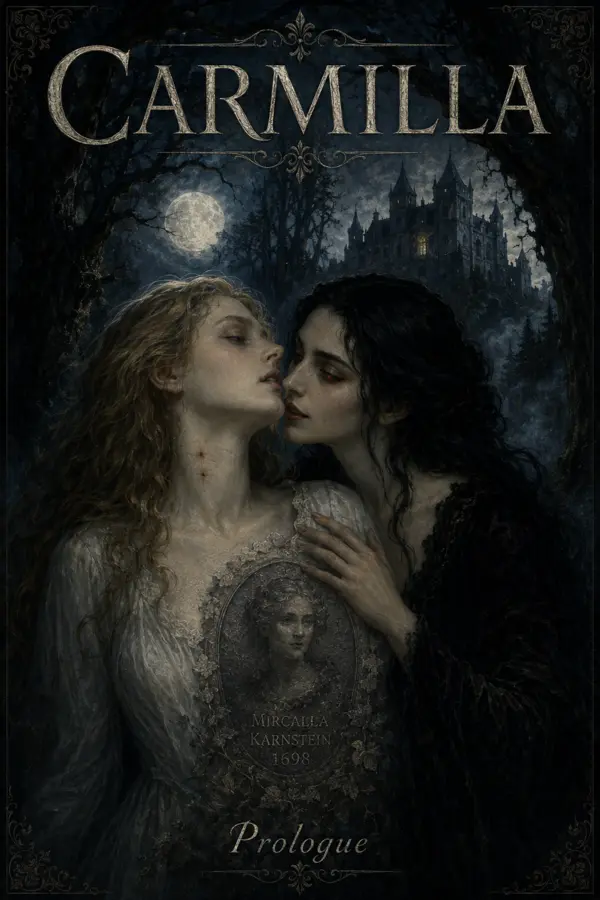
Обложка книги
Общее содержание книги
Carmilla is a Gothic horror novella narrated in the first person by Laura, a young Englishwoman who lives with her widowed father in a remote schloss deep in the forested hills of Styria, Austria. The story is framed by a brief prologue from Doctor Hesselius, a learned physician who has annotated the manuscript and whose scholarly interest in the supernatural lends the tale an air of grim authenticity. Laura's account begins with a haunting childhood memory: at the age of six, she woke in the night to find a beautiful young woman kneeling beside her bed, who caressed her and lay down beside her before seemingly vanishing beneath the furniture — leaving Laura with the sensation of two needles piercing her chest. The incident is never satisfactorily explained, and the face of that mysterious visitor is seared into Laura's memory forever. Years pass. Laura, now nineteen, lives a pleasantly isolated life with her father, their two governesses — the warm Madame Perrodon and the metaphysically inclined Mademoiselle De Lafontaine — and occasional visiting friends. Her world is shaken when word arrives that General Spielsdorf's niece and ward, Bertha Rheinfeldt, has died under disturbing circumstances; the General's letter is incoherent with grief and rage, referring darkly to "hellish arts" and a monster he intends to hunt down. That same evening, a carriage accident on the road before the schloss delivers an unexpected guest: Carmilla, a beautiful and languid young noblewoman whose mysterious mother entrusts her to Laura's father's care for three months while she continues an urgent, secret journey. From their first meeting, Laura and Carmilla are startled to recognize each other — both recall a shared dream from childhood, each glimpsing the other's face across the years. This eerie bond draws them into swift intimacy. Carmilla is captivating but deeply strange. She sleeps until noon, eats almost nothing, moves with a slow, exhausted grace, and deflects every question about her origins with practiced melancholy. She speaks of her family only in the vaguest terms: her name is Carmilla, her family is ancient and noble, her home lies somewhere to the west. Yet her behavior toward Laura grows increasingly intense — she presses declarations of ardent, consuming love upon her, whispering phrases that blend passion with an almost predatory menace: "you shall die — die, sweetly die — into mine." As weeks pass, Laura's health deteriorates in ways she cannot explain or bring herself to report. She suffers nightmares of a great black cat that transforms into a biting figure; she wakes with an aching sensation at her throat; a sweet, creeping lassitude steals over her days, making death feel strangely appealing. Around the countryside, local peasant girls are dying of a mysterious wasting illness attributed to the oupire — the vampire. The mystery deepens when a portrait is restored among the family's old paintings: the image of Mircalla, Countess Karnstein, dated 1698, is an exact likeness of Carmilla. The ruins of Karnstein Castle — ancestral home of that long-extinct and troubling family — stand only three miles from the schloss. The doctor summoned to examine Laura discovers a small blue mark on her throat and speaks in grave, hushed tones with her father. Carmilla, it is revealed, has been discovered absent from her locked room in the night, only to return without explanation. General Spielsdorf arrives, aged and darkened by grief and fury, speaking of a monstrous conspiracy and a mission to desecrate the Karnstein tombs in the name of justice. As the party makes their way toward the ruins, the noose of evidence tightens: Carmilla is not what she appears. She is something far older, far more dangerous, and far more intimately entangled with Laura's fate than any living guest could be — a creature that feeds on love and life alike, and whose hunger has already claimed at least one young woman's soul.
Содержание глав
Эта книга была рецензирована
Прочитать профессиональную рецензию на эту книгу
Отрывок из книги
Prologue
Upon a paper attached to the Narrative which follows, Doctor Hesselius has written a rather elaborate note, which he accompanies with a reference to his Essay on the strange subject which the MS. illuminates.
This mysterious subject he treats, in that Essay, with his usual learning and acumen, and with remarkable directness and condensation. It will form but one volume of the series of that extraordinary man’s collected papers.
As I publish the case, in this volume, simply to interest the “laity,” I shall forestall the intelligent lady, who relates it, in nothing; and after due consideration, I have determined, therefore, to abstain from presenting any précis of the learned Doctor’s reasoning, or extract from his statement on a subject which he describes as “involving, not improbably, some of the profoundest arcana of our dual existence, and its intermediates.”
I was anxious on discovering this paper, to reopen the correspondence commenced by Doctor Hesselius, so many years before, with a person so clever and careful as his informant seems to have been. Much to my regret, however, I found that she had died in the interval.
She, probably, could have added little to the Narrative which she communicates in the following pages, with, so far as I can pronounce, such conscientious particularity.
Готовы читать дальше?
Откройте для себя всю историю и все главы
Уже доступна в нашем интернет-магазине