Carmilla
Book Preview
Author
Joseph Sheridan Le Fanu
Genre
Horror
Book Cover
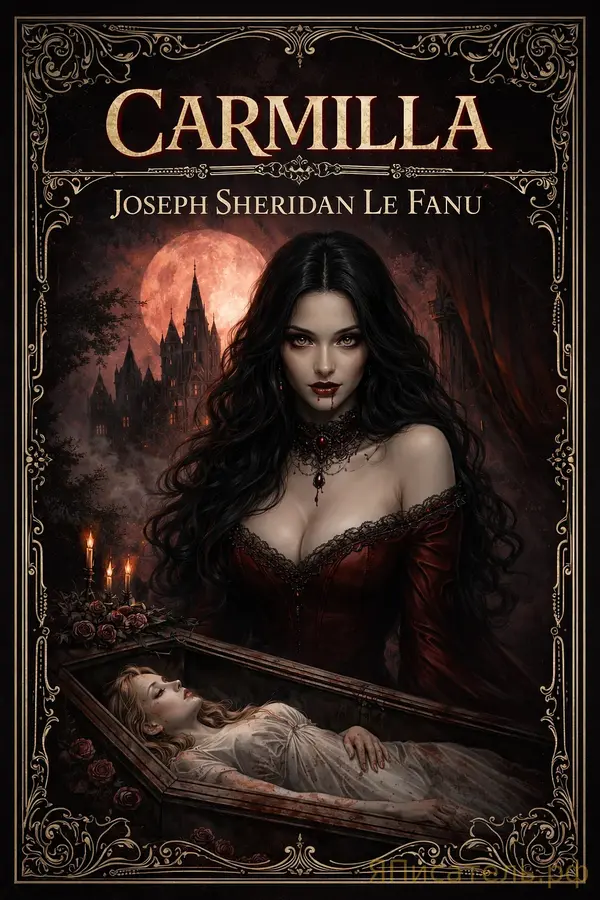
General Book Summary
"Carmilla" is a Gothic horror novella set in the remote, picturesque forests of Styria (Austria), narrated by Laura, a young Englishwoman who lives in an isolated schloss with her widowed father and two governesses, Madame Perrodon and Mademoiselle De Lafontaine. The story begins with Laura recounting a mysterious childhood incident: at age six, she awoke to find a beautiful young woman in her bed who caressed her before seemingly biting her breast. This traumatic experience left an indelible impression, though the adults dismissed it as a dream. Years later, when Laura is nineteen, her father receives devastating news from his friend General Spielsdorf—his ward Bertha Rheinfeldt has died under mysterious circumstances, and the General speaks cryptically of a "fiend" and "monster" responsible for her death. That same evening, a carriage accident near the schloss brings an enigmatic guest into their lives: a beautiful young woman named Carmilla, left in their care by her mysterious mother who claims urgent business prevents her from staying. Laura is immediately struck by Carmilla's extraordinary beauty and experiences a strange sense of recognition—Carmilla is identical to the apparition from her childhood. As Carmilla becomes part of the household, an intense, unsettling relationship develops between the two young women. Carmilla displays peculiar behaviors: she sleeps until afternoon, refuses to discuss her past or family, never prays, and exhibits passionate, almost lover-like affection toward Laura. Meanwhile, Laura begins experiencing disturbing dreams of a large cat-like creature pressing upon her chest and feels her health mysteriously declining. The region becomes plagued by a strange epidemic—young women dying after prolonged, wasting illnesses. When General Spielsdorf arrives and encounters Carmilla, he recognizes her as "Millarca," the creature who killed his niece Bertha under the same pretense of aristocratic hospitality. He reveals that Carmilla is actually Mircalla, Countess Karnstein—a vampire from the extinct noble family whose ruined castle lies nearby. With the help of Baron Vordenburg, a descendant of a man who loved Mircalla in life, they locate her tomb in the Karnstein chapel. Following traditional methods, they destroy the vampire by driving a stake through her heart, decapitating her, and burning the remains. Laura survives but remains haunted by her ordeal, never fully recovering from the psychological trauma of her intimate brush with supernatural evil.
Table of Contents
Book Excerpt
I was anxious on discovering this paper, to reopen the correspondence commenced by Doctor Hesselius, so many years before, with a person so clever and careful as his informant seems to have been. Much to my regret, however, I found that she had died in the interval.
She, probably, could have added little to the Narrative which she communicates in the following pages, with, so far as I can pronounce, such conscientious particularity.
I. An Early Fright
In Styria, we, though by no means magnificent people, inhabit a castle, or schloss. A small income, in that part of the world, goes a great way. Eight or nine hundred a year does wonders. Scantily enough ours would have answered among wealthy people at home. My father is English, and I bear an English name, although I never saw England. But here, in this lonely and primitive place, where everything is so marvelously cheap, I really don’t see how ever so much more money would at all materially add to our comforts, or even luxuries.
My father was in the Austrian service, and retired upon a pension and his patrimony, and purchased this feudal residence, and the small estate on which it stands, a bargain.
Nothing can be more picturesque or solitary. It stands on a slight eminence in a forest. The road, very old and narrow, passes in front of its drawbridge, never raised in my time, and its moat, stocked with perch, and sailed over by many swans, and floating on its surface white fleets of water lilies.
Over all this the schloss shows its many-windowed front; its towers, and its Gothic chapel.
The forest opens in an irregular and very picturesque glade before its gate, and at the right a steep Gothic bridge carries the road over a stream that winds in deep shadow through the wood. I have said that this is a very lonely place. Judge whether I say truth. Looking from the hall door towards the road, the forest in which our castle stands extends fifteen miles to the right, and twelve to the left. The nearest inhabited village is about seven of your English miles to the left. The nearest inhabited schloss of any historic associations, is that of old General Spielsdorf, nearly twenty miles away to the right.
I have said “the nearest _inhabited_ village,” because there is, only three miles westward, that is to say in the direction of General Spielsdorf’s schloss, a ruined village, with its quaint little church,...