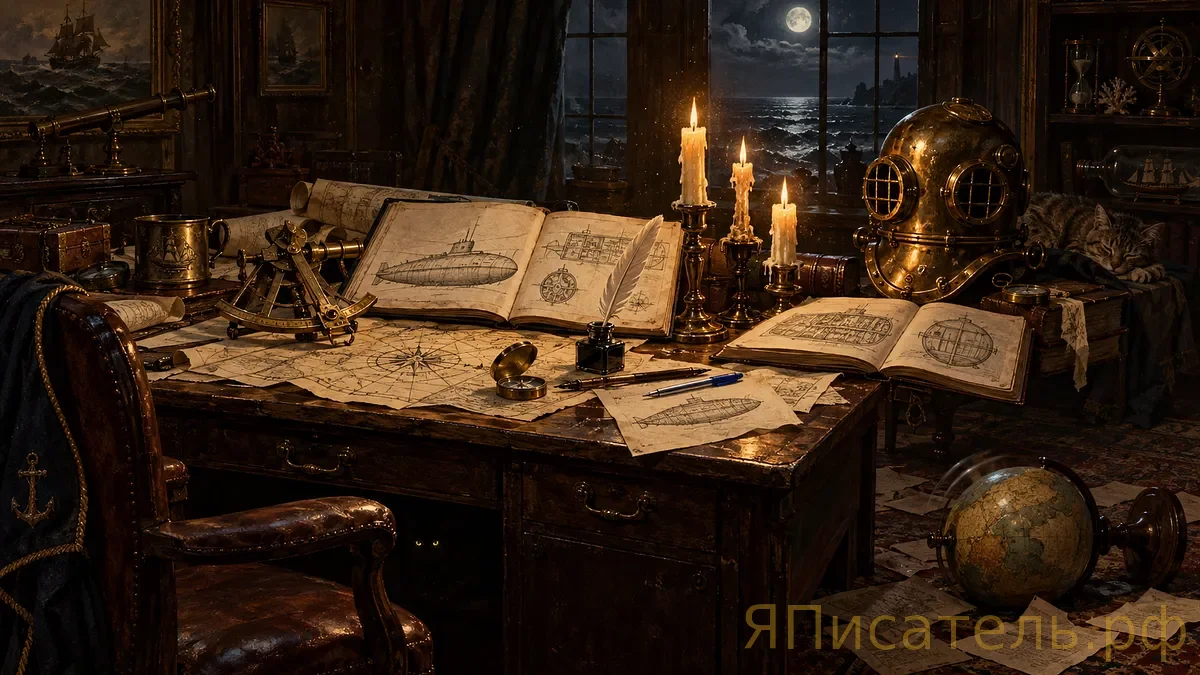
The Man Who Invented the Future — Then Watched It Come True
On February 8, 1828, in the port city of Nantes, a boy was born who would grow up to predict submarines, helicopters, video calls, and space travel — all without a single engineering degree. Jules Verne didn't just write science fiction. He wrote the blueprint for the twentieth century, and the engineers who built it openly admitted they were copying his homework.
Today marks 198 years since Verne's birth, and here's the uncomfortable truth: we still haven't caught up with everything he imagined. But let's start at the beginning, because the origin story is almost too perfect.
Picture this: young Jules, age eleven, sneaks aboard a merchant ship bound for the Indies. He wants adventure so badly he can taste the salt air. His father, a respectable Nantes lawyer named Pierre Verne, catches him at the last port before open ocean and drags him home by the ear. According to family legend, the boy promised his furious father that from then on, he would "travel only in his imagination." Most kids break promises like that within a week. Verne kept his for the rest of his life — and his imaginary travels turned out to be more accurate than most real expeditions.
Here's where it gets wild. Verne's father wanted him to be a lawyer. Jules dutifully went to Paris to study law, passed his exams, and then did what every sensible person does with a law degree — absolutely nothing related to law. He fell in with the literary crowd, befriended Alexandre Dumas (yes, that Dumas, the Three Musketeers guy), and started writing plays that nobody watched. For nearly a decade, Verne was what we'd today call a struggling creative. He worked as a stockbroker to pay the bills. A stockbroker! The man who would invent science fiction spent his twenties doing spreadsheets. Let that sink in next time you feel like your day job is killing your creativity.
The turning point came in 1862 when Verne met publisher Pierre-Jules Hetzel. Verne handed him a manuscript about balloon travel across Africa. Hetzel saw something nobody else had — a writer who could make science thrilling. He signed Verne to an extraordinary contract: two novels per year for twenty years. That's the kind of deal that would make any modern author weep with a mixture of joy and terror. And Verne delivered. Oh, how he delivered.
Let's talk about the big three, because they deserve it. "Journey to the Center of the Earth" (1864) took readers through volcanic tubes into a prehistoric underground world. Absurd? Sure. But Verne packed it with so much real geology and mineralogy that actual scientists wrote him letters debating his theories. "Twenty Thousand Leagues Under the Sea" (1870) gave us Captain Nemo and the Nautilus — a fully electric submarine at a time when real submarines were little more than leaky coffins with hand-cranked propellers. Verne described the Nautilus with such engineering precision that Simon Lake, who built the first successful modern submarine, wrote in his autobiography: "Jules Verne was in a sense the director-general of my life." Let me repeat that. A real submarine inventor credited a novelist as his life's guiding force. That's not literature — that's witchcraft.
Then came "Around the World in Eighty Days" (1873), and this is where Verne proved he was also a marketing genius. The novel was serialized in newspapers, and readers became so obsessed with whether Phileas Fogg would make it in time that they placed actual bets. Gambling houses across Europe set odds on a fictional character's travel schedule. Six years later, journalist Nellie Bly decided to do it for real, completing the journey in 72 days. She stopped in Amiens to visit Verne on her way. He was reportedly delighted and slightly jealous.
But here's what most people miss about Verne, and it's the thing that makes him genuinely terrifying as a prophet. He didn't just predict technology — he predicted the moral problems that would come with it. Captain Nemo isn't Tony Stark. He's a traumatized anti-imperialist who uses his technological superiority to wage a one-man war against colonial powers. In "The Begum's Fortune" (1879), Verne described a weapon of mass destruction — a giant cannon firing poisonous gas shells — decades before World War I made chemical warfare a horrifying reality. His unpublished novel "Paris in the Twentieth Century," written in 1863 but rejected by Hetzel as too depressing, described a future city with glass skyscrapers, high-speed trains, gas-powered automobiles, a worldwide communications network, and a society so obsessed with technology and commerce that art and literature had withered to nothing. Sound familiar? The manuscript was found in a safe in 1989, and when it was finally published in 1994, critics were speechless.
Verne wrote 54 novels in his "Extraordinary Voyages" series. He is the second most translated author in the world, right behind Agatha Christie. He outsells most living authors while being dead for 120 years. His work has been adapted into over 200 films. And yet, for decades, the French literary establishment treated him as a children's writer, unworthy of serious consideration. The Académie Française never admitted him. Critics dismissed him as a mere popularizer of science. It took until the late twentieth century for scholars to recognize what readers had known all along: Verne wasn't just entertaining — he was reshaping how humanity imagined its own future.
There's a melancholy footnote to this story. In 1886, Verne's nephew Gaston, who suffered from mental illness, shot him in the leg. Verne was left with a permanent limp and became increasingly reclusive. His later novels grew darker — less adventure, more pessimism about where technology was taking humanity. He served on the municipal council of Amiens, the quiet provincial city where he'd settled with his wife Honorine, and died there on March 24, 1905. Twenty thousand people attended his funeral. His gravestone in Amiens shows him bursting from his tomb, reaching toward the sky. It's the most on-brand gravestone in literary history.
So, 198 years later, what do we do with Jules Verne? We can start by admitting something slightly humbling: a nineteenth-century Frenchman with no formal scientific training, working by candlelight with ink and paper, imagined our world more accurately than most futurists with supercomputers. He didn't predict the future because he was a genius — although he was. He predicted it because he understood something fundamental about human nature: give us a tool, and we will use it. For wonder. For war. For profit. For escape. Every technology Verne imagined came wrapped in a story about what it would cost us to use it.
The next time someone tells you that fiction doesn't matter, that novels are just entertainment, that stories can't change the real world — point them to the submarine. Point them to the moon landing. Point them to the fact that NASA engineers kept dog-eared copies of Verne on their desks. Then remind them that the most powerful technology humanity ever developed wasn't the rocket or the submarine. It was the story. And nobody understood that better than the boy from Nantes who promised his father he'd only travel in his imagination.
Pega este código en el HTML de tu sitio web para incrustar este contenido.