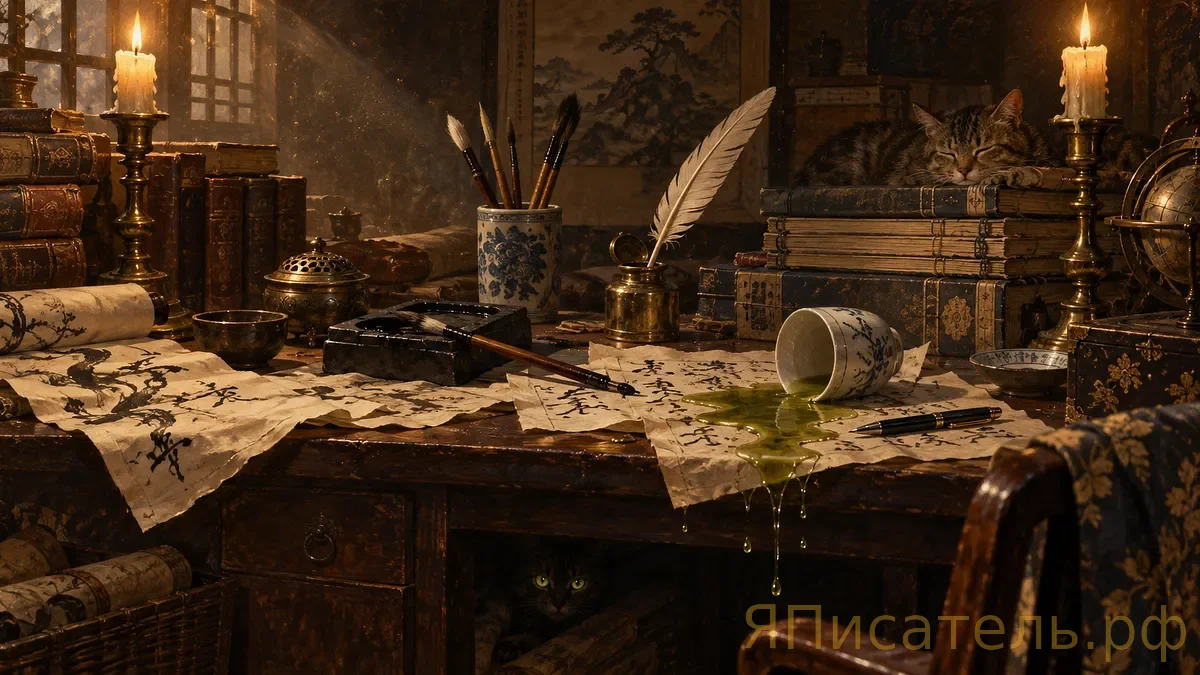
The Man Who Put His Face on Money by Writing from a Cat's Perspective
Imagine telling your bank that the guy on the thousand-yen bill got famous by pretending to be a cat. That's Natsume Soseki for you — a man so brilliantly neurotic that Japan decided to immortalize him on currency. Born 159 years ago today, on February 9, 1867, in Tokyo, Soseki went from being an unwanted child literally given away by his parents to becoming the most important novelist in Japanese history. Not bad for someone who spent two years in London being absolutely miserable.
Let's start with the childhood, because it's the kind of origin story that would make Dickens weep into his porridge. Soseki — born Natsume Kinnosuke — was the youngest of eight children, and his parents apparently decided that was too many. They gave him away to a secondhand goods dealer and his wife when he was barely two years old. He bounced between families, wasn't told who his real parents were for years, and eventually returned to his birth family at age nine, only to find himself caught in a domestic cold war. If you ever wondered where all that existential dread in his novels comes from, well, mystery solved.
But here's where it gets interesting. Despite this emotional trainwreck of a childhood, Soseki became a genuinely brilliant student. He devoured Chinese classics, fell in love with English literature, and eventually landed a government scholarship to study in London from 1900 to 1902. Now, you might think two years in London would be a grand adventure. For Soseki, it was closer to a psychological breakdown. He was isolated, poor, racially marginalized, and increasingly paranoid. His landlords kept changing, his stipend was pathetic, and he spent most of his time locked in his room reading obsessively rather than attending lectures. The Japanese government actually received reports that he'd gone mad. He hadn't — he was just having the worst study-abroad experience in literary history.
And yet, those miserable London years forged something extraordinary. When Soseki returned to Japan, he was a different man — bitter, yes, but armed with a devastating understanding of the collision between Western modernity and Japanese tradition. In 1905, he published "I Am a Cat" (Wagahai wa Neko de Aru), a satirical novel narrated entirely by a nameless, supremely judgmental housecat observing the idiotic behavior of its owner and his intellectual friends. The cat has no name. The cat doesn't need a name. The cat is better than everyone, and it knows it. The novel is essentially what would happen if your most sarcastic friend gained the ability to narrate your life, and it became an immediate sensation.
What made Soseki revolutionary wasn't just his humor — though the man was genuinely funny in a way that most "literary" writers never manage. It was his unflinching willingness to dissect the modern self. Take "Botchan" (1906), his second major hit. On the surface, it's a romp about a brash young Tokyo man who takes a teaching job in the countryside and clashes with provincial hypocrites. It reads fast and fun, almost like a comic novel. But underneath, it's a razor-sharp examination of integrity versus conformity, of what happens when an honest person collides with a system that rewards dishonesty. Botchan loses, by the way. Soseki wasn't in the business of happy endings.
Then there's "Kokoro" (1914), and this is where we need to have a serious conversation. If you've never read "Kokoro," you are missing one of the most devastating novels ever written in any language. I'm not exaggerating. The title means "heart" or "the heart of things," and the novel is structured as a quiet, almost gentle story about a young student who befriends an older man he calls Sensei. For the first two-thirds, you think you're reading a pleasant meditation on mentorship and loneliness. Then Sensei's confession arrives in the final section, and Soseki drives a knife into your chest so cleanly that you don't even realize you're bleeding until the last page. It deals with betrayal, guilt, the impossibility of true human connection, and the weight of secrets — all set against the backdrop of Emperor Meiji's death and the ritual suicide of General Nogi, which marks the symbolic death of old Japan. It is flawless. It is ruthless. It will ruin your afternoon.
What set Soseki apart from his contemporaries was his refusal to choose sides in the great cultural war of Meiji-era Japan. While other writers either embraced Western modernization wholesale or retreated into nostalgic nationalism, Soseki stood in the uncomfortable middle, pointing out that both paths led to alienation. His later works — the trilogy of "Sanshiro," "And Then," and "The Gate" — trace an increasingly dark arc of individuals crushed between tradition and modernity, duty and desire. He wasn't anti-Western or anti-Japanese. He was anti-delusion, which made him unpopular with pretty much everyone who had a simple answer to complicated questions.
Soseki also understood something about loneliness that most writers only pretend to grasp. His characters aren't lonely because they lack company. They're lonely because genuine connection requires a vulnerability that modern life has made impossible. In "The Gate," a married couple who committed a terrible betrayal to be together live in quiet, loving suffocation — they have each other, yet they're more isolated than if they were alone. Soseki saw that modernity's great trick wasn't taking people away from each other; it was putting them side by side while making real intimacy unachievable.
His influence on Japanese literature is almost impossible to overstate. Soseki essentially created the modern Japanese novel. Before him, Japanese fiction was dominated by the "I-novel" (watakushi shōsetsu), a confessional, autobiographical form that Soseki found narcissistic and artistically limiting. He insisted on crafted plots, complex characters, and thematic architecture — the stuff that Western readers take for granted but that was genuinely revolutionary in early twentieth-century Japan. Writers like Akutagawa Ryunosuke, Kawabata Yasunari, and even Haruki Murakami exist in his shadow, whether they acknowledge it or not.
Soseki died on December 9, 1916, at just forty-nine, from a stomach ulcer that had plagued him for years. He was working on a novel called "Light and Darkness" (Meian), which many scholars believe would have been his masterpiece. It remains unfinished — 188 chapters of brilliance that simply stop. His death was front-page news across Japan, and his face eventually appeared on the thousand-yen note from 1984 to 2004, making him literally the face of Japanese commerce for two decades.
Here's what stays with me about Soseki, 159 years after his birth: he wrote about loneliness not as a condition to be cured but as the fundamental texture of modern existence. He didn't offer solutions or comfort. He offered recognition — the strange, painful relief of reading someone who sees exactly how alone you are and doesn't pretend otherwise. In a world that's only gotten lonelier since 1916, that's not just literature. That's a lifeline disguised as a novel about a cat.
Pega este código en el HTML de tu sitio web para incrustar este contenido.