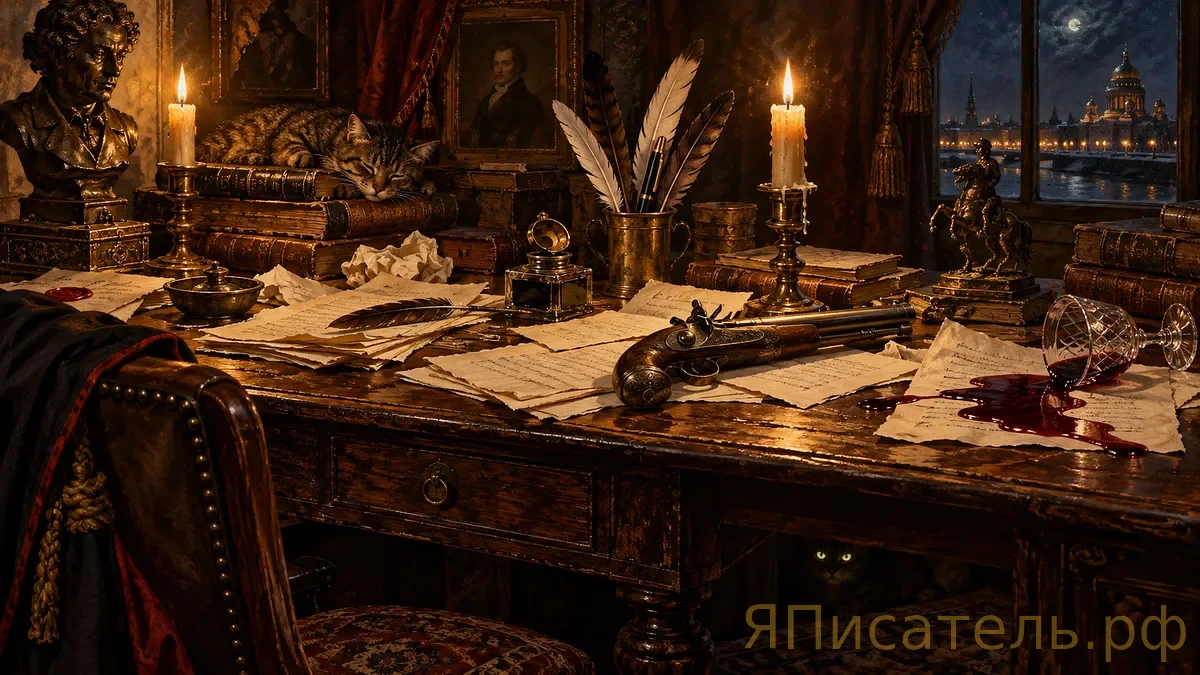
Pushkin Died 189 Years Ago — And Still Writes Better Than You
On February 10, 1837, Alexander Pushkin bled out on a couch after a duel over his wife's honor. He was 37. That's younger than most people when they finally get around to reading him. And yet, nearly two centuries later, this man's ghost has a firmer grip on world literature than most living authors could dream of. Here's the uncomfortable truth: Pushkin invented modern Russian literature the way Steve Jobs invented the smartphone — not from scratch, but by making everything before him look embarrassingly primitive.
Let's start with the elephant in the room: most English-speaking readers have never properly read Pushkin. They've heard the name, maybe nodded along when someone mentioned "Eugene Onegin," and moved on to their Dostoevsky phase. This is a tragedy on par with loving Italian food but never having tried actual pasta in Italy. You think you get it, but you absolutely do not. Pushkin in translation is like listening to jazz through a wall — you catch the rhythm, you miss the soul.
But let's talk about what even the wall can't muffle. "Eugene Onegin" — a novel in verse, which sounds like the most pretentious thing imaginable until you realize Pushkin pulled it off with the effortless cool of someone who knows they're the smartest person in the room but refuses to be boring about it. Written between 1823 and 1831, it tells the story of a jaded aristocrat who rejects a young woman's love, only to fall desperately for her years later when she's moved on. Sound familiar? That's because every romantic comedy you've ever watched stole this plot. Every single one. Pushkin didn't just write a love story; he wrote THE love story, the template, the original code that Hollywood has been copy-pasting for decades.
What makes Onegin terrifying in its brilliance is the Onegin stanza — 14 lines of iambic tetrameter with a rhyme scheme so intricate it makes sonnets look like limericks. Pushkin maintained this structure for over 5,000 lines while keeping the tone conversational, witty, and devastatingly human. Tchaikovsky turned it into an opera. Scholars have spent careers dissecting it. And somewhere, a 25-year-old Pushkin was probably just having fun.
"The Captain's Daughter" is where Pushkin decided to casually invent the Russian historical novel. Published in 1836, just a year before his death, it's set during the Pugachev Rebellion of 1773-1775 — a massive peasant uprising that the Russian government would have preferred everyone forgot about. Pushkin didn't forget. He researched it obsessively, traveled to the actual locations, interviewed survivors, and then wrapped the whole bloody mess in a coming-of-age love story that reads like an adventure novel. Walter Scott was doing similar things in Britain, sure, but Pushkin did it with fewer pages and more danger. The man literally had to get government permission to access the archives. Writing historical fiction in tsarist Russia wasn't a hobby; it was an act of quiet rebellion.
And then there's "The Queen of Spades" — a short story so perfectly constructed it should be studied in engineering schools. Published in 1834, it's about a young officer named Hermann who becomes obsessed with discovering an old countess's secret to winning at cards. It's got gambling, madness, ghosts, and a twist ending that M. Night Shyamalan wishes he'd thought of. In about 30 pages, Pushkin created a psychological thriller that anticipated Dostoevsky's explorations of obsession by three decades. Prokofiev made it into an opera. It's been adapted into films at least a dozen times. The story is so tight, so ruthlessly efficient, that it makes you angry at every bloated 400-page thriller sitting on airport bookshelves today.
Here's what connects all three works, and what makes Pushkin's legacy genuinely dangerous: he respected his readers' intelligence. He never explained too much. He never sentimentalized. He trusted you to catch the irony, feel the heartbreak, and understand the political subtext without being beaten over the head with it. In an era of literature that often drowned in Romantic excess and melodrama, Pushkin wrote with the precision of a surgeon and the warmth of a best friend. That combination is rarer than you think.
The influence is everywhere once you start looking. Dostoevsky openly worshipped him. Tolstoy's "Anna Karenina" opens with a direct echo of Onegin's themes. Turgenev, Gogol, Chekhov — they all grew in the garden Pushkin planted. But it goes beyond Russia. Pushkin's narrative techniques — the unreliable narrator flirtations, the metafictional asides, the mixing of high and low registers — these are tools that modern literature takes for granted. When a contemporary novelist breaks the fourth wall or lets their narrator crack a joke mid-tragedy, they're speaking Pushkin's language whether they know it or not.
There's also the uncomfortable biographical dimension. Pushkin was of African descent — his great-grandfather, Abram Gannibal, was brought from Africa to the court of Peter the Great. In the rigidly hierarchical, deeply racist aristocratic world of 19th-century Russia, Pushkin turned his heritage into a source of fierce pride while simultaneously becoming the most celebrated literary figure in the empire. He didn't transcend his identity; he weaponized it. His unfinished novel "The Moor of Peter the Great" directly addressed his ancestor's story. In 2026, when conversations about representation in literature have finally become mainstream, Pushkin's biography reads like a radical manifesto written 200 years early.
The duel that killed him was, in its way, the most Pushkin thing possible. Georges d'Anthès, a French officer, had been publicly pursuing Pushkin's wife, Natalia. Anonymous letters mocked Pushkin as a cuckold. Rather than ignore the gossip like a sensible person, Pushkin chose to defend his honor with pistols in the snow. He was shot in the abdomen and died two days later. It was stupid, it was tragic, it was impossibly romantic, and it was exactly the kind of ending one of his own characters might have faced — which is either poetic justice or proof that life plagiarizes from art far more often than the other way around.
So here we are, 189 years after a bullet in the gut silenced the voice that taught an entire civilization how to speak. The question isn't whether Pushkin is still relevant — that's like asking whether oxygen is still useful. The question is whether we're brave enough to actually read him, not as a dusty monument on a school syllabus, but as what he actually was: a young, furious, brilliant troublemaker who happened to write in verse. Pick up "The Queen of Spades" tonight. It'll take you an hour. And I promise you — you'll spend the rest of the week wondering why nobody writes like that anymore.
Pega este código en el HTML de tu sitio web para incrustar este contenido.