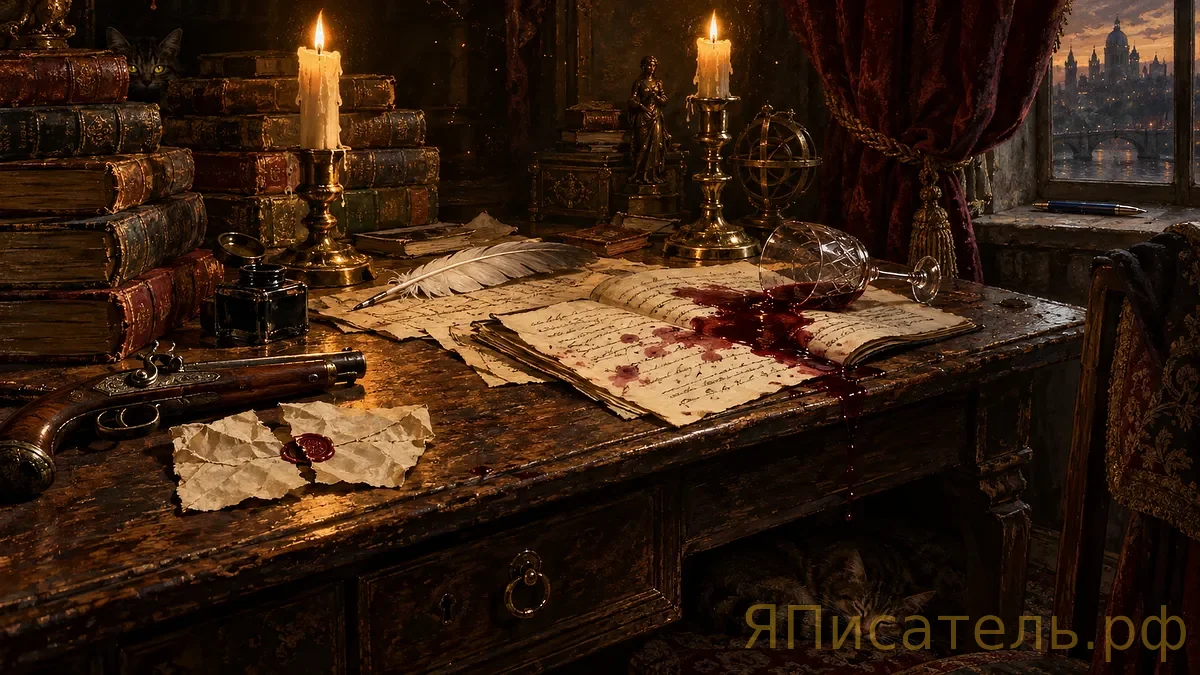
Pushkin Died in a Duel at 37 — And Still Writes Better Than You
On February 10, 1837, Alexander Pushkin bled out on a couch after taking a bullet to the gut in a duel over his wife's honor. He was thirty-seven. By that age, most of us have accomplished precisely nothing that will be remembered in two centuries. Pushkin had already invented modern Russian literature, written a novel in verse that makes grown men weep, and created characters so alive they've been arguing with readers for nearly two hundred years.
Here's the uncomfortable truth: 189 years after his death, Pushkin is more relevant than ninety percent of what's on your bookshelf right now. And if that offends you, good — keep reading.
Let's start with "Eugene Onegin," the novel in verse that shouldn't work but absolutely does. Imagine someone today pitching this to a publisher: "So it's a love story, but in poetry, and the hero is a bored aristocrat who rejects the girl, kills his best friend in a duel, then comes crawling back years later only to get rejected himself." Any sane editor would say pass. But Pushkin pulled it off with such grace, such devastating psychological precision, that Tchaikovsky turned it into an opera, and university professors have been dissecting it ever since like it's some kind of literary genome.
What makes Onegin terrifyingly modern is that its protagonist is essentially the first literary fuckboy. He's educated, charming, emotionally unavailable, and pathologically incapable of recognizing a good thing until it's gone. Sound familiar? Scroll through any dating advice subreddit and you'll find thousands of Onegins and Tatianas posting their sad little stories, completely unaware that a Russian poet diagnosed their exact problem in 1833. Pushkin didn't just write a character — he wrote a personality type that has haunted every generation since.
Then there's "The Captain's Daughter" — Pushkin's historical novel about the Pugachev Rebellion of the 1770s. On the surface, it's an adventure story: young officer, forbidden love, a charismatic rebel leader. But underneath, it's asking a question that no era has managed to answer satisfactorily: What do you owe to authority, and when does loyalty become cowardice? Pushkin wrote this while the Russian Empire was tightening its grip on everything, and he managed to portray the rebel Pugachev with such humanity that the censors didn't quite know what to do. The villain is the most compelling person in the book. That's not accidental — that's genius-level subversion.
And speaking of subversion, let's talk about "The Queen of Spades." This one is a masterpiece of psychological horror disguised as a gambling story. Hermann, the protagonist, is obsessed with discovering a secret three-card combination that guarantees winning at faro. He manipulates an old countess, she dies of fright, her ghost may or may not visit him with the secret, and — spoiler for a story published in 1834 — it all goes spectacularly wrong. Dostoevsky read this and basically built his entire career on the foundation Pushkin laid. "Crime and Punishment" is, in many ways, "The Queen of Spades" with more pages and more suffering.
What's remarkable about these three works taken together is how completely they map the territory of human weakness. Onegin is about emotional cowardice. "The Captain's Daughter" is about moral cowardice. "The Queen of Spades" is about intellectual arrogance. Pushkin understood that people don't fail because they're stupid — they fail because they're brilliant enough to construct elaborate justifications for their worst impulses. If that's not a description of the twenty-first century, I don't know what is.
Now, you might be thinking: "Sure, but he's a Russian writer. What does he have to do with me?" And that's where you'd be dead wrong. Pushkin's influence bleeds across every border. Tchaikovsky's operas based on his works are performed in every major opera house on the planet. Mussorgsky's "Boris Godunov" — Pushkin. The entire tradition of the Russian novel that gave us Tolstoy, Dostoevsky, Chekhov, and Bulgakov — Pushkin started it. When Dostoevsky said "We all came out of Gogol's 'Overcoat,'" he conveniently forgot to mention that Gogol came out of Pushkin's coat pocket.
But influence on other writers is the boring answer. The real legacy is simpler and stranger: Pushkin taught literature how to be honest without being heavy. Before him, Russian writing was either stiff odes to the tsar or clumsy imitations of French novels. Pushkin wrote in the language people actually spoke. He made poetry feel like conversation. He made novels feel like confessions whispered at three in the morning. Every writer who's ever tried to be "authentic" on the page is, whether they know it or not, following a trail Pushkin blazed.
There's also the matter of his death, which has become the stuff of myth. Georges-Charles de Heeckeren d'Anthès, a French officer adopted by a Dutch diplomat, had been publicly flirting with Pushkin's wife Natalia. Anonymous letters mocked Pushkin as a cuckold. He challenged d'Anthès to a duel. D'Anthès shot first and hit Pushkin in the abdomen. Pushkin, lying in the snow, managed to fire back and wound d'Anthès, but it wasn't enough. He died two days later. The tsar allegedly paid off his debts and provided for his family — a magnanimous gesture somewhat undercut by the fact that the tsar's own secret police had been surveilling Pushkin for years.
The duel itself has become a metaphor for what happens when a society destroys its geniuses. Russia has a particular talent for this — see also: Lermontov (duel), Mayakovsky (suicide under political pressure), Mandelstam (gulag), Bulgakov (censorship unto death). But Pushkin was the prototype. He showed that a country could simultaneously worship a poet and make his life impossible.
So here we are, 189 years later. Pushkin's been dead longer than most nations have existed. And yet Tatiana's letter to Onegin still makes people cry. Hermann's madness still sends a chill down the spine. Pugachev's rough charisma still raises uncomfortable questions about who the real villains are in any given revolution. The man wrote with a quill pen by candlelight, died before the invention of the telegraph, and somehow managed to describe your emotional life with more accuracy than your therapist.
If that doesn't make you want to pick up one of his books tonight, I genuinely don't know what will. But do yourself a favor — start with "The Queen of Spades." It's short, it's savage, and it will ruin gambling for you forever. Which, honestly, is a public service.
Pega este código en el HTML de tu sitio web para incrustar este contenido.