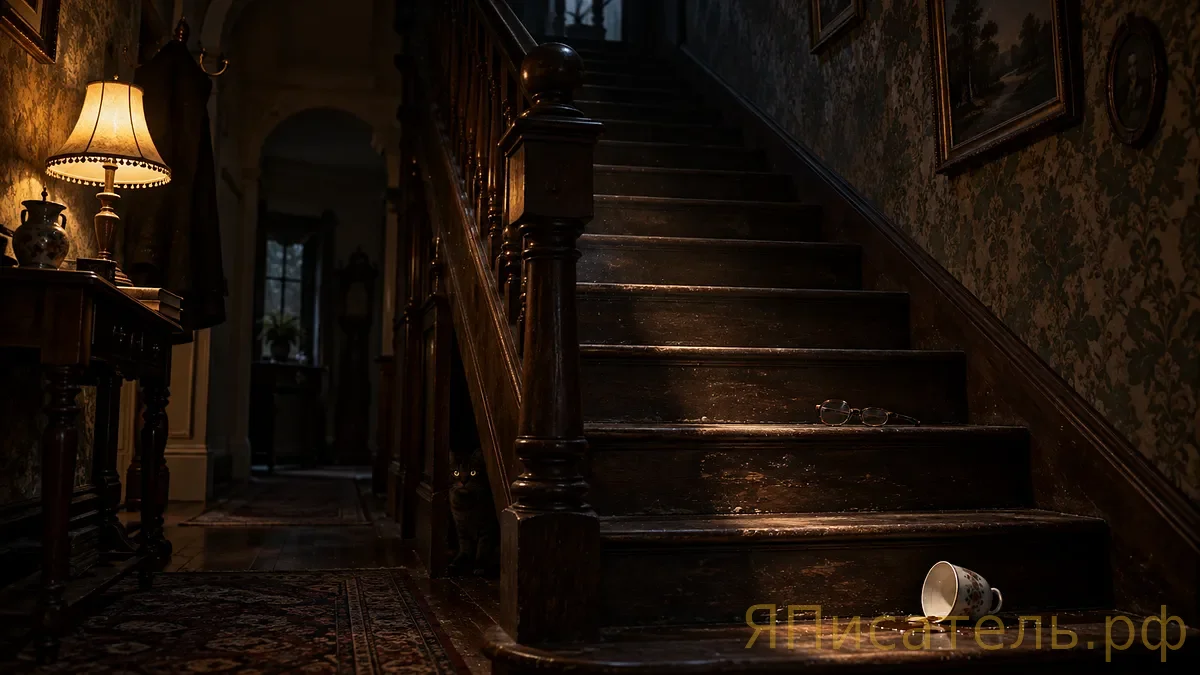
The Staircase That Grew
Our new house had seventeen stairs leading to the second floor. I counted them the day we moved in because my daughter Lily insisted. She was six, and counting things was her favorite game. Seventeen stairs. I remember because she sang each number as she climbed, her small hand gripping the oak banister, her voice echoing in the bare hallway.
That was a Saturday.
By Wednesday, there were eighteen.
I didn't notice at first. You don't count stairs every day. But Lily noticed. She always noticed. She came to me in the kitchen, tugging at my sleeve, her face scrunched in that way she had when a puzzle didn't fit together.
"Daddy, the stairs are wrong."
"What do you mean, sweetheart?"
"There's one more. There's eighteen now."
I laughed. I actually laughed. I told her she must have miscounted the first time. She shook her head with the absolute certainty that only children possess, but I ruffled her hair and went back to unpacking boxes. The house was old—built in 1891, the realtor had said—and old houses settle. They creak. They shift. They do not, however, grow additional stairs.
Except ours did.
By Friday, there were nineteen. I counted them myself this time, standing at the bottom with my coffee going cold in my hand. Nineteen. I went back down and counted again. Nineteen. The new stairs weren't obvious. They didn't look new. They had the same dark oak, the same worn edges, the same faint groove in the center where a century of footsteps had softened the wood. They looked as though they had always been there.
But they hadn't.
I called a contractor. He came out on Monday, a thick-necked man named Dale who smelled like sawdust and chewing tobacco. He measured the staircase, consulted the original blueprints I'd found in the basement, and frowned.
"Plans say seventeen," he said. "I'm counting twenty."
"Twenty?" My stomach dropped. It had been nineteen two days ago.
"Could be a renovation that wasn't documented," Dale offered, but he didn't sound convinced. He kept running his hand along the banister, feeling the wood. "Thing is, these stairs are all original. Same wood, same joinery, same finish. Nobody added these later. These have been here since 1891."
"They weren't here last week."
Dale looked at me for a long time. Then he packed up his tools, refused payment, and left without another word. He didn't return my calls after that.
I started keeping a journal. Every morning, before anything else, I would count the stairs.
Monday: 20
Tuesday: 20
Wednesday: 21
Thursday: 21
Friday: 23
Two in one day. They were accelerating.
The staircase itself didn't look longer. That was the part that made my skin crawl. The distance from the first floor to the second floor hadn't changed. The ceiling was the same height. But somehow, more stairs fit into the same space. Each step was just slightly shorter, slightly narrower than the day before. The angle of ascent steepened so gradually that you wouldn't notice unless you were paying attention.
But your body noticed. By the time there were twenty-five stairs, climbing to the second floor left me slightly winded. Not from the extra steps—there was no extra distance—but from something else. A heaviness that settled on your shoulders around step fifteen and grew with each subsequent stair. Like the air was thicker up there. Like something was pressing down on you, testing how much weight you could carry.
Lily stopped counting the stairs. She stopped singing when she climbed them. She would stand at the bottom, staring up, her small body rigid, and then she would run—fast, panicked, taking two at a time until she reached the top, where she would gasp and shake like a wet cat.
"I don't like the middle part," she whispered one night when I was tucking her in.
"What about the middle part?"
"It listens."
I told myself she was being imaginative. Children are imaginative. But that night, I stood in the middle of the staircase—step sixteen of what was now twenty-seven—and I held still. I held my breath. The house was quiet. The street outside was quiet. Everything was quiet except for a sound so faint I might have imagined it.
Breathing.
Not mine. I was holding my breath. Not Lily's—her room was at the far end of the hall. This breathing came from the stairs themselves. From beneath them, or within them, or between them—from some space that shouldn't exist but somehow did, a space that was growing every day, step by step, making room for itself inside the geometry of my home.
I ran. I'm not ashamed to admit it. I ran up the remaining stairs and shut myself in my bedroom and sat on the edge of the bed with the lights on until dawn.
Thirty stairs by the following Tuesday.
I called the previous owners. The number was disconnected. I called the realtor, who said the house had been empty for eleven years before I bought it. I asked why.
"The family moved out suddenly," she said. "Left most of their things. It happens sometimes."
"Did they say why?"
A pause. "The wife said the house was getting bigger inside. We assumed she meant it felt spacious." Another pause. "She was very insistent about the phrasing, though. Not that it felt bigger. That it was getting bigger. That it was making room."
"Making room for what?"
"She didn't say. They moved to Arizona. I think she wanted to live somewhere flat."
Somewhere flat. Somewhere without stairs.
I started sleeping downstairs. I moved Lily down too, set up a mattress in the living room, told her it was an adventure, like camping. She didn't argue. She hadn't gone upstairs voluntarily in a week.
But here's the thing about avoidance: it only works if the thing you're avoiding stays where it is.
Thirty-five stairs now. And the staircase was no longer content to remain between the first and second floors.
I found a new step at the bottom—below the first floor. It went down into what should have been the foundation but was instead a darkness so complete it seemed to have texture, like velvet, like fur. I shone a flashlight into it and the beam didn't penetrate. It just stopped, as if the darkness had a surface.
And the breathing was louder.
Not just from the stairs anymore. From the walls. From the space behind the plaster, which I now understood was not insulation and wooden framing but something else—an architecture that existed parallel to my own, growing inside it like a vine inside a tree, and the stairs were not stairs at all but a spine, and the house was not a house but a shell, and what lived inside the shell was waking up, step by step, and each new stair was a vertebra clicking into place.
Forty stairs.
I write this from a motel room sixty miles away. Lily is asleep beside me. We left everything behind. I don't care. Let it have the furniture, the clothes, the boxes we never finished unpacking.
But I need to tell you something, and I need you to understand that I am not crazy and I am not making this up.
Before we left, I stood in the front yard and looked at the house. Our house. And the roofline was higher than it should have been. Not by much. Maybe a foot. Maybe two. As if the house was slowly straightening, slowly standing up, and the stairs inside were the reason—each new step pushing the structure upward, like something unfolding, something that had been crouched and compressed for a very long time and was now, finally, stretching.
We've been at the motel for three days.
This morning, Lily pulled at my sleeve.
"Daddy."
"What is it, sweetheart?"
"Count the stairs."
The motel is one story. There are no stairs. There is no staircase. There is no second floor.
But Lily was pointing at the wall beside the bathroom. And I looked. And at the base of the wall, where the carpet met the baseboard, there was a step.
One small, dark oak step.
With a faint groove worn in its center.
As though someone—or something—had been walking on it for a very, very long time.
将此代码粘贴到您网站的HTML中以嵌入此内容。