Pushkin Died 189 Years Ago — And He Still Writes Better Than You
On February 10, 1837, Alexander Pushkin bled out on a couch from a bullet wound inflicted by a French dandy who was flirting with his wife. He was 37 years old. That's younger than most people when they finally get around to writing their first novel. And yet, in those 37 years, Pushkin managed to essentially invent modern Russian literature, write a novel in verse that still makes grown men weep, and create characters so alive they walked right off the page and into the DNA of world culture.
Here's the thing that should genuinely bother every living writer: Pushkin's work hasn't aged. Not in the way Shakespeare hasn't aged — preserved under glass in universities, dutifully studied and rarely enjoyed. No, Pushkin is still genuinely, viscerally relevant. His characters still walk among us. His themes still hit where it hurts.
Let's start with *Eugene Onegin*, because it's the one that changed everything. On the surface, it's a love story: bored aristocrat rejects earnest country girl, regrets it later, gets rejected himself. Sounds like every romantic comedy ever made, right? That's precisely the point. Pushkin didn't just write that plot — he *invented* it. Every time you watch a film where the cynical, too-cool protagonist realizes too late that they let the real thing slip away, you're watching a variation on Onegin. The "superfluous man" — that brooding, intelligent, emotionally crippled male lead — became a literary archetype that infected Russian literature for a century and Western pop culture forever. Every tortured antihero from Pechorin to Don Draper owes Pushkin a royalty check.
But here's what makes *Onegin* truly wild: it's a novel written entirely in verse. Fourteen-line stanzas, iambic tetrameter, with a rhyme scheme Pushkin invented specifically for this work — the "Onegin stanza." He basically said, "I'm going to write a 400-page novel, but I'm going to make it harder for myself by doing it in poetry, and oh, by the way, I'll invent a new poetic form while I'm at it." The sheer audacity is staggering. And the result reads not like a stiff literary exercise but like someone talking to you — witty, digressive, self-aware. Pushkin breaks the fourth wall constantly, comments on his own writing, argues with his characters. He was doing metafiction in the 1820s, a full century before it became fashionable.
Now, *The Captain's Daughter*. If *Onegin* is Pushkin the poet showing off, this is Pushkin the storyteller operating with surgical precision. It's a historical novel set during the Pugachev Rebellion of 1773, and it reads like an adventure film — duels, sieges, a young officer torn between duty and love, a charismatic rebel leader who's equal parts terrifying and magnetic. Walter Scott was the king of the historical novel at the time, and Pushkin basically walked into his territory and outdid him in a fraction of the pages. Where Scott sprawled, Pushkin compressed. Every scene earns its place. Every character is drawn in a few strokes that somehow feel more complete than Scott's elaborate portraits. Hemingway, who famously admired Russian literature, would have recognized a kindred spirit in this economy of language.
What's remarkable about *The Captain's Daughter* is how it treats its villain — or rather, refuses to make him one. Pugachev, the rebel leader, is brutal and dangerous, but also generous, funny, and weirdly honorable. Pushkin doesn't moralize. He shows you a complicated human being and trusts you to handle the ambiguity. In an era when historical novels were basically propaganda with better prose, this was revolutionary. It's the same moral complexity we now demand from prestige television, and Pushkin was doing it in 1836.
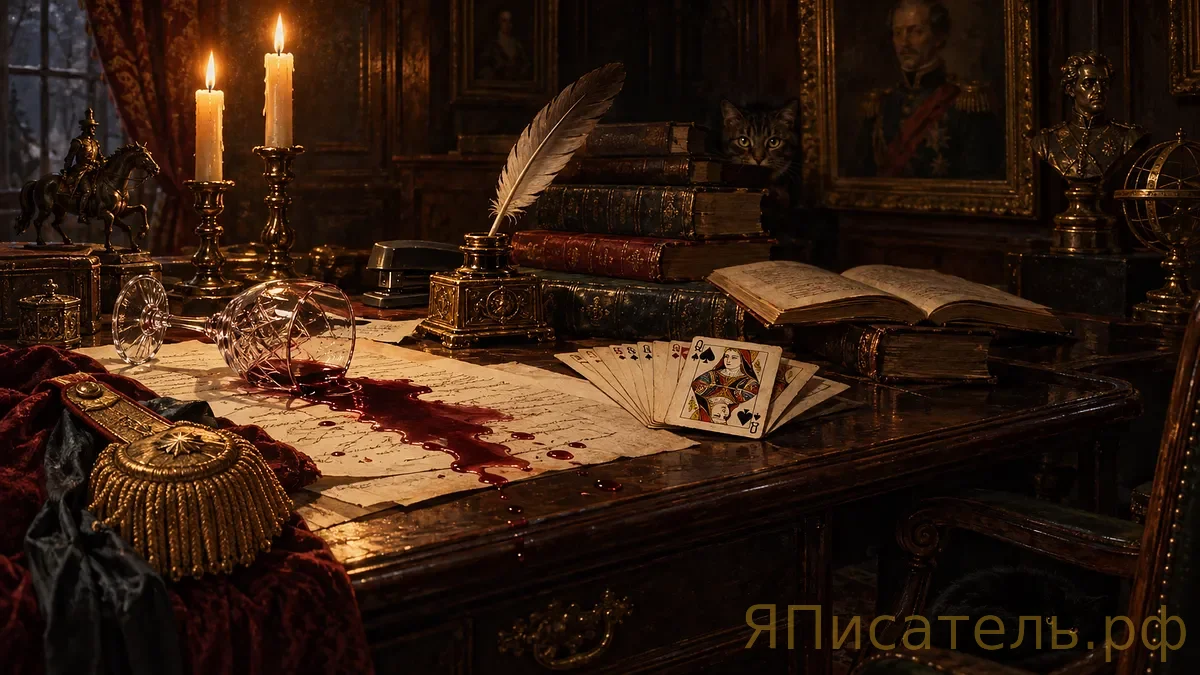
Then there's *The Queen of Spades*, and if you haven't read it, stop reading this article and go fix that. It's short — barely a novella — and it's perfect. An obsessive young officer becomes convinced that an ancient countess knows a secret card combination that guarantees winning at faro. He seduces her ward to gain access to the old woman, confronts her, she dies of fright, and then her ghost visits him with the secret. He plays the cards, wins twice, and on the third hand draws the queen of spades instead of the ace — and sees the dead countess winking at him from the card. He goes insane.
It's a ghost story. It's a psychological thriller. It's a savage commentary on greed and obsession. It's all of these things in about forty pages. Tchaikovsky turned it into an opera. Countless filmmakers have adapted it. The image of that winking queen has haunted readers for nearly two centuries. And the genius of it is that Pushkin never tells you whether the supernatural element is real or whether Hermann — the protagonist — is simply losing his mind. That ambiguity is the engine of the story, and it's a technique that writers from Henry James to Shirley Jackson would later make their own.
So why does Pushkin still matter, 189 years after a pointless duel snuffed out his life? It's not just because he was first, though he was. It's not just because he was brilliant, though he was that too. It's because he was *modern* in a way that his contemporaries weren't. He wrote about real emotions in real language. He distrusted pomposity. He had a sense of humor about himself and his art. He understood that a story could be entertaining and profound at the same time — that these weren't opposing qualities but complementary ones.
Every year, Russian schoolchildren memorize his verses, and every year, some of them actually fall in love with literature because of it. That's not a small thing. Dostoyevsky, Tolstoy, Chekhov, Bulgakov — they all grew up reading Pushkin, and they all acknowledged him as the foundation. Without Pushkin, the entire tradition of Russian literature — arguably the richest national literature in the world — looks fundamentally different. Maybe it doesn't exist at all.
Here's the final irony, and it's a cruel one. Georges d'Anthès, the man who killed Pushkin, lived to be 83. He went on to have a perfectly comfortable life as a French senator. He is remembered for exactly one thing: pulling the trigger. Meanwhile, Pushkin — dead at 37, buried in a country churchyard — became immortal. D'Anthès fired a bullet. Pushkin fired back with *Eugene Onegin*, *The Queen of Spades*, and *The Captain's Daughter*. Ask yourself: who won that duel?
将此代码粘贴到您网站的HTML中以嵌入此内容。