The Mirror Shows Tomorrow
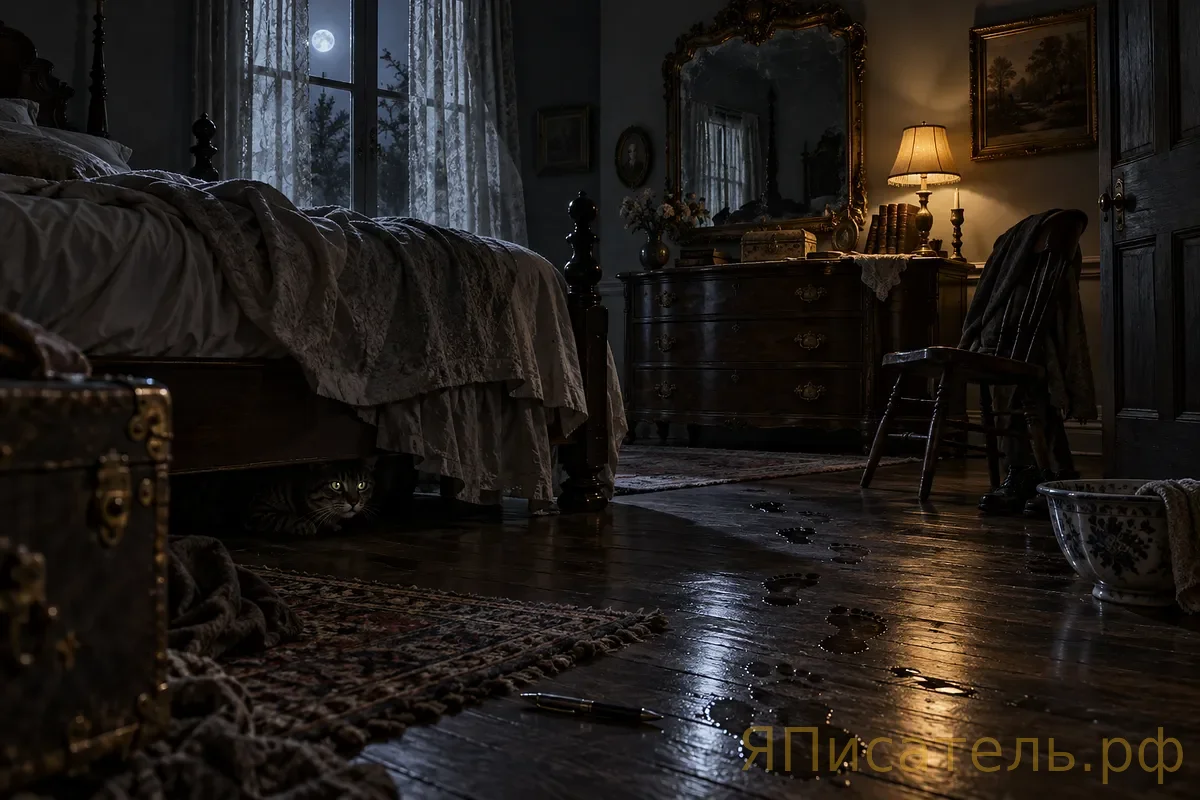
I bought the antique mirror at an estate sale for twenty dollars. The old woman running the sale looked relieved when I handed her the money, almost grateful, as if I'd taken something terrible off her hands. "It belonged to my mother," she said, not meeting my eyes. "She stopped looking into it three days before she died." I should have asked why. I should have walked away. Instead, I loaded it into my car and brought it home to hang in my bedroom, directly across from my bed.
The first night, I noticed nothing unusual. The mirror reflected my room perfectly—the rumpled sheets, the stack of unread books on my nightstand, the cat sleeping at the foot of my bed. But on the second night, I woke at exactly 3:17 AM with the inexplicable certainty that something was wrong.
Moonlight streamed through my curtains, illuminating the mirror's surface. I sat up and looked at my reflection. Everything seemed normal at first. My own face, pale and sleep-creased, stared back at me. My bedroom behind me, ordinary and still.
Then I noticed the book.
On my nightstand, I had three books stacked. But in the mirror's reflection, there were only two. The third—a novel I'd been reading for weeks—was gone. I turned to look at my actual nightstand. Three books, exactly as I'd left them.
I told myself it was a trick of the light. The angle. My tired eyes playing games in the darkness. I went back to sleep.
The next morning, I couldn't find the book anywhere. I searched my entire apartment, under the bed, behind the furniture, in rooms I hadn't even entered in days. It had simply vanished. I remembered the missing reflection and felt the first cold finger of unease trace down my spine.
That night, I stayed awake, watching the mirror. At 3:17 AM, I saw it happen. My reflection moved before I did. Just slightly—a turn of the head, a shift of the shoulders—while I remained perfectly still. And in the mirror's version of my room, the lamp on my dresser was lying on its side, broken.
I looked at my actual lamp. Intact. Upright. Fine.
I couldn't sleep after that. I sat rigid in my bed, staring at that lamp until dawn bled through my curtains. When I finally allowed myself to relax, to move, to breathe, I stood up too quickly and my elbow caught the lamp, sending it crashing to the floor.
The shade dented. The bulb shattered. It lay on its side, broken, exactly as the mirror had shown.
The mirror didn't reflect the present. It showed what would happen next.
I should have destroyed it then. I should have smashed it into a thousand pieces and buried the fragments. But I was curious. Foolishly, dangerously curious. I began checking the mirror every night at 3:17, comparing its reflection to my reality, cataloging the differences.
Small things at first. A coffee cup that would break the next day. A drawer left open that I would forget to close. My cat sleeping in a different spot. Each time, within twenty-four hours, reality caught up to the reflection.
Then the differences became larger.
One night, I looked into the mirror and saw a crack running across my bedroom window. The next afternoon, a bird struck the glass at full speed, leaving that exact fracture behind. Another night, the mirror showed my front door standing wide open. I woke the next morning to discover I'd forgotten to lock it, and it had blown open in the wind.
I became obsessed with checking the mirror, with knowing what was coming. It felt like power—the ability to see the future, even if only in fragmentary glimpses. I stopped sleeping. I stopped eating properly. I stopped leaving my apartment. All I did was wait for 3:17 AM and stare into that antique glass.
Two weeks after I bought the mirror, I looked into it and saw something that stopped my heart.
My reflection was gone.
The bedroom was there—the bed, the books, the curtains, everything in its proper place. But where I should have been standing, there was only empty space. A bedroom without an occupant. A bed that would go unslept in.
I stumbled backward, gasping. When I looked again, my reflection had returned, pale and terrified, mirroring my panic perfectly. But I had seen it. The empty room. The space where I should have been.
The mirror was showing me tomorrow. And tomorrow, I wouldn't be there.
I tried to leave. I grabbed my keys, my coat, anything I could carry, and ran for the door. But my hands shook so badly I couldn't work the lock. My legs felt weak, disconnected from my body. A wave of dizziness crashed over me, and I collapsed against the door, sliding to the floor.
I must have passed out. When I opened my eyes, I was back in my bedroom. In bed. As if I had never moved at all.
The clock on my nightstand read 3:16 AM.
I sat up slowly, my entire body trembling. The mirror hung on the wall, its surface dark and still. One minute until the reflection would change. One minute until I would see what tomorrow held.
I didn't want to look. I couldn't look. But my body moved without my permission, swinging my legs over the side of the bed, standing, walking toward that terrible glass.
3:17 AM.
I looked into the mirror and saw my bedroom, perfect in every detail. The rumpled sheets. The stack of books. The lamp on my dresser, whole and unbroken.
And standing behind my reflection, close enough to touch, was a figure I didn't recognize. Tall. Thin. Its face obscured by shadow, but its posture unmistakable—the posture of something that had been waiting a very, very long time.
In the mirror, it placed one long-fingered hand on my reflection's shoulder.
I felt the pressure. Real and solid and cold.
I couldn't turn around. I couldn't look away from the mirror. I could only watch as my reflection's face contorted in terror, as its mouth opened in a scream I couldn't hear.
The figure leaned close to my reflection's ear. Its lips moved, whispering something I couldn't understand. And then, slowly, it turned its head.
It looked directly at me. Not at my reflection. At me, watching from outside the glass.
And it smiled.
The mirror shows tomorrow. But tomorrow hasn't happened yet. I'm writing this now, at 3:47 AM, still feeling the cold pressure on my shoulder, still unable to turn around and face what stands behind me.
The reflection showed what would happen next. But it didn't show how long I would have to wait.
My cat has disappeared under the bed. She refuses to come out. She keeps making that low, frightened sound cats make when they sense something we cannot see.
The hand on my shoulder has started to squeeze.
I think tomorrow is almost here.
将此代码粘贴到您网站的HTML中以嵌入此内容。