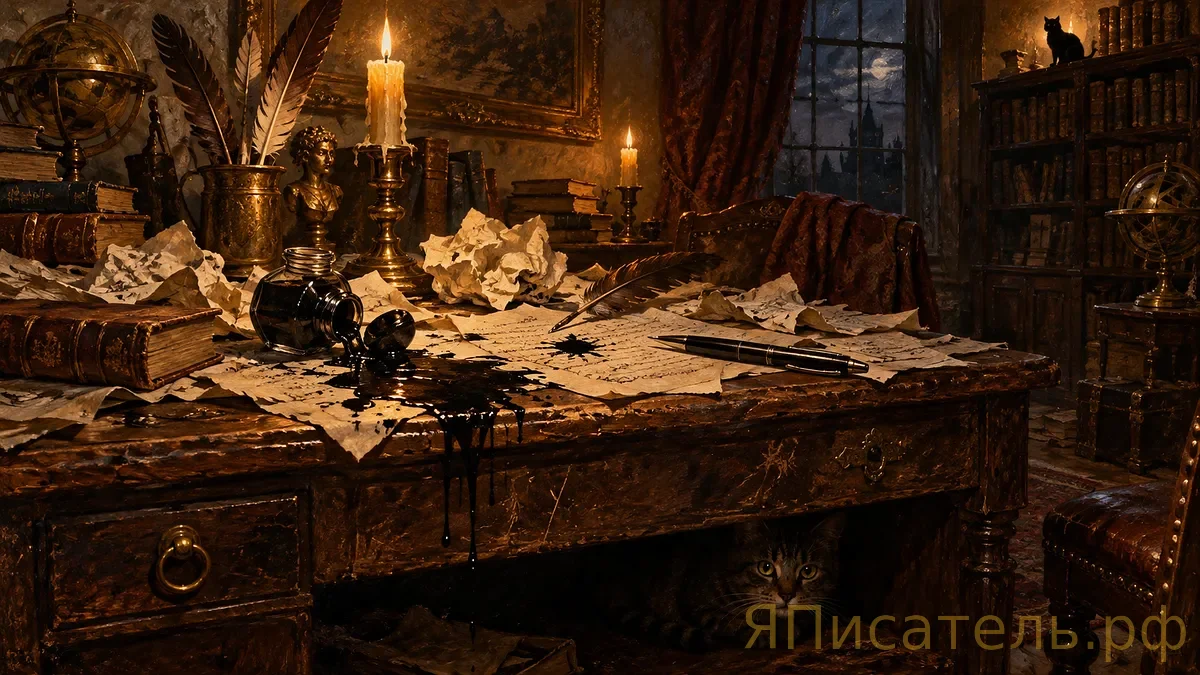
Why Your First Draft Is Garbage — And Why Every Great Writer Knew It
Here's a dirty little secret the writing industry doesn't want you to know: every single masterpiece you've ever loved started as hot garbage. That pristine prose on your bookshelf? It was once a mess of crossed-out sentences, half-baked ideas, and paragraphs that made their authors physically cringe. Hemingway said it best — and he didn't mince words — 'The first draft of anything is shit.' Not 'could use improvement.' Not 'needs a little polish.' Shit. And if Papa Hemingway's first drafts were terrible, what makes you think yours should be any different?
Let me tell you about Leo Tolstoy. The man wrote War and Peace — one of the greatest novels in human history, a book that has humbled readers and writers for over 150 years. Do you know how many drafts it took? His wife, Sophia, hand-copied the entire manuscript seven times. Seven. That's roughly 1,500 pages, multiplied by seven, copied by hand with a quill pen. The first draft of War and Peace wasn't War and Peace. It was a sprawling, unfocused mess called 'The Year 1805,' and Tolstoy himself described early versions as embarrassing. So the next time you look at your shaky first attempt and want to throw your laptop out the window, remember: Tolstoy felt the same way, and he had a countess doing his secretarial work.
The cult of the first draft is one of the most toxic myths in writing. Somewhere along the way, we started believing that real writers sit down and genius just flows out of them like water from a tap. That Mozart composed symphonies in one sitting. That Kerouac typed On the Road in three weeks on a single scroll of paper and never looked back. Here's the thing about that Kerouac story — it's mostly nonsense. Yes, he typed a version in April 1951 on a continuous scroll of paper. But he'd been working on the material in notebooks for three years before that. And after the scroll? Six more years of revisions before it was published in 1957. The 'spontaneous' masterpiece was nearly a decade in the making.
Raymond Carver, the master of the American short story, had his work so heavily edited by Gordon Lish that scholars still argue about who actually wrote those spare, devastating sentences. Carver's first drafts were often twice as long as the published versions. Lish would slash and burn, cutting sometimes 70 percent of the text. Carver's original draft of 'What We Talk About When We Talk About Love' was a completely different beast — longer, softer, more explanatory. Lish carved it into a diamond. The first draft was the raw stone; the editing was the craft.
And then there's F. Scott Fitzgerald. The Great Gatsby — 180 pages of pure, distilled American perfection. Fitzgerald's editor, Maxwell Perkins, received a first draft that was, by Fitzgerald's own admission, 'a mess.' Fitzgerald then rewrote the entire novel, restructuring the chronology, cutting characters, and rewriting the ending multiple times. The iconic last line — 'So we beat on, boats against the current, borne back ceaselessly into the past' — didn't exist in the first draft. It was born in revision. The most quoted sentence in American literature was an afterthought.
So why do we torture ourselves over first drafts? Because we confuse the process with the product. We see the finished book on the shelf and assume it arrived fully formed. We don't see the seventeen versions in the recycling bin. We don't see Dostoevsky gambling away his advance and then dictating The Gambler in twenty-six days to a stenographer because he was desperate for money — and then spending months fixing the mess. We don't see the panic, the self-doubt, the three a.m. rewrites fueled by cold coffee and existential dread.
Here's what a first draft actually is: it's a conversation with yourself. You're figuring out what you want to say. You're laying bricks — ugly, uneven, sometimes cracked — but you're building a wall. You can't sand and paint a wall that doesn't exist. Anne Lamott, in her brilliant book Bird by Bird, calls them 'shitty first drafts' and insists that every writer she knows produces them. Not most writers. Every writer. The difference between a published author and someone with an abandoned manuscript in a drawer isn't talent — it's the willingness to go back and do the brutal, unglamorous work of rewriting.
The editing process is where the actual magic happens. It's not sexy. Nobody writes inspirational quotes about the fourth revision. But consider this: Michael Crichton rewrote Jurassic Park from scratch after his editor told him the original version didn't work. Not a light revision — he threw it out and started over. Stephen King, in On Writing, recommends cutting your first draft by at least ten percent. He calls it 'killing your darlings,' a phrase originally attributed to Arthur Quiller-Couch in 1914. You write the beautiful sentence, the clever metaphor, the brilliant aside — and then you murder it because it doesn't serve the story. That's editing. That's the job.
The real danger isn't writing a bad first draft. The real danger is never writing one at all. Perfectionism is procrastination wearing a tuxedo. It looks respectable, even admirable — 'Oh, I just have such high standards' — but the result is the same: nothing gets written. You stare at the blank page, paralyzed by the gap between the masterpiece in your head and the clumsy words on the screen. Meanwhile, the writers who actually finish books? They've made peace with being terrible. They've embraced the garbage. They know that you can fix a bad page, but you can't fix a blank one.
There's a famous story about a ceramics teacher who divided his class into two groups. One group would be graded on quantity — the more pots they made, the higher the grade. The other would be graded on quality — they just had to make one perfect pot. At the end of the semester, the best pots came from the quantity group. By making pot after pot, they learned, improved, and accidentally produced excellence. The quality group spent the whole semester theorizing about the perfect pot and produced mediocre work. Writing is the same. Your first draft is pot number one. It's supposed to be lumpy.
So here's my challenge to you, whoever you are, wherever you are in your writing: write the terrible first draft. Write the scene that makes you wince. Write the dialogue that sounds wooden. Write the description that's cliché and overwrought and would make your writing teacher weep. Get it all out. Because buried in that mess — in between the bad metaphors and the plot holes and the characters who all sound suspiciously like you — there are sparks. There are moments of genuine truth. And those moments are what you'll build on in draft two, three, four, and seven.
The first draft isn't the book. It never was. It's the raw ore you pull from the mine — dirty, rough, full of rock and sediment. The book is what emerges after you smelt it, hammer it, shape it, and polish it until it gleams. Every great writer in history has known this. The only question is whether you'll trust the process long enough to discover it yourself. Now stop reading articles about writing, open that document, and go make some beautiful garbage.
Вставьте этот код в HTML вашего сайта для встраивания контента.