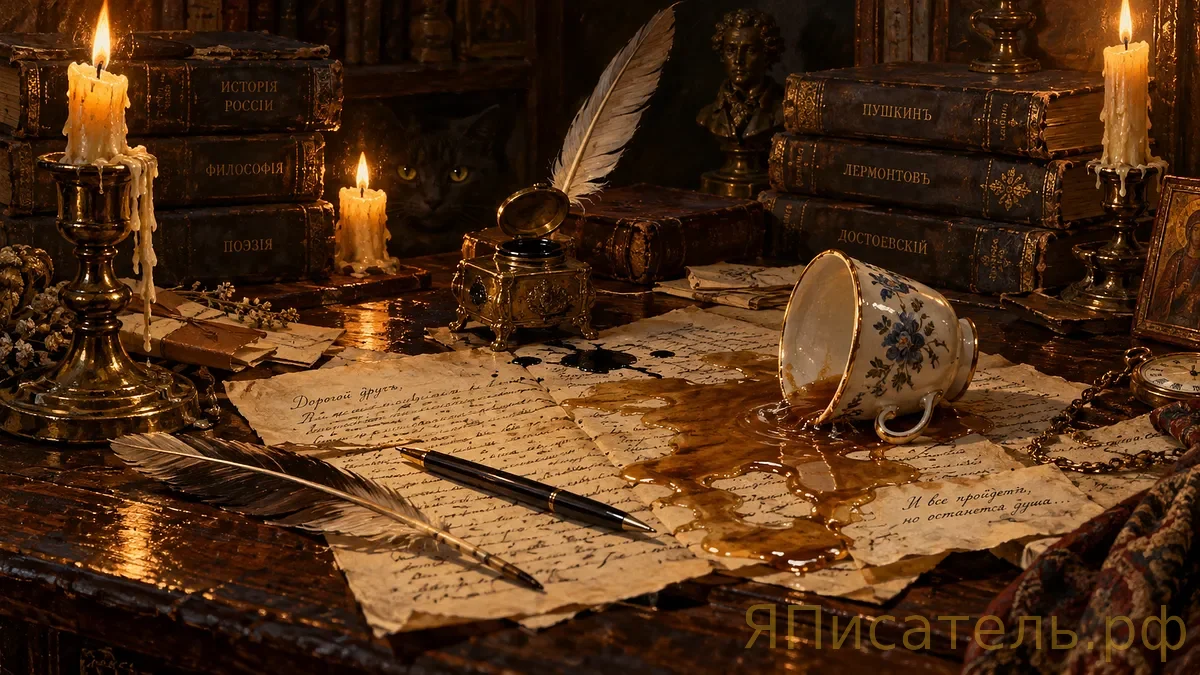
The Man Who Won the Nobel Prize and Had to Refuse It: Boris Pasternak's Impossible Life
Imagine winning the most prestigious literary award on the planet and being forced to say 'no thanks' because accepting it might get you killed—or worse, exiled from the only home you've ever known. That was Boris Pasternak's reality in 1958, and frankly, it's one of the most absurd chapters in literary history. Born 136 years ago today, Pasternak lived a life so dramatic that if you pitched it as a screenplay, producers would say it's too over-the-top.
Boris Leonidovich Pasternak came into this world on February 10, 1890, in Moscow, into a family so cultured it practically bled art. His father was a famous painter who illustrated Tolstoy's works (yes, THAT Tolstoy was a family friend who occasionally dropped by for tea), and his mother was a concert pianist. Young Boris grew up with Rachmaninoff playing in his living room and Rilke sending letters. Talk about setting the bar impossibly high for the rest of us mortals.
Here's the thing about Pasternak that most people don't realize: he didn't even start as a writer. The man studied philosophy in Germany and was dead set on becoming a composer. He had serious musical chops, trained seriously, and everyone expected him to follow in his mother's footsteps. But then—and this is peak artist behavior—he decided he wasn't good enough to be a truly great composer and pivoted to poetry instead. Because apparently being merely excellent wasn't acceptable. Some of us can't even commit to a Netflix show, and this guy was out here switching entire artistic careers because his standards were too high.
Pasternak's poetry made him famous in Russia long before Doctor Zhivago existed. We're talking about verses so innovative they made other poets look like they were still using quill pens in the age of typewriters. He played with rhythm and imagery in ways that Russian hadn't quite seen before, blending philosophical depth with sensory vividness. His collections like 'My Sister, Life' and 'Second Birth' established him as one of the leading voices of his generation. The man could make you feel the weight of snow on birch branches or the exact temperature of a Moscow twilight through words alone.
But let's get to the elephant in the room: Doctor Zhivago. Pasternak spent a decade writing this sprawling epic about a physician-poet navigating the Russian Revolution, and when he finished it in 1956, he knew he had created something dangerous. The Soviet authorities took one look at it and essentially said, 'Absolutely not.' The novel portrayed the Revolution with all its chaos, violence, and moral ambiguity—not exactly the heroic narrative the Communist Party preferred. It depicted people as complex humans rather than ideological archetypes. It had the audacity to suggest that love and poetry might matter more than politics. Scandalous stuff, really.
What happened next reads like a Cold War thriller. An Italian publisher named Giangiacomo Feltrinelli got his hands on the manuscript and published it in 1957, despite Soviet attempts to retrieve it. The book became an international sensation, translated into dozens of languages, and turned Pasternak into a global literary celebrity overnight. Western readers devoured it—partly for its genuine literary merit and partly because reading a banned Soviet book felt deliciously rebellious. The CIA allegedly helped distribute copies, which is either hilarious or terrifying depending on your perspective.
Then came the Nobel Prize in 1958, and this is where everything went sideways. The Swedish Academy announced Pasternak as the winner 'for his important achievement both in contemporary lyrical poetry and in the field of the great Russian epic tradition.' You'd think this would be cause for champagne and celebration, right? Wrong. The Soviet Writers' Union called him a 'literary weed' and expelled him. Newspapers ran vicious attacks calling him a traitor. Citizens who had never read a word of his work were organized to denounce him publicly. The pressure became so intense that Pasternak was forced to decline the prize—the only person in history to do so under governmental pressure. He wrote to the Swedish Academy that he was 'extremely grateful, touched, proud, astonished, abashed.'
The aftermath was brutal. Pasternak remained in Russia—exile would have been unbearable for a man so connected to his homeland—but lived under a cloud of official disgrace. His long-time partner Olga Ivinskaya, who partly inspired the character of Lara in Doctor Zhivago, would later be sent to a labor camp after his death. The system wanted to punish him through those he loved, which is about as villainous as it gets. Pasternak died in 1960, just two years after the Nobel controversy, officially of lung cancer but arguably also of a broken heart.
Here's what makes Pasternak's legacy so fascinating though: he ultimately won. Doctor Zhivago wasn't published in Russia until 1988, nearly thirty years after his death, but when it finally appeared, it was recognized as the masterpiece it always was. The novel is now considered one of the greatest works of twentieth-century literature. The 1965 David Lean film brought the story to millions more, featuring Omar Sharif and Julie Christie and that absolutely haunting 'Lara's Theme' that you've definitely heard even if you don't know the name. In 1989, Pasternak's son finally accepted the Nobel medal on his father's behalf. The Soviet Union that tried to destroy him? It collapsed two years later.
What strikes me most about Pasternak, 136 years after his birth, is his stubborn insistence on beauty and humanity in the face of systems that demanded conformity. He wasn't a political dissident in the traditional sense—he didn't write manifestos or organize protests. He simply refused to lie in his art. He wrote about love during purges, about individual souls during collectivization, about the eternal when everyone demanded the immediate. In Doctor Zhivago, he gave voice to the millions who experienced the Revolution not as glorious ideology but as upheaval, loss, and the desperate struggle to remain human.
The man once wrote, 'What is laid down, ordered, factual is never enough to embrace the whole truth: life always spills over the rim of every cup.' That's Pasternak in a sentence—always reaching for what exceeds the official narrative, the approved version, the acceptable story. And that's why we're still talking about him, still reading him, still moved by a love story set against the Russian Revolution. He understood something essential: that art isn't about serving power or following rules. It's about capturing the parts of human experience that can't be contained by any system, no matter how total its claims.
So here's to Boris Pasternak on his 136th birthday—the composer who became a poet, the poet who became a novelist, the Nobel laureate who couldn't accept his prize, and the man whose words outlasted the empire that tried to silence them. Not a bad legacy for someone the Soviet Writers' Union called a weed.
Вставьте этот код в HTML вашего сайта для встраивания контента.