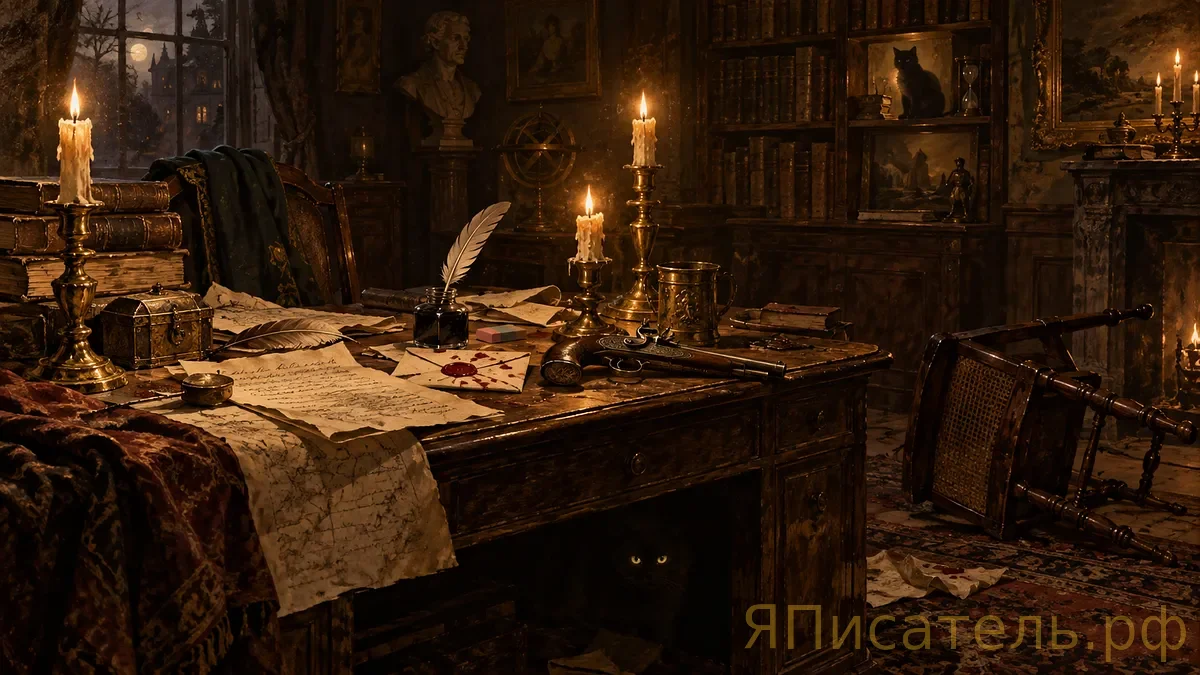
Pushkin Died in a Duel at 37 — And Still Writes Better Than You
Here's a fun exercise: name a poet who got killed defending his wife's honor, invented modern Russian literature on the side, and still manages to haunt every love-struck teenager 189 years later. You can't — because there's only one. Alexander Pushkin died on February 10, 1837, from a gunshot wound sustained in a duel with a French military officer who may or may not have been sleeping with his wife. He was 37. That's younger than most people when they finally get around to writing their first novel.
And yet, in those 37 years, the man produced a body of work so staggeringly influential that the entire Russian literary tradition — Tolstoy, Dostoevsky, Chekhov, all of them — basically owes him rent. Today marks 189 years since that fatal duel, and it feels like a good time to ask: why does a guy who wrote in verse about aristocratic ennui still matter in a world of TikTok and AI-generated slop?
Let's start with the elephant in the room — "Eugene Onegin." If you haven't read it, here's the pitch: imagine a 19th-century influencer who's bored with everything, rejects a sincere woman's love, kills his best friend in a pointless duel (ironic, given Pushkin's own fate), and then spends years regretting it all. Sound familiar? That's because Pushkin essentially invented the "superfluous man" — a character type so powerful it became the template for every brooding antihero from Pechorin to Don Draper. Onegin is the original sad boy, and Pushkin wrote him with a level of self-awareness that most modern writers can only dream of. The novel in verse isn't just a love story; it's a vivisection of an entire social class, performed with surgical wit and set to a rhyme scheme so intricate that translators have been weeping over it for two centuries.
But Pushkin wasn't a one-trick pony. "The Captain's Daughter" is basically a historical adventure novel disguised as a coming-of-age story, set against the backdrop of Pugachev's Rebellion of 1773-1775. It's got love, war, betrayal, clemency from an outlaw leader, and a young woman who walks into the court of Catherine the Great to beg for her lover's life. Hollywood hasn't adapted it yet, and honestly, that's Hollywood's loss. The novel is a masterclass in economy — every sentence does three things at once, and the whole thing clocks in at barely over a hundred pages. Pushkin could do in a paragraph what lesser writers need a chapter for.
Then there's "The Queen of Spades" — a short story so tightly wound it practically vibrates. A young officer named Hermann becomes obsessed with a secret card-playing formula supposedly known by an elderly countess. He terrorizes the old woman, she dies of fright, her ghost visits him with the secret, and then — well, let's just say gambling addiction doesn't end well. Tchaikovsky turned it into an opera. Dostoevsky cited it as an influence on his own gambling obsession. The story is barely 30 pages long, and it contains more psychological tension than most 500-page thrillers. It's the literary equivalent of a knife: small, sharp, and absolutely lethal.
What makes Pushkin genuinely revolutionary — not in the watered-down way we use that word for every mildly innovative creator — is what he did to the Russian language itself. Before Pushkin, Russian literary language was a stiff, Frenchified mess, full of Church Slavonic constructions and aristocratic affectations. Pushkin took the language people actually spoke, the Russian of streets and salons and arguments and love letters, and he made it sing. He didn't dumb it down. He elevated the vernacular into art. Gogol reportedly said, "When I heard the name Pushkin, it seemed to me that everything Russian breathed in that name." That's not hyperbole. It's a statement of fact.
Here's what really gets me, though. Pushkin's themes haven't aged a day. Eugene Onegin's inability to recognize love until it's too late? That's every third person on a dating app. Hermann's descent into obsession over a get-rich-quick scheme in "The Queen of Spades"? That's crypto bros in 2024. The moral courage of Masha Mironova in "The Captain's Daughter," who risks everything for the person she loves while the men around her dither and posture? That's a story we still desperately need to hear. Pushkin understood something fundamental about human nature: we are creatures who consistently choose pride over happiness, obsession over contentment, performance over authenticity. And he wrote about it not with moralistic finger-wagging, but with compassion and devastating humor.
The tragedy of Pushkin's death is compounded by the sheer stupidity of how it happened. Georges d'Anthès, a French officer serving in the Russian cavalry, had been openly pursuing Pushkin's wife, Natalia Goncharova — widely considered the most beautiful woman in St. Petersburg. Anonymous letters mocking Pushkin as a cuckold circulated through society. Pushkin, proud and hot-tempered, challenged d'Anthès to a duel. D'Anthès shot first, the bullet lodging in Pushkin's abdomen. Pushkin managed to fire back from the ground, wounding d'Anthès slightly, but the damage was done. He died two days later. The Tsar reportedly said, "It's a pity he's dead." Even the autocrat recognized the magnitude of the loss.
D'Anthès, by the way, survived, was expelled from Russia, went back to France, and became a senator. He lived to 83. There's a cosmic joke in there somewhere — the mediocre man outlives the genius by nearly half a century. But here we are, 189 years later, and nobody's writing articles about Georges d'Anthès.
So what do we do with Pushkin in 2026? We read him. Not because he's a monument or a school assignment, but because his writing is genuinely, absurdly alive. Pick up "The Queen of Spades" on your lunch break — it'll take you 40 minutes and you'll think about it for weeks. Try "Eugene Onegin" in a good translation and discover that a 200-year-old verse novel can make you laugh out loud on a train. Read "The Captain's Daughter" and realize that moral courage has never gone out of style.
Pushkin died at 37 with a bullet in his gut and a duel on his conscience. He left behind a body of work that essentially created modern Russian literature, influenced everyone from Dostoevsky to Nabokov, and remains as sharp, as funny, and as heartbreaking as the day it was written. The least we can do — 189 years on — is actually read it. Trust me, your Netflix queue can wait.
Вставьте этот код в HTML вашего сайта для встраивания контента.