The Souls of Black Folk
Предпросмотр книги
Автор
William Edward Burghardt
Жанр
Обложка книги
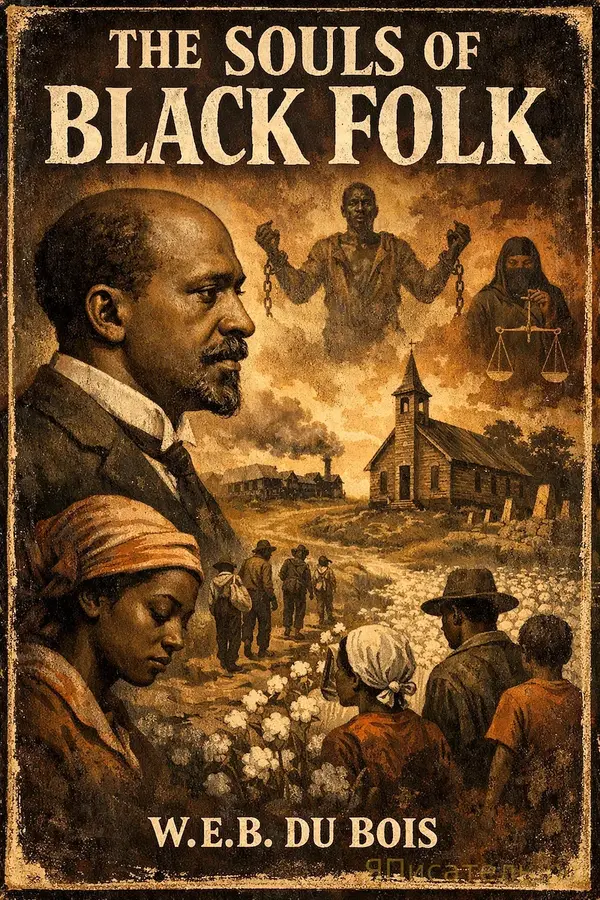
Общее содержание книги
"The Souls of Black Folk" is a seminal work of American literature and sociology, published in 1903 by W.E.B. Du Bois, one of the most influential African American intellectuals of the twentieth century. The book is a profound exploration of the African American experience in post-Civil War America, combining essays, historical analysis, personal narrative, and sociological study. Du Bois introduces the concept of "double-consciousness"—the psychological challenge faced by African Americans who must view themselves through the lens of a society that regards them with contempt and pity. He famously declares that "the problem of the Twentieth Century is the problem of the color-line," a prophetic statement that continues to resonate. The work traces the history of African Americans from slavery through Emancipation and Reconstruction, examining the rise and fall of the Freedmen's Bureau, which attempted to integrate formerly enslaved people into American society. Du Bois offers a nuanced critique of Booker T. Washington's accommodationist approach, arguing that Washington's emphasis on industrial education and political submission sacrifices civil rights and higher education for economic advancement—a dangerous compromise that accepts second-class citizenship. Through personal narratives, Du Bois shares his experiences teaching in rural Tennessee, painting vivid portraits of Black families striving for education and dignity amid poverty. He explores the Black Belt of Georgia, documenting the economic exploitation of Black farmers trapped in cycles of debt and sharecropping—a system he describes as economic slavery. The book examines the role of the Black church as the central institution of African American life, the importance of higher education for developing Black leadership (the "Talented Tenth"), and the cultural significance of the "Sorrow Songs"—spirituals that Du Bois considers America's only original musical contribution. Interspersed throughout are deeply personal chapters, including a moving elegy for his infant son who died, and a tribute to Alexander Crummell, a Black Episcopal priest who embodied intellectual and spiritual aspiration. The fictional tale "Of the Coming of John" dramatizes the tragic consequences of racial prejudice when an educated Black man returns to his Southern hometown. "The Souls of Black Folk" remains essential reading for understanding American racial history, the ongoing struggle for equality, and the complex inner life of those who have lived behind what Du Bois calls "the Veil."
Содержание глав
Отрывок из книги
The Souls of Black Folk
by W. E. B. Du Bois
Herein is Written
The Forethought I. Of Our Spiritual Strivings II. Of the Dawn of Freedom III. Of Mr. Booker T. Washington and Others IV. Of the Meaning of Progress V. Of the Wings of Atalanta VI. Of the Training of Black Men VII. Of the Black Belt VIII. Of the Quest of the Golden Fleece IX. Of the Sons of Master and Man X. Of the Faith of the Fathers XI. Of the Passing of the First-Born XII. Of Alexander Crummell XIII. Of the Coming of John XIV. Of the Sorrow Songs The Afterthought
To Burghardt and Yolande The Lost and the Found
The Forethought
Herein lie buried many things which if read with patience may show the strange meaning of being black here at the dawning of the Twentieth Century. This meaning is not without interest to you, Gentle Reader; for the problem of the Twentieth Century is the problem of the color line.
I pray you, then, receive my little book in all charity, studying my words with me, forgiving mistake and foible for sake of the faith and passion that is in me, and seeking the grain of truth hidden there.
I have sought here to sketch, in vague, uncertain outline, the spiritual world in which ten thousand thousand Americans live and strive. First, in two chapters I have tried to show what Emancipation meant to them, and what was its aftermath. In a third chapter I have pointed out the slow rise of personal leadership, and criticized candidly the leader who bears the chief burden of his race to-day. Then, in two other chapters I have sketched in swift outline the two worlds within and without the Veil, and thus have come to the central problem of training men for life. Venturing now into deeper detail, I have in two chapters studied the struggles of the massed millions of the black peasantry, and in another have sought to make clear the present relations of the sons of master and man. Leaving, then, the white world, I have stepped within the Veil, raising it that you may view faintly its deeper recesses,—the meaning of its religion, the passion of its human sorrow, and the struggle of its greater souls. All this I have ended with a tale twice told but seldom written, and a chapter of song.
Some of these thoughts of mine have seen the light before in other guise. For kindly consenting to their republication here, in altered and extended form, I must thank the publishers of the Atlantic...
Готовы читать дальше?
Откройте для себя всю историю и все главы
Уже доступна в нашем интернет-магазине