Gulliver's Travels
Предпросмотр книги
Автор
Jonathan Swift
Дата публикации
20 февраля 2026 11:42
Жанр
Обложка книги
Общее содержание книги
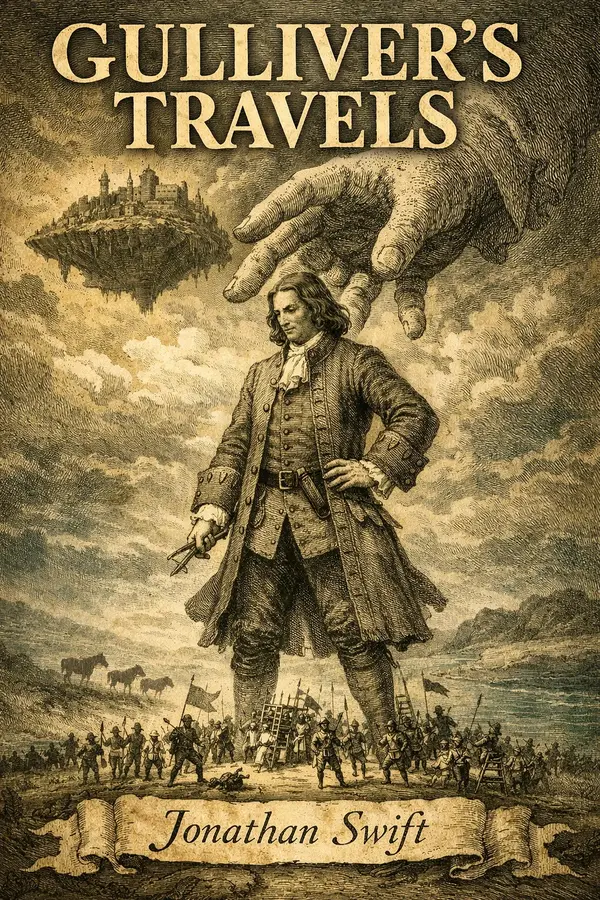
Gulliver's Travels into Several Remote Nations of the World, published in 1726 by Jonathan Swift, is one of literature's most enduring and subversive satirical masterworks. Presented as the genuine travel memoir of Lemuel Gulliver — ship's surgeon, dutiful husband, and irrepressible adventurer — the novel is, at its satirical core, a devastating indictment of human pride, political corruption, colonial ambition, and the self-flattering delusions of European civilization. The book opens with framing devices that immediately undermine the reliability of the narrative: a publisher's preface by Richard Sympson and a furious letter from Gulliver himself, who is outraged that his text has been altered and censored. Gulliver complains that humanity — dismissively termed 'Yahoos' — has proven incapable of the moral reform he had hoped his travels might inspire. This bitter introduction sets the satirical tone for everything that follows. In Part I, A Voyage to Lilliput, Gulliver is shipwrecked and awakens to find himself bound by the ropes of the six-inch-tall Lilliputians. He is transported to their capital city, Mildendo, kept chained, and gradually granted conditional freedom after swearing elaborate oaths of loyalty to the Emperor. The Lilliputians are petty, scheming, and consumed by absurd political rivalries — most famously the theological war with the neighboring empire of Blefuscu over which end of a boiled egg should be broken first, a transparent parody of the Catholic-Protestant conflict. Gulliver earns favor by capturing the Blefuscudian fleet but falls from grace when he refuses to be a tool of imperial conquest, extinguishes a palace fire by unconventional means, and is ultimately impeached on fabricated charges of treason. He escapes to Blefuscu and eventually sails home. In Part II, A Voyage to Brobdingnag, the tables are turned entirely. Abandoned by his shipmates on a strange shore, Gulliver is discovered by a race of giants — the Brobdingnagians — to whom he is as small and helpless as a Lilliputian was to him. He is taken in by a farmer who exhibits him as a traveling curiosity, until the Queen of Brobdingnag purchases him and installs him at court. The farmer's young daughter, Glumdalclitch, becomes his devoted nurse and protector. In the giant king's company, Gulliver proudly describes Europe's governments, legal systems, and military technologies — only to be told by the philosophically-minded monarch that the bulk of Europeans appear to be 'the most pernicious race of little odious vermin that nature ever suffered to crawl upon the surface of the earth.' The episode inverts the perspective of Part I: if Lilliput made Gulliver a god among pygmies, Brobdingnag reduces him to a freak and a pet. Part III, A Voyage to Laputa and its surrounding territories, takes Gulliver to a flying island populated by impractical intellectuals so lost in abstract thought that they must be struck with bladders to attend to ordinary conversation. Below the floating island, the devastated land of Balnibarbi has been ruined by fanatical application of half-baked scientific theories. In the island of Glubbdubdrib, Gulliver converses with the resurrected ghosts of historical figures and learns that recorded history is largely a catalogue of lies. In Luggnagg, he encounters the Struldbruggs — immortal humans condemned to ever-worsening senility rather than eternal wisdom. Part IV, A Voyage to the Country of the Houyhnhnms, is Swift's most radical and disturbing movement. Among a race of supremely rational horses who live in harmony and reason, Gulliver discovers the Yahoos — savage, brutish humanoid creatures unmistakably recognizable as mankind stripped of civilization's thin veneer. Gulliver is forced to confront the possibility that he, too, is essentially a Yahoo. He comes to adore the Houyhnhnms' placid rationality and is devastated when expelled from their society as an undesirable anomaly. Returning to England, he finds himself unable to tolerate human company — including his own wife and children — and retreats to his stables to commune with horses. Swift's genius lies in the way each voyage recalibrates the reader's sense of scale, perspective, and moral judgment. Gulliver is by turns giant and miniature, admired and despised, a figure of power and of pathetic helplessness — and through each metamorphosis, the pieties of European culture are held up and found wanting. The book endures as one of the most brilliantly executed works of political and philosophical satire ever written.
Содержание глав
Отрывок из книги
The author of these Travels, Mr. Lemuel Gulliver, is my ancient and intimate friend; there is likewise some relation between us on the mother’s side. About three years ago, Mr. Gulliver growing weary of the concourse of curious people coming to him at his house in Redriff, made a small purchase of land, with a convenient house, near Newark, in Nottinghamshire, his native country; where he now lives retired, yet in good esteem among his neighbours.
Although Mr. Gulliver was born in Nottinghamshire, where his father dwelt, yet I have heard him say his family came from Oxfordshire; to confirm which, I have observed in the churchyard at Banbury in that county, several tombs and monuments of the Gullivers.
Before he quitted Redriff, he left the custody of the following papers in my hands, with the liberty to dispose of them as I should think fit. I have carefully perused them three times. The style is very plain and simple; and the only fault I find is, that the author, after the manner of travellers, is a little too circumstantial. There is an air of truth apparent through the whole; and indeed the author was so distinguished for his veracity, that it became a sort of proverb among his neighbours at Redriff, when any one affirmed a thing, to say, it was as true as if Mr. Gulliver had spoken it.
By the advice of several worthy persons, to whom, with the author’s permission, I communicated these papers, I now venture to send them into the world, hoping they may be, at least for some time, a better entertainment to our young noblemen, than the common scribbles of politics and party.
This volume would have been at least twice as large, if I had not made bold to strike out innumerable passages relating to the winds and tides, as well as to the variations and bearings in the several voyages, together with the minute descriptions of the management of the ship in storms, in the style of sailors; likewise the account of longitudes and latitudes; wherein I have reason to apprehend, that Mr. Gulliver may be a little dissatisfied. But I was resolved to fit the work as much as possible to the general capacity of readers. However, if my own ignorance in sea affairs shall have led me to commit some mistakes, I alone am answerable for them. And if any traveller hath a curiosity to see the whole work at large, as it came from the hands of the author, I will be ready to...
Готовы читать дальше?
Откройте для себя всю историю и все главы
Уже доступна в нашем интернет-магазине