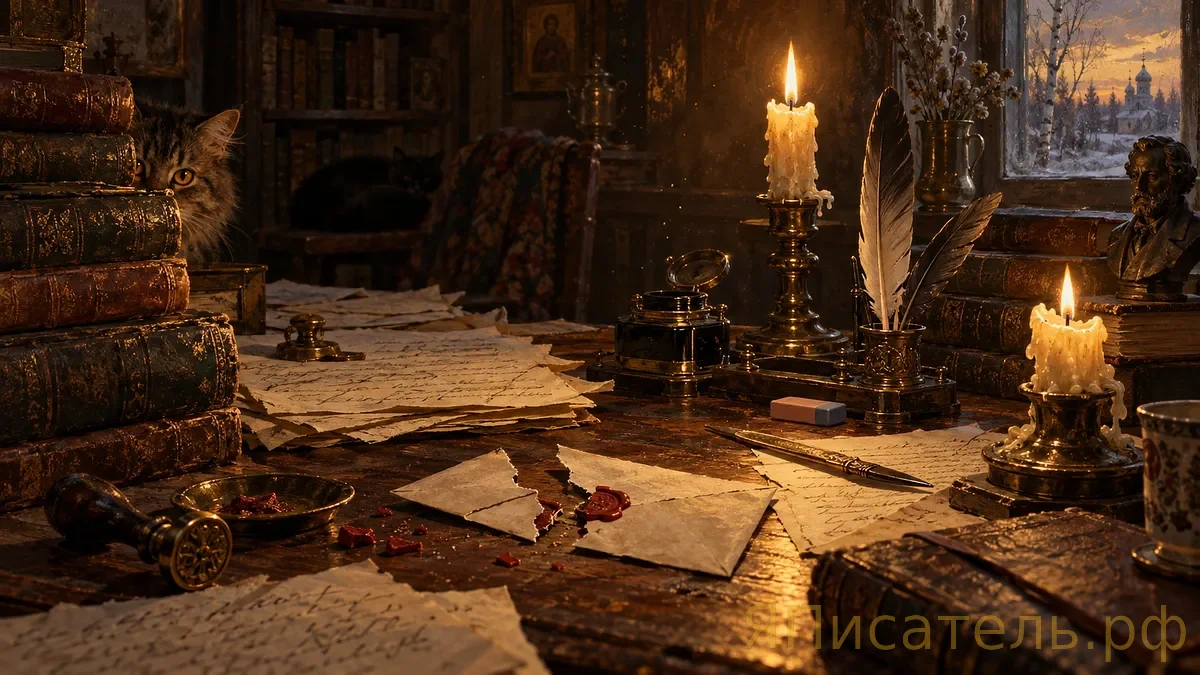
The Nobel Prize That Almost Killed Boris Pasternak
Imagine winning the most prestigious literary award on the planet and being forced to reject it — under threat of exile from your own country. That's not a dystopian novel plot. That's Tuesday for Boris Pasternak, born 136 years ago today, a man who wrote the greatest Russian love story of the twentieth century and was nearly destroyed by it. His government called him a pig. His colleagues demanded his deportation. And his novel, Doctor Zhivago, had to be smuggled out of the Soviet Union in a washing machine drum.
Boris Leonidovich Pasternak was born on February 10, 1890, in Moscow, into a family so cultured it was practically radioactive with talent. His father, Leonid, was a prominent painter who illustrated Tolstoy's novels. His mother, Rosa Kaufman, was a concert pianist who gave up her career for the family. Little Boris grew up with Tolstoy literally visiting their apartment and Scriabin influencing his musical education. If you ever needed proof that genius is partly environmental, the Pasternak household is Exhibit A.
Young Boris initially wanted to be a composer. He studied music for six years, then abruptly quit because he didn't have perfect pitch. Let that sink in — the man abandoned an entire artistic career over a technicality. He then pivoted to philosophy, studying at the University of Marburg in Germany, before deciding that wasn't quite right either. It took him until his early twenties to land on poetry, which is like a surgeon deciding at thirty that actually, they'd rather be a chef. Except in this case, the chef turned out to be the best in the world.
Pasternak's early poetry collections — "A Twin in the Clouds" (1914) and "Over the Barriers" (1917) — were ambitious but rough. It was "My Sister, Life" (1922) that detonated like a bomb in Russian literary circles. Written during the summer of 1917, between the two revolutions, the collection captured a sense of euphoria and natural wonder that felt almost indecent against the backdrop of political chaos. Marina Tsvetaeva, herself a titan of Russian verse, wrote him fan letters. The Futurists wanted to claim him. The Symbolists thought he was theirs. Pasternak belonged to nobody, which is exactly what made him dangerous.
For the next three decades, Pasternak navigated the Soviet literary landscape like a man walking through a minefield in ballet shoes. He translated Shakespeare, Goethe, and Shelley — partly because translation was safer than original work, and partly because he was genuinely brilliant at it. His translations of Hamlet and King Lear are still considered definitive in Russian. Stalin, in one of history's more surreal phone calls, personally rang Pasternak in 1934 to discuss the arrested poet Osip Mandelstam. Pasternak fumbled the call, trying to arrange a meeting to discuss "life and death." Stalin hung up. Pasternak spent the rest of his life wondering if that botched conversation had sealed Mandelstam's fate.
Then came Doctor Zhivago. Pasternak worked on it for over a decade, from the mid-1940s to 1955, pouring everything into this sprawling, lyrical novel about a poet-physician caught in the gears of the Russian Revolution. It was personal, it was political, and it was absolutely unpublishable in the Soviet Union. The manuscript was rejected by Soviet literary journals with the kind of polite horror usually reserved for discovering a live grenade in your mailbox. "The spirit of your novel is one of non-acceptance of the socialist revolution," one rejection letter stated, which was basically Soviet-speak for "are you trying to get yourself killed?"
Here's where the story turns into a spy thriller. In 1956, Pasternak gave a copy of the manuscript to Sergio D'Angelo, an Italian literary scout visiting Moscow. The manuscript was passed to the publisher Giangiacomo Feltrinelli in Milan. The Soviet government demanded it back. Feltrinelli refused. The CIA — yes, that CIA — got involved, helping to distribute Russian-language copies to Soviet citizens at the 1958 Brussels World Fair. Doctor Zhivago became the Cold War's most literary weapon. The novel was published in Italian in 1957, and within a year it had been translated into eighteen languages.
In October 1958, the Swedish Academy awarded Pasternak the Nobel Prize in Literature. For roughly forty-eight hours, he was ecstatic. Then the Soviet machinery kicked into gear. The Union of Soviet Writers expelled him. Pravda published venomous attacks. Factory workers who had never read a single poem signed petitions condemning him. One famous formulation circulated: "I haven't read Pasternak, but I condemn him." It became an immortal phrase capturing the absurdity of ideological conformity. Khrushchev reportedly called him "a pig who fouled the spot where he ate and slept."
Faced with the threat of being stripped of his Soviet citizenship and exiled — meaning separation from his beloved Olga Ivinskaya, the woman who inspired Lara in Doctor Zhivago — Pasternak sent a telegram to the Nobel Committee: "In view of the meaning given to this honor in the society to which I belong, I must renounce this undeserved distinction." It remains one of the most heartbreaking sentences in literary history. He won, and he couldn't even keep the prize.
Pasternak died on May 30, 1960, of lung cancer, at his dacha in Peredelkino. He was seventy years old. Despite official efforts to suppress any public mourning, thousands of people attended his funeral. Hand-copied poems were passed among the crowd. The state had tried to erase him, and the people showed up anyway.
What makes Doctor Zhivago endure isn't its politics — frankly, as a political novel, it's rather clumsy. What makes it immortal is its stubborn insistence that private life matters. That love and poetry and the smell of candles on a winter evening are not bourgeois indulgences but the very substance of being human. In an era that demanded collective identity, Pasternak wrote a hymn to the individual soul. That's why they hated him. That's why we still read him.
Here's the final irony that would have made Pasternak smile with that gentle, sad expression his friends always described. In 1988, Doctor Zhivago was finally published in the Soviet Union. The Nobel Prize was posthumously accepted by his son, Yevgeny, in 1989. The empire that tried to crush him didn't outlast his novel by three years. Boris Pasternak wrote a book, and the book won. It always does.
Pega este código en el HTML de tu sitio web para incrustar este contenido.