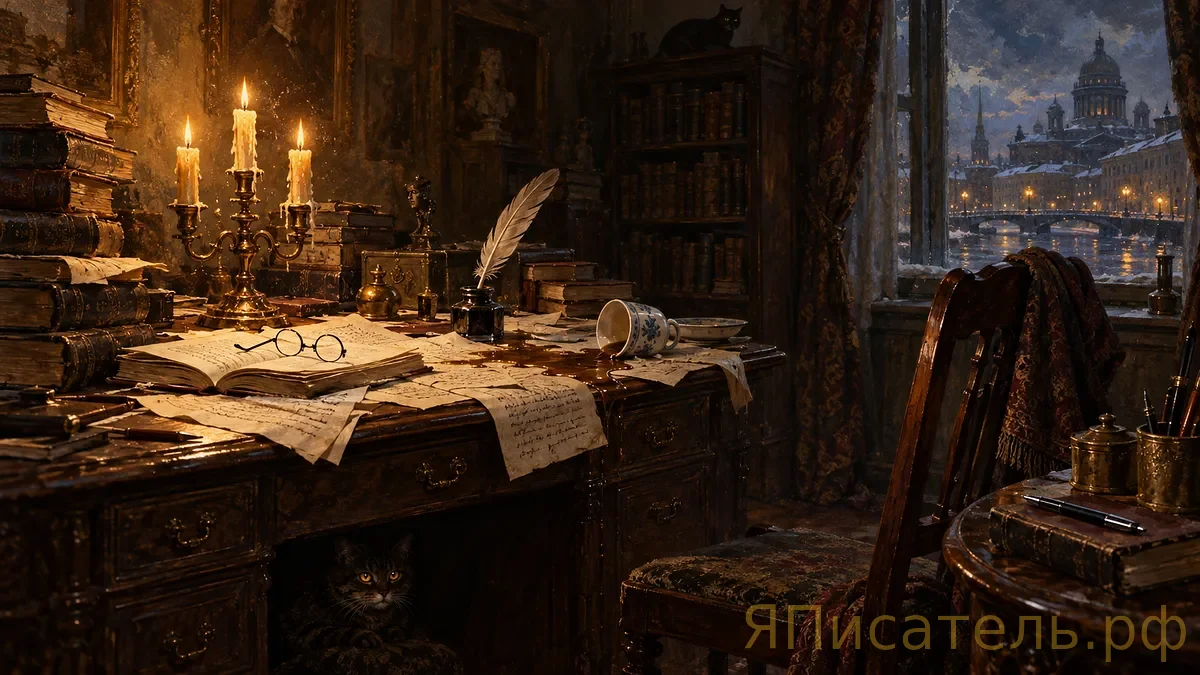
Dostoevsky Diagnosed Your Mental Illness 150 Years Before Your Therapist
On February 9, 1881, Fyodor Dostoevsky died in St. Petersburg, leaving behind a body of work so disturbingly accurate about the human psyche that modern psychiatrists still use his characters as case studies. One hundred and forty-five years later, we're all living inside a Dostoevsky novel — we just haven't noticed yet.
If you've ever doom-scrolled at 3 a.m., argued with strangers online about morality, or felt simultaneously superior to and disgusted by the entire human race, congratulations: you're a Dostoevsky character. The man didn't just write fiction. He performed open-heart surgery on the human soul without anesthesia, and what he found in there is still bleeding.
Let's start with the obvious: Crime and Punishment. Raskolnikov murders an old pawnbroker because he's convinced he's an extraordinary man, above common morality. Sound familiar? That's basically every tech bro who's ever said "move fast and break things" without a shred of irony. Dostoevsky wrote the ultimate takedown of the "I'm special, rules don't apply to me" mindset — in 1866. The book isn't about crime. It's about the nauseating realization that you're not the Napoleon you thought you were. You're just a guy with an axe and a headache. Every generation rediscovers this novel and thinks it was written specifically for them. That's because it was.
Then there's The Idiot, which poses a question so brutal it should come with a warning label: what happens when a genuinely good person enters a society built on cynicism, greed, and manipulation? Prince Myshkin is Christ-like in his kindness, and the world absolutely destroys him for it. Dostoevsky wasn't being pessimistic — he was being a journalist. Try being sincerely, uncomplicatedly kind on the internet for five minutes and see what happens. People will assume you're naive, running a scam, or both. The Idiot is the most savage indictment of civilized society ever written, and it's disguised as a love story.
But the masterpiece — the one that makes other novels look like grocery lists — is The Brothers Karamazov. Published in 1880, just months before Dostoevsky's death, it's a family drama, a murder mystery, a philosophical treatise, and a theological debate all crammed into one massive book. The Grand Inquisitor chapter alone contains more ideas per page than most philosophers produce in a lifetime. Ivan Karamazov's argument — that he "returns the ticket" to God's creation because he cannot accept a world where children suffer — remains the single most devastating challenge to religious belief ever articulated. Atheist philosophers have been essentially footnoting Ivan for 145 years.
Here's the thing that makes Dostoevsky truly dangerous: he understood that humans aren't rational actors. Decades before Freud started talking about the unconscious, Dostoevsky's characters were already acting against their own self-interest, sabotaging their happiness, and choosing suffering over comfort just to feel alive. Notes from Underground, published in 1864, features a narrator who literally says that man will sometimes choose what is harmful to himself simply to assert his freedom. Behavioral economists in the 21st century call this "irrational decision-making" and win Nobel Prizes for studying it. Dostoevsky just shrugged and said, "Obviously."
What's genuinely eerie is how Dostoevsky predicted the ideological catastrophes of the 20th century. In Demons — written in 1872 — he depicted a group of radical intellectuals whose utopian idealism curdles into manipulation, violence, and murder. The novel reads like a documentary about every revolutionary movement that devoured its own children. Lenin reportedly hated the book. He should have — it was a mirror.
The man's biography reads like a novel he would have written. Sentenced to death by firing squad at age 28, he stood blindfolded before the guns, heard the drums, prepared to die — and then received a last-second reprieve from Tsar Nicholas I. The whole execution had been staged as psychological torture. Most people would need therapy for decades after that. Dostoevsky went to a Siberian prison camp for four years, came out, and wrote some of the greatest literature in human history. He was also an epileptic, a compulsive gambler who lost everything at roulette multiple times, and a man who buried two children. His suffering wasn't theoretical. When his characters scream into the void, it's because he'd been there and taken notes.
Modern culture is soaked in Dostoevsky whether it knows it or not. Christopher Nolan's obsession with moral dilemmas? Dostoevsky. Every prestige TV antihero from Walter White to Tony Soprano? They're all Raskolnikov in different costumes. The entire genre of psychological thriller owes him a royalty check. Even Kanye West once claimed Crime and Punishment changed his life — which, if you think about the Napoleon complex angle, tracks perfectly.
So why does a 19th-century Russian novelist still matter on his 145th death anniversary? Because the questions he asked have no expiration date. Is morality real or just a social contract? Can a good person survive in a corrupt world? Does suffering have meaning, or is it just suffering? Are we free, or do we just perform freedom? These aren't academic exercises. These are the questions you ask yourself at 2 a.m. when the performance of your life briefly drops and the real you — confused, contradictory, desperate — peeks through.
Dostoevsky didn't offer clean answers. That's precisely why he endures. Self-help gurus give you five steps to happiness. Dostoevsky gives you a character who finds a cockroach in his soul and describes it in 800 pages. And somehow, impossibly, you feel less alone after reading it. Because at least someone — dead for 145 years, buried in a St. Petersburg cemetery — understood that being human is not a problem to be solved. It's a condition to be endured, examined, and occasionally laughed at through tears.
If you haven't read him, start. If you have read him, read him again. You're a different person now than the last time, and Dostoevsky, that magnificent bastard, already wrote about who you've become.
Pega este código en el HTML de tu sitio web para incrustar este contenido.