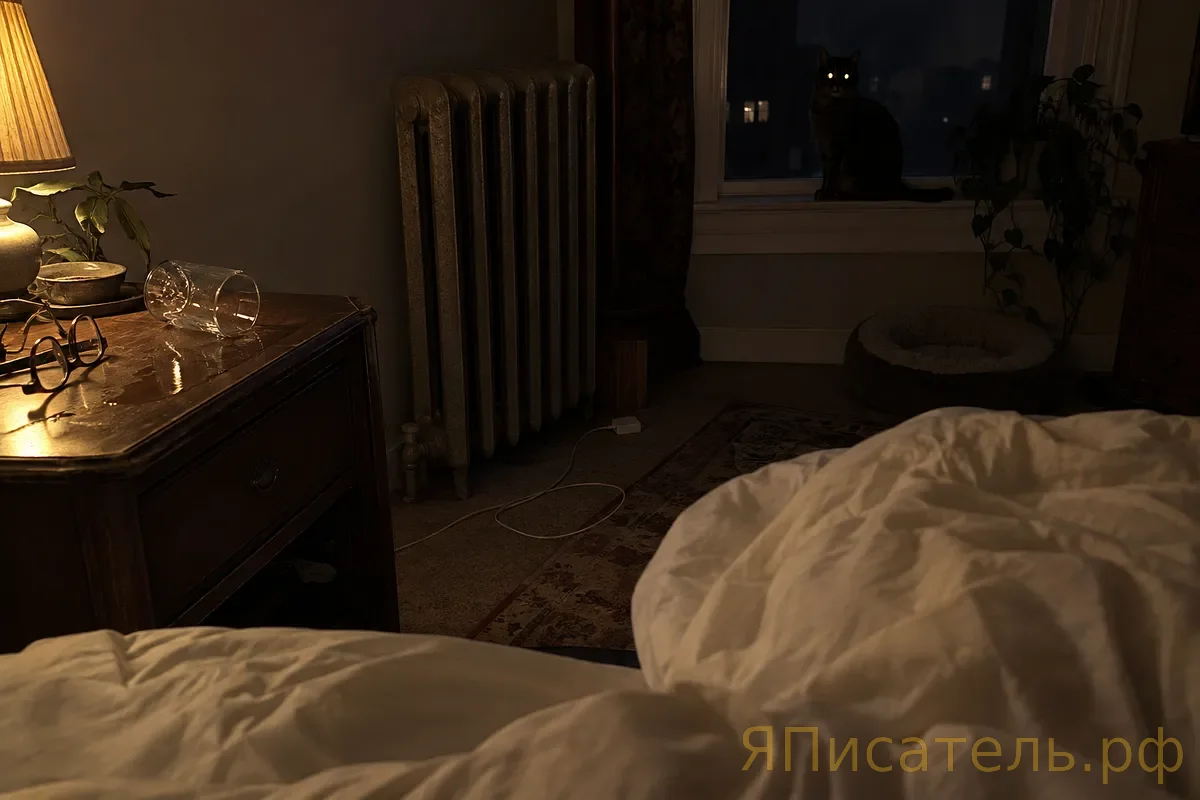
The Voice That Answered Back
Every night before sleep, Martin whispered a prayer into the darkness. It was a habit from childhood — meaningless words murmured into the pillow, addressed to no one. He never expected an answer.
But three weeks ago, something in the darkness of his bedroom began to whisper back.
At first, he thought it was the radiator. The old cast-iron beast in the corner of his one-bedroom flat had always made noises — ticking, gurgling, the occasional groan of expanding metal. He told himself that's all it was. A mechanical coincidence. The timing was strange, yes — the sound always came precisely after he finished his prayer, in that breath-held pause before he rolled over to sleep — but coincidences happen.
Then he thought it was the wind. February had been brutal, and the old sash windows let drafts slip through their rotten seals. Wind could sound like anything. Wind could sound like words.
Then he thought it was his own half-dreaming mind. That liminal state between waking and sleeping where the brain manufactures phantom sounds, phantom voices. Hypnagogic hallucinations, he'd read about them. Perfectly normal. Nothing to worry about.
But the whispers grew clearer.
Not louder — that was the strange part. They never got louder. They simply became more... articulate. As if whatever was making them was learning. Practicing. Finding the shape of human speech the way a child finds the shape of letters, tracing them again and again until they become recognizable.
And last night, for the first time, they used his name.
"Martin."
Just that. Nothing more. His name, spoken in a voice that sounded like dry leaves being crushed very slowly. He lay rigid under his duvet, eyes wide open, staring at the ceiling he couldn't see. His heart hammered so hard he could feel it in his teeth.
He didn't sleep that night.
This morning, he called in sick to work. He spent the day in the flat with every light on, drinking coffee until his hands trembled, telling himself he was being ridiculous. He was a thirty-four-year-old systems analyst. He paid taxes. He had a pension. He did not believe in things that whispered in the dark.
But as the daylight began to drain from the sky — earlier now, always earlier in February — a thought settled into him like a stone sinking into deep water: he would have to go to bed eventually. And when he did, habit would take over. He would whisper his prayer. And something would answer.
He tried to stay up. He sat on the sofa with the television on, volume high, watching a cooking competition where cheerful people made soufflés. But his eyelids grew heavy. The coffee had stopped working hours ago. At twenty past midnight, he gave in.
He brushed his teeth. He changed into his pyjamas. He turned off the lights — all of them, because he'd always slept in complete darkness, and changing that felt like admitting something was wrong, and admitting something was wrong felt like giving it power.
He lay in bed.
The flat was quiet. Not silent — flats are never silent. The refrigerator hummed in the kitchen. A pipe ticked somewhere in the wall. From the street below, the occasional hiss of tyres on wet tarmac. Normal sounds. Living sounds.
He pressed his face into the pillow. He would not say his prayer tonight. He would simply lie here, in the ordinary darkness, and fall asleep like an ordinary person, and in the morning he would feel foolish.
Minutes passed. Five. Ten. The darkness pressed against his closed eyelids like velvet. His breathing slowed. His muscles began to unknot.
And then his lips moved.
He didn't mean to. He didn't choose to. But the words came anyway, rising from somewhere deeper than conscious thought, from that place where habits live like sleeping animals — the place where you reach for a light switch in a room you haven't lived in for years, and your hand still knows exactly where it is.
The prayer spilled out of him in a barely audible murmur. The same words he'd said every night since he was six years old. Words his grandmother had taught him. Words that had lost all meaning decades ago, worn smooth like river stones.
He finished. The last syllable dissolved into the pillow.
Silence.
The refrigerator hummed. The pipe ticked. A car passed below.
Nothing answered.
Martin let out a long, shuddering breath. Relief flooded through him, warm and sweet. He almost laughed. Of course nothing answered. Nothing had ever answered. He'd been sleep-deprived, anxious, and his overworked brain had done what overworked brains do — it had filled the silence with phantoms.
He rolled onto his side. He pulled the duvet up to his chin. He closed his eyes.
"You stopped too soon."
The voice came from directly beside the bed. Not from the radiator. Not from the window. From the space between the edge of the mattress and the wall — a gap of perhaps eight inches, where nothing could possibly fit.
It was not a whisper this time. It was a voice. Low, dry, and impossibly close, as if the speaker's mouth were inches from his ear. And it carried something that whispers never had — tone. Emotion.
Disappointment.
Martin could not move. Every muscle in his body had locked. His lungs refused to expand. His eyes were open, but the darkness was absolute, and he saw nothing — nothing — though every nerve in his body screamed that there was something to see, something right there, right beside him, if only there were light.
"You used to say more," the voice continued. Patient. Almost gentle. "When you were small. You used to say more. There were extra words at the end. You dropped them when you were... twelve? Thirteen? You thought they didn't matter."
A sound reached him — soft, rhythmic, deliberate. It took him several seconds to identify it.
Breathing. Something beside the bed was breathing.
"They mattered, Martin."
His hand shot out and slapped the bedside lamp. Light — blessed, yellow, ordinary light — flooded the room. He twisted, looked down at the gap between the bed and the wall.
Nothing.
Empty carpet. A dust bunny. The charging cable for his phone, coiled like a sleeping snake.
He searched the flat. Every room, every closet, behind the shower curtain, inside the wardrobe. Nothing. No one. The front door was locked from the inside, the chain still fastened. The windows were shut. He was alone.
He left every light on and sat in the centre of his bed with his back against the headboard, knees drawn to his chest, until dawn bled grey through the curtains.
In the morning, he called his mother.
"Mum, that prayer Gran taught me. The one I say before bed. Did it used to be longer?"
A pause. "Oh, that old thing. Yes, I think so. She had you saying all sorts. Why?"
"Do you remember the extra words? The ones at the end?"
Another pause, longer this time. "Let me think... something about closing? Or... sealing? Sealing the door? No, that's not right. Sealing the — oh, I don't know, love. It's been thirty years. Why do you want to know?"
"No reason."
But it wasn't no reason. Because Martin understood now, with the terrible clarity that comes after a sleepless night, what his grandmother's prayer had been. Not a prayer at all. An incantation. A nightly ritual of binding, of closing, of keeping something sealed in some place that his six-year-old mind had never needed to understand.
And at twelve or thirteen, when he'd begun to feel foolish, when he'd started trimming the words down to their barest bones, he had — without knowing it — left the last lines unspoken. The lines that mattered. The lines that closed the door.
For twenty years, he had been opening something every night and forgetting to shut it again.
And now it was through.
He spent the next day in the library, then online, then on the phone to distant relatives he hadn't spoken to in years, trying to find anyone who remembered the full prayer. No one did. His grandmother had been the last keeper of that particular tradition, and she had died when he was fifteen, taking the complete words with her.
That night, he didn't go to bed. He sat in the kitchen with the lights on, drinking whisky, watching the clock. At 1:01 AM, the kitchen light flickered. Just once. Just for a moment.
And from the hallway — from the direction of his bedroom — he heard it.
Not a whisper. Not a voice. A sound that was worse than either.
A door opening.
There were no doors in his hallway. He had removed them years ago to make the flat feel more spacious. There was nothing that could open.
But the sound was unmistakable. The creak of old hinges. The sigh of wood moving across carpet. And then, beneath it, a new sound — footsteps. Slow. Deliberate. Each one slightly heavier than the last, as if whatever was walking was becoming more solid with each step it took.
Martin sat in his kitchen chair, the glass of whisky trembling in his hand, and listened as the footsteps moved down the hallway toward him.
They stopped just outside the kitchen doorway.
The light flickered again. In the half-second of darkness, he saw it — or thought he saw it — a shape in the doorway. Tall. Thin. Wrong in some way he couldn't articulate, something about the proportions, the angles, as if it had been folded to fit through a space that was never meant to hold it.
The light came back. The doorway was empty.
But the air in the kitchen had changed. It was thicker now, warmer, and it carried a smell — old paper, candle wax, and something underneath, something sweet and decaying, like flowers left too long in a vase.
And then, from directly behind his chair, so close he could feel the breath on the back of his neck:
"Say the rest of the words, Martin."
He opened his mouth.
But he didn't have them. He had never had them. The words were gone, buried with a woman who had tried to protect him from something she had never explained, trusting a six-year-old boy to keep saying syllables he didn't understand, every night, forever.
The breath on his neck grew warmer.
"Then I suppose," the voice said, with something that might have been patience, or might have been hunger, "the door stays open."
Martin sat very still in his bright kitchen, whisky untouched, and felt the presence settle around him like a coat being draped over his shoulders. Heavy. Warm. Almost tender.
He understood, with perfect clarity, that it would never leave.
And somewhere, in a part of his mind he could no longer trust, a thought surfaced — gentle, intrusive, not entirely his own:
*You could always ask it to teach you new words.*
The kitchen light went out.
It did not come back on.
Paste this code into your website HTML to embed this content.